If ASTM A992 is the grade of the rolled beam, ASTM A572 is the grade of almost everything that is welded from plate. Built-up girders, box and cruciform columns, tapered rafters, base plates, crane girder flanges and heavy gussets on US jobs are usually ordered as A572 Grade 50. This article explains the five grades of A572, the thickness limit that goes with each one, the alloy "types" on the certificate and what a clear plate order looks like.
The values below are a selection from the current edition of ASTM A572/A572M. The edition named in the project specification governs.
What A572 covers
ASTM A572/A572M is the standard specification for high-strength low-alloy columbium-vanadium structural steel. It covers shapes, plate, sheet piling and bars for riveted, bolted or welded construction. "Low-alloy" is the key: A572 reaches its strength with small additions of columbium (niobium), vanadium or titanium, rather than with high carbon, which keeps it weldable.
A572 is listed among the approved structural steels in AISC 360-22 Section A3.1. Like the other rolled steel specifications, it draws its general requirements, including dimensional tolerances, testing, marking and certification, from ASTM A6/A6M.
Five grades and their thickness limits
| Grade | Minimum yield | Minimum tensile | Maximum plate thickness |
|---|---|---|---|
| 42 | 290 MPa (42 ksi) | 415 MPa (60 ksi) | 150 mm (6 in) |
| 50 | 345 MPa (50 ksi) | 450 MPa (65 ksi) | 100 mm (4 in) |
| 55 | 380 MPa (55 ksi) | 485 MPa (70 ksi) | 50 mm (2 in) |
| 60 | 415 MPa (60 ksi) | 520 MPa (75 ksi) | 32 mm (1-1/4 in) |
| 65 | 450 MPa (65 ksi) | 550 MPa (80 ksi) | 32 mm (1-1/4 in) |
The grade number is the minimum yield in ksi. The thickness limits matter: as plate gets thicker, it cools more slowly at the mill and it becomes harder to reach high strength through the full thickness with low alloy content. That is why the higher grades stop at thinner plate. Shapes and bars have similar limits, set by size group.
Minimum elongation falls as the grade rises, from about 20% in 200 mm (8 in) for Grade 42 to about 15% for Grade 65. Higher strength comes with somewhat less ductility.
Why Grade 50 is the workhorse
Grade 50 is the most used grade of A572 for three practical reasons.
- It matches A992. A built-up girder of A572 Grade 50 plate has the same minimum yield as the A992 rolled beams beside it, so the designer uses one yield strength across the frame.
- It covers the thicknesses most jobs need. Up to 100 mm (4 in) includes nearly all girder flanges, column plates and base plates.
- It is widely rolled. Plate mills in Asia and the US produce A572 Grade 50 as a standard product, often dual-certified with other specifications.
Higher grades save weight where strength governs and thickness is moderate, for example in long-span trusses or tall building columns. They also need more care in welding, and filler metal must match their strength, so they are usually chosen deliberately rather than by default.
The alloy types
A572 lets the mill reach the strength with one of four microalloy systems, called types:
- Type 1: columbium.
- Type 2: vanadium.
- Type 3: columbium and vanadium together.
- Type 5: titanium and nitrogen, with columbium or vanadium in some cases.
Each type has its own limits, and Type 1 has an extra restriction on thickness for Grade 50 plate. Unless the order names a type, the mill chooses one, and the certificate shows which. For most structural work the type makes no difference to design. It can matter for special cases: a welding procedure qualified on one chemistry, a galvanizing reaction, or a fatigue-sensitive detail where the engineer wants a particular toughness. In those cases, name the type on the order.
A572 in built-up members
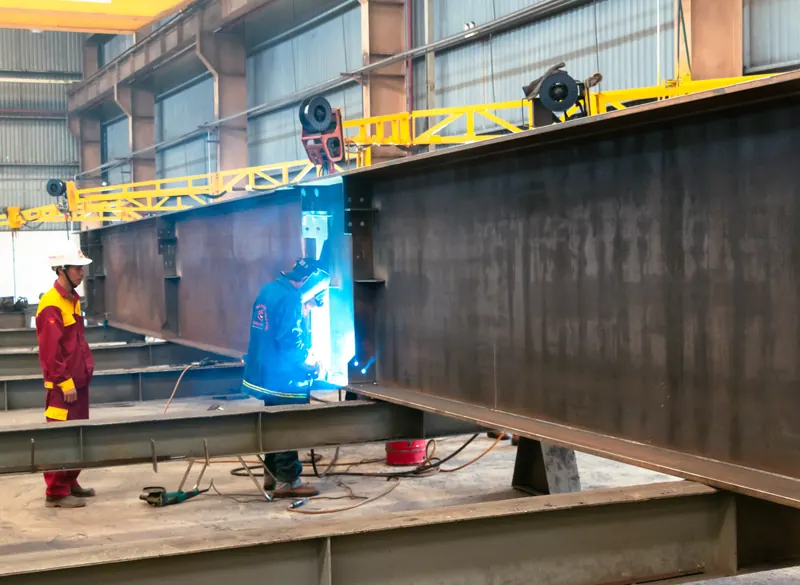
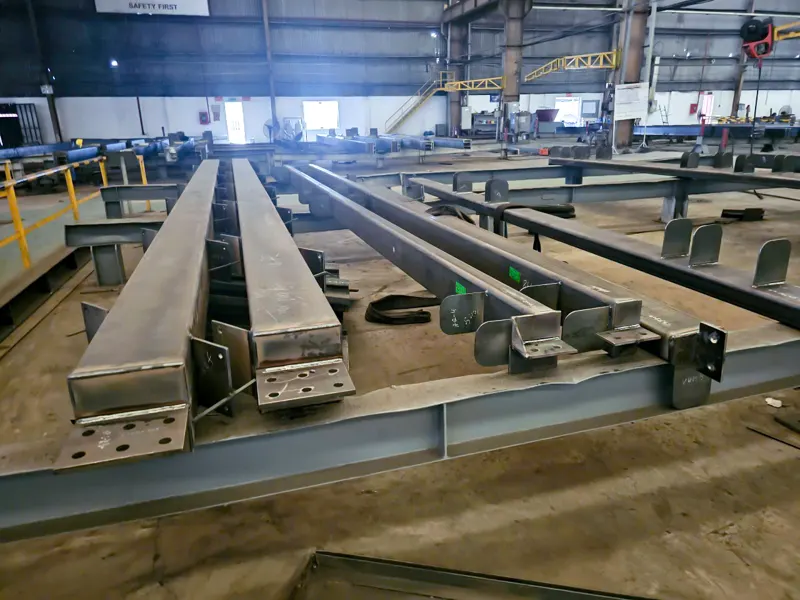
Plate girders and built-up columns are where A572 shows up most. A girder is three or more plates welded together, and every plate is A572 Grade 50 unless the design says otherwise. A few points come up on every built-up job:
- Flange and web can have different thicknesses and therefore come from different heats. Each plate keeps its own heat number on the cut part, so the certificate of every part of the girder can be found.
- Heavy flanges over 50 mm (2 in) in members carrying primary tension with complete-joint-penetration welds need Charpy V-notch testing under AISC 360-22 Section A3.1d.
- Thick plate in T and corner joints can be sensitive to lamellar tearing. Where the design has large welds pulling on the face of a thick plate, the engineer may ask for ultrasonic examination of the plate or through-thickness testing.
Our built-up steel sections page shows the girders, box columns and cruciform columns we make from this plate, and laser machines that cut and hole plate up to 100 mm (4 in) thick.
A572 for base plates and connections
Base plates, cap plates and heavy gussets are another large use. Many designs call for A36 for connection plate, and A572 Grade 50 for plates where strength governs. Two habits keep this clear:
- Write the grade on each plate type in the material schedule, not just in a general note.
- Mark plate grade on the shop drawing piece mark, so the fitter, the inspector and the reviewer see the same thing.
When a connection mixes A36 and A572 Grade 50 plates of similar thickness, mix-ups are possible in any shop. Color coding and heat numbers on cut parts, checked at fit-up, are the practical defense.
Ordering A572 plate: what to write
A plate order, or a plate line on the material schedule, should state:
- ASTM A572/A572M and the grade.
- Type, if it matters to the design or the welding procedure.
- Plate thickness, width and length, in mm with inches for the US drawings.
- Supplementary requirements from ASTM A6, such as Charpy V-notch testing (S5) with energy, temperature and frequency, ultrasonic examination (S8), or a carbon equivalent limit.
- Through-thickness testing under ASTM A770, if specified.
- Certificate type: EN 10204 3.1, or the equivalent mill test report.
The ASTM A6 article explains the supplementary requirements in more detail.
Galvanizing and painting A572
A572 has no special coating rules of its own. For paint, the surface preparation and profile depend on the blasting, not the grade. For galvanizing, the silicon and phosphorus content of the plate decides how thick and how bright the zinc grows. Plate with silicon in certain ranges reacts strongly and can produce a thick, dull, brittle coating. When a member must be galvanized, a silicon range can be agreed with the galvanizer and written into the plate order. The reactive steel article explains the ranges.
Heavy plate for crane and industrial work
Crane runway girders, heavy transfer girders and equipment supports often use A572 plate in the 40 to 100 mm (1-1/2 to 4 in) range. At those thicknesses, three questions should be answered on the drawings:
- Which grade, given the thickness limits? Grade 50 is fine to 100 mm (4 in); Grade 55 and higher are not.
- Is Charpy testing required, at what energy and temperature, and at what frequency (per heat or per plate)?
- Are the flange-to-web welds fatigue-sensitive, and does the engineer want ultrasonic examination of the plate before welding?
The AIST TR-13 series, written while we fabricated the 5,000 t Sunpro Steel mill, covers these checks for crane buildings.
Common mistakes with A572 on drawings
Reviewing plate submittals across many US jobs, the same few problems appear:
- No grade on the plate line. "A572" alone is not a complete order, because the specification has five grades. The mill will ask, or supply its default.
- A higher grade beyond its thickness limit. A drawing that calls for Grade 60 or 65 on a 40 mm (1-1/2 in) plate asks for something the specification does not cover. The design must change the grade, the thickness or the specification.
- Charpy written without a temperature. "Plate to be Charpy tested" is not enough; the energy, the temperature and the frequency are needed.
- Plate mixed between members. Flange plates from one heat and web plates from another are normal, but the shop drawing piece marks and the cut list must keep them apart, so each part of a girder can be traced.
- A572 asked for where A992 is meant. A rolled W shape can be dual-certified to both, but if the design depends on the A992 maximum yield or ratio, the drawing should say A992 for shapes and A572 only for plate.
A quick review of the material schedule against these five points before release saves most plate questions later.
A572 and the shop
In the shop, A572 Grade 50 plate is cut by plasma, oxy-fuel or laser, drilled or laser-holed, and welded with filler metal that matches its strength. Thermal cutting leaves a thin heat-affected edge; for most structural work it needs no treatment, but some fatigue-sensitive details or edges to be galvanized are ground. Welding procedures are qualified or prequalified for the A572 grade and thickness range used, with preheat set by the AWS D1.1 table for the thickest part in the joint.
How World Steel orders and checks A572 plate
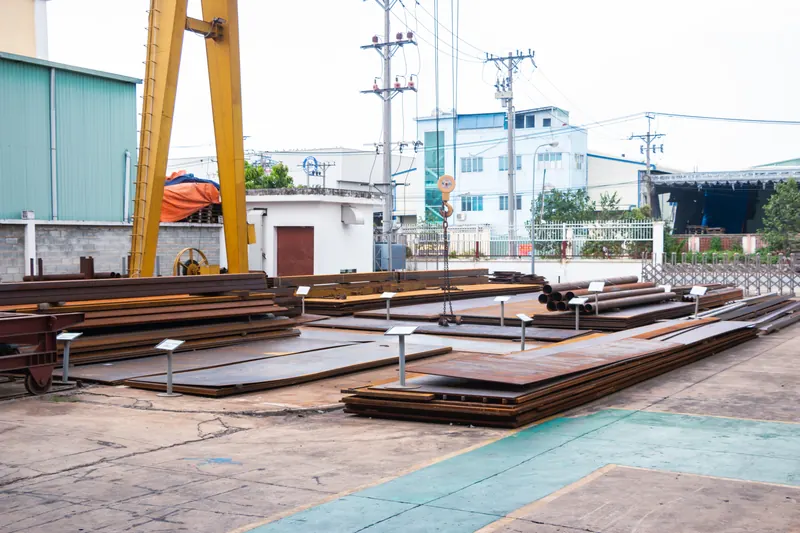
World Steel fabricates 2,500 metric tons of structural steel a month in its own IAS AC472-accredited plant in Vietnam, and plate for built-up members is the largest share of the steel we buy. Plate comes mainly from leading Vietnamese mills, with Japan, Korea, Indonesia and Thailand when a thickness, grade or supplementary requirement calls for it, always ordered to the specification on your drawings.
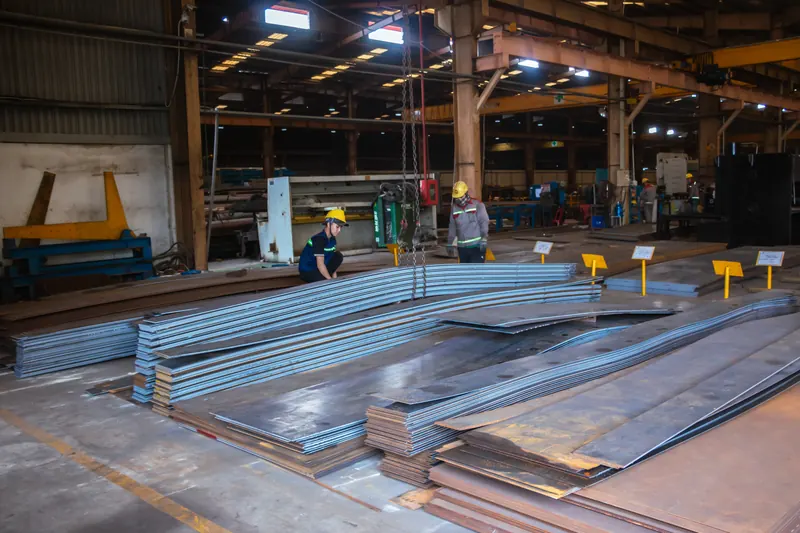
Each plate is matched by heat number to its EN 10204 3.1 certificate at intake, checked for grade, thickness and the supplementary tests your order requires, and the heat number is transferred to every cut part. Charpy V-notch results come with the certificate when the project asks for them, and check tests run at an ILAC-recognized ISO/IEC 17025 laboratory or the laboratory you name. All the grades we supply are on the structural steel materials page. Next in the series: A36 plate, angles and channels.
Quick answers
What is the difference between A572 Grade 50 and Grade 65?
Minimum yield: 345 MPa (50 ksi) for Grade 50 against 450 MPa (65 ksi) for Grade 65. Grade 65 plate is limited to 32 mm (1-1/4 in) thick, while Grade 50 plate is available up to 100 mm (4 in).
What does Type 1, 2, 3 or 5 mean in A572?
The type names the microalloying elements used to reach the strength: Type 1 columbium, Type 2 vanadium, Type 3 columbium and vanadium, Type 5 titanium and nitrogen. Unless the order names a type, the mill chooses.
Is A572 Grade 50 the same as A992?
They share a 345 MPa (50 ksi) minimum yield, but A992 applies to shapes only and also limits the maximum yield, the yield-to-tensile ratio and the carbon equivalent. A572 covers plate, shapes and bars without those limits.
Can A572 plate be galvanized?
Yes. As with any grade, the silicon and phosphorus content decides how the steel reacts in the zinc bath, so plate for galvanized members can be ordered with a silicon range agreed with the galvanizer.
Keep building your steel plan
Go further on USPEB.com
On this topic
Across the US market
- US codes and standardsIBC, AISC, AWS and MBMA, designed to
- Seismic steel structuresSDC D to F framing for West Coast jobs
- Crane building designUS crane standards for mill and bay buildings
- Design ReportWhat our US-code design report contains
- Large projects, 2,500 t a monthCapacity for large US general contractors
- Contractor partnershipLong-term supply for US contractors