
What we promise
US-standard steel, every requirement met, every heat traced
US specifications, not look-alikes
Material is ordered to the ASTM specification and grade your contract documents name. Where a mill works to another standard, the comparison goes to your Engineer of Record before anything is ordered.
Every project requirement, in writing
Supplementary requirements such as Charpy V-notch at a stated temperature, Z-direction testing, weathering steel or galvanizing classes are listed in the material schedule and carried into the mill order.
Traceable from mill to jobsite
Each heat is matched to its EN 10204 3.1 certificate at our gate, cut parts keep the heat number, and every finished piece mark leads back to the mill that rolled it.
Specification matrix
ASTM material specifications on a US structural steel job
The grades US engineers name most often, by member family, with minimum yield in metric first and US units beside.
Rolled shapes and plate
The primary frame: wide flanges, channels, angles and the plate built-up members are welded from.
ASTM A992
Wide-flange beams and columns (W shapes)
· 345 MPa (50 ksi)
ASTM A572
Plate for built-up girders, columns and rafters
Grade 50 · 345 MPa (50 ksi)
ASTM A572
Higher-strength plate and shapes
Grade 55 / 60 / 65 · 380–450 MPa (55–65 ksi)
ASTM A36
Angles, channels, connection and base plates
· 250 MPa (36 ksi)
ASTM A588
Weathering steel, where specified
· 345 MPa (50 ksi)
ASTM A770
Plate with through-thickness testing
With the base grade · Per base grade
Hollow sections and pipe
Tube columns, braces, trusses and canopy framing.
ASTM A500
Square and rectangular HSS
Grade C · 345 MPa (50 ksi)
ASTM A500
Round HSS
Grade C · 315 MPa (46 ksi)
ASTM A1085
HSS with tighter tolerances and toughness
Grade A · 345 MPa (50 ksi)
ASTM A53
Steel pipe for columns and bollards
Grade B · 240 MPa (35 ksi)
Cold-formed framing and sheeting
Purlins, girts, eave struts, roof and wall panels and trims.
ASTM A653
Galvanized coil for Z and C purlins and girts
SS Grade 50 / 55, G90 · 340–380 MPa (50–55 ksi)
ASTM A1011
Hot-rolled coil for black or primed purlins
SS Grade 50 · 340 MPa (50 ksi)
ASTM A792
55% aluminum-zinc (Galvalume) coil for panels
SS Grade 50 / 80, AZ50 / AZ55 · 340–550 MPa (50–80 ksi)
ASTM A755
Prepainted coil for colored panels and trims
On A653 or A792 substrate · Per substrate
Bolts, anchor rods and studs
The parts that hold the frame together and to the foundation.
ASTM F3125
High-strength structural bolts
Grade A325 · 830 MPa tensile (120 ksi tensile)
ASTM F3125
High-strength structural bolts, heavier duty
Grade A490 · 1,040 MPa tensile (150 ksi tensile)
ASTM A563 / F436
Heavy hex nuts and hardened washers
Matched to the bolt
ASTM F1554
Anchor rods
Grade 36 / 55 / 105 · 250 / 380 / 725 MPa (36 / 55 / 105 ksi)
ASTM A108 · AWS D1.1 Type B
Headed shear studs
· 350 MPa (51 ksi)
ASTM A615
Reinforcing bars, when in our scope
Grade 60 · 420 MPa (60 ksi)
Coatings and galvanizing
Zinc and paint systems that protect the steel once it is in place.
ASTM A123
Hot-dip galvanizing of members
Thickness by steel class
ASTM A153
Hot-dip galvanizing of hardware
By hardware class
ASTM F2329
Galvanized bolts and nuts
For A325 only, never A490
SSPC-SP 6 / SP 10
Surface preparation before paint
As the coating system requires
Grades and minimum yield values are typical for US structural steel and metal building work. The grades for your job are the ones in your contract documents; the proposal lists each one, how it is supplied and which certificates come with it.
Standards bodies
The standards behind the material, and what each one decides
ASTM International
A6, A370, A992, A572, A500, F3125 and the rest of the matrix
What the steel is: chemistry, strength, tolerances and how each is tested.
AISC
AISC 360, AISC 341, Code of Standard Practice (AISC 303)
Which materials a structural steel design may use, and the notch-toughness rules for seismic systems.
AWS
D1.1, D1.3, D1.8 and the A5 filler metal specifications
Welding procedures, welders and consumables matched to the base metal.
RCSC
Specification for Structural Joints Using High-Strength Bolts
Bolt, nut and washer combinations and how bolted joints are installed and checked.
AISI
AISI S100 North American Specification
Design of cold-formed purlins, girts and other light-gauge members.
MBMA
Metal Building Systems Manual
Common practice for metal building systems, from loads to materials and tolerances.
AMPP (formerly SSPC)
SSPC-SP surface preparation and PA 2 coating thickness
How steel is cleaned before coating and how dry film thickness is measured.
EN 10204
Type 3.1 inspection certificate
The mill certificate: test results for the heat, validated by an inspector independent of production.
World Steel designs, orders and fabricates to these documents. They describe the material and the work; they are not a certification of World Steel. All US codes and standards
Where it comes from
Rolled mainly in Vietnam, sourced across Asia when your spec needs it
Vietnam, our main source
Source: World Steel Association, World Steel in Figures 2026
Most of the plate, coil, sections and coated sheet in a World Steel package is rolled in Vietnam, close to our plant in Tay Ninh Province. Short inland hauls mean material arrives when sizes are fixed, and each heat comes with its mill certificate.
Rolled in Vietnam for our plant
- Hot-rolled coil and plate
- Rolled sections
- Steel pipe
- Galvanized coil
- Aluminum-zinc coil
- Prepainted coil
Leading Vietnamese mills we source from
- Hoa Phat Group
Vietnam’s largest steel group: hot-rolled coil, steel pipe and coated sheet.
- Formosa Ha Tinh
Integrated steelworks on the central coast: hot-rolled coil, wire rod and billet.
- POSCO
Korean steelmaker with mills in Vietnam: cold-rolled coil and rolled sections.
- Hoa Sen
Galvanized and aluminum-zinc coated coil for roof and wall sheeting.
- Nam Kim
Galvanized, aluminum-zinc and prepainted coil for panels, trims and light-gauge framing.
Mills we source from. Naming them does not imply a partnership or endorsement; the mill for each heat is the one on its certificate.
Japan, Korea, Indonesia and Thailand, when your project calls for it
When your specification calls for a grade, size or thickness that is not rolled in Vietnam, we buy it from mills in Japan, Korea, Indonesia or Thailand. The rules stay the same: the ASTM grade you named, a 3.1 certificate and the heat number on record.
Japan
Heavy rolled sections and plate grades with tight toughness or through-thickness requirements.
Korea
Thick plate, large wide flanges and hollow sections in sizes outside the Vietnamese range.
Indonesia
Hot-rolled coil and plate when regional supply suits the size and the schedule.
Thailand
Sections and coated coil when a specified product is rolled there.
OEM and private-label supply: 100% of the materials come from plants in Vietnam. Supply under your brand
Project compliance
From your specification to the mill order
Nothing is bought on assumption. Every grade and extra requirement is written down, reviewed and carried through to the certificate.
Read your specification
Engineers list every material grade, supplementary requirement and coating class in your drawings and Division 05 sections.
Material schedule for your review
Each member family gets its ASTM specification, grade and certificate type, submitted before fabrication.
Equivalents only with approval
If a mill rolls to JIS, KS, EN or TCVN, its chemistry and mechanical values go next to the ASTM limits for your Engineer of Record to accept or reject.
Mill order to the letter
The order names the ASTM grade plus extras such as Charpy V-notch, Z-direction testing or a coating weight.
Checked at our gate
Plate, sections and coil are matched to their certificates and marked; any mismatch is quarantined, not used.
Closed out in the record
Certificates indexed by heat go into the Manufacturing Data Record and stay linked to each piece mark in PEB Studio.
Traceability
One heat number, from the mill to your jobsite
- MillRolls and tests the heat, issues the 3.1 certificate.
- IntakeHeat matched to its certificate and logged in PEB Studio.
- Cut partsEvery part inherits the heat number of its plate.
- Piece markThe finished member lists every heat welded into it.
- JobsiteScan the label and the certificates open.
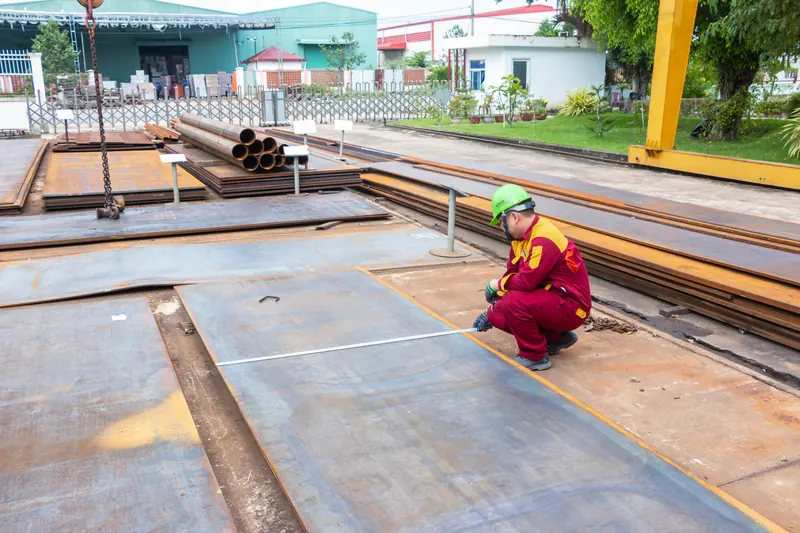
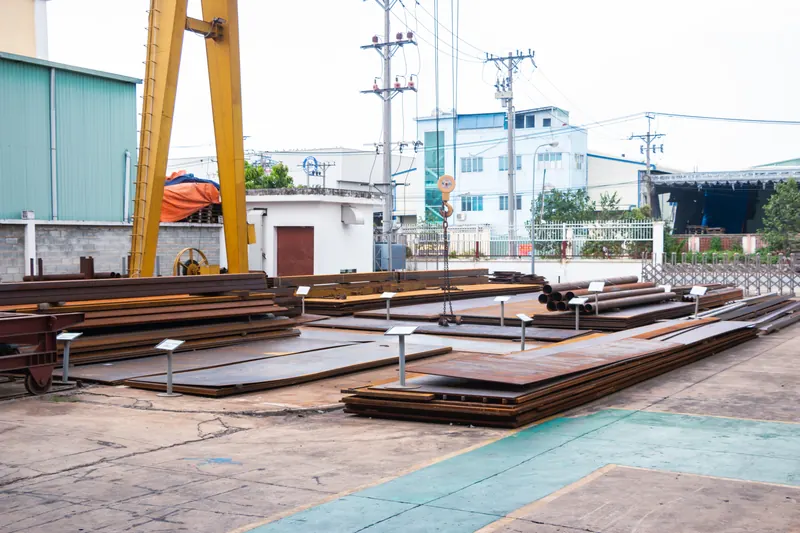
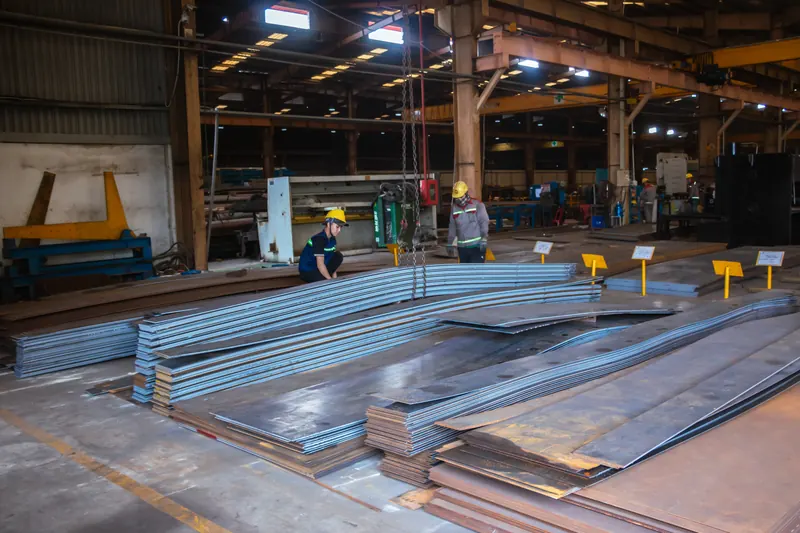
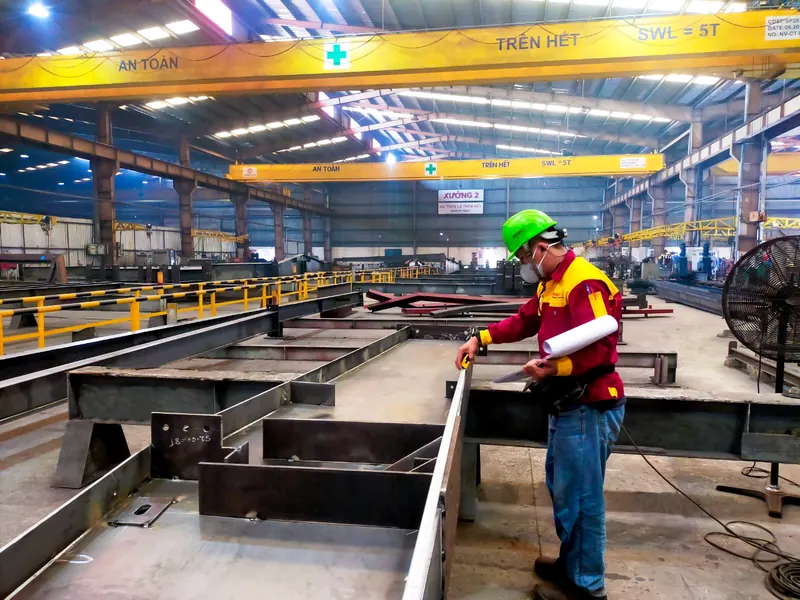
Material intake, storage by grade and heat, and member checks at World Steel’s plant in Tay Ninh Province, Vietnam.
Related
Where the material goes next
Built-up steel sections
A572 plate welded into girders, box and cruciform columns.
Steel frame systems
Ten standard frames designed to your loads and fabricated from this steel.
Seismic steel structures
Charpy-tested plate and AISC 341 material rules for seismic frames.
Inside the factory
Intake, cutting, welding, blasting and coating in our IAS AC472 plant.
Questions
Structural steel material questions
Which ASTM grades can World Steel supply for a US project?
The common ones for structural steel and metal buildings: A992 and A36 shapes, A572 plate, A500 and A1085 hollow sections, A53 pipe, A653, A1011 and A792 coil, F3125 bolts and F1554 anchor rods. We confirm each grade job by job against your specification.
Where does World Steel’s steel come from?
Mainly from leading mills in Vietnam, such as Hoa Phat Group, Formosa Ha Tinh, POSCO, Hoa Sen and Nam Kim. When your specification calls for a grade, size or thickness not rolled in Vietnam, we source it from mills in Japan, Korea, Indonesia or Thailand. OEM and private-label supply uses 100% Vietnamese materials.
Is steel made in Vietnam or Asia accepted on US projects?
What a US specification controls is the grade, not the country: material that meets the named ASTM specification, with a mill certificate that proves it, meets the requirement. Some public projects add domestic-content rules; check those with your owner before you bid.
What if a mill certifies to JIS, KS or EN instead of ASTM?
We put the certified chemistry and mechanical values next to the ASTM limits and submit the comparison to your Engineer of Record. Material is ordered only after written acceptance, or a mill that certifies to the ASTM grade directly is used.
Can you provide Charpy V-notch results and Z-direction testing?
Yes, on request. Charpy V-notch results at the temperature your specification sets, as AISC 341 requires for thick seismic members, and through-thickness testing to ASTM A770 for plate loaded across its thickness.
How is each member traced to its steel?
Material is stored by grade and heat number, cut parts keep the heat number of their plate, and each piece mark lists every heat in it. In PEB Studio and on the member label, the piece mark opens its certificates.
Do you supply the bolts and anchor rods too?
Yes. High-strength bolts to ASTM F3125 with matching A563 nuts and F436 washers, and anchor rods to ASTM F1554 in the grade your foundation engineer chooses, each with its own certificates.
Do you erect the steel or seal the drawings?
No. World Steel designs, fabricates and supplies the steel. The US contractor, our customer, erects it, and your Engineer of Record reviews and approves the drawings and material submittals.
Built for large jobs
Structural steel materials for your next large package
Our own plant in Vietnam fabricates 2,500 metric tons of structural steel a month, is accredited under IAS AC472 since 2019 and is audited twice a year. Shop drawings are included on every project.
- 5,000 tSunpro Steel Factory
- 2,500 tCPV Food Processing Factory
- 2,000 tLong Son petrochemical complex
- 2,000 tM&D (MD Factory)
Request a quote
Send drawings, a model or a member schedule. Our engineers check the US code basis, size or verify the members and price the fabricated steel, delivered to your US port.
Become our partner in the US
You erect and own the customer; we design, fabricate and ship. Engineering support on your bids and supply under your brand.
Who approves the design. We prepare calculations and drawings ready for your Engineer of Record’s review and approval. The PE seal and the permit stay with the US contractor, our customer.
Shop drawings, included