
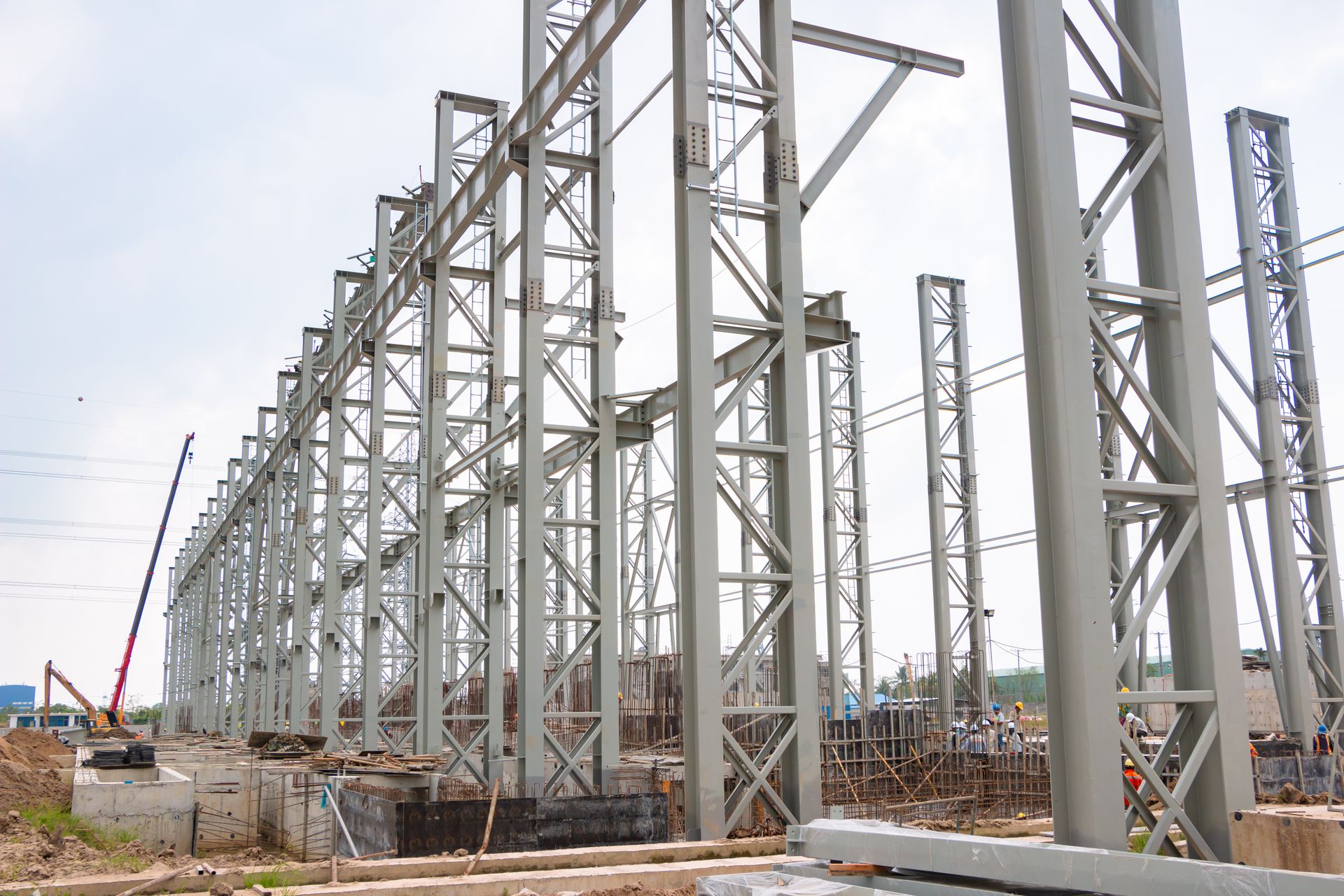
Lattice crane columns on a World Steel job in Can Tho City, Vietnam.
- Additions
- Bays, lean-tos, new spans, mezzanines, cranes
- Existing building
- Any make, from drawings or a field survey
- Code path
- IEBC and IBC as adopted by your jurisdiction
- Approval
- Your Engineer of Record reviews and approves
What we add
Five common ways to grow a steel building
Lengthen the building
Remove the endwall and add bays. Endwalls designed to be expanded make this simpler, and we check the old endwall frame either way.
Add a lean-to
A single-slope addition along a sidewall for storage, loading or offices, tied into the existing columns.
Add a new span
A second building alongside, sharing a column line or standing free with its own frames.
Add a mezzanine
A steel floor inside the building for offices or storage, designed for its live load and checked against the existing frames.
Add a crane
A crane runway and brackets for a bridge crane or monorail, with the existing columns checked or new ones added.
Add openings
New doors and framed openings in walls that were never designed for them, with the bracing they disturb rerouted.
How it works
Checking the old before adding the new
-
Existing information
Send the original drawings and calculations if you have them. If not, your contractor or a surveyor measures the frames, members and connections.
-
Existing frame check
We check whether the existing frames can carry the new loads, such as drift snow against a taller addition or crane forces on the columns.
-
Design of the addition
The addition is designed to the code your jurisdiction applies to additions, usually the IEBC with the IBC, and goes to your Engineer of Record for review and approval.
-
Reinforcement where needed
If an existing member falls short, we design the reinforcement plates or new members and make them with the addition.
-
Fabricated to fit
New members are made to the measured geometry, with hole patterns and panel profiles that match the existing building.
- Completed projects Buildings framed with World Steel steel, from US warehouses and community centers to jobs overseas. See projects →
- How we work Design, shop work and shipping run by one project manager, with each piece visible to you in PEB Studio. See the process →
- Engineering to US codes IBC 2024, ASCE 7-22 and AISC 360 applied to the wind, snow and seismic data for your address. Engineering basis →
Parts for your addition
What the addition is made of
New frames, endwall columns and the reinforcement for existing frames.
Mezzanine framing, deck, stairs and guardrails.
Crane runway beams, brackets and stops.
Asked by US buyers
Questions about expansions & add-ons
Can you expand a building made by another manufacturer?
Yes, if we have the original drawings or a field survey of the frames, members and connections.
Do the existing frames need to be checked?
Usually yes. A new addition can add snow drift, wind or crane loads to the old frames, and the building department will expect that check.
Will the new panels match the old ones?
We match the panel profile. Old panels fade over time, so we pick the closest color from our range rather than promise an exact match.
Can a mezzanine go into a building that is in use?
Often yes. A free-standing mezzanine puts little or no load on the existing frames, and its parts are sized for erection inside the building.
Who measures the existing building?
Your contractor or a local surveyor. We send a checklist of the measurements we need.
More solutions
Often used together
Engineering
Steel building design
Calculations and drawings to US codes, ready for your Engineer of Record’s review and approval.
Learn more →Supply models
Components-only supply
Frames, purlins, panels and trim made in our Vietnam plant, sold on their own.
Learn more →Delivery
PEB Studio real-time tracking
Follow your own members through fabrication, inspection, packing and shipping online.
Learn more →Solutions
All World Steel solutions
Supply models, engineering, delivery and the industries we serve.
See all →Bidding a large US project?
Send the bid documents, or just a footprint and an address. Our engineers check them against US code requirements and confirm what World Steel would supply, from a plant that fabricates 2,500 metric tons of structural steel a month.