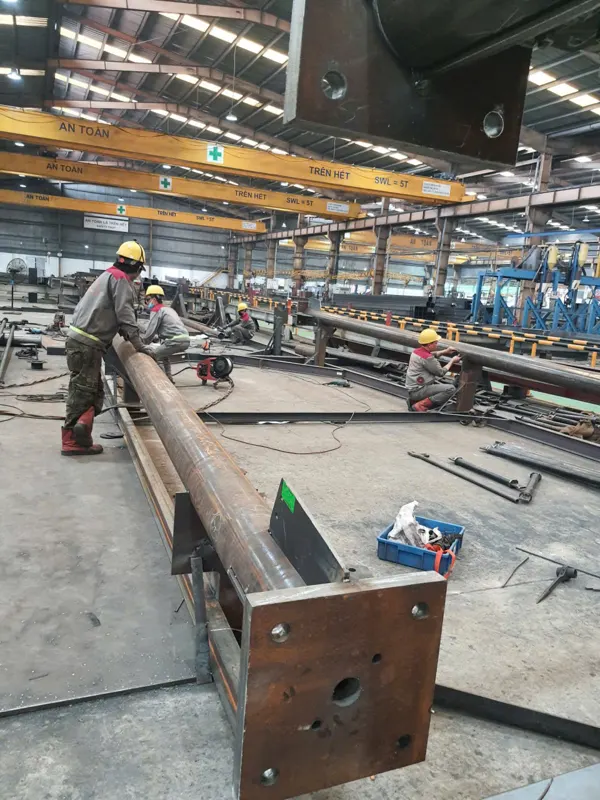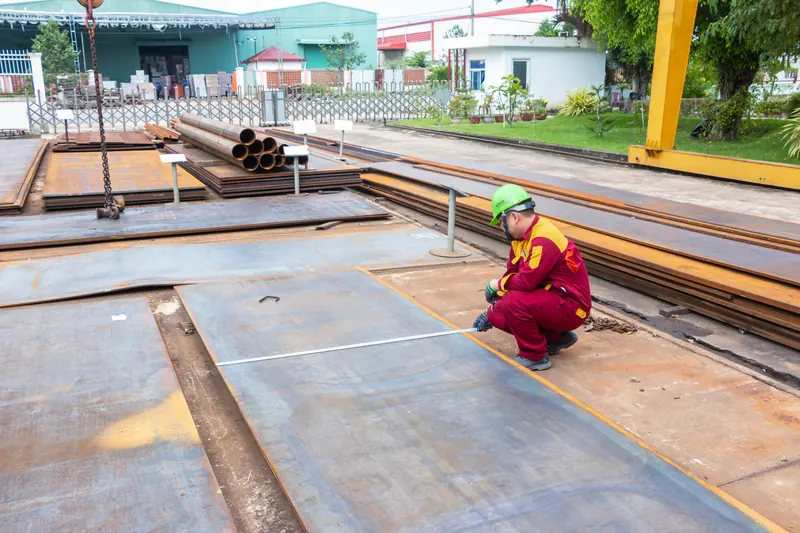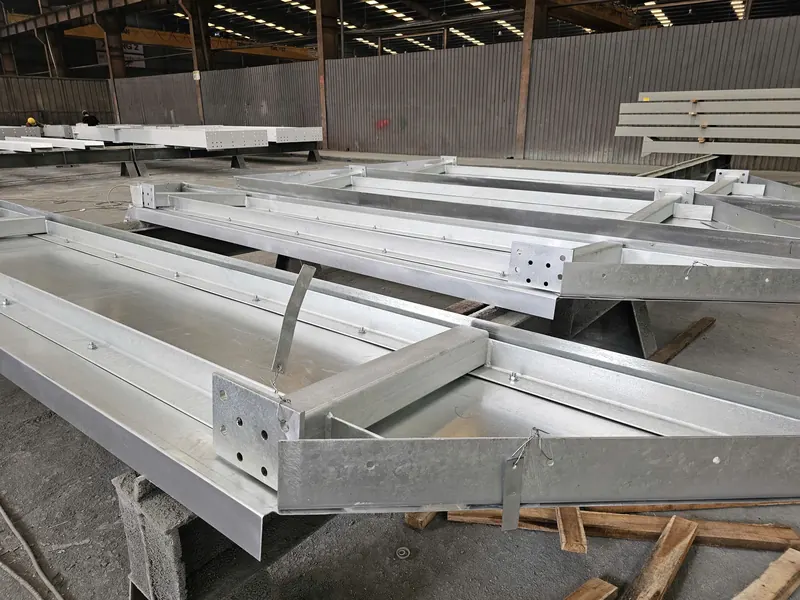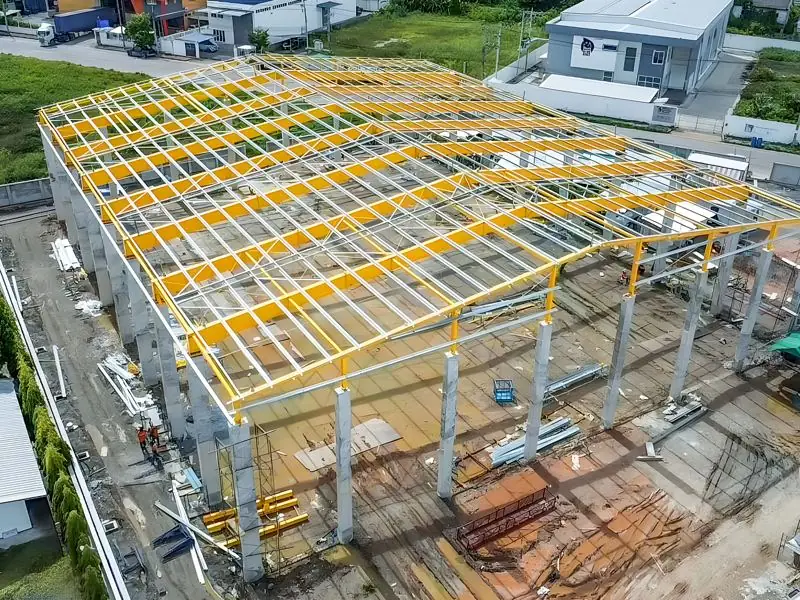
A metal building is two kinds of steel. The primary frame, columns and rafters, is hot-rolled shapes or built-up plate, ordered to A992, A572 or A36. Everything around it, the Z and C purlins, girts, eave struts, roof and wall panels and trims, is formed cold from coil. Those parts follow different specifications, with different grade names, coating codes and design rules. This article explains the cold-formed steel grades a US metal building order names, and what to check when the coil and the formed parts arrive.
The values below are a selection from current editions of ASTM A653/A653M, A1011/A1011M, A792/A792M and AISI S100. The editions named in the project specification govern.
Three sheet specifications
| Specification | Product | Typical use |
|---|---|---|
| ASTM A653/A653M | Hot-dip zinc-coated (galvanized) sheet | Galvanized purlins, girts, eave struts, decking |
| ASTM A1011/A1011M | Hot-rolled sheet and strip, uncoated | Black or primed purlins and girts, built-up light members |
| ASTM A792/A792M | 55% aluminum-zinc alloy-coated sheet (Galvalume) | Roof and wall panels, trims |
Prepainted panels add ASTM A755, which covers the paint on A653 or A792 substrate. Cold-rolled sheet to A1008 is used for some light parts.
Grade names: SS and HSLAS
Sheet specifications do not use the A36 or A572 names. Each one has designations:
- SS, structural steel, with grades named by minimum yield in ksi, such as SS Grade 33, 40, 50, 55 and 80.
- HSLAS, high-strength low-alloy steel, with grades and classes, used where better formability at a given strength is needed.
- CS, FS, DS and DDS, commercial, forming and drawing steels, which have no guaranteed mechanical properties and are not used for structural members.
For purlins and girts, the common choices are SS Grade 50 and SS Grade 55:
| Designation | Minimum yield | Minimum tensile |
|---|---|---|
| A653 SS Grade 50 Class 1 | 340 MPa (50 ksi) | 450 MPa (65 ksi) |
| A653 SS Grade 55 | 380 MPa (55 ksi) | 480 MPa (70 ksi) |
| A1011 SS Grade 50 | 340 MPa (50 ksi) | 450 MPa (65 ksi) |
| A1011 SS Grade 55 | 380 MPa (55 ksi) | 480 MPa (70 ksi) |
Note the metric value: 340 MPa for sheet Grade 50, where rolled shapes say 345 MPa. Both are 50 ksi; the metric versions of the specifications round differently.
Grade 80 and the ductility question
A653 SS Grade 80 and A792 SS Grade 80 have a minimum yield of 550 MPa (80 ksi) but are full-hard steels with low elongation. AISI S100 Section A3 sets which steels may be used in cold-formed design and limits the use of such low-ductility steels: they are permitted for multiple-web configurations such as roofing, siding and floor decking, with the design yield taken as a reduced value rather than the full specified yield. Grade 80 is common in panels for that reason, and uncommon in purlins and girts, which rely on ductility in bending and at connections.
Zinc and aluminum-zinc coating codes
A653 uses a coating designation that gives the minimum coating mass, total on both sides, measured by the triple-spot test. The inch-pound and metric names are different:
| Inch-pound | Metric | Minimum total, both sides |
|---|---|---|
| G60 | Z180 | 180 g/m² (0.60 oz/ft²) |
| G90 | Z275 | 275 g/m² (0.90 oz/ft²) |
G90 is the usual coating for galvanized purlins and girts in metal buildings. For more corrosive sites, a heavier coating or a paint system over it may be specified.
A792 coatings for panels use AZ designations: AZ50 and AZ55 in inch-pound, AZ150 and AZ165 in metric, with the number the total coating mass. AZ55 is common for unpainted Galvalume panels and AZ50 under paint.
Thickness: bare steel, design and delivered
Cold-formed thickness causes more disputes than grade. Three numbers are involved:
- Design thickness: the base steel thickness used in the AISI S100 calculations.
- Delivered minimum thickness: AISI S100 requires the uncoated steel thickness as delivered to the job site to be at least 95% of the design thickness at any location.
- Coated thickness: the thickness a micrometer reads on a galvanized purlin, including zinc on both sides.
A G90 coating adds roughly 0.04 mm to the thickness of the sheet. When a purlin is checked on site, the coating must be accounted for before comparing with the design thickness. Gauge numbers, still used informally, are not a precise thickness and should not appear alone on structural drawings.
Where each grade goes in a metal building
| Part | Usual material |
|---|---|
| Z and C purlins | A653 SS Grade 50 or 55, G90; or A1011 SS Grade 50 or 55, primed |
| Wall girts | Same as purlins |
| Eave struts | Same as purlins |
| Flange braces and clips | A653 or A1011 sheet, or A36 angle |
| Roof panels | A792 SS Grade 50 or 80, AZ55 or AZ50 painted |
| Wall panels | A792 or A653, painted, often Grade 80 |
| Trims and flashings | A792 or A653, painted |
Our Z purlins and C purlins pages show sizes and lap details.
Welding sheet steel
Welds on cold-formed parts, such as clips welded to purlins or puddle welds on decking, follow AWS D1.3, the sheet steel welding code, not AWS D1.1. D1.3 covers steel up to 4.8 mm (3/16 in) thick and sets procedures and welder qualification for thin material. Galvanized sheet gives off zinc fumes when welded and the coating is damaged around the weld, so welds on galvanized parts are repaired with zinc-rich paint. The AWS D1.3 page explains the code.
Ordering coil and formed parts: what to write
- The specification and designation: A653 SS Grade 55, A1011 SS Grade 50, A792 SS Grade 50.
- The coating: G90 or Z275, AZ55 or AZ165, or primed for A1011.
- The design base steel thickness in mm, with inches.
- The profile and size of each formed part.
- Any paint system for prepainted coil, to A755.
- Certificates showing yield, tensile, elongation, coating mass and thickness.
Checking on arrival
At intake, coil certificates are compared with the order for designation, grade and coating, and formed parts are checked for bare steel thickness, profile dimensions and hole positions. Coating mass is taken from the certificate, and can be checked with a magnetic gauge on the formed part as a cross-check.
Common review questions on cold-formed parts
- "The certificate says SS Grade 50 Class 1. Is there a Class 2?" Yes. A653 SS Grade 50 has classes with different tensile and elongation requirements; the design and the order should agree on which is used.
- "The purlins are primed, not galvanized. Is that acceptable?" Only if the drawings allow it. Primed A1011 purlins are common in enclosed, dry buildings; galvanized purlins are better where condensation, humidity or open sides are expected.
- "Can Grade 80 panels be used as diaphragm?" Yes, within the limits of AISI S100 and the panel manufacturer's tested values, which already account for the reduced design yield.
- "Why does the purlin measure thicker than the drawing?" Because the gauge reads the coating too. Subtract the zinc, or measure on a bare edge.
Purlin laps, bracing and grade
Z purlins are often lapped over the frames to make them continuous, and the lap length and bolt pattern are part of the design. The grade used in the design is the grade the lap calculations assume. A change from Grade 55 to Grade 50 coil, for example, can change lap lengths, bracing requirements or purlin depth. Flange braces, sag rods and roof bracing complete the system, and they too are shown on the drawings with their materials. Our secondary framing page shows how the parts fit together.
Corrosion protection by exposure
The coating on cold-formed parts is their only protection, because the steel is too thin to tolerate much corrosion. A useful way to choose is by exposure:
- Enclosed, heated, dry buildings: primed A1011 or G60 galvanized parts are usually enough.
- Unheated warehouses, open-sided sheds and humid interiors: G90 galvanized purlins and girts are the normal choice.
- Coastal sites, agricultural buildings and chemical exposure: a heavier zinc coating, a paint system over G90, or a corrosion-resistant panel coating may be needed. Fasteners and trims must match.
The roof and wall panels have their own coating, AZ55 or a paint system over AZ50, and the panel manufacturer's warranty often depends on the site's exposure. Picking the coating with the exposure in mind, at design, avoids changing coil after it is ordered.
Light-gauge welding and fasteners
Cold-formed parts are mostly connected with bolts and self-drilling screws, not welds. Bolt holes in purlins and girts are punched during roll-forming, so their positions come from the shop drawings. Screw types for panels follow the panel manufacturer's tested assemblies. Where welding is used, AWS D1.3 governs, and the coating is repaired afterwards.
How World Steel supplies cold-formed parts
World Steel fabricates 2,500 metric tons of structural steel a month in its own IAS AC472-accredited plant in Vietnam, and every metal building package includes purlins, girts and eave struts roll-formed for the job. Coil comes mainly from leading Vietnamese sheet makers, including Hoa Sen and Nam Kim among our sources, with other mills in Asia when the grade or coating calls for it, always ordered to the specification on your drawings.
Each coil is matched to its mill certificate, EN 10204 3.1 when your specification asks for one, and formed parts are checked for thickness and profile before packing. Check tests, when your inspector asks for them, run at an ILAC-recognized ISO/IEC 17025 laboratory or the laboratory you name. All our grades are on the structural steel materials page. Next in the series: JIS, KS and EN grades against ASTM.
Quick answers
What grade are cold-formed purlins made from?
Usually ASTM A653 structural steel (SS) Grade 50 or 55 galvanized coil, or ASTM A1011 SS Grade 50 or 55 hot-rolled coil for black or primed purlins. The design names the grade, since it sets the yield used in AISI S100.
What does G90 mean?
A zinc coating designation in ASTM A653: a minimum of 0.90 oz/ft² total on both sides in the triple-spot test, which is the inch-pound name of Z275, 275 g/m² total on both sides.
Can Grade 80 sheet be used for structural members?
A653 SS Grade 80 has very high yield but low ductility. AISI S100 allows it for some uses, such as roof and wall panels and decking, with a reduced design yield, rather than its full specified value.
How thin can a delivered purlin be?
AISI S100 requires the uncoated steel thickness as delivered to be at least 95% of the thickness used in design at any location. Thickness is checked on the bare steel, not including the coating.
Keep building your steel plan
Go further on USPEB.com
On this topic
Across the US market
- US codes and standardsIBC, AISC, AWS and MBMA, designed to
- Seismic steel structuresSDC D to F framing for West Coast jobs
- Crane building designUS crane standards for mill and bay buildings
- Design ReportWhat our US-code design report contains
- Large projects, 2,500 t a monthCapacity for large US general contractors
- Contractor partnershipLong-term supply for US contractors