For decades, ASTM A36 steel was the default grade for American structural steel. A drawing that said "all steel A36 unless noted" covered beams, columns, plates and angles alike. That changed in the late 1990s, when wide flange shapes moved to A992, and again as built-up girders moved to A572 Grade 50. A36 did not disappear, though. It is still on almost every US job, in the parts that are not sized by yield strength. This article explains where A36 fits today, what the specification requires and what to watch when A36 and stronger grades sit side by side.
The values below are a selection from the current edition of ASTM A36/A36M. The edition named in the project specification governs.
What A36 covers
ASTM A36/A36M is the standard specification for carbon structural steel. It covers shapes, plate and bars of structural quality for riveted, bolted or welded construction of bridges and buildings and for general structural purposes. "Carbon" is the key word: A36 reaches its strength with carbon and manganese, without the microalloying elements of A572 or the strength ceiling of A992.
A36 is one of the structural steels listed in AISC 360-22 Section A3.1. It takes its general requirements, such as tolerances, testing, marking and certification, from ASTM A6/A6M.
Strength requirements
| Product | Minimum yield | Tensile strength |
|---|---|---|
| Shapes | 250 MPa (36 ksi) | 400 to 550 MPa (58 to 80 ksi) |
| Plate and bars up to 200 mm (8 in) | 250 MPa (36 ksi) | 400 to 550 MPa (58 to 80 ksi) |
| Plate over 200 mm (8 in) | 220 MPa (32 ksi) | 400 to 550 MPa (58 to 80 ksi) |
The minimum elongation is 20% in 200 mm (8 in) and 23% in 50 mm (2 in) for plate, with 21% in 50 mm (2 in) for shapes. A36 is ductile, which is part of why it still suits connection material that must deform without cracking.
There is no maximum yield in A36. A modern A36 plate from an electric arc furnace or a basic oxygen furnace often tests well above 250 MPa (36 ksi). That is usually a bonus; in a few designs it is something to think about, as explained below.
Chemistry
A36 limits carbon by thickness, from about 0.25% for thin material up to about 0.29% for heavy plate, and sets manganese ranges for plate over 20 mm (3/4 in). It limits phosphorus and sulfur and allows copper when copper-bearing steel is ordered for some extra atmospheric corrosion resistance. Silicon limits apply to heavier plate.
There is no carbon equivalent limit in A36 itself. For welded connections that are thick or highly restrained, a welding engineer can calculate the carbon equivalent from the certificate and set preheat accordingly. AWS D1.1 lists A36 as a prequalified base metal, and its preheat table covers it by thickness.
Where A36 fits on a modern frame
AISC lists A36 as the preferred grade for several products. In practice, US designs use it for:
| Part | Why A36 still fits |
|---|---|
| Connection plates, clip angles and shear tabs | Sized by bolt bearing, weld length and minimum thickness, not by yield |
| Base plates and cap plates | Often sized by bending, but thickness is set in standard steps, so the grade decides little |
| Angles and channels | Widely rolled as A36, often dual-certified with A572 Grade 50 |
| Stiffeners and fillers | Sized by geometry and local buckling |
| Bars, flat bar and rods | General structural quality |
| Stairs, handrails, ladders and miscellaneous metals | Strength rarely governs |
The rule of thumb: when a part is sized by something other than yield strength, the cheaper and more available A36 is normal. When strength governs, the designer moves to a 345 MPa (50 ksi) grade.
A36 next to stronger grades
A typical connection might have an A992 beam, an A572 Grade 50 gusset and A36 clip angles. That is normal design, but it creates two practical risks in the shop.
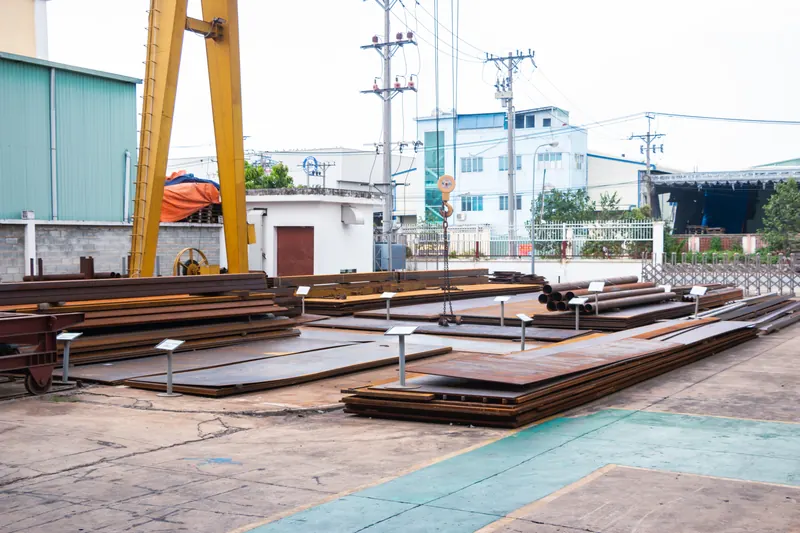
- Mixing plates of similar thickness. A 20 mm (3/4 in) A36 plate and a 20 mm A572 Grade 50 plate look the same. If the wrong one goes into a strength-governed connection, the connection is understrength. Heat numbers on every cut part and a grade column on the cut list prevent it.
- Assuming the stronger plate is always fine. Putting A572 Grade 50 where A36 is drawn is usually harmless, but in a seismic system, a part meant to yield first, such as a gusset in a special concentrically braced frame or a link, may then be stronger than the members around it. That moves the yielding. Such a change should go through the Engineer of Record.
The grade substitution article covers how to ask for and document a change of grade.
Dual-certified A36/A572-50
Many mills supply angles, channels and plate certified to both A36 and A572 Grade 50. The steel meets the A36 chemistry and has a yield of at least 345 MPa (50 ksi). It meets an A36 order and an A572 Grade 50 order alike.
For most jobs this is a convenience: one stock item fills both lines of the schedule. For seismic or fatigue-sensitive work, the engineer may prefer to state on the drawings whether dual material is acceptable where A36 is specified. A one-line note in the general notes settles it before material is bought.
A36 and galvanizing
A36 is often galvanized, as stairs, handrails, lintels and outdoor steel. As with any grade, the silicon and phosphorus content controls how the steel reacts in the bath. A36 plate made with silicon-killed practice can fall in a reactive range and grow a thick, gray coating. That is a matter of appearance and sometimes of adhesion, not strength, and it can be managed by agreeing a silicon range with the galvanizer. The ASTM A123 series explains why.
A36 for anchor rods: a different specification
Older drawings sometimes call for "A36 anchor bolts". Today anchor rods are normally ordered to ASTM F1554, whose Grade 36 has the same 250 MPa (36 ksi) minimum yield but is written for threaded rods cast into concrete, with tensile, thread and marking rules that A36 bar does not have. The anchor rod article explains the F1554 grades.
What a reviewer checks on an A36 certificate
For each heat the certificate should show:
- A36/A36M and, if dual-certified, every other specification claimed.
- The heat number, matching the number on the steel.
- The product and size, such as plate 20 × 2,000 × 6,000 mm, or angle L100 × 100 × 10 (L4 × 4 × 3/8).
- Heat analysis of carbon, manganese, phosphorus, sulfur, silicon and copper where required.
- Yield, tensile and elongation results.
- Any supplementary test the order asked for, such as Charpy V-notch.
For dual material, check that the yield meets the higher grade and the chemistry meets both. The EN 10204 mill certificate page explains what each certificate type proves.
Writing A36 on the drawings
A36 is often covered by a general note, which is fine when it is used for small parts. Three refinements help reviewers and the shop:
- List the parts that are A36 in the material schedule, and the parts that must be A572 Grade 50, rather than relying on "unless noted".
- Say whether dual A36/A572-50 is acceptable where A36 is drawn, especially in seismic systems.
- Give anchor rods their own line with ASTM F1554 and the grade.
A36 in the shop
A36 is the easiest structural steel to work. It cuts cleanly by plasma, oxy-fuel or laser, punches and drills without difficulty, bends cold to tight radii and welds with the most common electrodes. Those qualities are part of why it remains the grade of clip angles, stair stringers and miscellaneous metals. Three shop habits still matter:
- Cold bending. A36 tolerates cold bending well, but tight bends in thick plate should follow the minimum inside radius the engineer or the mill recommends, especially for parts that will be galvanized, since severe cold work increases sensitivity to embrittlement in the bath.
- Edges. Thermally cut edges are normally acceptable as cut. Edges of members in fatigue or edges to be galvanized may be ground to remove hardened material and sharp corners.
- Marking. Because A36 and stronger plate look identical, grade marking survives cutting only if the shop transfers it. A color or letter code on each cut part, matched to the cut list, is a simple safeguard.
These are ordinary shop practices in an accredited plant, and they are what an IAS AC472 audit looks for when it checks material control.
How World Steel orders and checks A36 material
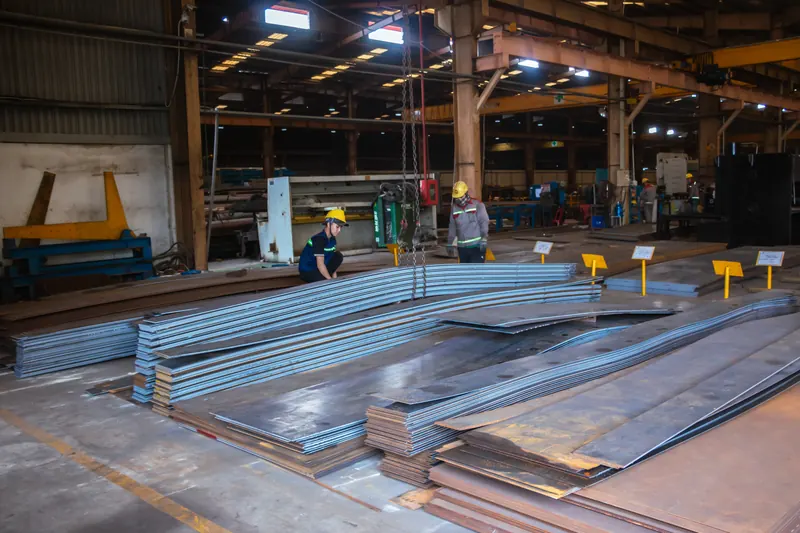
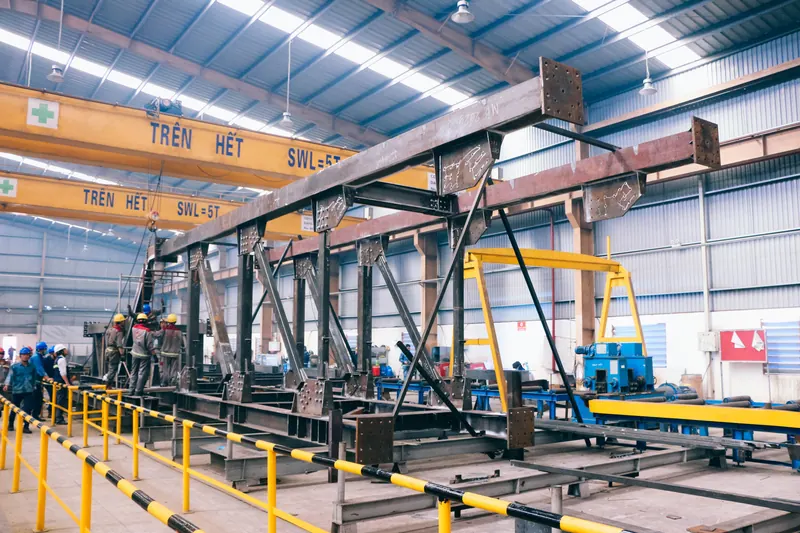
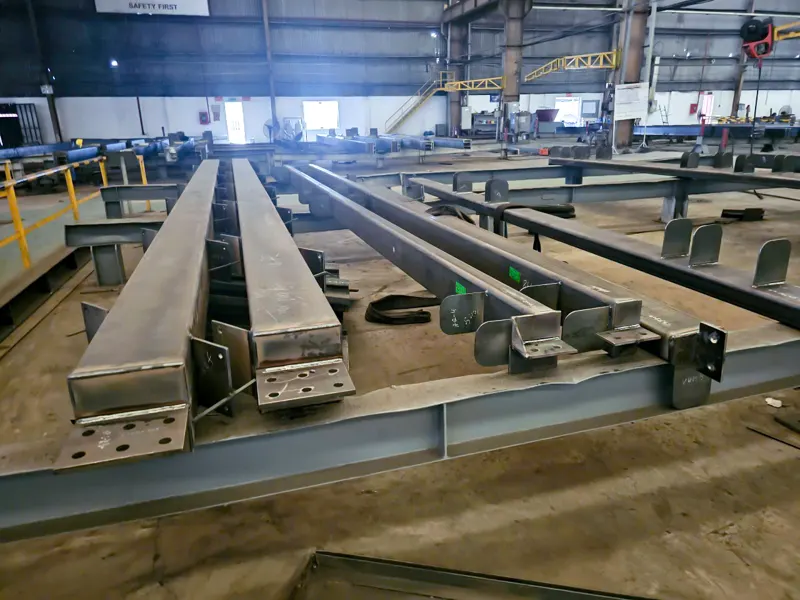
World Steel fabricates 2,500 metric tons of structural steel a month in its own IAS AC472-accredited plant in Vietnam, and every frame we ship carries A36 parts beside its A992 and A572 members. The steel comes mainly from leading Vietnamese mills, with Japan, Korea, Indonesia and Thailand when the project specification calls for them, and is always ordered to the grade on your drawings.
Each plate and bundle is matched by heat number to its EN 10204 3.1 certificate at intake. Cut parts keep their heat number, and the grade of every plate appears on our cut lists and shop drawings, so a 20 mm A36 plate cannot quietly take the place of a 20 mm A572 Grade 50 plate. Check tests, where your inspector asks for them, run at an ILAC-recognized ISO/IEC 17025 laboratory or the laboratory you name. The grades we supply are listed on the structural steel materials page. Next in the series: A500 Grade C hollow sections.
Quick answers
What is the yield strength of A36 steel?
A minimum of 250 MPa (36 ksi) for shapes and for plate up to 200 mm (8 in) thick, and 220 MPa (32 ksi) for plate over 200 mm (8 in). The tensile strength range is 400 to 550 MPa (58 to 80 ksi).
Is A36 still used for structural steel?
Yes, for connection plates, base plates, angles, channels, bars, stairs and miscellaneous steel. Wide flange shapes moved to A992 and most built-up members to A572 Grade 50.
Is dual-certified A36/A572-50 acceptable where A36 is specified?
It meets an A36 order, because it satisfies both specifications. Where higher actual strength could change a design, such as a seismic fuse or a connection meant to yield, the engineer should say whether dual material is allowed.
Is A36 easy to weld?
Yes. Its carbon is limited by thickness and it has no microalloying requirement, so it welds with the AWS D1.1 prequalified procedures for its thickness. Heavy plate still needs the preheat the code sets.
Keep building your steel plan
Go further on USPEB.com
On this topic
Across the US market
- US codes and standardsIBC, AISC, AWS and MBMA, designed to
- Seismic steel structuresSDC D to F framing for West Coast jobs
- Crane building designUS crane standards for mill and bay buildings
- Design ReportWhat our US-code design report contains
- Contractor partnershipLong-term supply for US contractors
- Solutions by stateState-by-state steel solutions