Skip to content
Seeking US contractor partners IAS AC472 ACCREDITED ★ METAL BUILDINGS ★ AC472 IAS AC472 accreditedIAS AC472
World Steel USA

Megaproject corridor · Texas

One steel supply line for the whole Texas Triangle

Chip fabs north of Austin and north of Dallas, auto and battery plants on the Austin edge, data centers around Dallas–Fort Worth and San Antonio, and the petrochemical coast at Houston: four metros, three interstates and one port that can feed them all. We fabricate the steel in our own plant in Vietnam and land it at the Port of Houston, a day’s haul from every corner.

2,500 ta month from our own plant
385 kmHouston to Dallas–Fort Worth on I-45 (240 mi)
1 portHouston feeds all three corners

Large-project capacity

Capacity for two corners of the board at once

The Triangle builds megaprojects in every corner at once, and each corner has its own steel crowd. A fabricator outside that crowd, with 2,500 metric tons (about 2,750 US tons) a month of its own capacity, can split a big job across two corners or carry a whole package that local shops cannot staff.

Several sites, one route

Every package lands at Houston, so jobs in different corners share one sailing plan and one customs broker.

Heavy and repeat steel

Built-up columns, crane girders and trusses for plants; repeat frames for warehouses and data halls.

Each job tracked apart

Every project has its own PEB Studio view, so two Triangle jobs never mix on the shop floor.

Largest single jobs, metric tons

CPV Food Processing Factory 2,500 t
Long Son petrochemical complex 2,000 t
M&D (MD Factory) 2,000 t
Tongwei Tien Giang feed factory, phase 1 1,500 t

Plant output: 2,500 t (about 2,750 US tons) a month. How large jobs run

The triangle board

Four metros, three interstates, one port

Each corner of the Triangle buys different steel. The edges are the hauls from the Port of Houston; distances are approximate road distances.

Dallas–Fort Worth

Data centers, distribution hubs and a chip fab cluster to the north.

Houston

Petrochemical plants, LNG on the coast, the port and its logistics parks.

Austin

Chip fabs to the north and east, EV and battery plants, office and lab campuses.

San Antonio

Data centers, aerospace and auto suppliers on the I-35 and I-10 junction.

I-45Houston to Dallas–Fort WorthAbout 385 km (240 mi). Plant and warehouse steel for the north corner, and the longest single haul on the board.
I-10Houston to San AntonioAbout 320 km (200 mi). Data hall frames and supplier plants for the western corner.
US 290 / TX 71Houston to AustinAbout 265 km (165 mi). Fab support steel, EV plant halls and campus frames.
I-35San Antonio to Austin to Dallas–Fort WorthAbout 445 km (275 mi) end to end. The spine that ties the three inland corners together.

One supply line

From our plant to any corner, through Houston

Sailing

Packages leave our plant in erection order and sail to the Port of Houston.

Port of Houston

Breakbulk and containers cleared by your broker under the Incoterm you buy on.

Haul

Trucked on I-45, I-10 or US 290 to the corner where the site is.

Site

Your crew sets the steel from our erection drawings and bolt lists.

The port in detail: steel shipped to the Port of Houston. The Texas side: Texas ports and logistics.

Proof of scale

Jobs the size of a Triangle package

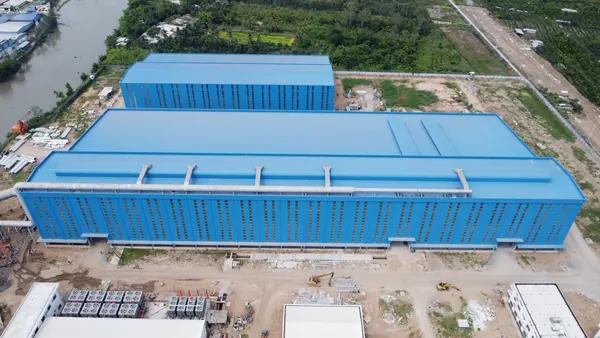
Sunpro Steel Factory, Can Tho City, Vietnam · 2024 5,000 t

Steel industry · Can Tho City, Vietnam · 2024

Sunpro Steel Factory

About 5,000 t: the tonnage of a full plant package in one corner of the Triangle.

Project page
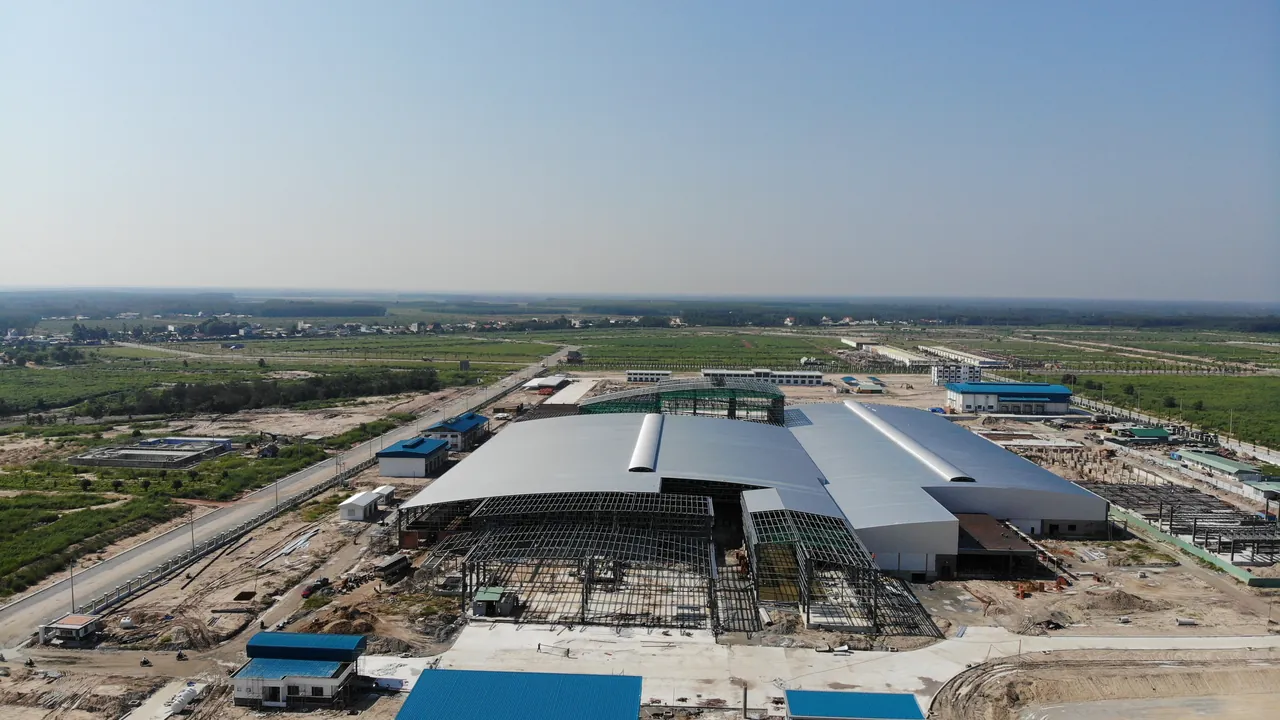
CPV Food Processing Factory, Dong Nai Province, Vietnam · 2020 2,500 t

Food processing · Dong Nai Province, Vietnam · 2020

CPV Food Processing Factory

About 2,500 t of process plant steel, the scale of a Triangle supplier or food campus.

Project page
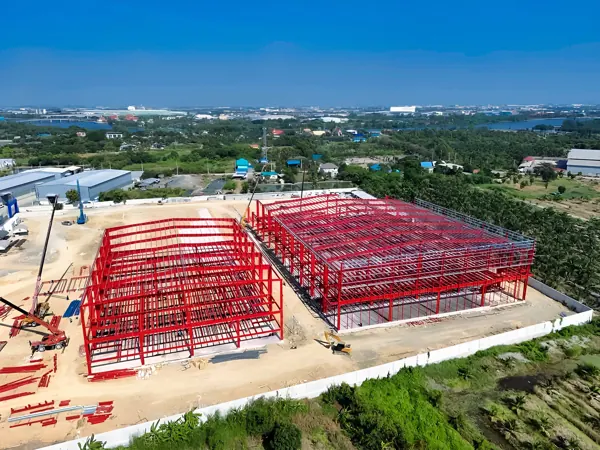
M&D (MD Factory), Thailand · 2024 2,000 t

Warehouse and industrial · Thailand · 2024

M&D (MD Factory)

About 2,000 t of repeat warehouse frames, as the Triangle’s logistics parks buy them.

Project page

Reference jobs fabricated by World Steel outside the US, shown for scale and process. Tonnage in metric tons.

In our plant in Vietnam

Heavy steel leaving our plant for the Gulf

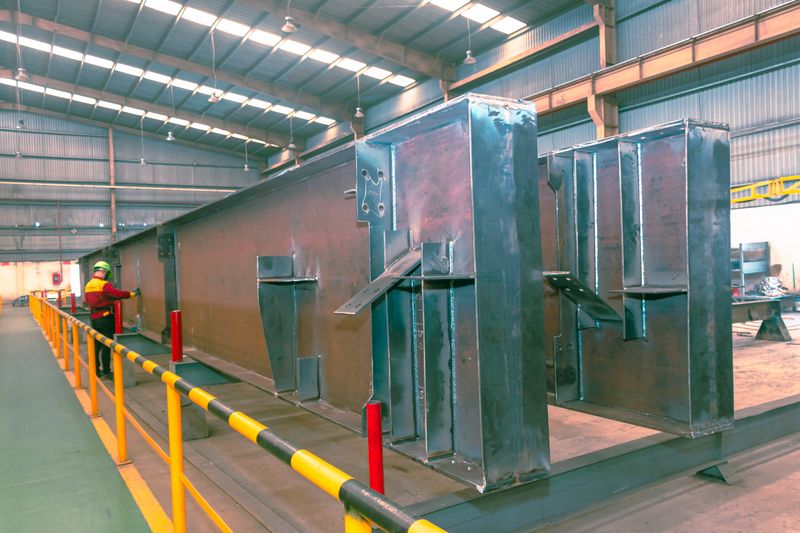
Real photos from World Steel: the shop floor, heavy girders, packed bundles and trucks leaving the plant. None is shown as a Texas site.
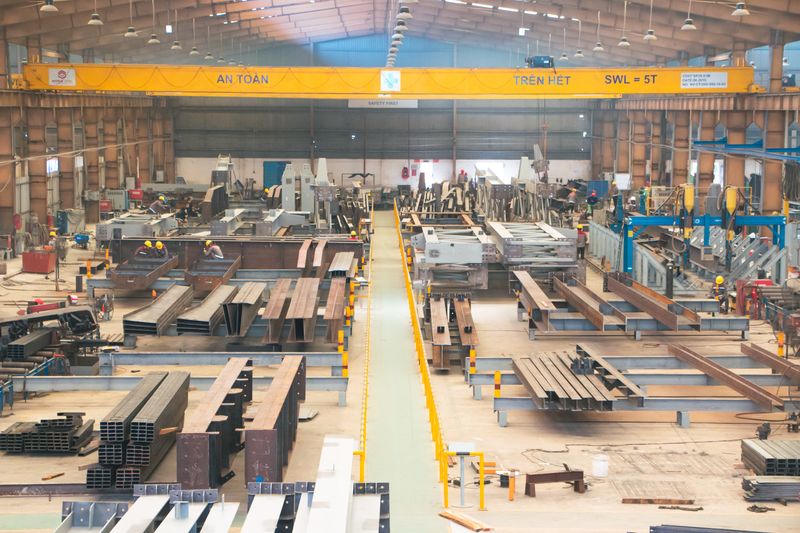
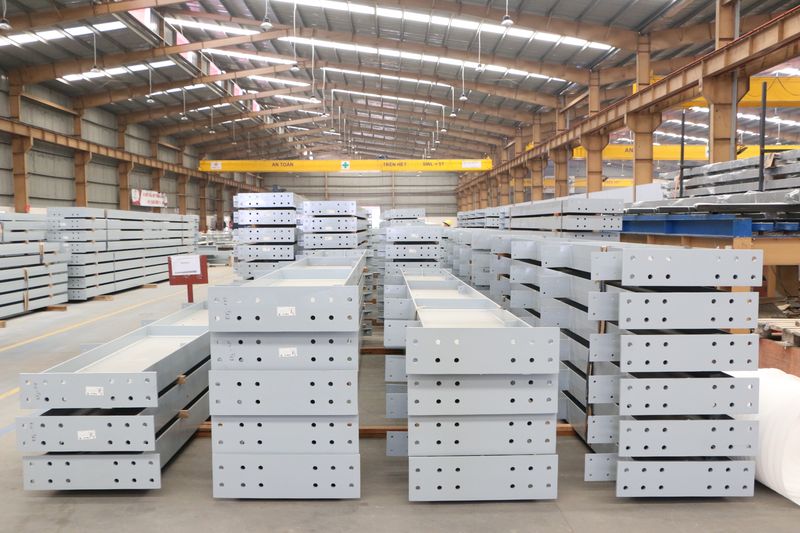
Long shop floor of built-up members, overhead cranes and a center walkway
Stiffened heavy plate girders resting on shop supports
Painted members strapped into bundles and stacked for the voyage
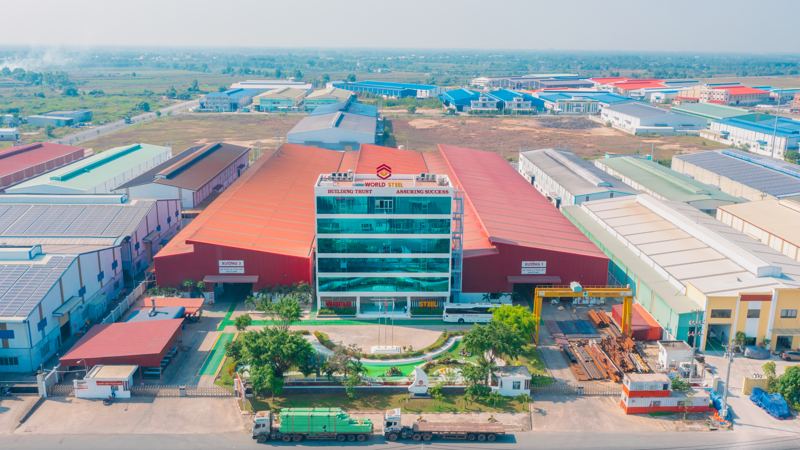
Trucks loaded with fabricated steel leaving the World Steel plant, seen from the air

States on this corridor

Codes, loads and site conditions, state by state

Every state on the corridor has its own structural steel guide set. Start there for the adopted code, wind, snow, seismic and soil questions behind your package.

Who does what

We make the steel. The US contractor builds the job.

World Steel

  • Steel design to the codes the project names, with calculations for your Engineer of Record
  • Proposal, approval, shop and erection drawings at no extra cost
  • Columns, girders, trusses, racks, platforms, stairs, purlins and girts, cut, welded and drilled in our plant
  • Blasting and coating in our plant, with dry film records and every piece tracked in PEB Studio
  • Packages loaded in erection order and shipped to the US port that serves your corridor

The US contractor, our customer

  • Drawing approval, the PE seal and the permit, with your Engineer of Record
  • Foundations, anchor rods set to template, slabs and site work
  • Import, customs and the inland haul, as the Incoterm sets out
  • Erection, cranes, bolting up and the lift plan
  • Cladding install, MEP, process equipment and fit-out

Win-win partnership

Texas contractors: take the second corner without a second local shop

You already run work in one corner of the Triangle. With World Steel behind you, a job in another corner does not wait for local fabrication: 2,500 t a month, US-code drawings and steel landed at Houston for your haul. You grow across the board; we stay your supply line.

Questions

Texas Triangle steel: what contractors ask first

What is the Texas Triangle?

The region framed by Dallas–Fort Worth, Houston and San Antonio, with Austin on I-35. It holds most of the state’s population and many of its largest new chip, auto, data center and logistics projects.

How does steel from Vietnam reach a Triangle site?

By sea to the Port of Houston, then by truck: about 385 km (240 mi) to Dallas–Fort Worth on I-45, 320 km (200 mi) to San Antonio on I-10 and 265 km (165 mi) to Austin. We pack every package in erection order for that haul.

Can you supply two Triangle projects at the same time?

Yes. Our plant fabricates about 2,500 metric tons (2,750 US tons) a month, and each project runs on its own schedule and PEB Studio view.

Which Texas codes do you design to?

Texas has no statewide building code for most private work, so we design to the IBC edition and amendments the city adopts, ASCE 7 loads, AISC 360 and AWS D1.1, plus the owner’s specifications. Your Engineer of Record approves.

Does World Steel erect the steel?

No. World Steel designs and fabricates the steel structure only. Erection and site work are the scope of the US contractor, our customer.

Is there a separate page for each Texas city?

No. The Triangle is covered as one corridor, and the Texas structural steel guides cover codes, soils, wind and ports for the whole state.

Bidding steel anywhere on the Texas Triangle?

Send the drawings, the corner the site sits in and the schedule. We return a written steel scope, designed to the city’s adopted code, fabricated in our plant in Vietnam and landed at the Port of Houston.