Pedestrian live load
4.3 kPa (90 psf) over the deck, not reduced for span or loaded area.
- What we need from the owner
- Clear deck width and any crowd or event use
Where it sits in the US code stack
Where it governs in your building
Six checks every footbridge passes
A footbridge is light, long and walked on in step, so its design turns on a different set of checks from a building. These are the ones that shape the steel we fabricate, with what we need from the owner for each.
4.3 kPa (90 psf) over the deck, not reduced for span or loaded area.
Where vehicles are not physically kept off, an H5 or H10 design vehicle, chosen by the clear deck width.
Vertical frequency above 3.0 Hz and lateral above 1.3 Hz, or the guide's weight-based alternative, so walking in step does not set the deck moving.
Pedestrian live load deflection held to span/360, and span/220 for cantilever arms.
Wind on the trusses, deck and any enclosure, with fatigue checked at the welded details that see repeated stress.
Bridge steel to ASTM A709 with Charpy testing where required, and welding to AWS D1.5, or D1.1 for tubular members where the owner allows.
17 answers from our engineers
The questions bridge owners, US contractors and engineers ask us about steel footbridges: which code applies, the loads and vibration limits, steel and welding, shop assembly, shipping long spans and who does what.
Usually AASHTO. Bridges that carry people, bicycles and light maintenance vehicles are normally designed to the AASHTO LRFD Guide Specifications for the Design of Pedestrian Bridges with the AASHTO LRFD Bridge Design Specifications. The bridge owner names the specification; a footbridge inside a building or a short link between floors may follow the IBC instead, and the owner and Engineer of Record decide.
The agency that will own and maintain the bridge: a state DOT, a city or county, a park agency, a campus or a transit authority. The owner sets the design specification, the edition, any extra criteria and the inspection, so we confirm the owner's documents before design starts.
The one the owner names, with its interim revisions. Where the owner points to the current AASHTO LRFD Bridge Design Specifications for loads such as wind, we use the edition they name and list it on the design criteria sheet.
Yes. Trail and park bridges are pedestrian bridges under the guide specification, often with an H5 or H10 maintenance vehicle when the trail lets a light truck on.
The guide specification uses a pedestrian live load of 4.3 kPa (90 psf) over the deck, and it is not reduced for long spans. The owner can ask for more, for example where crowds gather at events.
When vehicles are not physically kept off the bridge, for example by bollards or posts. The guide then uses an H5 or H10 design vehicle depending on the clear deck width, and the vehicle is checked on its own, not added to the crowd load.
People walk at about two steps a second, and a light, long span can respond to that rhythm. The guide keeps the vertical frequency above 3.0 Hz and the lateral above 1.3 Hz, or uses a weight-based alternative, so the deck does not bounce or sway.
For pedestrian live load, span/360 for the main span and span/220 for cantilever arms in the guide specification. The owner may set tighter limits.
Screens, roofs and glazing catch far more wind than an open truss, so the wind area is taken from the actual enclosure. Tell us early if screens or a roof may be added later.
Usually ASTM A709 bridge steel, such as Grade 50 or the weathering Grade 50W, with Charpy impact testing where the owner's specification requires it. Hollow sections for tubular trusses follow the grade the specification names.
AWS D1.5, the Bridge Welding Code, is the usual welding code for bridge steel. Many owners allow AWS D1.1 for tubular trusses, which D1.5 does not cover. The owner's specification decides, and our procedures are qualified to the code it names.
A tension member whose failure would bring the bridge down. Where the owner designates fracture critical members, the specification adds tougher steel, a fracture control plan and more inspection, so it has to be known before material is bought.
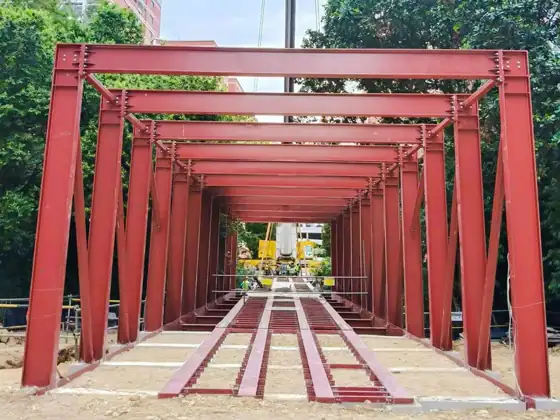
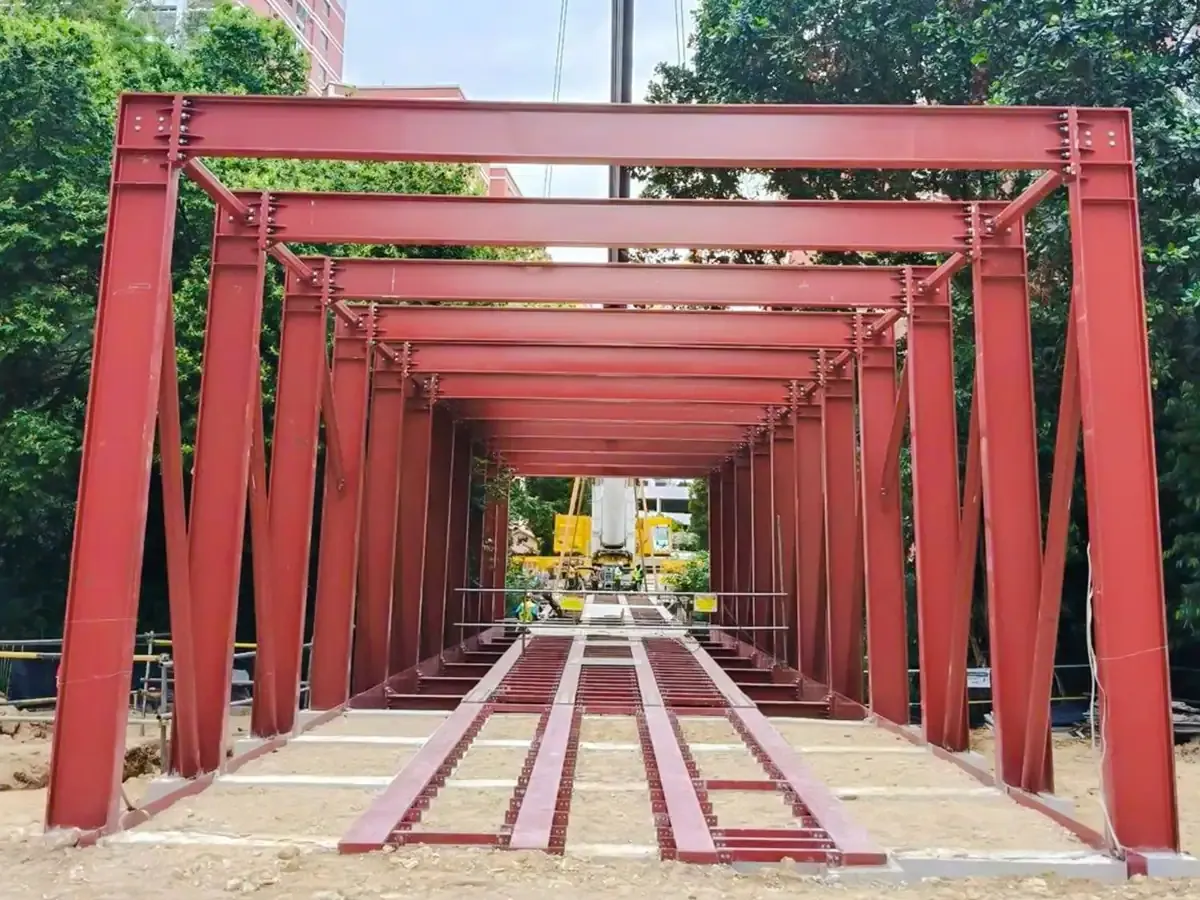
Both are common. Hot-dip galvanizing suits trusses that are hard to repaint; a paint system suits a colour scheme, such as the red Singapore footbridge. We work with worldwide paint brands so touch-up material is easy to buy in the US.
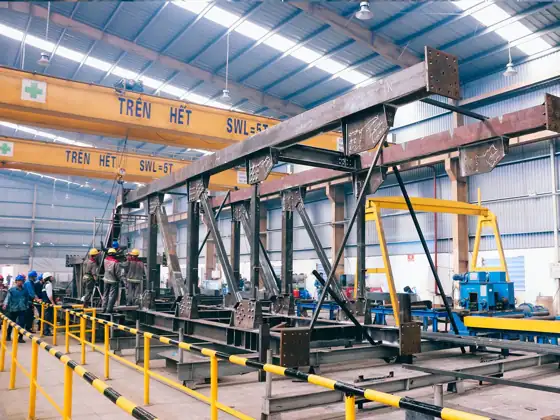
Where the job calls for it, yes. Our CP4 steel bridge for Singapore was fitted up in the shop before shipping, so the splices met on site the first time and the span went up in one night lift.
In bolted segments sized for containers or flat racks, with splices at the points the design allows. The Guyana program covered spans of 26, 33, 40.25 and 47.5 m, all shipped as segments and assembled on site.
The US contractor, our customer. World Steel fabricates and supplies the steel; assembly, lifting, bearings and the closure plan are the contractor's scope.
No. World Steel holds IAS AC472 accreditation for metal building systems and makes no claim to AISC certified bridge fabricator status or state DOT prequalification. If the owner requires one, it has to be settled before award.
More answers on every US code we design to: search all standards questions.
Building or bridge
| Topic | Steel building | Pedestrian bridge |
|---|---|---|
| Governing code | IBC adopted by the jurisdiction | AASHTO guide specification, named by the bridge owner |
| Loads | ASCE 7 | AASHTO pedestrian live load, vehicle and wind loads |
| Steel specification | AISC 360 | AASHTO LRFD Bridge Design Specifications, Section 6 |
| Steel grades | ASTM A992, A572, A36 | ASTM A709 bridge grades, with Charpy testing where required |
| Welding | AWS D1.1 | AWS D1.5, or D1.1 for tubular members where the owner allows |
| Who approves | Building official | The bridge owner: a state DOT, city, park agency, campus or transit authority |
From design to span
Span, width, live load, vehicle access, vibration limits and finish are taken from the owner's specification and confirmed with the Engineer of Record.
Trusses, floor beams and bracing are designed or checked to the approved design, then every piece is detailed in Tekla.
Bridge steel with its mill certificates, qualified welding procedures and the inspection the specification sets.
Spans are fitted up in our plant where the job calls for it, so the splices meet on site the first time.
Galvanized or painted to the specified system, then shipped in bolted segments sized for containers or flat racks.
The US contractor, our customer, assembles and lifts the span, often in one night closure, with our records in the handover file.
References
Who does what on a footbridge
A pedestrian bridge has an owner, not a building official. This is how the work splits on a World Steel footbridge.
What a bridge reviewer checks
Bridge reviews are stricter on steel and welding than building reviews. Each item below has its record before the steel ships.
| The reviewer checks | Where it comes from | What our package shows |
|---|---|---|
| The live load and the vehicle | AASHTO pedestrian guide spec, loads | Pedestrian live load and the design vehicle, or the barrier that rules it out, on the design criteria sheet. |
| Vibration | AASHTO pedestrian guide spec, vibrations | Computed vertical and lateral frequencies, or the weight-based check, against the guide's limits. |
| Deflection | AASHTO pedestrian guide spec, deflections | Live load deflection of the span and any cantilever against the limits. |
| Fatigue at welded details | AASHTO LRFD Section 6 | Detail categories and stress ranges at the welded connections that see repeated load. |
| Bridge steel and toughness | ASTM A709 and the owner's Charpy zone | Grade and Charpy results on the 3.1 certificate for each heat, matched to the members. |
| Welding procedures and inspection | AWS D1.5 or D1.1 | Qualified WPS and welders, and the NDT the specification sets, recorded by piece mark. |
In the bridge file
Issued as the job runs, posted in PEB Studio and bound into the handover file for the owner.
EN 10204 3.1 for each heat, with impact results where the specification asks.
EN 10204 explained →The WPS, PQR and welder qualifications behind every bridge weld.
WPS and PQR guide →Spans fitted up in the plant, with the splice and camber checks before shipping.
Pedestrian bridges →Certificates, inspection, coating and packing records for the bridge owner.
Handover documents →Real photos from World Steel
Photographed in our own plant in Tay Ninh Province, Vietnam, and on World Steel jobs. Not stock images.



AASHTO Pedestrian Bridges never works alone
Each link opens the full page, with its own questions and answers.
What we do not claim
World Steel holds IAS AC472 accreditation for metal building systems. It holds no AISC certified bridge fabricator status and no state DOT prequalification. Federally funded bridges can also carry domestic steel requirements, which the owner confirms before ordering.
Who does what
World Steel designs, fabricates and supplies the steel structure from its own plant in Vietnam. The US contractor, our customer, erects it, has the drawings approved and sealed by their Engineer of Record and pulls the permit.
Details confirmed in quote Edition: As the bridge owner specifies, with the AASHTO LRFD Bridge Design Specifications
Source record: https://store.transportation.org/
Last checked: —. Editions change on a cycle, so your Engineer of Record confirms which one your jurisdiction enforces.
All US codes & standardsSend the span, the width, the owner's specification and the site. We confirm the design criteria with your Engineer of Record and show how the spans will be fabricated, assembled and shipped.