Round members in US steel buildings come in two families. Hollow structural sections are made to A500 or A1085. Pipe, named by nominal pipe size and schedule, is usually ASTM A53 Grade B. Pipe columns in older warehouses and retail buildings, bollards, handrails, guardrails, pipe supports and many pipe racks use it. A53 is a pressure pipe specification that structural engineers adopted, and that history explains its lower yield, its sizes and its wall tolerance. This article covers what to know before specifying it.
The values below are a selection from current editions of ASTM A53/A53M and AISC 360-22. The editions named in the project specification govern.
What A53 covers
ASTM A53/A53M is the standard specification for pipe, steel, black and hot-dipped zinc-coated, welded and seamless. It was written for mechanical and pressure applications, such as steam, water, gas and air lines, and it is also acceptable for ordinary structural uses. AISC 360-22 Section A3.1 lists A53 Grade B among the approved structural steels for pipe, and AISC lists it as the preferred grade for round pipe.
A53 has three types:
- Type F: furnace-butt welded, continuous welded. Made only in Grade A.
- Type E: electric-resistance welded, in Grades A and B.
- Type S: seamless, in Grades A and B.
For structural members the order should say Type E or Type S, Grade B.
Strength requirements
| Grade | Minimum yield | Minimum tensile |
|---|---|---|
| A | 205 MPa (30 ksi) | 330 MPa (48 ksi) |
| B | 240 MPa (35 ksi) | 415 MPa (60 ksi) |
A53 Grade B has a lower yield than any of the common structural grades. A pipe column of A53 Grade B carries about 30% less than the same size in a 345 MPa (50 ksi) round HSS. For members that are not strength-governed, such as bollards, handrails and short posts, the lower yield rarely matters. For a heavily loaded column, it often points to round HSS instead.
A53 also requires hydrostatic testing of each length, or nondestructive electric testing in place of it for welded pipe, because it is a pressure pipe. That test proves the pipe holds pressure; it says nothing extra about structural behavior.
Sizes and schedules
Pipe is not named by outside diameter and wall like HSS. It is named by nominal pipe size (NPS) and weight class or schedule:
- NPS is a number that is close to, but not the same as, the inside diameter for small sizes. NPS 6 pipe has an outside diameter of 168.3 mm (6.625 in).
- Weight classes are Standard (STD), Extra Strong (XS) and Double Extra Strong (XXS). Schedules such as 40 and 80 overlap with them in most sizes.
The AISC Manual lists structural pipe by NPS and weight class. A structural drawing should name both, for example "Pipe 6 XS", or the outside diameter and wall in mm, so there is no doubt about which pipe is meant.
The wall tolerance
A53 allows the wall thickness at any point to be up to 12.5% under the nominal wall. That is a wider allowance than A500 (±10%) and much wider than A1085 (no thinner than 95% of nominal).
AISC 360-22 Section B4.2 sets the design wall thickness for HSS; for welded pipe, the AISC Manual's pipe tables likewise use a reduced design wall. Whatever the source, the designer should confirm that the section properties used match the specification ordered. Treating an A53 pipe as if its wall were exactly nominal overstates its capacity.
Where A53 Grade B fits
| Use | Why A53 fits |
|---|---|
| Bollards | Impact resistance comes from size and concrete fill, not yield |
| Handrails and guardrails | Sized by deflection and code loads on the rail |
| Light pipe columns | Long-standing use in retail and warehouse buildings |
| Pipe supports and shoes | Pipe sizes match the process piping |
| Pipe racks in industrial plants | Often a mix of wide flange frames and pipe members |
| Canopy posts | Round look, galvanized or painted |
A53 or round HSS?
Round members can be ordered as A53 Grade B pipe or as round HSS to A500 Grade C or A1085. The choice usually follows four questions:
- Does strength govern? If yes, round A500 Grade C at 315 MPa (46 ksi) or A1085 at 345 MPa (50 ksi) is stronger than A53 Grade B at 240 MPa (35 ksi).
- Is the size a pipe size? If the design needs to match process piping, or the architect wants a standard pipe rail, A53 is natural.
- Is toughness needed? A1085 includes a Charpy requirement; A53 does not.
- Is it galvanized? A53 can be supplied hot-dipped zinc-coated by the pipe maker, which suits rails and posts. Fabricated assemblies are galvanized after fabrication to ASTM A123.
Substitutes for A53
Pipe made to other specifications, such as API 5L line pipe or ASTM A106, is sometimes offered in place of A53. These can be acceptable, but they are not automatically equivalent: their grades, chemistry, toughness requirements and wall tolerances differ. Any such alternate should be shown to the Engineer of Record with its certificate before it is ordered. The grade substitution article explains how.
Fabrication notes
- Concrete-filled pipe: bollards and some columns are filled with concrete on site. Vent holes may still be needed for galvanizing, and the detail should show whether they are sealed afterwards.
- Welding: A53 Grade B welds well with the procedures used for other carbon steels. The welding engineer confirms the base metal grouping under AWS D1.1.
- Galvanizing: closed pipe needs vent and drain holes, like HSS. See the vent and drain holes article.
- Ends and caps: cap plates and base plates are plate grades, usually A36 or A572 Grade 50, listed separately on the schedule.
Ordering A53: what to write
- ASTM A53/A53M, Type E or S, Grade B.
- Size by NPS and weight class or schedule, or outside diameter and wall in mm.
- Black or hot-dipped zinc-coated, or galvanized after fabrication to A123.
- Whether alternates such as API 5L are acceptable, and with what conditions.
- Any toughness or supplementary requirement.
Checking A53 on the certificate
An A53 certificate should show the type and grade, the size and wall, the heat number, the heat analysis, the tensile results and the hydrostatic or nondestructive electric test. For structural use, check the type is E or S and the grade is B. A Type F pipe, even a well-made one, does not meet a Grade B order.
Pipe racks and industrial pipe supports
Pipe racks in refineries, chemical plants, power plants and data centers carry process piping, cable trays and sometimes equipment. Most are framed with wide flange columns and beams in A992, and use pipe only for posts, stanchions, shoes, guides and small supports. The pipe pieces often match the size of the process pipe they support, which is where A53 Grade B comes in naturally.
Three points come up on pipe rack jobs:
- Mixed specifications. A single rack may include A992 shapes, A572 Grade 50 plate, A36 angles, A53 pipe and A500 tube. Each needs its own line on the material schedule and its own certificates, and each cut part keeps its heat number.
- Galvanizing. Racks in coastal and chemical plants are often galvanized, so every closed pipe piece needs vent and drain holes, and the galvanizer's kettle size can limit the length of a frame.
- Owner standards. Many industrial owners have their own material and coating standards that sit on top of ASTM. They should be read alongside the drawings before material is ordered, because they may require extra tests or forbid certain pipe types.
Common review questions on A53
- "The certificate says A53 Grade B, Type E. Is that acceptable?" Yes, for a Grade B order where welded pipe is allowed.
- "The pipe is dual-certified A53/A106/API 5L. Is that a problem?" No, if each specification is named and the A53 Grade B results are met.
- "The wall reads 12% thin at one spot." Within A53's 12.5% allowance, so not a rejection, but it confirms why the design should not use the nominal wall.
Concrete-filled pipe and composite columns
Pipe and round HSS columns are sometimes filled with concrete to increase capacity and fire resistance. AISC 360 Chapter I covers composite members, and the steel grade enters the design directly. For filled pipe columns, the drawings should state the steel grade, the concrete strength and the fill method, and the shop drawings should show any vent holes, which let steam escape in a fire. These holes are separate from galvanizing vents, and the engineer decides their size and spacing.
How World Steel orders and checks pipe
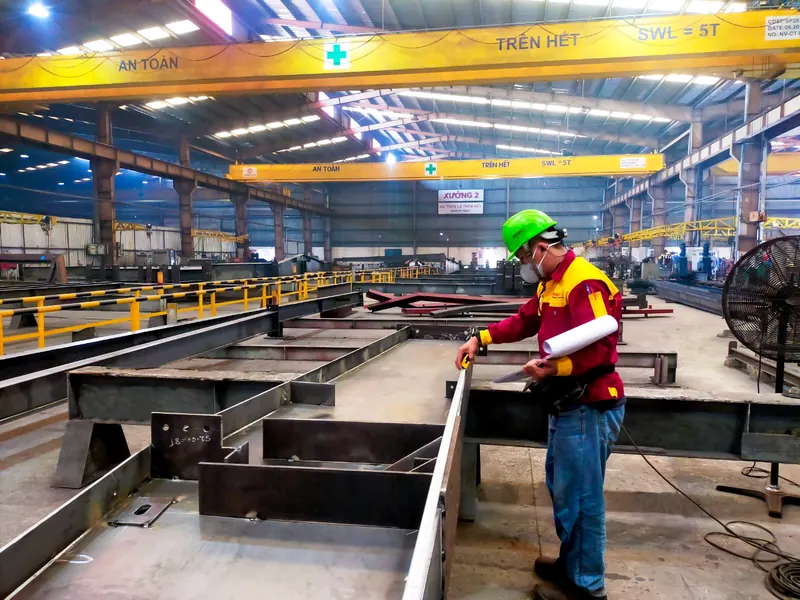
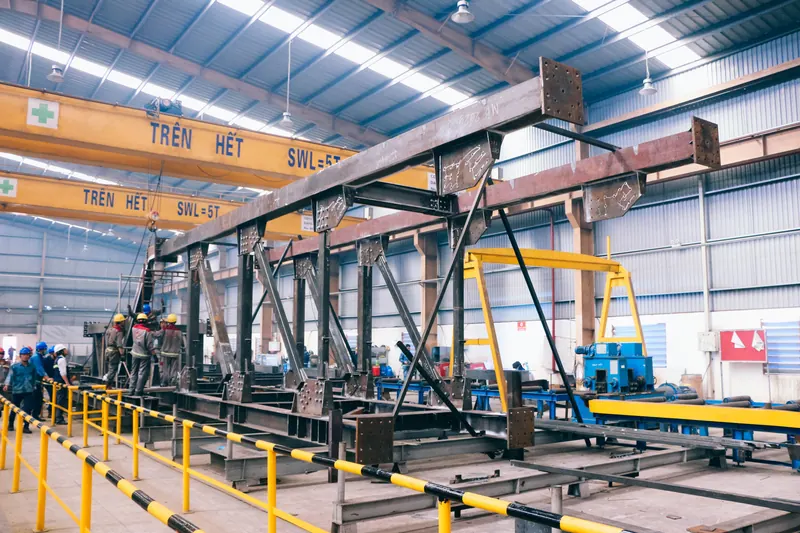
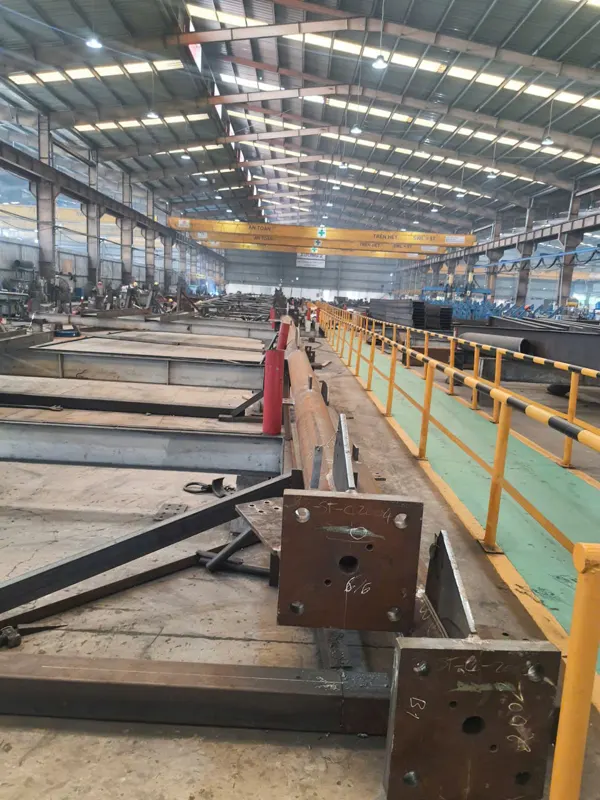
World Steel fabricates 2,500 metric tons of structural steel a month in its own IAS AC472-accredited plant in Vietnam, including platforms, rails, pipe supports and pipe racks for industrial plants. Pipe comes mainly from Vietnamese pipe makers, with Japan, Korea, Indonesia and Thailand when a size, schedule or grade calls for it, always ordered to the specification on your drawings.
At intake each lot is matched to its EN 10204 3.1 certificate, the type and grade are checked, and wall thickness is measured. Check tests, when your inspector asks for them, run at an ILAC-recognized ISO/IEC 17025 laboratory or the laboratory you name. The grades we supply are listed on the structural steel materials page. Next in the series: the general rules of ASTM A6.
Quick answers
What is the yield strength of A53 Grade B pipe?
A minimum of 240 MPa (35 ksi), with a minimum tensile strength of 415 MPa (60 ksi). Grade A is lower, at 205 MPa (30 ksi) yield.
Which type of A53 is used for structural work?
Type E (electric-resistance welded) or Type S (seamless) in Grade B. Type F, furnace-butt welded, is only made in Grade A and is not normally used for structural members.
How thin can the wall of A53 pipe be?
The wall at any point may be up to 12.5% under the nominal wall thickness, which is why designers should use section properties prepared for pipe rather than the nominal wall.
Should I specify A53 or round A500 HSS?
A53 Grade B suits pipe sizes, posts, bollards and rails, and many pipe racks. For strength-governed round members, round A500 Grade C or A1085 gives a higher yield and sizes made for structural design.
Keep building your steel plan
Go further on USPEB.com
On this topic
Across the US market
- US codes and standardsIBC, AISC, AWS and MBMA, designed to
- Seismic steel structuresSDC D to F framing for West Coast jobs
- Crane building designUS crane standards for mill and bay buildings
- Design ReportWhat our US-code design report contains
- Large projects, 2,500 t a monthCapacity for large US general contractors
- Contractor partnershipLong-term supply for US contractors