Hollow structural sections, HSS for short, carry columns, braces, truss chords, canopy frames, handrail posts and pedestrian bridge members on US jobs. When the drawings say HSS, the grade is almost always ASTM A500 Grade C. It is a simple grade to specify, but three details often cause trouble: round and shaped HSS have different strengths, the wall thickness used in design is not the nominal one, and the cold-formed corners behave differently from the flat sides. This article covers all three.
The values below are a selection from current editions of ASTM A500/A500M and AISC 360-22. The editions named in the project specification govern.
What A500 covers
ASTM A500/A500M is the standard specification for cold-formed welded and seamless carbon steel structural tubing in rounds and shapes. Tube is formed cold from flat strip, welded along its length (usually by electric resistance welding, ERW) and then, for square and rectangular sections, shaped. Because the steel is cold-formed, the corners of a square tube are strain-hardened: stronger, but less ductile than the flat faces.
Current editions include Grades B, C and D. Grades B and C are the structural grades. Grade D is heat-treated after forming and has a lower yield. AISC 360-22 Section A3.1 lists A500 among the approved specifications for HSS.
Round and shaped strengths
| Grade | Round HSS yield | Shaped HSS yield | Minimum tensile |
|---|---|---|---|
| B | 290 MPa (42 ksi) | 315 MPa (46 ksi) | 400 MPa (58 ksi) |
| C | 315 MPa (46 ksi) | 345 MPa (50 ksi) | 425 MPa (62 ksi) |
"Shaped" means square and rectangular. The difference between round and shaped comes from the extra cold work when a round tube is squared up: the shaped tube ends up stronger. For Grade C the shaped value matches the 345 MPa (50 ksi) of A992 and A572 Grade 50, which is one reason Grade C became the common choice. A designer who sizes a round HSS column with 345 MPa (50 ksi) has used the wrong yield; for round Grade C it is 315 MPa (46 ksi).
Many mills certify tube to both Grades B and C. Dual B/C material meets the higher of the two in each case, so it satisfies a Grade C order.
Design wall thickness: the 0.93 rule
A500 allows the wall thickness to vary within a tolerance of plus or minus 10% of the nominal wall, and the mass of a length may be up to 3.5% under the nominal mass. ERW tubes have historically tended toward the thin side of that tolerance.
AISC 360-22 Section B4.2 recognizes this. For HSS made to A500, the design wall thickness, t, is taken as 0.93 times the nominal wall thickness. Section properties in the AISC Manual for A500 HSS are already calculated with the reduced wall. HSS made to ASTM A1085, which has a much tighter tolerance, may be designed with the full nominal wall. The A1085 article compares the two.
What this means in practice:
- A 10 mm (3/8 in) nominal A500 tube is designed as about 9.3 mm thick.
- Section properties should come from tables made for the specification actually ordered.
- If a tube from another standard is offered, its wall tolerance should be checked before using A500 design properties for it.
The corners
A500 limits the outside corner radius of square and rectangular sections to no more than three times the specified wall thickness. Corners matter for three reasons.
- Welding. Weld details at the corners of HSS connections depend on the radius. A large radius leaves a gap where a flat plate meets the tube, which affects flare-bevel welds and fit-up.
- Toughness. The heavily cold-worked corners have less ductility. For fatigue-sensitive details or cold service, the engineer may ask for a different specification or extra testing.
- Galvanizing. ASTM A143 lists severe cold work as one of the conditions that can make steel more sensitive to embrittlement during hot-dip galvanizing. The embrittlement article explains how designers and galvanizers manage it.
Size and dimensional tolerances
A500 sets tolerances on outside dimensions, wall thickness, straightness, squareness of sides, twist and corner radius. For a structural job, the ones that matter most are:
- Straightness: important for long columns and truss chords, and checked at intake.
- Twist: affects how bolted connections at the two ends line up.
- Outside dimension: affects fit with cap plates, base plates and slotted gusset connections.
Our shop measures HSS on arrival, and dimensional checks are recorded with the heat number.
Where A500 Grade C goes on a frame
| Use | Notes |
|---|---|
| Columns in light industrial and commercial frames | Square HSS, often filled or capped at the top |
| Braces in concentrically braced frames | Square or round HSS; AISC 341 sets width-to-thickness limits in seismic systems |
| Truss chords and webs | Square or round, with welded or bolted gusset joints |
| Canopy and entrance framing | Often galvanized or painted for exposure |
| Pedestrian bridge members | Truss chords and diagonals |
| Handrails, guardrails and posts | Round or square |
For braces in seismic systems, the width-to-thickness ratio article explains the AISC 341 limits that apply to HSS walls.
Galvanizing HSS
HSS is often galvanized, and it needs details that rolled shapes do not:
- Vent and drain holes at both ends of every closed section, and at every internal plate, so molten zinc flows in and out and trapped air or moisture cannot cause a dangerous burst in the bath.
- Sealing or venting of overlapping surfaces where tubes meet plates.
- Attention to the corners, as above.
The vent and drain holes article gives the sizes and locations.
Ordering A500: what to write
An HSS line on the material schedule should state:
- ASTM A500/A500M, Grade C (or Grade B where the design allows it).
- Shape and size, for example HSS 200 × 200 × 10 (HSS 8 × 8 × 3/8).
- Whether dual B/C certification is acceptable.
- Whether A1085 may be offered instead.
- Any supplementary requirement, such as Charpy V-notch testing for cold service.
- Any finish that needs holes or closure plates detailed, such as galvanizing.
Common review questions on A500
Questions that come up when HSS submittals are reviewed:
- "The certificate shows Grade B/C. Is that acceptable for a Grade C order?" Yes, if the results meet Grade C for the shape: 345 MPa (50 ksi) for square and rectangular, 315 MPa (46 ksi) for round.
- "The wall measures 9.4 mm on a 10 mm nominal tube. Is it out of tolerance?" No. A500 allows the wall to be up to 10% under nominal, and the design already uses 93% of nominal.
- "Can a tube from an EN or JIS standard replace A500?" Only as a substitution, because wall tolerance, corner radius and strength basis differ. The foreign grade equivalents article explains the checks.
- "Does A500 need Charpy testing for an outdoor structure?" Not by default. If the engineer wants toughness for cold service, it must be added to the order, or A1085 specified instead.
A500 and connections
HSS connections deserve attention early in detailing, because the tube wall is the part that carries local loads. A gusset welded to the face of a square HSS bends that face; a beam framing into the side of a tube column pulls on its wall. AISC 360 Chapter K covers these checks. Where the wall is too thin for the connection force, the design adds a through plate, a cap plate, a stiffening collar or a thicker tube. Settling those details on the shop drawings, before steel is ordered, keeps the tube size and the grade from changing late.
Ordering for long members
Long truss chords and columns are often longer than a standard mill length. Splices then add welds and cost, so the material schedule should note where long lengths are needed. Some sizes can be ordered in longer mill lengths, which is worth checking during detailing.
A500 in seismic and exposed structures
In seismic systems, HSS braces and columns must meet the width-to-thickness limits of AISC 341 for their ductility class, and the expected strength of the brace drives the design of its connections. A500 is permitted, but because it has no yield ceiling its expected strength factor is relatively high, which raises connection forces. Many designers therefore specify A1085 for seismic braces and keep A500 for the rest of the frame.
For exposed structures such as canopies and pedestrian bridges, the closed shape of an HSS is an advantage: there are no ledges to trap water, and the outside is easy to coat. The inside is the risk. A sealed tube with no moisture inside does not corrode internally, but a tube with small openings can collect condensation. The detail should either seal the tube completely or vent and drain it properly, and the coating choice should follow the site's corrosivity.
How World Steel orders and checks HSS
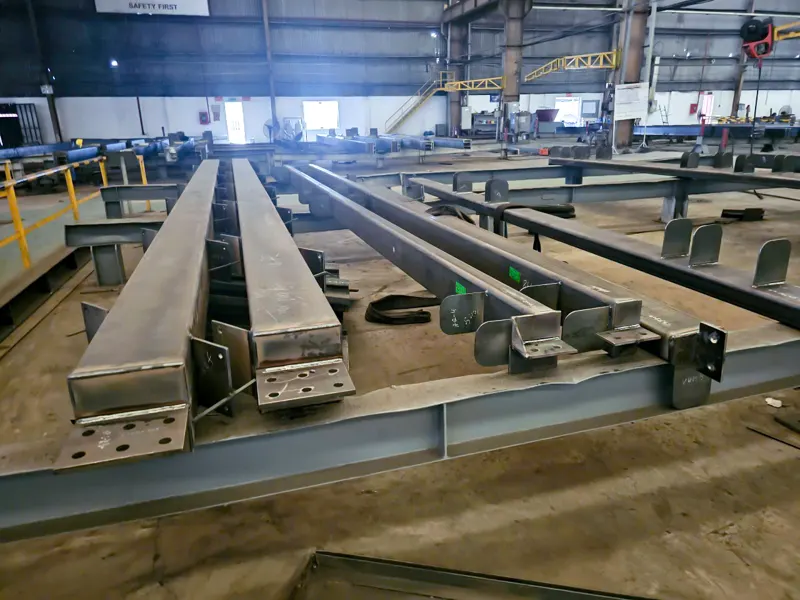
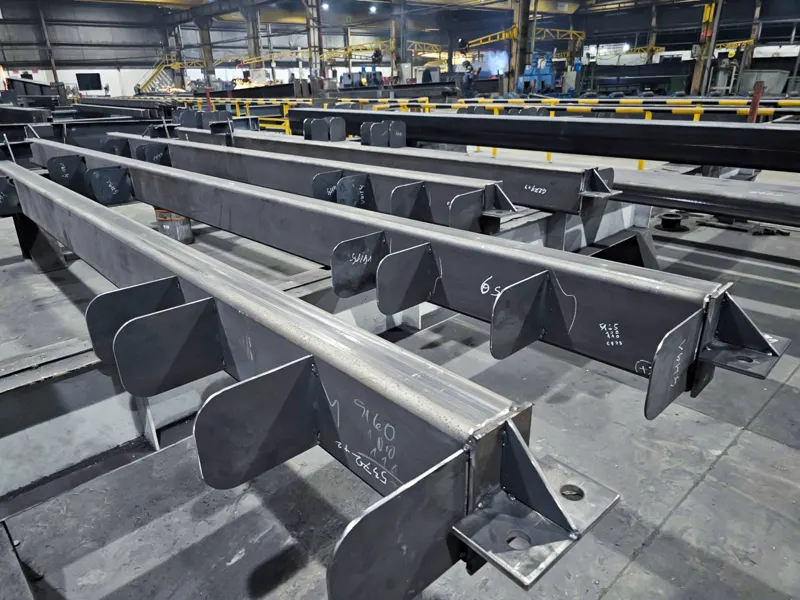
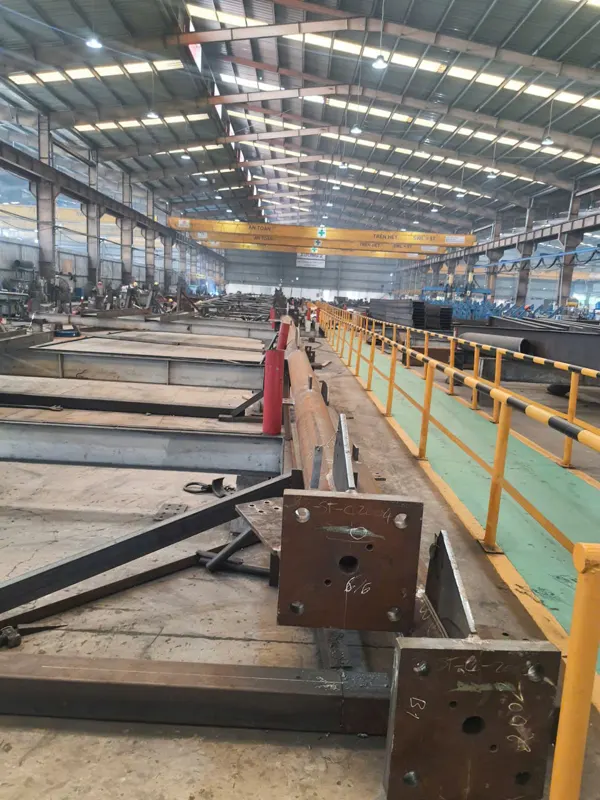
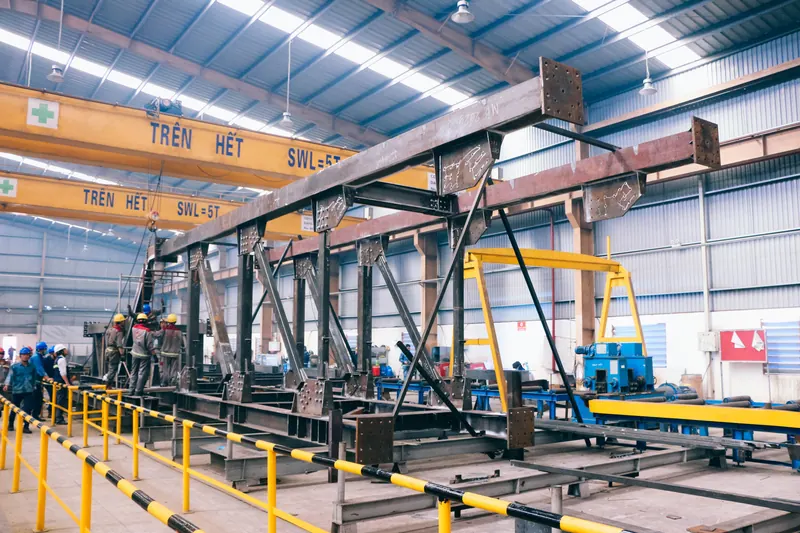
World Steel fabricates 2,500 metric tons of structural steel a month in its own IAS AC472-accredited plant in Vietnam, including tube trusses, canopies, platforms and pedestrian bridges. Hollow sections come mainly from Vietnamese tube makers, with Japan, Korea, Indonesia and Thailand when a size, wall or grade calls for it, always ordered to the specification on your drawings.
Each bundle is matched by heat number to its EN 10204 3.1 certificate, the round or shaped strength is checked against the grade, and wall thickness and straightness are measured at intake. Check tests, when your inspector asks for them, run at an ILAC-recognized ISO/IEC 17025 laboratory or the laboratory you name. Our shop drawings show vent and drain holes for galvanized tube. The grades we supply are on the structural steel materials page. Next in the series: A1085 against A500.
Quick answers
What is the yield strength of A500 Grade C?
For square and rectangular HSS, 345 MPa (50 ksi); for round HSS, 315 MPa (46 ksi). The minimum tensile strength is 425 MPa (62 ksi) for both.
Why is HSS design wall thickness 0.93 times the nominal?
A500 allows the wall to be thinner than nominal within its tolerance, and electric-resistance-welded tubes have historically been produced toward the low side. AISC 360-22 Section B4.2 therefore uses 0.93 times the nominal wall for A500 HSS in design.
Is A500 Grade B still used?
Yes, but Grade C has become the common choice because its shaped HSS strength matches the 345 MPa (50 ksi) of the rolled frame. Many tubes are dual-certified to Grades B and C.
Can A500 HSS be galvanized?
Yes, with vent and drain holes sized for the kettle and attention to the cold-formed corners, which ASTM A143 identifies as one of the conditions that can make steel more sensitive to embrittlement.
Keep building your steel plan
Go further on USPEB.com
On this topic
Across the US market
- US codes and standardsIBC, AISC, AWS and MBMA, designed to
- Seismic steel structuresSDC D to F framing for West Coast jobs
- Crane building designUS crane standards for mill and bay buildings
- Design ReportWhat our US-code design report contains
- Large projects, 2,500 t a monthCapacity for large US general contractors
- Contractor partnershipLong-term supply for US contractors