
- Design
- AISC 360-22, plus AISC 341 where the seismic system calls for it
- Welding
- AWS D1.1 per your spec, automated submerged arc web-to-flange welds
- Accreditation
- IAS AC472 Parts A and C, the first and only plant in Vietnam
- Material
- ASTM plate grades from mills in Vietnam, traced by heat number
Why built-up
Six things a built-up section does that a rolled shape cannot
Rolled shapes are the right answer for most beams and braces. On large members they run out of depth, waste weight or simply do not exist in the shape the structure needs. That is where welding from plate pays.
Beyond the rolled range
The deepest standard W-shapes stop at about 1,100 mm (44 in). A welded girder goes as deep as the span needs, and a column can be as heavy as the load needs.
Depth set by design and the trip to site
Weight where the load is
Web and flanges are sized one by one, and can change along the member. No steel is carried just because the catalog shape came that way.
Tonnage saved repeats on every frame
Any depth, any proportion
Deep and narrow, shallow and wide, unequal flanges or a thin web with stiffeners: the section is drawn for the job, not picked from a table.
Sections drawn to your calculations
Plate is easy to get
Heavy rolled shapes can be hard to source in the size and quantity a large job needs. Built-up members start from plate in common US grades, such as ASTM A572 Grade 50, from mills in Vietnam and traced by heat number.
ASTM A572 Grade 50 plate up to 100 mm thick
Tapered and variable members
Rafters deep at the knee and slim at the ridge, haunched beams, stepped columns: shapes a mill cannot roll at all.
Web cut on CNC machines from the model
Closed and special shapes
Box columns and cruciform columns give strength on both axes for two-way frames and composite columns.
Box and cruciform made in our plant
Member types
Built-up members for large US structures
Each type has its own guide: what it is for, how it is designed and checked, how we make it and what to send for a quote.
More built-up members we fabricate
Built-up columns
Prismatic or tapered columns welded from plate, with base plates, cap plates and knee connections built in. Ideal where a rolled column would be heavier than the load needs.
Used in Tall-eave warehouses, cold storage, multi-story frames, canopies
Product detailsTapered portal frames
Matched columns and rafters designed as one rigid frame, analyzed as a whole and split into bolted segments that fit the container or flat rack.
Used in Clear-span metal buildings from small workshops to large logistics halls
Product detailsCrane and stepped columns
Columns with unequal flanges or a stepped profile that carry both the roof frame and a crane runway bracket.
Used in Crane-served industrial buildings
Product detailsThe basics
Three plates, two welds, any depth you need
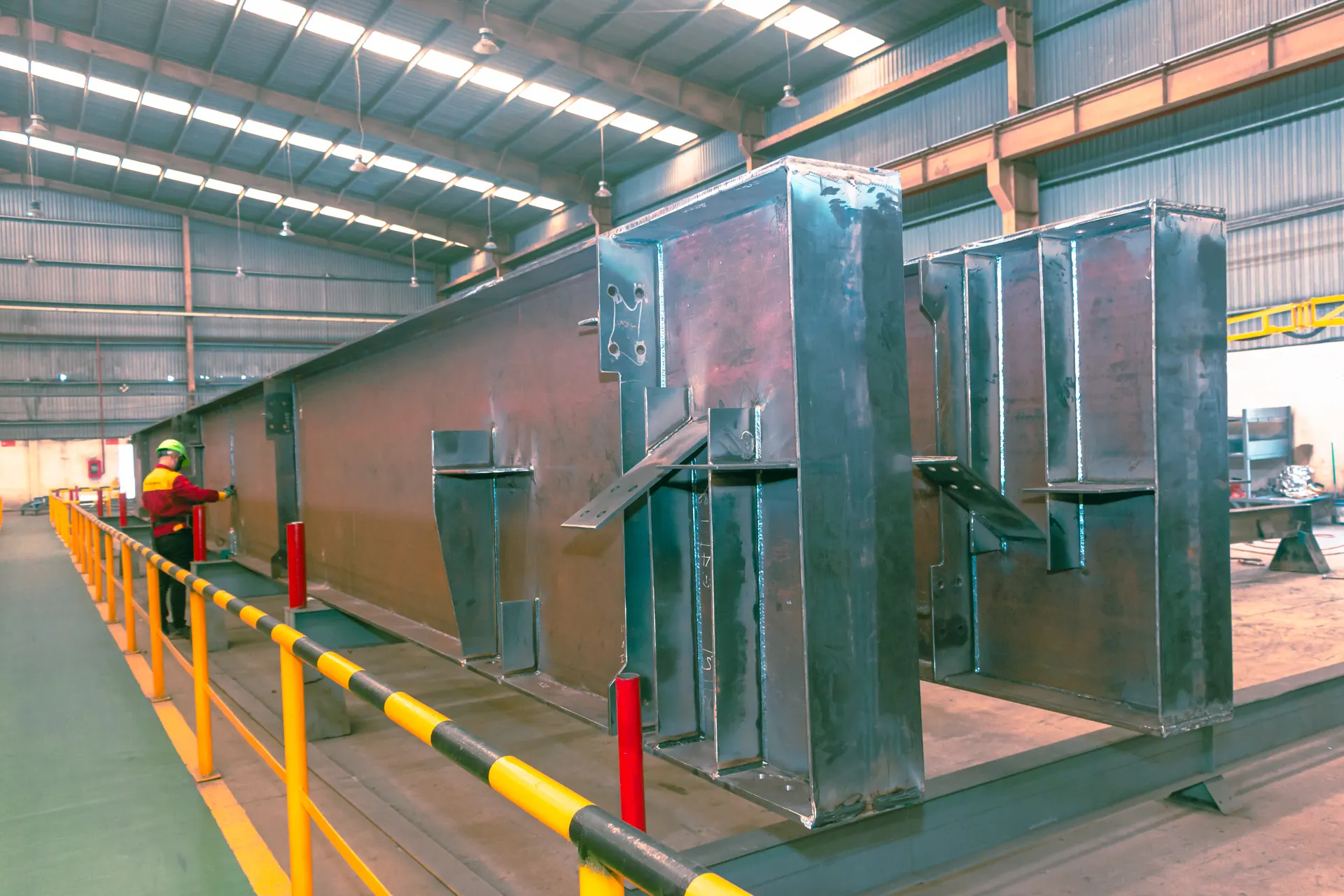
A built-up section is a structural member assembled from separate steel plates instead of being rolled to a catalog shape at a mill. The most common form is an I-section: two flange plates joined to a web plate by continuous fillet welds. Because each plate is chosen on its own, the engineer can set the depth, flange width, flange thickness and web thickness independently, and can change them along the member.
That freedom is why built-up members carry most clear-span metal buildings, crane buildings and hangars in the US. A rafter can be 1,200 mm (47 in) deep at the knee where bending peaks and much shallower at the ridge. A girder can be deeper than any rolled beam on the market. A crane column can get a heavier flange on the crane side. The steel goes where the forces are and nowhere else.
- Flange plates. Carry most of the bending. Width and thickness are sized for strength, local buckling and lateral-torsional stability.
- Web plate. Carries shear and holds the flanges apart. It can be slender, tapered or cut to a curve.
- Web-to-flange welds. Continuous fillet welds made by automated submerged arc welding in our plant, sized for the shear flow between web and flange.
- Stiffeners. Plates welded across the web at bearing points, knees, concentrated loads and where shear demands them.
- End plates and clips. Bolted end plates, purlin and girt clips, flange-brace holes and cap plates are welded or drilled in the shop, so the site crew only bolts.
| Rolled W-shape | Built-up section | |
|---|---|---|
| Depth | Fixed by the mill catalog | Any depth the design needs, constant or tapered |
| Flanges and web | Fixed ratios for each shape | Sized separately; unequal flanges are possible |
| Shape along the length | Straight and uniform | Straight, tapered, haunched, cambered or curved |
| Typical US grade | ASTM A992 | ASTM A572 Grade 50 plate, or the grade your specification names |
| Best fit | Short spans, floor beams, braces and secondary framing | Clear-span frames, heavy girders, crane runways and members beyond rolled sizes |
Made in our plant in Vietnam
The machines behind every built-up member
Every built-up member for a US job is cut, welded, inspected and coated in World Steel’s own plant in Tay Ninh Province, Vietnam, under its IAS AC472 fabrication accreditation. 100% of the plate comes from mills in Vietnam.
Laser cutting machines
Cut webs, flanges, stiffeners and bolt holes in steel up to 100 mm (about 4 in) thick.
See this stationCNC plasma and gas cutting
Cut long strips and tapered or curved webs straight from the model.
See this stationHydraulic shearing
Square cuts on thinner plate for stiffeners and fittings.
CNC drilling and punching
Bolt holes for splices, end plates and clips, in the positions the model sets.
See this stationAutomated beam welding line
Assembles web and flanges and runs the submerged arc welds along the member.
See this stationGantry beam welding machine
Submerged arc welding of heavy and deep members, including box corners.
See this stationBeam straightening machine
Corrects flange tilt from welding heat before the member is measured.
See this station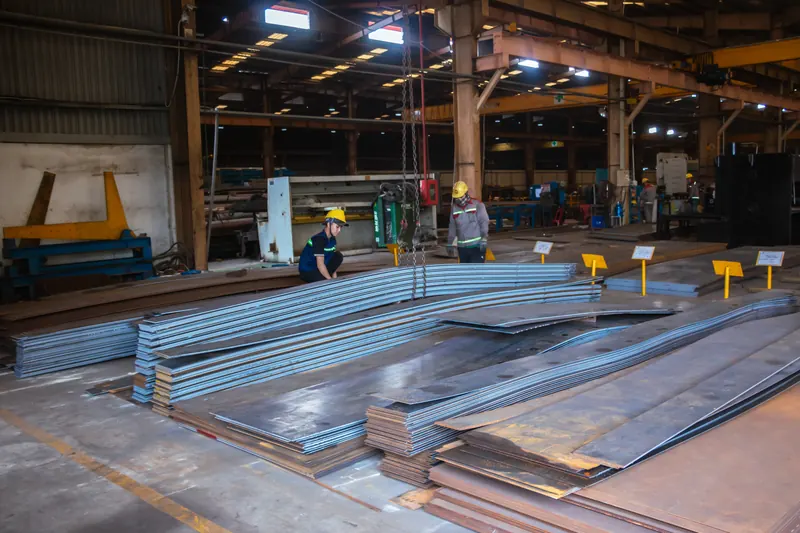
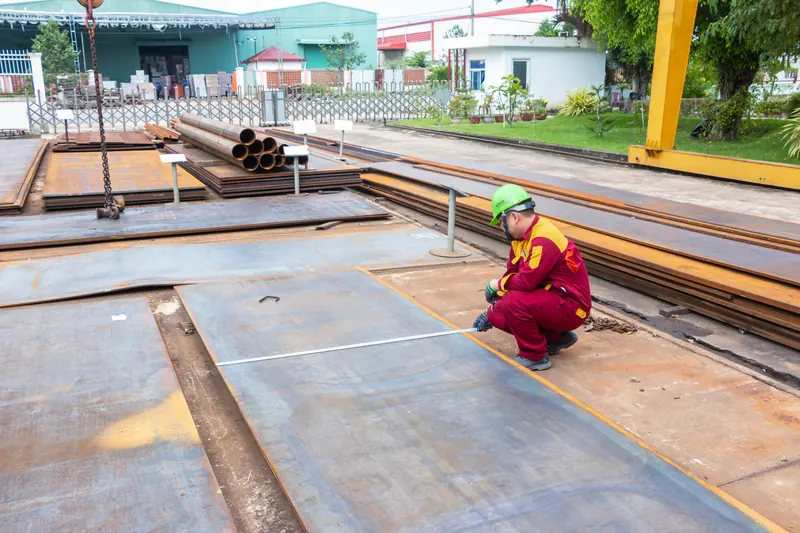
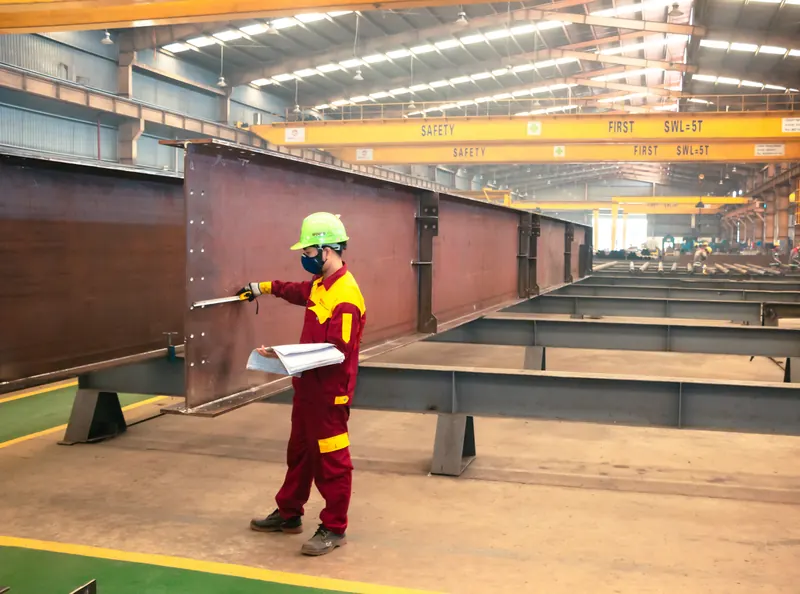
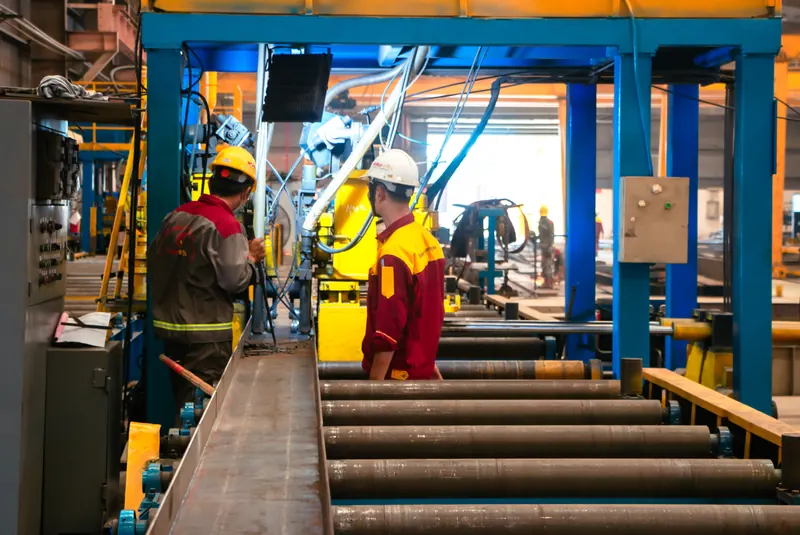
Photos: World Steel plant, Vietnam. Westminster, California is our US office; no steel is fabricated in the US.
Built for large jobs
Heavy members, in tonnages that fill a site
Built-up girders and columns are the heaviest pieces on most large structures. Our plant fabricates 2,500 metric tons of structural steel a month and has delivered single jobs of up to 5,000 t.
Large-project program- 5,000 t Sunpro Steel Factory Steel industry
- 2,500 t CPV Food Processing Factory Food processing
- 2,000 t Long Son petrochemical complex Oil and gas
- 2,000 t M&D (MD Factory) Warehouse and industrial
- 1,500 t Tongwei Tien Giang feed factory, phase 1 Animal feed
- 1,000 t New Era cold storage Cold storage, phase 1 tonnage
Choose a member
Which built-up member does your structure need?
A first pointer, not a design: your Engineer of Record makes the final choice.
The member must
Span further, or carry more, than the deepest rolled beam
The member must
Carry a clear-span roof with as little steel as possible
The member must
Bend about both axes, resist torsion or be filled with concrete
The member must
Take moment beams from four sides and stay open for bolting
The member must
Carry an overhead crane runway, with fatigue in mind
The member must
Span far while resisting twisting or off-center loads
The member must
Pick up columns from the floors above an open space
The member must
Follow an arched roof or end up level under load
The member must
Carry the roof frame and a crane bracket in one column
Designed and welded to US codes
The rulebook behind every girder
A welded member is only as good as the rules it was designed and made to. On US projects these are the documents we work to, unless your Engineer of Record names something else.
| Document | What it governs on a built-up member |
|---|---|
| AISC 360-22 | Strength and stability: width-to-thickness limits, flexure of slender-web girders, shear and tension field action, stiffeners, combined forces, connections and, where cranes cycle, fatigue (Appendix 3). |
| AISC Design Guide 25 | Frame design using web-tapered members: how tapered rafters and columns are analyzed and checked. |
| AISC Design Guide 7 | Industrial buildings and crane runways: runway girder design, crane columns and serviceability. |
| AISC 341-22 | Seismic provisions, applied when the lateral system and seismic design category require them, with welds to the AWS D1.8 supplement. |
| ASCE 7-22 and IBC 2024 | The loads: dead, live, roof, snow and drift, wind and seismic, at the edition your jurisdiction has adopted. |
| AWS D1.1 | Welding procedures (WPS and PQR), welder qualification, workmanship and acceptance criteria for the welds. |
| AISC Code of Standard Practice | Fabrication and erection tolerances, alongside the dimensional tolerances AWS D1.1 sets for welded members. |
| RCSC Specification | Bolted end-plate splices and connections: joint type, bolt grade and installation. |
| ASTM A572 / A36 / F3125 | Plate and bolt materials as named in your specification, with mill certificates for every heat. |
Inspection and records
Checked before it leaves the shop
| Check | What it confirms | Record you receive |
|---|---|---|
| Material | Plate grade, chemistry and mechanical properties match the specification | Mill certificates linked to each piece mark by heat number |
| Welding procedures | Each joint type has a written, tested procedure and a qualified welder | WPS, PQR and welder qualification records |
| Visual inspection | Every weld: size, profile, undercut, porosity and cracks | Pass or fail by piece mark |
| NDT | UT, MT or PT on the welds your specification or the code singles out | NDT reports and technician qualifications |
| Dimensions | Length, depth, flange tilt, camber, sweep and hole positions | Dimensional check sheet per member |
| Coating | Surface preparation and dry film thickness | Coating inspection record |
PEB Studio · real-time tracking
Watch your girders being made, from the US
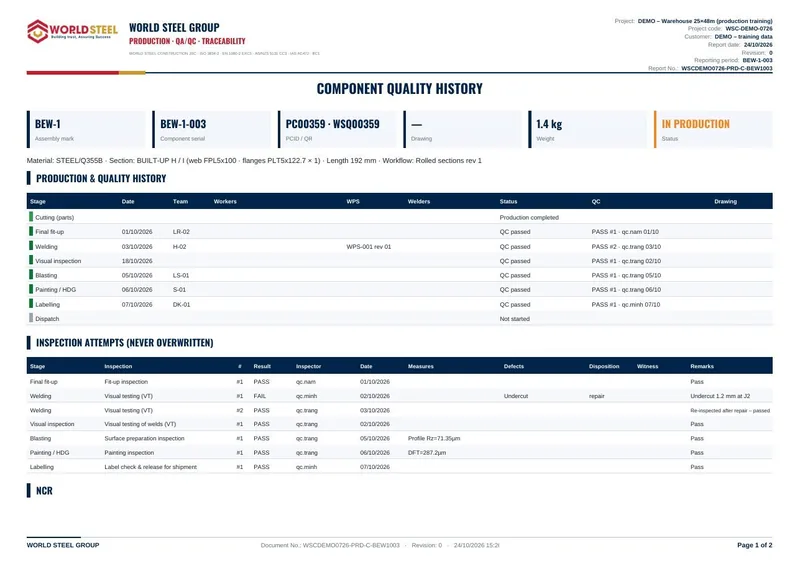
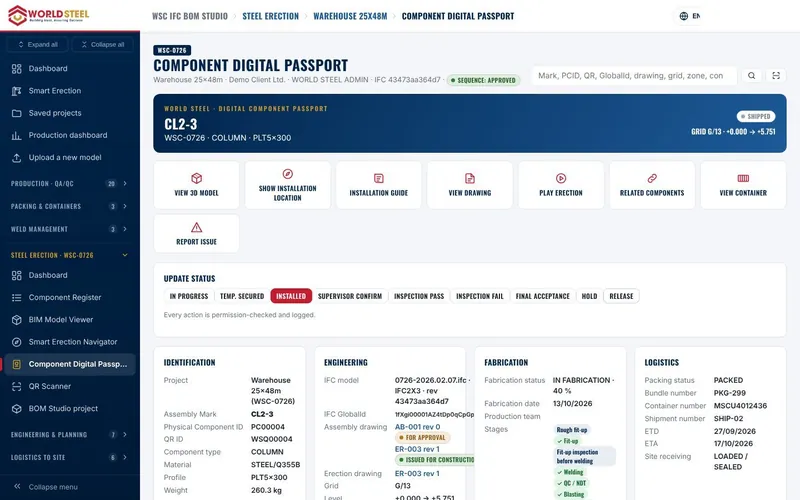
Each piece mark moves through cutting, welding, inspection, coating and packing in PEB Studio as it happens. Open a girder to see its plate heat numbers, weld and NDT results and dimensional checks, or scan its QR tag on site to see where it goes.
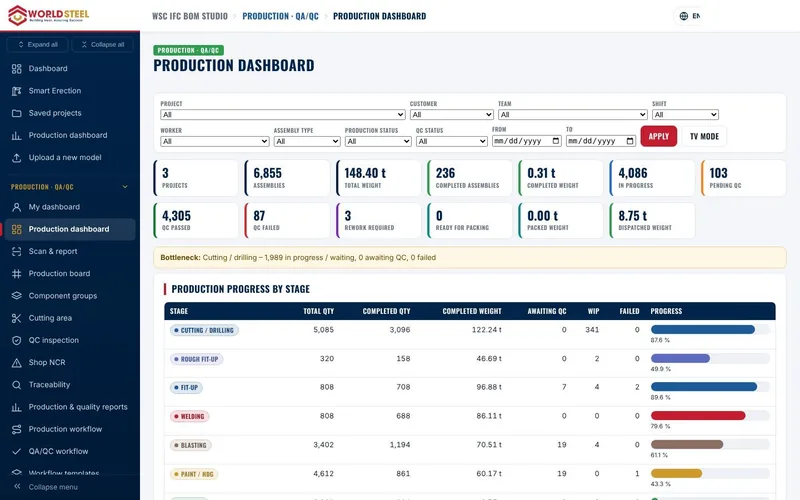 Demonstration data
Production
Shop progress by stage, with the holdup flagged
Cutting, fit-up, welding, blasting and painting are tallied by count and weight, alongside what is waiting on QC and what failed. Your regular production report is built from the same numbers.
These are real PEB Studio screens filled with sample training data, so no customer’s job is exposed and personal names are masked.
Vietnam to your US port
Long girders, planned for the voyage
Long members are planned for the trip from day one. Splice locations are set in design so each segment fits the box: a 40 ft high-cube container has an inside length of about 12.0 m (39 ft 5 in). Longer or heavier pieces travel on flat racks or as breakbulk, and every splice is a bolted end plate, so no welding waits for your crew on site.
Every bundle carries its piece marks and weights in kg (lb), and the packing report lists what is in each container in erection order. Steel ships from Vietnam to the West, Gulf or East Coast port that suits your job, and each quote states the Incoterm and the importer of record.
Splices planned in design
Segment lengths are set around container and flat-rack sizes before the shop drawings are issued.
Bolted, not welded, on site
End-plate splices go together with high-strength bolts under the RCSC Specification.
Packed in erection order
Bundles follow your frame lines, so the first frame you set is the first one you unload.
Weights on every tag
Piece weights in kg (lb) on drawings, tags and packing lists help your erector plan each lift.
Get a quote
What to send, and what comes back
Send us
- Framing plans, a member schedule or your Engineer of Record’s design
- Code basis: IBC edition, ASCE 7 edition and any local amendments
- Design loads, including collateral, snow, wind and seismic criteria
- Crane data where it applies: capacity, span, wheel loads and service class
- Plate grade, coating system and NDT extent from your specification
- Project location and the US port or jobsite for delivery
You receive
- Design calculations to AISC 360 for your Engineer of Record
- Anchor rod plan with column reactions, issued early for the foundation design
- Approval drawings, then shop and erection drawings from the Tekla model
- Welding procedures and the Inspection and Test Plan for review
- Mill certificates, weld, NDT, dimensional and coating records by piece mark
- Packing reports and a Manufacturing Data Record at closeout
No prices or standard sizes are published: every member is sized and quoted for its own loads.
Who orders built-up members
Structural engineers
Send a design and get members fabricated to it, or ask us to size the built-up frame for your review.
General contractors
Carry one engineered steel number in your bid and track fabrication from the US while the site work starts.
Metal building dealers
Sell clear-span frames under your own brand, with engineering and OEM labels handled by our team.
Fabricators and erectors
Have heavy girders and tapered frames made to your drawings when your own shop is full.
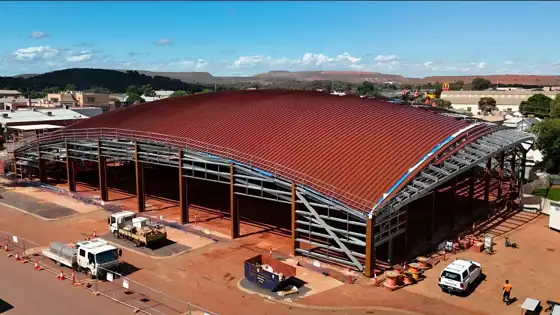
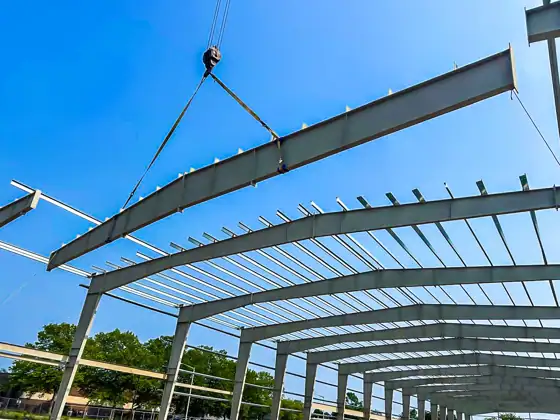
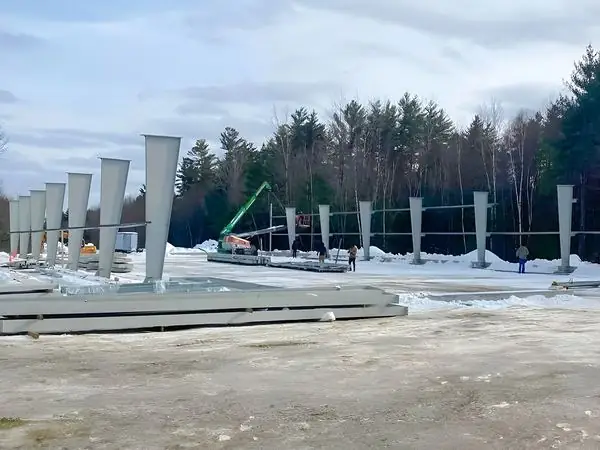
Projects framed with our welded members
Asked by US engineers and contractors
Built-up section questions
What is the difference between a built-up section and a plate girder?
“Built-up section” covers any member welded together from plates. A plate girder is one kind: a deep welded I-beam, usually with stiffeners, used as a beam or girder. Tapered rafters, built-up columns and crane runway girders are built-up sections too.
When is a built-up member better value than a rolled W-shape?
Usually on clear spans, deep or heavy girders, tapered frames and crane buildings, where matching the section to the force saves more steel than the extra welding costs. For short, lightly loaded members a rolled shape is often simpler. Our engineers compare both piece by piece and show the options to your Engineer of Record.
Which codes do you design and weld built-up members to?
Design follows AISC 360-22, with AISC 341 added where the seismic system requires it, using IBC and ASCE 7 loads at the edition your jurisdiction has adopted. Welding follows your specification, usually AWS D1.1, with written procedures, qualified welders and an inspection plan you approve.
How are the web-to-flange welds made?
On automated submerged arc welding equipment in our plant in Vietnam. Weld size is set by the design for the shear flow between web and flange, and every weld is inspected visually, with UT, MT or PT added to the extent your specification calls for.
Where are the members made, and where does the steel come from?
Every member is cut, welded and coated in World Steel’s own plant in Tay Ninh Province, Vietnam, the first and only steel building plant in Vietnam accredited under IAS AC472. The plate comes mainly from mills in Vietnam, ordered to the ASTM grade you specify and traced by heat number. Our Westminster, California location is an office, not a plant.
Can we follow our girders through production?
Yes. PEB Studio shows each piece mark as it moves through cutting, welding, inspection, coating and packing, with the records attached. Your team, your inspector or your owner can follow the job online from the US.
Can our special inspector witness the welding?
Yes. Hold and witness points are written into the Inspection and Test Plan. They can be witnessed in person at the plant, by a third-party agency, or live over Zoom or Microsoft Teams. Under IBC §1704.2.5 the building official may also accept shop fabrication by an approved fabricator; that decision is theirs.
How do long girders ship to the US?
Splices are planned so segments fit containers or flat racks, and each splice is a bolted end plate. Bundles are tagged and packed in erection order and shipped to a West, Gulf or East Coast port. Each quote names the Incoterm and the importer of record.
How much built-up steel can your plant take on for one project?
Our own plant in Vietnam fabricates 2,500 metric tons (about 2,750 short tons) of structural steel a month, and has delivered single jobs of up to 5,000 t, such as Sunpro Steel. Large packages are scheduled in sequences that match your erection plan, and several projects run in parallel.
Do you publish prices or standard sizes?
No. Every built-up member is sized for its own loads, so there is no price list or size table. Send your drawings or member schedule and you receive a written scope and quote.
Keep reading
Related products and standards
Need large built-up members for a US job?
Send the drawings or a member schedule. Our engineers check the code basis, size or verify the members and return a written scope for steel made in our Vietnam plant and shipped to your port.