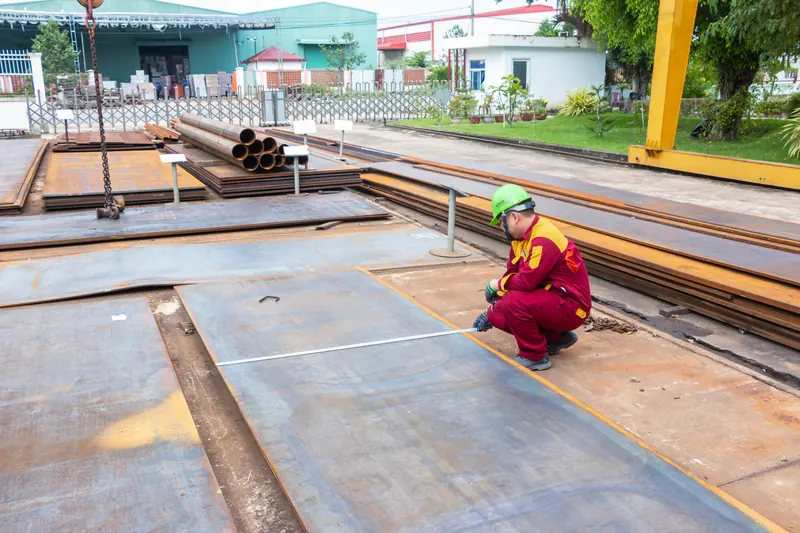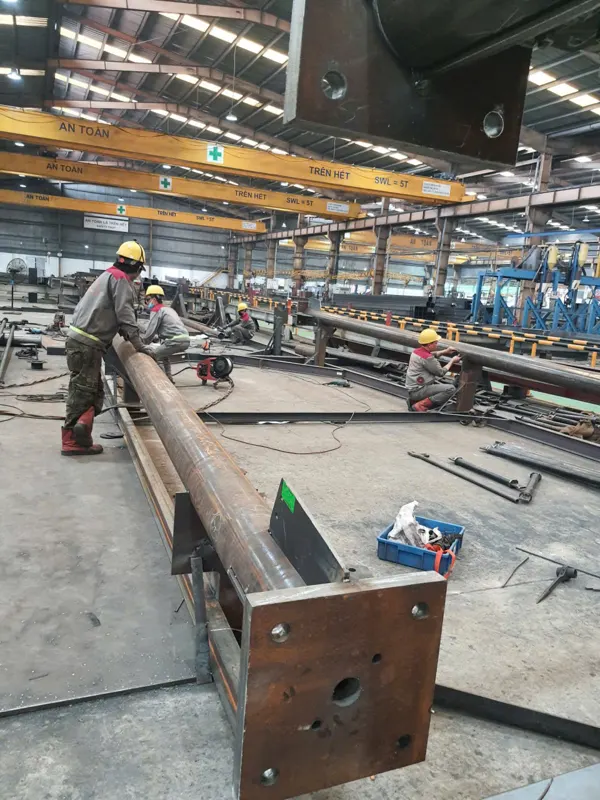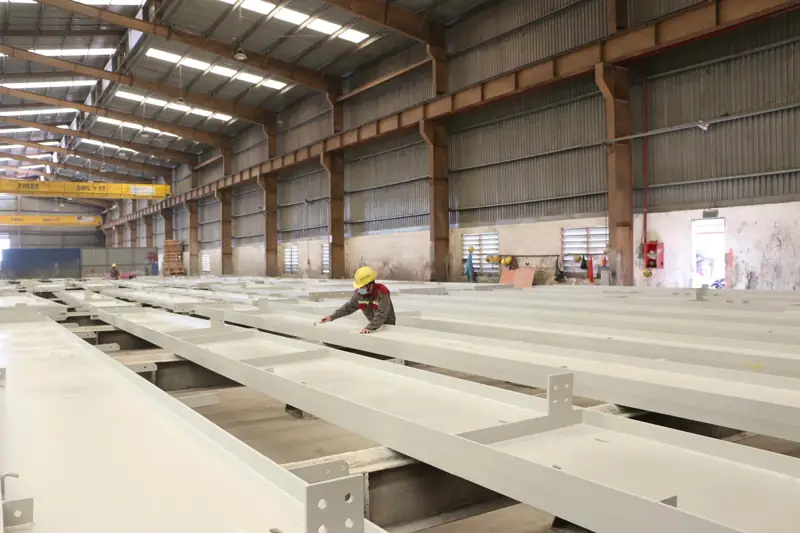
Drawings name a grade and a section for every member. Most of the time the steel arrives exactly as drawn. Sometimes it cannot: a size is not rolled in the needed grade, a heavy plate is not available with the Charpy requirement on time, or a mill offers a stronger grade in place of the one specified. A steel grade substitution is then needed. Done in writing and reviewed by the Engineer of Record, it is routine. Done by assumption, it can end with rejected material on site or a frame that behaves differently from its design. This article explains when a substitution is needed, what the engineer checks, and what records to keep.
The rules below follow AISC 360-22, AISC 341-22 and common US submittal practice. The project's contract documents set the actual procedure.
When a substitution is needed
A change needs a formal request when the steel supplied would differ from the contract documents in any of these:
- Specification or grade: A572 Grade 50 plate where A36 is drawn, A500 where A1085 is drawn, S355 where A572 Grade 50 is drawn.
- Section: a heavier or different shape, a built-up member in place of a rolled one, or a different HSS wall.
- Supplementary requirement: a different Charpy temperature or frequency, no ultrasonic examination where it was specified.
- Source standard: steel rolled to JIS, KS, EN or another standard in place of the ASTM grade.
It is not needed when the steel is certified to the specified grade and meets it, even if it also meets another grade. Dual-certified material is the common example.
Why "stronger" is not automatically safe
The most common substitution offers a higher grade or a heavier section. For a beam carrying gravity load it is usually harmless. The engineer still checks it, because a stronger member can cause problems in at least five ways.
- Seismic systems. AISC 341 designs connections and adjacent members for the expected strength of the yielding element, using factors set for each specification in Section A3.2. A stronger brace, link or beam than designed can overload its connections or the columns, moving damage to places meant to stay elastic.
- Connections. A thicker plate may need a larger weld, a different bolt pattern or a different edge distance.
- Welding. A higher grade may need matching filler metal of higher strength, higher preheat or a different qualified procedure.
- Galvanizing. A different chemistry, especially silicon and phosphorus, can change the zinc coating, and heavier sections change distortion and thickness grades.
- Weight and erection. Heavier members change piece weights, lifting plans and shipping.
A good request answers these questions before the engineer has to ask.
What the Engineer of Record checks
For a grade change, the engineer typically compares:
| Property | Why it matters |
|---|---|
| Minimum and, where relevant, maximum yield | Member strength and expected strength in seismic design |
| Tensile strength and yield ratio | Connection rupture checks and ductility |
| Elongation | Ductility |
| Chemistry and carbon equivalent | Weldability and galvanizing |
| Charpy energy and temperature | Fracture resistance where specified |
| Thickness range of the grade | Whether the strength holds at the actual thickness |
For a section change, the engineer checks section properties, local buckling and width-to-thickness limits, connection geometry, deflection and any effect on the architecture or other trades. For HSS, the design wall basis in AISC 360-22 Section B4.2 is part of the check, since A500 and A1085 use different design walls.
What goes in the request
A complete substitution request includes:
- The members affected, by piece mark or member type, and the drawings they appear on.
- Specified and proposed grade, section and supplementary requirements, side by side.
- The reason: availability, schedule, a mill offer, or an improvement.
- The evidence: the proposed material's certificate or a representative one, and a property comparison table.
- The design effect: calculations or a statement of which checks change, including connections, welds and seismic requirements.
- Other effects: welding procedures, coating, weight, schedule.
- Who approves, with space for the Engineer of Record's response.
Sending it through the contract's submittal or request-for-information path keeps it in the project record. The material and color submittals guide shows where it fits in our process.
Timing
Substitutions are cheapest before steel is ordered, and most expensive after it is cut. Three moments to look for them:
- At bid: flag grades, sizes or requirements that are hard to source, and offer alternates with the bid.
- At design development and shop drawings: confirm availability of every grade and section before release, especially heavy plate with Charpy, A1085 HSS, weathering steel and large W shapes.
- At mill order: if a mill cannot supply as ordered, raise the request immediately rather than substituting quietly.
Value engineering proposals often include grade or section changes. They follow the same route; the value engineering page shows how we present them.
After approval: keeping the record
An approved substitution should leave a clear trail:
- The Engineer of Record's written response, with any conditions.
- Revised shop drawings or material schedule showing the approved grade or section.
- The certificates of the material actually supplied, linked to the piece marks.
- Any changed welding procedure or coating record.
At handover, the reviewer or the owner should be able to pick any substituted member and find why it differs from the design drawings and who approved it.
Substitutions that should be refused
A fabricator should refuse, not request, a few changes:
- Unidentified steel in main members, which AISC 360-22 Section A3.1 does not allow except for parts whose failure would not reduce the strength of the structure.
- Material whose certificate cannot be matched to the steel.
- Relabeling of steel to a grade it was not certified to.
A worked example
A design calls for W610 × 125 (W24 × 84) beams in A992. The size is not available in the needed quantity on time, and the fabricator proposes W610 × 140 (W24 × 94), one size heavier, in A992.
A complete request would show:
- Members: the beam types and piece marks on the affected floors.
- Comparison: same depth series, same grade, about 12% heavier, higher section modulus and moment of inertia.
- Design effect: strength and deflection improve. Connections: the flange is thicker, so the bolt grip and the shear tab detail are checked; the web is thicker, so the copes and welds are checked.
- Other effects: heavier pieces for the crane and shipping, more paint area, a small schedule gain from availability.
- Seismic: if the beams are part of a moment frame, the expected moment capacity rises, and the columns and panel zones must be rechecked under AISC 341. That one check can turn a routine substitution into a redesign, which is why it must be raised.
With that information, the engineer can answer quickly and in writing.
Common mistakes
- Raising a substitution after material is cut.
- Showing the proposed grade without the certificate.
- Forgetting the connections and welds.
- Treating an email from a site supervisor as approval.
- Leaving the approved change off the revised shop drawings, so the record and the steel disagree.
Substitutions and the building official
A substitution approved by the Engineer of Record may still need the building official's acceptance if it changes the approved construction documents. Many jurisdictions handle that through a revision submittal or a deferred submittal for steel. Special inspectors working under IBC Chapter 17 also check that the material installed matches the approved documents, including approved substitutions, so the paperwork should be ready for them. A clean record with the engineer's response, the revised drawings and the certificates lets an inspector close the item quickly.
Building alternates into the bid
On large projects, many substitutions can be avoided altogether by agreeing alternates at bid. A bid that lists, for example, "A1085 or A500 Grade C designed with A500 properties", "S5 Charpy per heat on plate over 50 mm" and "dual-certified A36/A572-50 acceptable for connection plates" gives the Engineer of Record a chance to accept or reject each alternate before the contract is signed. The US contractor then has a clearer schedule, and the fabricator can buy steel the day the drawings are released. We include material alternates of this kind in our proposals when the specification leaves room for them.
How World Steel handles substitutions
World Steel fabricates 2,500 metric tons of structural steel a month in its own IAS AC472-accredited plant in Vietnam, working with US contractors who bid and build large structural steel projects. The steel comes mainly from leading Vietnamese mills, with Japan, Korea, Indonesia and Thailand when the project specification calls for them, and is ordered to the grade on your drawings. Availability of every grade and section is checked before shop drawings are released, so any alternate is raised early, in writing, with a property comparison for your Engineer of Record.
Nothing is substituted without written approval. Approved changes are shown on revised shop drawings, the certificates of the steel actually used are EN 10204 3.1 and linked to piece marks in PEB Studio, and any supplementary test runs at an ILAC-recognized ISO/IEC 17025 laboratory or the laboratory you name. All the grades we supply are on the structural steel materials page, and the series starts again at A992, A572 or A36.
Quick answers
Is a stronger steel grade always an acceptable substitute?
No. A stronger grade usually helps gravity members, but in seismic systems it can move yielding to a place the design did not intend, and it can change welding, galvanizing and connection design. The Engineer of Record decides.
Who approves a steel grade substitution?
The Engineer of Record, through the contract's submittal or request-for-information process, and the building official where the change affects the approved documents. The fabricator proposes and documents it.
What goes in a substitution request?
The members affected, the specified and proposed grade or section, the reason, a comparison of properties with the certificate, the effect on design, connections, welding and coatings, and any schedule effect.
Does dual-certified steel need a substitution request?
Not when it is certified to the specified grade and meets it. A dual A36/A572-50 angle meets an A36 order. Some engineers still ask to be told, especially for seismic members, and a general note can settle it in advance.
Keep building your steel plan
Go further on USPEB.com
On this topic
Across the US market
- US codes and standardsIBC, AISC, AWS and MBMA, designed to
- Seismic steel structuresSDC D to F framing for West Coast jobs
- Crane building designUS crane standards for mill and bay buildings
- Design ReportWhat our US-code design report contains
- Large projects, 2,500 t a monthCapacity for large US general contractors
- Solutions by stateState-by-state steel solutions