For most of the history of hollow structural sections in the US, there was one structural specification: A500. Designers learned to live with its quirks, such as a design wall thinner than the nominal one and the lack of any toughness requirement. In 2013 a new specification, ASTM A1085, was published to answer those quirks directly. It is now accepted by AISC 360 and AISC 341, and designers can choose between the two. This article compares them and explains when the newer grade is worth asking for.
The values below are a selection from current editions of ASTM A1085/A1085M, ASTM A500/A500M and AISC 360-22. The editions named in the project specification govern.
What A1085 covers
ASTM A1085/A1085M is the standard specification for cold-formed welded carbon steel hollow structural sections. Like A500, it covers round, square and rectangular tubes formed cold and welded along their length. Unlike A500, it was written specifically for structural applications in buildings, with properties chosen to match how engineers design HSS. Grade A is the structural grade most jobs mean when they write "A1085".
Side by side
| Property | A500 Grade C | A1085 Grade A |
|---|---|---|
| Yield, square and rectangular | 345 MPa (50 ksi) minimum | 345 to 485 MPa (50 to 70 ksi) |
| Yield, round | 315 MPa (46 ksi) minimum | 345 to 485 MPa (50 to 70 ksi) |
| Tensile, minimum | 425 MPa (62 ksi) | 450 MPa (65 ksi) |
| Wall thickness tolerance | ±10% of nominal | No thinner than 95% of nominal |
| Design wall in AISC 360-22 | 0.93 × nominal | Nominal |
| Charpy V-notch | Not required | Required |
Four differences stand out.
- One yield for round and shaped. A1085 has the same 345 MPa (50 ksi) minimum for round and square sections. Designers no longer need to remember that round A500 Grade C is 315 MPa (46 ksi).
- A yield ceiling. A maximum yield of 485 MPa (70 ksi) does for HSS what A992 did for wide flange shapes: it narrows the strength band.
- A tighter wall. With the wall no thinner than 95% of nominal, AISC 360-22 Section B4.2 lets the designer use the nominal wall. Section properties are larger for the same tube size.
- Toughness. A1085 requires a Charpy V-notch test, at a minimum energy of 27 J (20 ft·lbf) at 4 °C (40 °F) in current editions, so every tube comes with a toughness result.
What the design wall means in kilograms
Take a 200 × 200 mm (8 × 8 in) square tube with a 10 mm (3/8 in) nominal wall. Designed as A500, the wall is taken as about 9.3 mm. Designed as A1085, it is 10 mm. The difference in area, moment of inertia and capacity is roughly 7%, without changing the tube. On a job with many tube columns or long truss chords, that can allow a lighter size or a thinner wall in some members.
The saving is real only if the design is done with A1085 properties and A1085 is actually ordered. Using A1085 section properties and then accepting A500 tube would leave the members about 7% weaker than designed.
Seismic braces
The most common reason to specify A1085 is a seismic brace. In a special concentrically braced frame, the brace is the part that yields in tension and buckles in compression. Its connections and the beams and columns around it are designed for the expected strength of the brace, which AISC 341 calculates from the specified minimum yield times a factor, Ry.
Because A500 has no yield ceiling, its Ry is high. A1085, with its narrower band, has a lower factor. A lower expected brace strength means lower design forces for the gussets, welds, beams and columns. On a large seismic job that can be a meaningful saving in connection material.
The AISC 341 series explains braced frames and expected strength. The required toughness of A1085 is a further advantage in braces that see large cyclic strains.
Cold service and fatigue
The Charpy requirement makes A1085 useful wherever toughness matters: outdoor structures in cold climates, members carrying cyclic loads, and pedestrian bridges where the owner wants toughness on every main member. A500 can be ordered with a supplementary Charpy test, but that is an extra the purchaser has to remember and the mill has to accept. With A1085 it is part of the grade.
When A500 is enough
A1085 is not always worth it. A500 Grade C remains the sensible choice when:
- The members are not in a seismic force-resisting system.
- Strength does not govern, for example in lightly loaded posts, girts or canopy framing.
- Availability of A1085 in the needed sizes is uncertain or would delay the job.
- The project has no toughness requirement.
Fewer mills roll A1085 than A500, and not every size is available from every source. When a design depends on A1085, it is worth confirming availability early and noting on the drawings whether A500 may be offered as an alternate with A500 properties.
Writing it on the drawings
A clear HSS note avoids a substitution dispute later:
- "HSS: ASTM A1085/A1085M Grade A" where the design uses A1085 properties.
- "A500 Grade C is not an acceptable substitute without Engineer of Record approval", or the opposite if it is.
- The seismic members that must be A1085, if not all HSS.
- Any toughness requirement beyond the A1085 default.
The grade substitution article explains how a substitution request is reviewed.
Checking A1085 on the certificate
An A1085 mill certificate should show, for each heat or lot:
- The specification, A1085/A1085M, and the grade.
- The yield and tensile results, with the yield inside the 345 to 485 MPa (50 to 70 ksi) range.
- The Charpy V-notch energies and test temperature.
- The heat analysis.
- The size and the nominal wall.
At intake, the wall thickness is measured to confirm it is no thinner than 95% of nominal, because the design depends on it.
Galvanizing and fabrication
For fabrication and galvanizing, A1085 behaves like A500: vent and drain holes, care at cold-formed corners and the same welding approach. The weld procedures that cover A500 usually cover A1085 within the base metal groups of AWS D1.1, but the welding engineer should confirm the procedure qualification range.
A worked comparison for a braced frame
Consider a special concentrically braced frame with square HSS braces. The brace size is set by compression and by the AISC 341 slenderness and width-to-thickness limits. The gusset plates, the welds to the brace, the beam at the brace intersection and the columns are then designed for the brace's expected tensile strength, which is the specified yield times Ry times the gross area.
With A500 Grade C, the specified yield is 345 MPa (50 ksi), but because the grade has no ceiling, its Ry is relatively high, and the gross area is taken from the 0.93 design wall. With A1085, the specified yield is the same, its Ry is lower, and the gross area uses the full nominal wall. The two effects pull in different directions: a larger design area increases the expected force a little, while the lower Ry reduces it more. In most cases the expected brace force with A1085 is lower, and so are the forces the connections and framing must carry. On a large braced building, those savings in gusset thickness, weld size and beam weight repeat in every bay.
The comparison is the Engineer of Record's to make, with the current AISC 341 factors and the actual brace sizes. The point is that A1085 is chosen for the whole system, not for the brace alone.
Common questions
- Is A1085 more expensive? It is a more demanding product, and fewer mills make it, so cost and lead time should be confirmed per project.
- Is it available in every size? Not always. Large or heavy-wall sections may not be offered.
- Can a project mix A1085 and A500? Yes, with each member type named on the drawings, for example A1085 braces and A500 posts.
A1085 for exposed and architectural work
A1085's tighter tolerances also help where tubes are on show. Architecturally exposed structural steel often includes long HSS members, and an architect may care about straight edges, consistent corner radii and wall thickness at cut ends. A1085's dimensional rules give a more consistent product, though the project specification for exposed steel still sets the visual requirements. For pedestrian bridges, canopies and stair structures with long exposed tubes, it is worth asking whether A1085 would make the appearance and the fit-up easier.
How World Steel orders and checks A1085 and A500
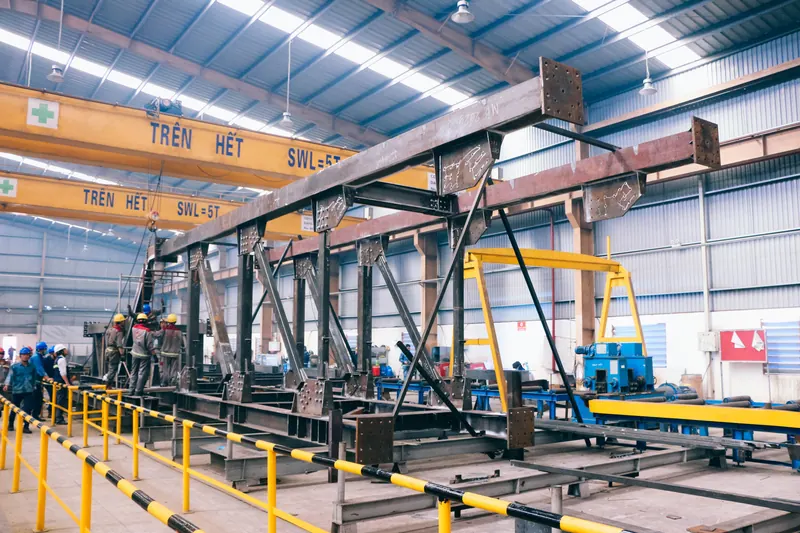
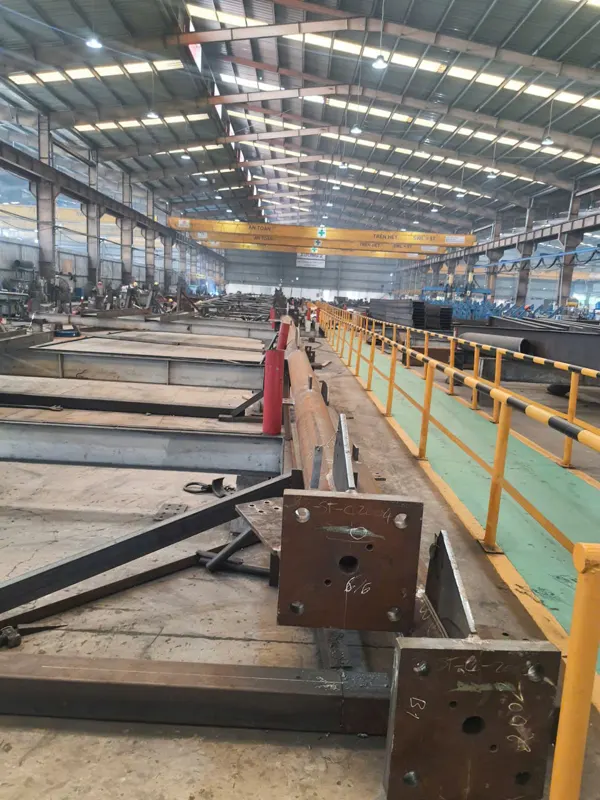
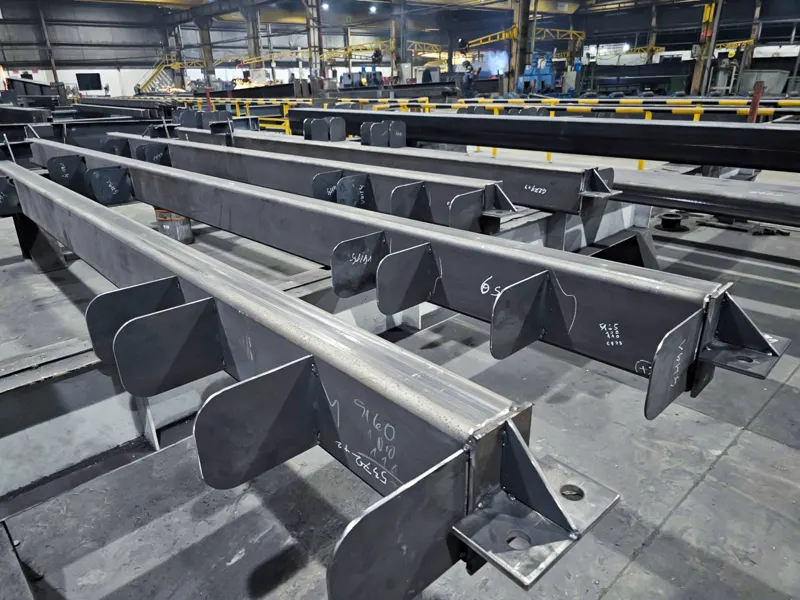
World Steel fabricates 2,500 metric tons of structural steel a month in its own IAS AC472-accredited plant in Vietnam, including braced frames for seismic regions and tube trusses for long spans. Hollow sections come mainly from Vietnamese tube makers, with Japan, Korea, Indonesia and Thailand when a grade such as A1085 or a size calls for it. When A1085 is specified, availability is confirmed before shop drawings are released, and any alternate goes to your Engineer of Record in writing.
Each lot is matched to its EN 10204 3.1 certificate, with the Charpy results and yield range checked against the grade and the wall measured at intake. Check tests run at an ILAC-recognized ISO/IEC 17025 laboratory or the laboratory you name. Our grades are listed on the structural steel materials page. Next in the series: A53 Grade B pipe.
Quick answers
What is the main difference between A1085 and A500?
A1085 has a minimum and maximum yield (345 to 485 MPa, 50 to 70 ksi) for round and shaped HSS alike, a much tighter wall thickness tolerance and a required Charpy V-notch toughness. A500 Grade C has no yield ceiling, a ±10% wall tolerance and no toughness requirement.
Can A1085 HSS be designed with the full nominal wall?
Yes. AISC 360-22 Section B4.2 allows the nominal wall thickness for A1085 HSS, while A500 HSS is designed with 0.93 times the nominal wall.
Is A1085 required for seismic braces?
Not by AISC 341, which also permits A500. Designers choose A1085 for braces because its yield ceiling and toughness make brace behavior more predictable and connection forces lower.
Can A500 be accepted where A1085 is specified?
Only with the Engineer of Record's approval, because design wall, expected strength and toughness all change. It is a substitution, not an equivalent.
Keep building your steel plan
Go further on USPEB.com
On this topic
Across the US market
- US codes and standardsIBC, AISC, AWS and MBMA, designed to
- Crane building designUS crane standards for mill and bay buildings
- Design ReportWhat our US-code design report contains
- Large projects, 2,500 t a monthCapacity for large US general contractors
- Contractor partnershipLong-term supply for US contractors
- Solutions by stateState-by-state steel solutions