
Where it sits in the US code stack
Where it governs in your building
Is it structural steel?
Sort an item the way AISC 303 Section 2 does
A bid for "structural steel" means the items Section 2.1 lists, and nothing in Section 2.2, unless the contract says otherwise. Pick an item to see where the Code puts it, the condition that moves it, and how it is handled on a World Steel job.
Structural steelSection 2.1
Other steel, iron or metal itemsSection 2.2
Where AISC 303 puts it
Anchor rods
Structural steel · Section 2.1
- What the Code says
- Anchor rods that will receive structural steel are structural steel.
- On a World Steel job
- Supplied with the steel, with an anchor rod plan and templates on request.
- Installed on site by
- Set in the concrete by the US contractor's foundation trade, to the Section 7 tolerances.
The contract documents can move any item from one list to the other. On a pre-engineered metal building, the Common Industry Practices in the MBMA Metal Building Systems Manual usually take the place of AISC 303.
16 answers from our engineers
AISC 303 questions and answers
What US contractors, Engineers of Record and project managers ask about the AISC Code of Standard Practice on steel fabricated in our plant in Vietnam: what it covers, approval documents and connections, tolerances, and who does what on site.
What the Code covers 4 answers
What is the AISC Code of Standard Practice?
ANSI/AISC 303 sets the trade practices for structural steel in buildings and bridges: what counts as structural steel, what the design documents must show, how approval drawings are handled, the tolerances for fabrication and erection, quality assurance and the contract terms. It governs where the contract documents are silent.
Is AISC 303 a building code requirement?
No. It is not adopted like the IBC. It binds the parties when the contract or the specification incorporates it, which most US structural steel specifications do. AISC 360 also points to it for practice between owner, designer, fabricator and erector.
Which edition of AISC 303 applies to a project?
The one named in the contract documents. AISC 303-22 is the current edition and many specifications still cite 303-16. We work to the edition your specification names and flag clauses that differ between them.
Does AISC 303 apply to a pre-engineered metal building?
For a metal building system, the Common Industry Practices in the MBMA Metal Building Systems Manual usually take that role. Where a project mixes a metal building with conventional structural steel, the contract should say which practice governs each part.
Design and approval documents 4 answers
What are approval documents under AISC 303?
The shop drawings and erection drawings the fabricator prepares from the design documents, plus any substantiating connection information. They go to the owner's design team for approval before fabrication starts.
What does approving the shop drawings mean?
It confirms the fabricator has read the design intent correctly and accepts the connections shown. It does not move the design to the fabricator, and it does not relieve the fabricator of the accuracy of dimensions and fit within its own work.
What are the three connection design options?
Under Section 3.1 the Engineer of Record either shows every connection, lets the fabricator select or complete connections from tables, or delegates connection design with the forces and criteria given. Our bid states which option the documents use.
Who seals delegated connection calculations?
World Steel designs the connections and submits the calculations for the Engineer of Record's review. Where the specification or the jurisdiction asks for a seal on them, it comes from the licensed engineer the US contractor engages for that purpose.
Tolerances 4 answers
What length tolerance does AISC 303 allow on a member?
For members finished for contact bearing at both ends, 0.8 mm (1/32 in). For other members framed to steel, 1.6 mm (1/16 in) up to 9.1 m (30 ft) long and 3.2 mm (1/8 in) over that.
How straight must a column be?
A compression member may deviate from straight by no more than 1/1000 of its length between points of lateral support. Other straight members follow the ASTM A6 mill tolerances.
How plumb must an erected column be?
Within 1 in 500 between working points, with further limits on how far exterior and elevator columns may drift from the building line. Plumbing the frame is the erector's work, on our jobs the US contractor's.
What tolerances apply to anchor rods?
Rods within one group within 3.2 mm (1/8 in) of each other, adjacent groups within 6.4 mm (1/4 in), and each group within 6.4 mm (1/4 in) of its column line. Setting them is on the owner's side, on our jobs the US contractor.
Erection and who does what 4 answers
Does World Steel erect the steel under AISC 303?
No. World Steel designs, fabricates and supplies the steel structure from its plant in Vietnam. The US contractor, our customer, is the erector under Section 7, with its own means, methods, safety and temporary supports.
Who is responsible for temporary bracing?
The erector, under Section 7, for the frame as it goes up. The Engineer of Record identifies any part that is not self-supporting in its final form. Our erection drawings show the permanent bracing and the sequence assumed in design.
What field corrections are normal under the Code?
Moderate reaming, grinding, welding or cutting and drawing pieces into line with drift pins are part of normal erection. Larger misfits are reported to the fabricator and the design team before they are fixed.
How does AISC 303 treat architecturally exposed steel?
Section 10 adds categories AESS 1 to AESS 4 and a custom category for steel that will be seen. The contract must name the category, because each one sets its own finish and tolerance requirements.
More answers on every US code we design to: search all standards questions.
How accurate the steel must be
Fabrication and erection tolerances in AISC 303
The Code sets the default accuracy for members leaving the shop (Section 6) and for the frame on site (Section 7). Tighter values, for example on architecturally exposed steel, must be written into the contract.
| Tolerance | AISC 303 default | Who answers for it |
|---|---|---|
| Length, both ends finished for contact bearing | ± 0.8 mm (1/32 in) | Fabricator: World Steel, checked by piece mark |
| Length, other members framed to steel, up to 9.1 m (30 ft) | ± 1.6 mm (1/16 in) | Fabricator: World Steel |
| Length, other members framed to steel, over 9.1 m (30 ft) | ± 3.2 mm (1/8 in) | Fabricator: World Steel |
| Straightness of compression members | 1/1000 of the length between lateral supports | Fabricator: World Steel, with ASTM A6 for the rest |
| Camber of beams up to 15.2 m (50 ft) | minus 0 to plus 13 mm (1/2 in) | Fabricator: World Steel, measured unstressed in the shop |
| Anchor rods within one group | 3.2 mm (1/8 in) center to center | Owner's side: the US contractor's foundation trade |
| Plumbness of an individual column | 1 in 500 between working points | Erector: the US contractor |
Section 4 on a World Steel job
How approval documents move from our plant to fabrication release
-
Design documents in
The Engineer of Record's drawings and specification, complete enough to detail, with the connection design option stated.
-
Detail in the model
Our detailers model every member and connection in Tekla and list the questions the drawings leave open.
-
Approval drawings out
Shop and erection drawings go out with a transmittal listing sheets, revisions and open questions.
-
Review and stamp
The Engineer of Record reviews and returns them approved, or approved subject to the corrections noted.
-
Revise and close
Corrections are made, revisions clouded and the drawings reissued until every sheet is released.
-
Release to the shop
Only released sheets reach the shop floor, and each change after release is logged as a revision.
Section 10: architecturally exposed structural steel
Four AESS categories, from basic to showcase
When steel stays in view, the contract names a category. Each one adds finish and tolerance requirements to the ones above it; a custom category, AESS C, lets the architect pick from the list.
AESS 1 basic elements
Exposed steel that needs more than standard structural care: SSPC-SP 6 blast cleaning, sharp edges ground, continuous weld appearance, standard bolts and weld spatter removed.
AESS 2 feature elements, not in close view
Seen from more than about 6 m (20 ft). Adds tighter fabrication tolerances, welds uniform and smooth, and fabrication marks that do not show.
AESS 3 feature elements in close view
Within about 6 m (20 ft) of the viewer. Adds mill marks removed, butt and plug welds ground smooth, tube seams turned from view and aligned abutting surfaces.
AESS 4 showcase elements
The steel is the architecture. Adds welds contoured and blended, surfaces filled and sanded, and tube seams that do not show.
Before a steel bid
What the design documents should settle under AISC 303
- Which edition of AISC 303 governs, and any clauses the contract changes
- The connection design option for each kind of connection, with forces where delegated
- Items moved into or out of structural steel from the Section 2 lists
- Members that are not self-supporting until the frame is complete
- Camber, tolerances tighter than the Code and any AESS category
- Shop painting, surface preparation and the members left unpainted
Who does what under AISC 303
Four parties the Code of Standard Practice names, and who they are on our jobs
AISC 303 is written around four roles. On a World Steel job the fabricator is our plant in Vietnam and every site role belongs to the US contractor, our customer, or to the owner's design team.
-
Owner's designated representative for design
- The Engineer of Record and architect, engaged by the owner
- Issues design documents complete enough to bid and detail
- Picks the connection design option and gives the forces
- Reviews and approves the approval documents
-
Fabricator: World Steel
- Prepares the approval documents: shop and erection drawings
- Designs connections when the contract delegates them
- Fabricates to the Section 6 tolerances in our plant in Vietnam
- Ships in erection sequence with marks and bolt lists
-
Owner's designated representative for construction
- The US contractor, our customer
- Sets anchor rods and embeds to the Section 7 tolerances
- Provides the site, access and bearing for the steel
- Coordinates the trades and the schedule
-
Erector: the US contractor's crew
- Erects, plumbs and bolts the frame
- Plans and installs temporary bracing and supports
- Makes the field corrections the Code counts as normal
- Reports discrepancies before they are built in
Scope questions on a steel bid
Five scope comments a reviewer writes, and the line in our package that answers each
Most disputes on a steel package start with a word the contract did not define. Our bid sheet answers these before the purchase order is signed.
-
“Is the stair, the deck or the grating in the steel package?”
AISC 303 Sections 2.1 and 2.2What our package showsA scope sheet lists every item on the drawings as structural steel, other item supplied, or by others.
-
“Who designs the connections?”
AISC 303 Section 3.1What our package showsThe bid names the option the design documents use and, if connection design is delegated, the forces we design for.
-
“What do the approval drawings commit us to?”
AISC 303 Section 4What our package showsApproval drawings go out with a transmittal that lists sheets, revisions and the open questions for the Engineer of Record.
-
“Which tolerances apply to the members we receive?”
AISC 303 Section 6, ASTM A6What our package showsDimensional check records by piece mark against the fabrication tolerances and mill tolerances.
-
“Who sets the anchor rods and to what accuracy?”
AISC 303 Section 7What our package showsThe anchor rod plan states the Code tolerances; setting and surveying stay with the US contractor.
In your submittal file
Four records that keep a steel contract inside the Code
Issued as the job moves from bid to delivery, posted in PEB Studio and bound into the handover file.
Scope sheet
Every item on the drawings sorted by Section 2, with what is supplied and what is by others.
Contract and payment →Approval documents
Shop and erection drawings with their transmittals, review stamps and revision log.
Shop drawings →Dimensional records
Length, straightness and camber checks by piece mark against the fabrication tolerances.
Dimensional check →Shipping list
Pieces, bolts and loose parts by bundle, in erection sequence, matched to the erection drawings.
Jobsite delivery →
Real photos from World Steel
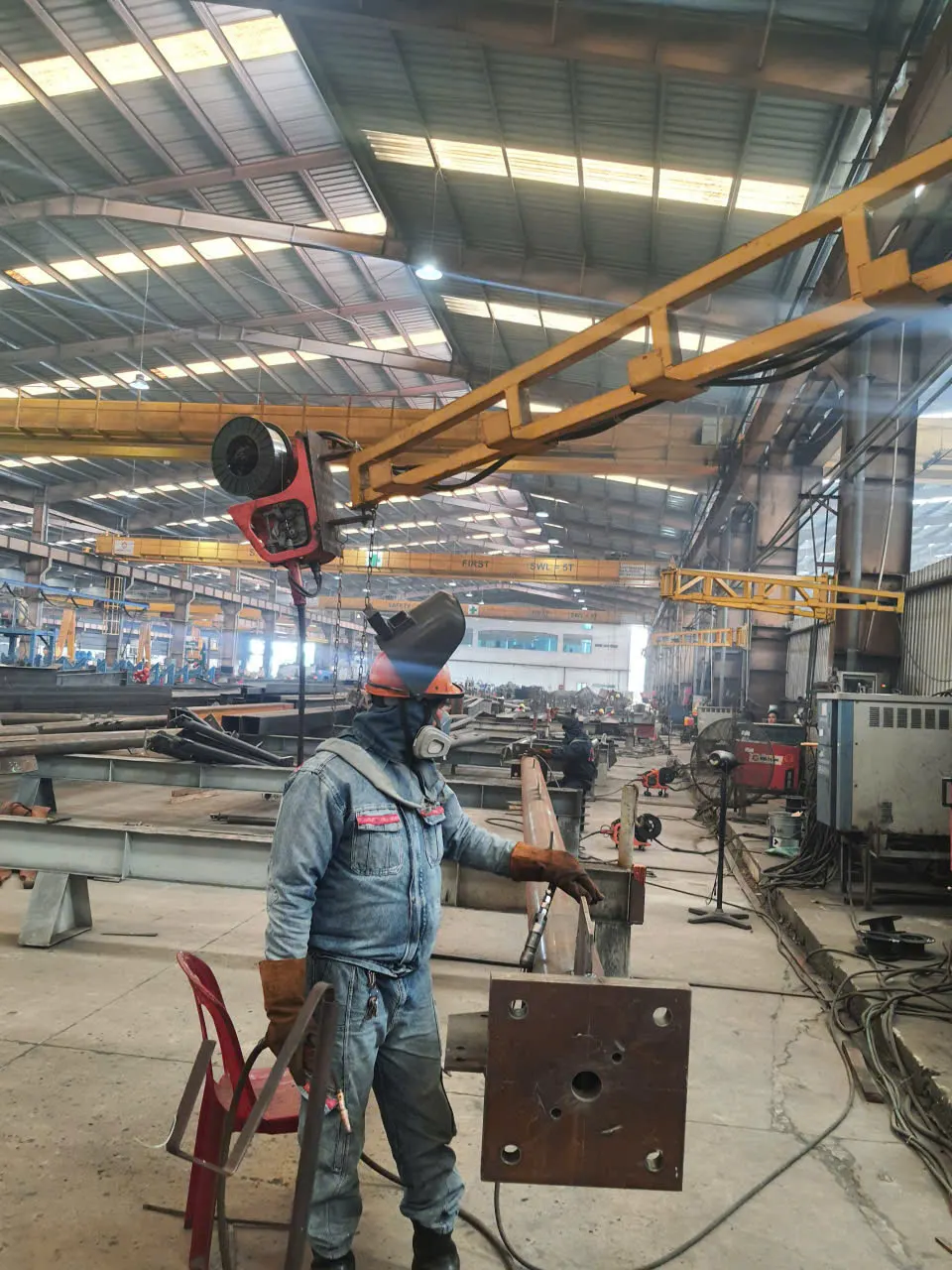
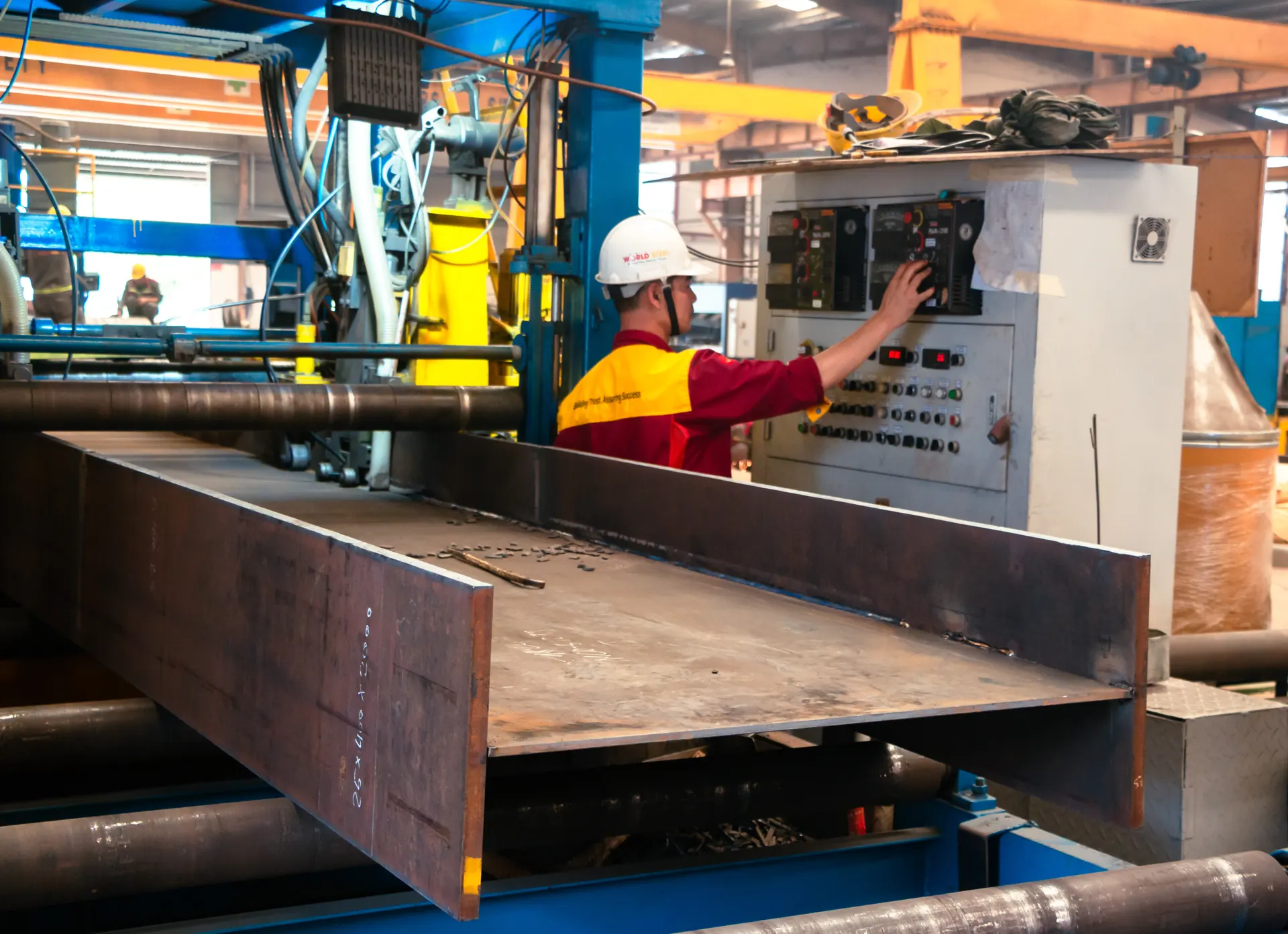
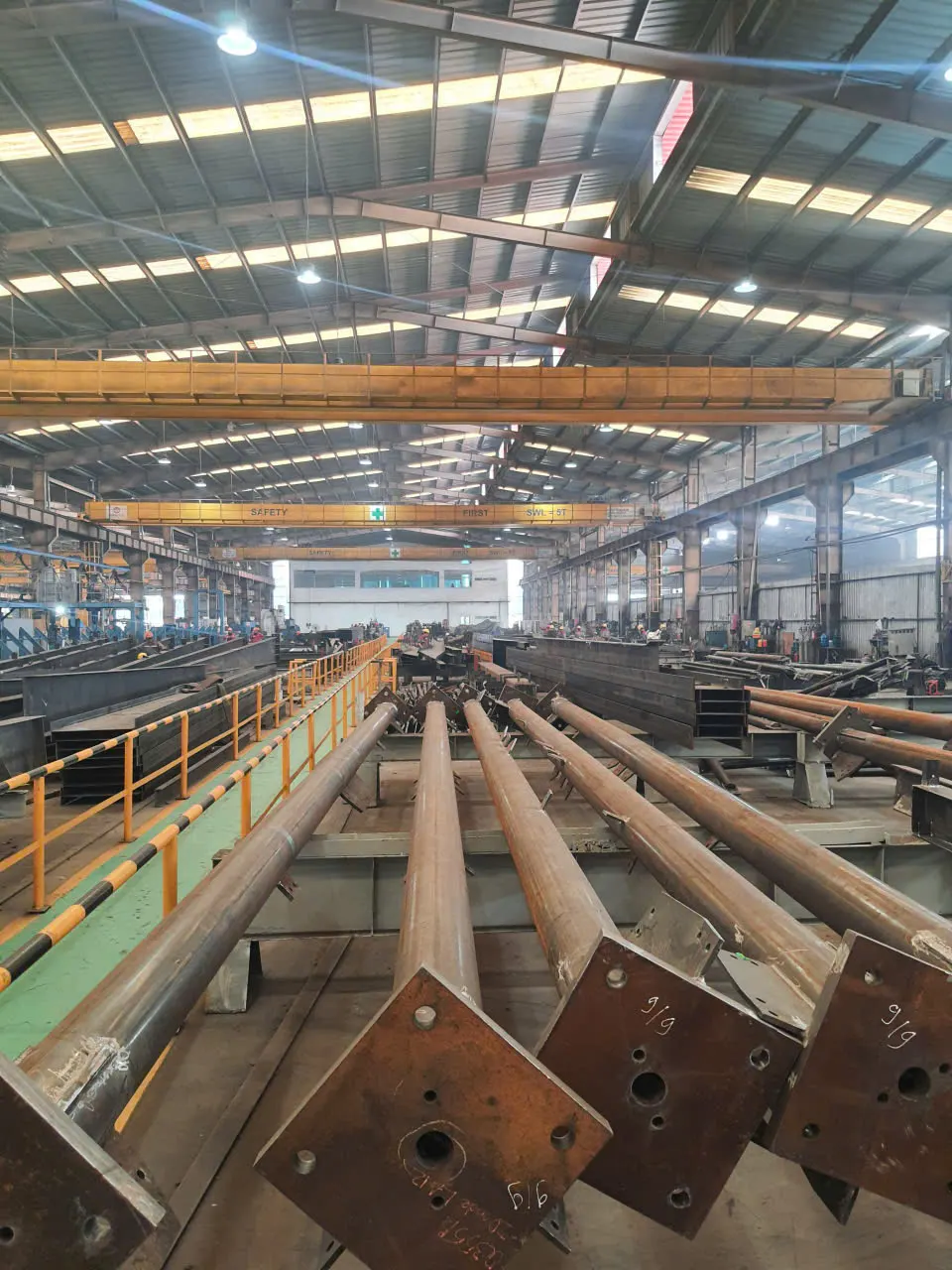
Structural steel as AISC 303 defines it, in our plant
Photographed in our own plant in Tay Ninh Province, Vietnam, and on World Steel jobs. Not stock images.

AISC 303 never works alone
The standards and guides it works with
Each link opens the full page, with its own questions and answers.
Our role under AISC 303
World Steel is the fabricator under AISC 303: it designs connections when the contract delegates them, prepares approval documents and fabricates in its own plant in Vietnam, designed to AISC 360 and fabricated under its IAS AC472 accredited program. The US contractor, our customer, is the owner's representative for construction and the erector: it sets anchor rods, erects and plumbs the frame and handles temporary bracing. Drawing approval and any seal stay with the Engineer of Record.
Who does what
World Steel designs, fabricates and supplies the steel structure from its own plant in Vietnam. The US contractor, our customer, erects it, has the drawings approved and sealed by their Engineer of Record and pulls the permit.
Details confirmed in quote Edition: AISC 303-22 current; 303-16 still cited in many specifications. The edition your contract names governs
Source record: https://www.aisc.org/publications/steel-standards/
Last checked: —. Editions change on a cycle, so your Engineer of Record confirms which one your jurisdiction enforces.
All US codes & standardsBidding structural steel under AISC 303?
Send the drawings and the specification. We return a scope sheet that sorts every item the way Section 2 does, the connection design option we will follow and the approval documents you will receive.