
Shop trial assembly
The whole span bolted together in our shop before it ships
A footbridge is often lifted in a few hours of road or rail closure. There is no time to ream a hole or shim a splice at height. So we lay the span out on our shop floor, bolt every splice, measure camber, length and bearing positions, match-mark the joints, and only then take it apart, coat it and pack it.
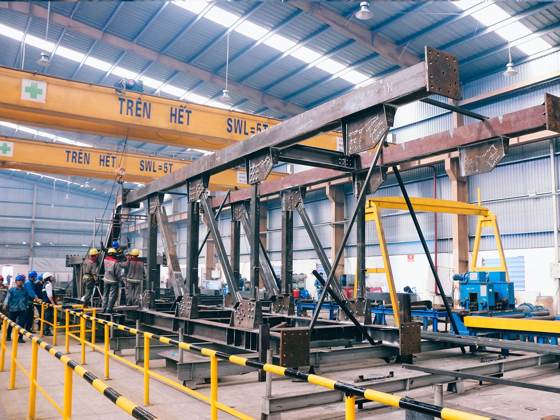
On the assembly floor
Six moves between welding and the paint hall
Supports set to camber
Chords go on levelled supports set to the cambered profile on the drawing.
Every splice bolted
Field splices are pinned and bolted with the mating plates in place.
Floor and bracing in
Floor beams, bracing and portal frames are fitted so the span is square.
Surveyed
Overall length, diagonals and bearing centres are measured and recorded.
Match-marked
Each joint gets matching marks that also appear on the erection drawing.
Taken apart
Segments are released for blasting, coating and packing in erection order.
Hold-point board
What is checked, how, and where it is recorded
Tolerances follow the approved drawings and the code your specification names.
| Check | How | Record |
|---|---|---|
| Splice hole fit | Drift pins and bolts through every field splice with the mating plates | Fit-up checklist, photo |
| Camber | Chord profile measured at panel points against the drawing | Dimensional report |
| Overall length | Bearing to bearing, along both trusses | Dimensional report |
| Squareness | Both diagonals of the deck plan compared | Dimensional report |
| Bearing positions | Centres checked against the abutment and pier drawing | Dimensional report |
| Match marks | Every joint marked before release | Erection drawing, photo |
Camber gauge
Built a little high, so it ends up level
Long members are built with an upward pre-camber so the deck settles level under its own weight. On the Guyana footbridges the general notes set span/500 for long members; on a 26 m span that is about 52 mm (2 in) at mid-span. Your designer sets the value; we build it in and measure it.
Cambered built-up members: curved and cambered members.
Your inspector
Three ways to see the span before it ships
Live by video
Your inspector follows the assembly from the US on a scheduled video walk-round.
In person
Your QA agency visits our plant for the hold point we plan into the schedule.
On record
Photos and the dimensional report go into your data book in PEB Studio.
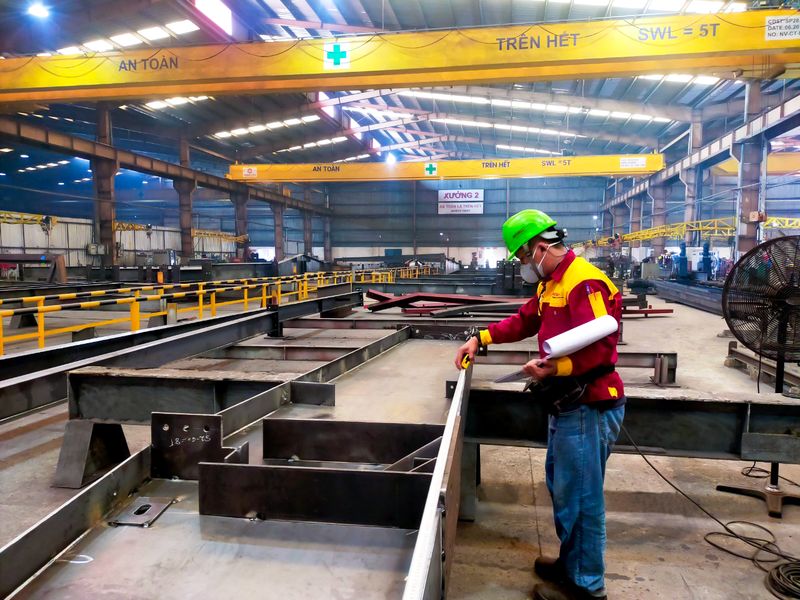
In our plant
Fit-up, splices and dimensional checks
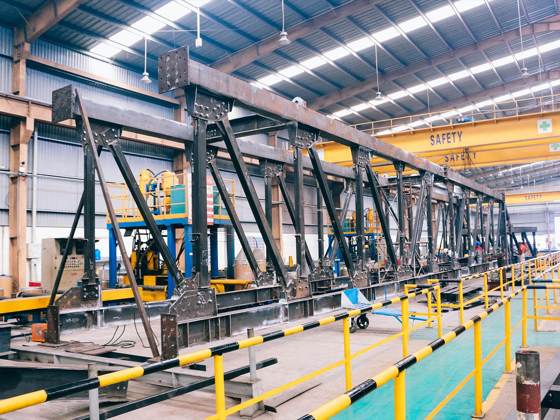
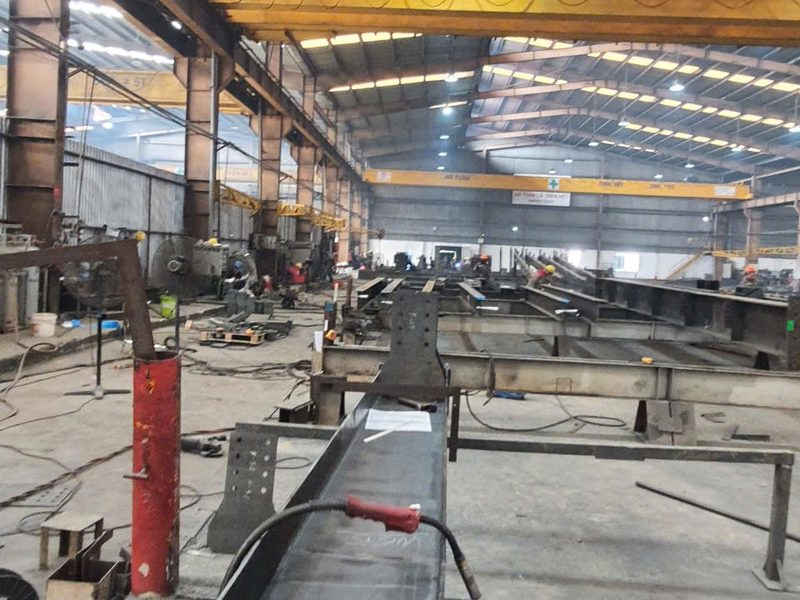
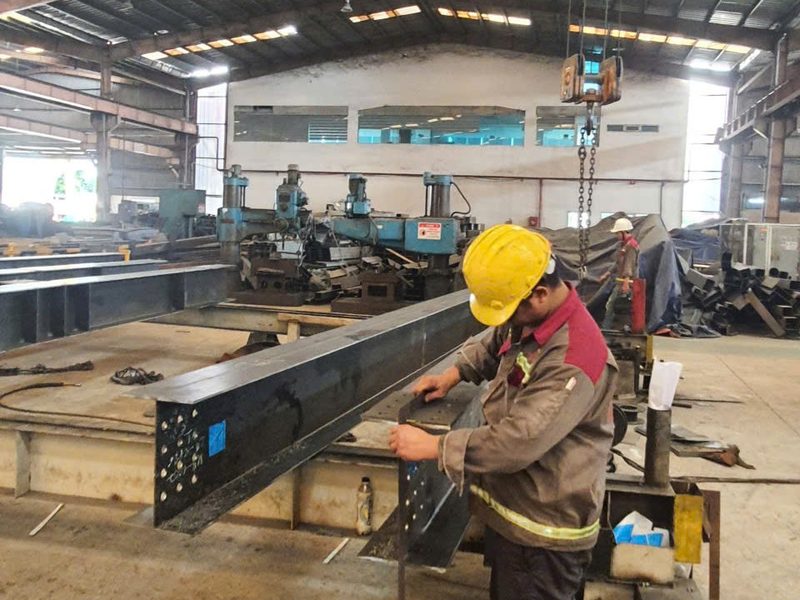
Pedestrian bridge guides
The rest of the footbridge story
Who buys footbridges and why: pedestrian bridges by market and trail and park bridges. The design code behind them: pedestrian bridge standards.
Questions
Trial assembly questions
What is shop trial assembly?
Laying out and bolting a span, or a large part of it, in the fabrication shop before shipping, to check that splices fit and that camber, length and bearing positions match the drawings.
Do you trial-assemble every footbridge?
We plan trial assembly for footbridge spans with field splices, as on the CP4 bridge in Singapore. Whether every span or a first-of-type span is assembled is agreed with you and your specification.
Is the steel painted before trial assembly?
Usually not. Spans are assembled in bare steel, then blasted and coated, so faying surfaces stay clean and fresh paint is not damaged.
Can my inspector witness it?
Yes. Trial assembly is a natural hold point. Your inspector can attend at our plant or watch live by video, and the records go into your data book.
Does trial assembly change who erects the bridge?
No. Erection stays with the US contractor, our customer. Trial assembly makes their job faster because problems are fixed in the shop.
Lifting a span in a short closure?
Send the span drawings and the closure window. We plan the trial assembly, the match marks and the segment weights around it.