
Where it sits in the US code stack
Where it governs in your building
The minimum zinc for your steel
Find the ASTM A123 coating grade for a member
The minimum zinc ASTM A123 asks for depends on two things: what kind of steel it is and how thick it is. Pick both below to see the minimum average coating thickness grade, what one specimen may drop to, and the same value in mils and grams per square metre.
| Steel thickness | under 1.6 mm(under 1/16 in) | 1.6 to under 3.2 mm(1/16 to under 1/8 in) | 3.2 to 4.8 mm(1/8 to 3/16 in) | over 4.8 to under 6.4 mm(over 3/16 to under 1/4 in) | 6.4 to under 16.0 mm(1/4 to under 5/8 in) | 16.0 mm and over(5/8 in and over) |
|---|---|---|---|---|---|---|
| Structural shapes | ||||||
| Plate | ||||||
| Strip and bar | ||||||
| Pipe and tubing |
Minimum average coating grade
Structural shapes, 6.4 to under 16.0 mm (1/4 to under 5/8 in)
100µm (3.9 mils)
- Any one specimen
- 85 µm (3.3 mils)
- Coating mass
- 705 g/m² (2.3 oz/ft²)
Wide flange beams and columns, channels, angles and welded built-up members.
Minimums from ASTM A123/A123M-13, Section 6.1 and Tables 1 and 2, for the categories of steel we fabricate. Wire and reinforcing bar have their own lines in the standard. Your specification may ask for more by agreement.
- Eta layer100 % zinc
The soft outer zinc that gives new galvanizing its bright look.
- Zeta layerabout 94 % zinc
Hard zinc-iron alloy crystals that resist abrasion.
- Delta layerabout 90 % zinc
A dense alloy layer bonded to the layer below.
- Gamma layerabout 75 % zinc
A thin layer metallurgically bonded to the steel.
16 answers from our engineers
ASTM A123 questions and answers
What engineers, coating inspectors and US contractors ask about ASTM A123 on steel fabricated in our plant: when it applies, how thick the zinc must be, how it is measured, what the finish may show, repairs, and who does the galvanizing.
When A123 applies 4 answers
What does ASTM A123 cover?
The zinc coating applied by dipping iron and steel in molten zinc: rolled, pressed and forged shapes, plate, bar, strip and castings, and fabricated assemblies such as structural steel members, welded tubes and frames. It is the specification for galvanizing structural steel after fabrication.
What is the difference between ASTM A123 and A153?
A123 covers members and assemblies. A153 covers hardware that is spun in a centrifuge after dipping to throw off excess zinc, such as bolts, nuts, washers and small castings. Threads on parts galvanized under A123 also follow A153.
Does A123 apply to galvanized sheet and purlins?
Not to sheet galvanized on a continuous line, such as roll-formed purlins and panels made from coated coil, which have their own ASTM coated-sheet specifications. It also does not apply to steel thinner than 0.76 mm (22 gage).
Should the order be placed in SI or inch-pound units?
Either, but not mixed. A123M orders use micrometres and A123 orders use coating grades in mils or oz/ft². We write the coating schedule in µm with mils in parentheses and confirm the system the specification uses.
Coating thickness 4 answers
How thick is the zinc on structural steel under ASTM A123?
For structural shapes 6.4 mm (1/4 in) and thicker the minimum average grade is 100 µm (3.9 mils). Thinner shapes need 75 µm (3.0 mils) down to 45 µm (1.8 mils). Plate, bar and tubing have their own lines in Table 1. Most real coatings come out thicker than the minimum.
Can a single reading below the minimum reject a member?
No. Section 6.1.3 says no single reading, or cluster of readings in one spot, rejects a specimen as long as the average of the dispersed readings meets the requirement. A specimen average may also be one grade below the table value.
Can we specify a heavier coating than A123 asks for?
Yes, by agreement before galvanizing. Heavier coatings may need reactive steel, abrasive blasting before dipping or trial batches, and some thicknesses cannot be reached reliably, as the standard itself warns. We confirm what is achievable for the steel on your job.
Why do some members come out thicker and dull gray?
Silicon and phosphorus in the steel speed up the zinc-iron reaction, so the alloy layers grow to the surface and leave a matte gray finish with more zinc. The galvanizer has limited control over it. It protects as well as bright zinc and is not a reason to reject.
Finish, inspection and repair 4 answers
What finish defects are grounds for rejection?
Bare areas, blisters, flux deposits, gross dross inclusions, and lumps or drips of zinc that interfere with the use of the part or make it dangerous to handle. Minor roughness, matte gray areas and roughness from the as-received steel are not.
How much bare area may be repaired instead of redipped?
Each area 25 mm (1 in) or less in its narrowest dimension, and in total no more than 0.5 % of the accessible surface of the piece or 256 cm² per metric ton of piece weight, whichever is less. Larger or inaccessible areas are redipped.
How is a galvanized coating repaired?
With one of the ASTM A780 methods: zinc-based solder, zinc-rich paint or sprayed zinc metallizing. The repair must reach the Table 1 thickness, and zinc-rich paint must go on 50 % thicker, up to 100 µm (4.0 mils).
Can our inspector check the galvanizing in Vietnam?
Yes. Section 9.2 gives the purchaser's inspector access to the galvanizing work. Your inspector or a third-party agency can measure lots at the galvanizer in person, or witness our measurements live by video, with the readings posted in PEB Studio.
Design and who galvanizes 4 answers
Who does the galvanizing on a World Steel job?
World Steel arranges it in Vietnam with a galvanizer named for your job, under World Steel's galvanizing procedure, and checks the coating against ASTM A123. The coating records go into your submittal with the rest of the steel.
Why do galvanized members need vent and drain holes?
Molten zinc has to flow into, over and out of every surface, and air and moisture trapped in a closed section can blow it apart in the kettle. ASTM A385 gives the guidance; we size and place the holes on the shop drawings for your engineer to approve.
Can galvanizing warp a welded frame?
It can, because the member is heated to about 450 °C (842 °F). ASTM A384 lists the measures: balanced and symmetric sections, similar thicknesses in one assembly, balanced welding, and temporary bracing. We plan them in detailing.
Does galvanizing make steel brittle?
Rarely for structural steel. Risk rises with severe cold work, such as tight bends or punched holes in thick steel, and with some castings. ASTM A143 gives the precautions, and embrittlement tests are only run when there is strong evidence of it.
More answers on every US code we design to: search all standards questions.
Sampling a lot
How many pieces of a lot are measured
Unless the order sets its own sampling plan, Section 7.3 picks the test articles at random from each lot. A lot is one order or one delivery load, galvanized in the same bath and shift.
| Pieces in the lot | Test articles measured | What it means on a steel job |
|---|---|---|
| 3 or fewer | All of them | Heavy girders or columns shipped a few at a time are all measured. |
| 4 to 500 | 3 | A typical bundle of rafters, purlins or bracing. |
| 501 to 1,200 | 5 | A full load of secondary steel or connection plates. |
| 1,201 to 3,200 | 8 | Large orders of small parts such as clips and gussets. |
| 3,201 to 10,000 | 13 | Repetitive pieces on large industrial jobs. |
| 10,001 and over | 20 | Very large runs; a statistical plan to ASTM B602 can be agreed instead. |
What ASTM A123 checks
Four properties every galvanized lot must show
Section 6 sets four coating properties. Thickness is measured; the other three are judged by eye and by a simple knife test.
Coating thickness
The average of at least five gauge readings per specimen, compared with the minimum grade for the steel category and thickness. Each specimen may be one grade lower, the article average may not.
Finish
Continuous, and as smooth and even as the shape and the dipping allow. Roughness that comes from steel chemistry or the as-received surface is not a reason to reject.
Appearance
No bare areas, blisters, flux deposits or gross dross inclusions when the steel leaves the galvanizer, and plain holes of 12.5 mm (1/2 in) or more clean of excess zinc.
Adherence
The zinc must stand normal handling without peeling or flaking. Where agreed, a stout knife pried into the coating checks that it does not lift off in a layer.
From lot to accepted
How a galvanized lot is measured and accepted
-
Define the lot
One order or one delivery load, galvanized in the same bath within one shift, unless the order says otherwise.
-
Pick test articles
At random, without regard to how pieces look, in the numbers Section 7.3 sets for the lot size.
-
Split into specimens
A piece larger than 100,000 mm² (160 sq in) is split into three equal specimens; one with several thicknesses or categories gets one specimen for each.
-
Read the gauge
At least five magnetic gauge readings spread across each specimen, away from flame-cut edges, threads and machined faces.
-
Average and compare
Specimen averages may be one grade below the table value; the average for the article, or for the sample of small parts, must meet it.
-
Accept, repair or redip
Bare spots inside the repair limits are repaired to ASTM A780; anything outside them, or a failed retest, is stripped and galvanized again.
Before the steel is dipped
What goes on a galvanizing order under ASTM A123
- Quantity and total weight of the pieces to be galvanized
- Description of the pieces, their sizes and weights
- The specification designation and its year, for example A123/A123M-13
- Steel grade and surface condition, including paint, markings or contamination
- Any sampling plan or special tests that differ from the standard
- Heavier coating, special stacking or tagging and piece-mark identification
Who does what under ASTM A123
Four hand-offs between the drawing and a galvanized member on site
ASTM A123 puts the design and fabrication for the kettle on the designer and the fabricator (Section 5.2) and the coating on the galvanizer (Section 9.1). On a World Steel job the work passes through four sets of hands.
-
Engineer of Record and US contractor
- Name ASTM A123 and its year in the coating section
- Mark which members are galvanized, painted or both
- Set any heavier coating, special tests or sampling plan
-
World Steel plant
- Details vent and drain holes and galvanizing-friendly joints to ASTM A385 and A384
- Lists the steel grades and surface condition for the galvanizer
- Fabricates, cleans weld slag and marks every piece for the kettle
-
Galvanizer named for the job
- Galvanizes under World Steel's galvanizing procedure, bath of at least 98.0 % zinc
- Runs the in-plant inspection Section 9.1 requires
- Repairs small bare spots to ASTM A780 or redips
-
Inspector, then the US contractor
- Your inspector measures and accepts the lot, in Vietnam or by video
- The US contractor, our customer, erects the steel
- Field damage is repaired to ASTM A780 with the procedure we send
Galvanizing on review
Five galvanizing checks a reviewer makes, and the record that answers each
Most galvanizing comments come from a submittal that says "galvanized" and nothing more. Ours names the specification, the grade and the proof.
| The reviewer checks | Where it comes from | What our package shows |
|---|---|---|
| Which specification and year governs the coating? | ASTM A123 Section 4.1.3 | The coating schedule names ASTM A123 and its year for members, and ASTM A153 for hardware. |
| Is the coating thickness grade right for each member? | ASTM A123 Section 6.1, Table 1 | Each member type is listed with its material category, steel thickness and minimum average grade in µm. |
| Can the steel be galvanized safely and fully? | ASTM A385, A384 and A143 | Shop drawings show vent and drain holes, closed sections and joint details agreed for the kettle. |
| How was thickness measured and sampled? | ASTM A123 Sections 7 and 8.2, ASTM E376 | Lot, test articles and at least five magnetic gauge readings per specimen, by piece mark. |
| How are bare spots repaired? | ASTM A123 Section 6.2, ASTM A780 | Repair records state the size of each area, the method used and the thickness of the repair. |
In your submittal file
Four galvanizing records that travel with the steel
Issued as the galvanized members are released, posted in PEB Studio and bound into the handover file.
-
Coating schedule
Members to be galvanized with their material category, steel thickness and ASTM A123 grade.
Hot-dip galvanizing -
Thickness readings
Lot, test articles and gauge readings per specimen, with the averages against Table 1.
Coating inspection -
Repair record
Each renovated area, its size, the ASTM A780 method and the repair thickness.
Maintenance planning -
Certificate of conformance
The Section 10 statement that each lot was inspected and met the specification.
Handover documents
In-depth articles
Hot-dip galvanizing under ASTM A123, from the spec to the site
Sixteen in-depth articles that follow a galvanized member from the coating specification, through design for the kettle and the dip itself, to the thickness gauge, the repair rules and the jobsite. Each one explains a part of ASTM A123 in plain terms and lists what to check.
What A123 covers, what goes on the order, and the steel and zinc chemistry behind the coating.
Vent and drain holes, distortion, embrittlement and welded assemblies.
The hot-dip process step by step and the zinc-iron layers it grows.
Coating grades by steel, how the zinc is measured and how a lot is sampled.
What the finish may show, A780 repairs, inspection and retest, and storage on the way to the job.
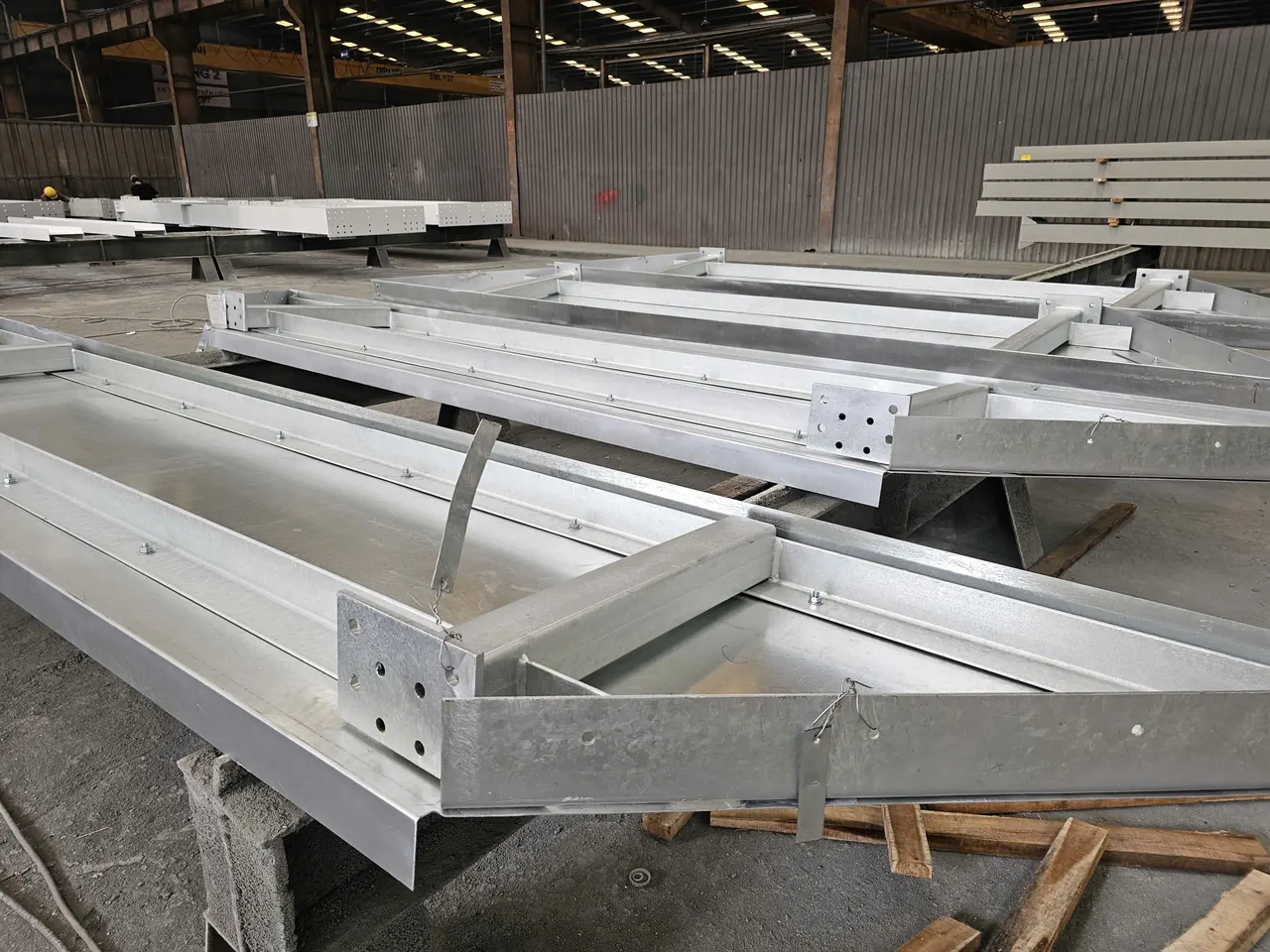
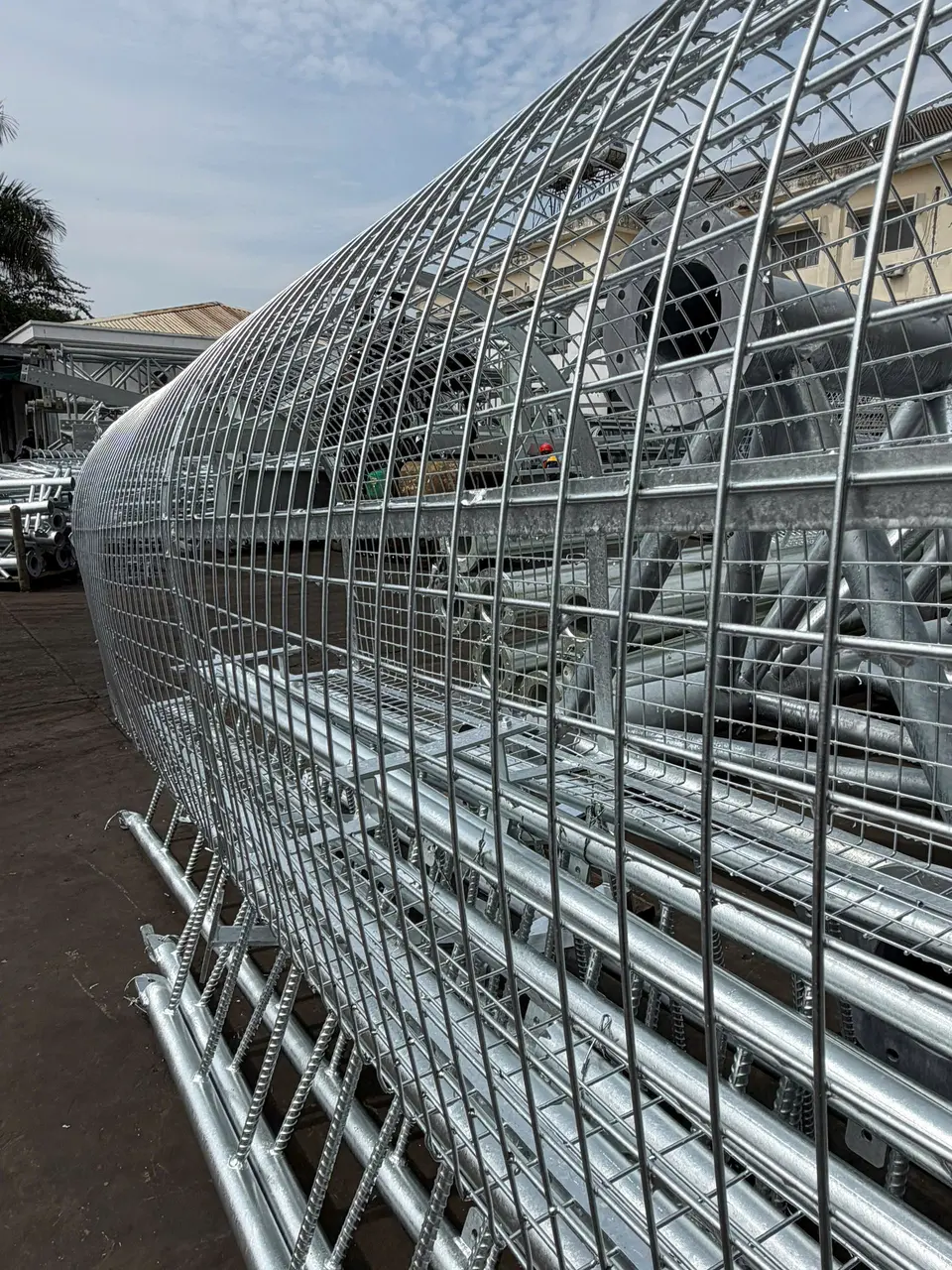
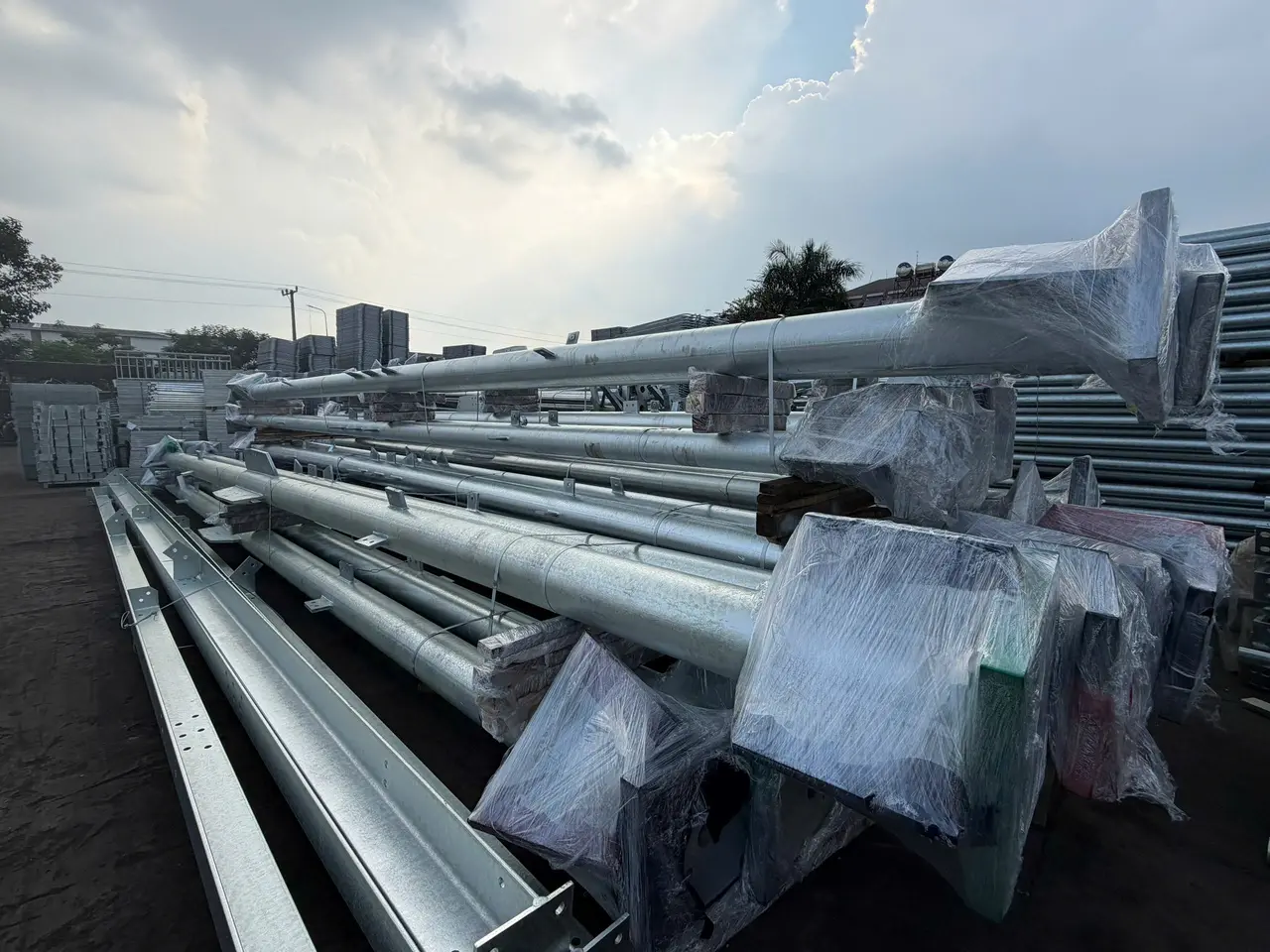
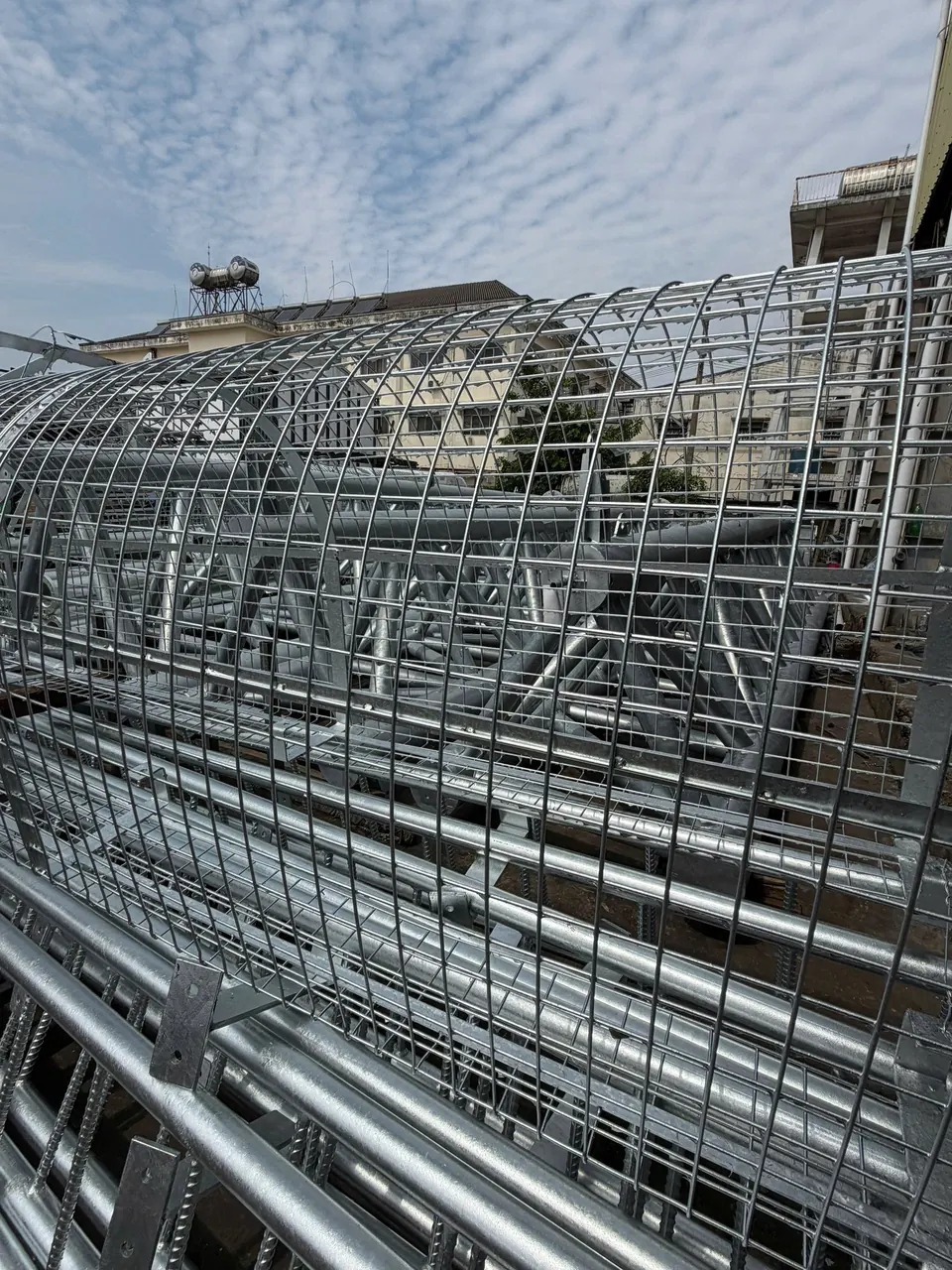
Real photos from World Steel
Galvanized members from World Steel jobs
Photographed in our own plant in Tay Ninh Province, Vietnam, and on World Steel jobs. Not stock images.
ASTM A123 never works alone
The standards and guides it works with
Each link opens the full page, with its own questions and answers.
Who galvanizes
World Steel designs and fabricates the steel in its own plant in Vietnam and arranges the hot-dip galvanizing in Vietnam with a galvanizer named for your job, under World Steel's galvanizing procedure. It does not claim its own galvanizing kettle. The coating is checked against ASTM A123 by piece mark, and your inspector or a third-party agency can witness the measurements.
Who does what
World Steel designs, fabricates and supplies the steel structure from its own plant in Vietnam. The US contractor, our customer, erects it, has the drawings approved and sealed by their Engineer of Record and pulls the permit.
Details confirmed in quote Edition: A123/A123M-13 reviewed here; the edition your specification names governs
Source record: https://www.astm.org/a0123_a0123m-13.html
Last checked: —. Editions change on a cycle, so your Engineer of Record confirms which one your jurisdiction enforces.
All US codes & standardsSpecifying galvanized steel for a US job?
Send the drawings and the coating section. We return the members to be galvanized with their ASTM A123 coating grade, the vent and drain holes we will add, and the checks your inspector can witness.