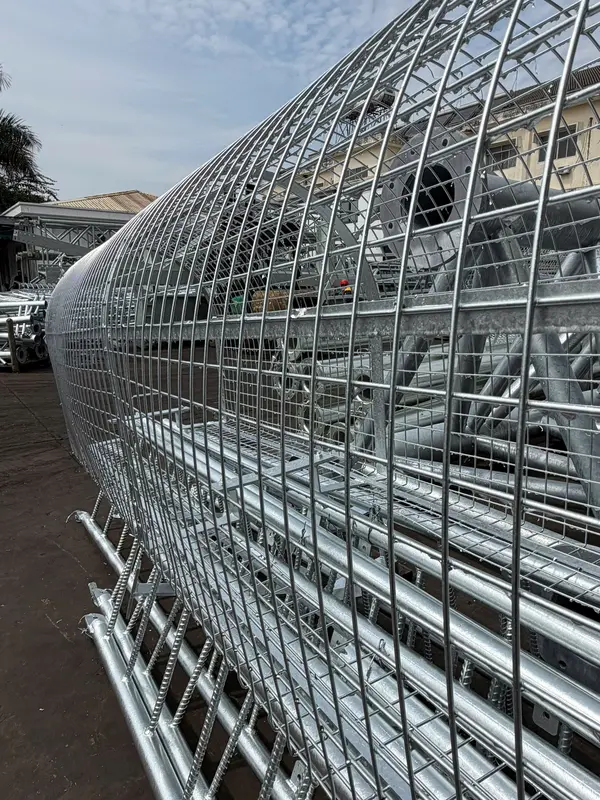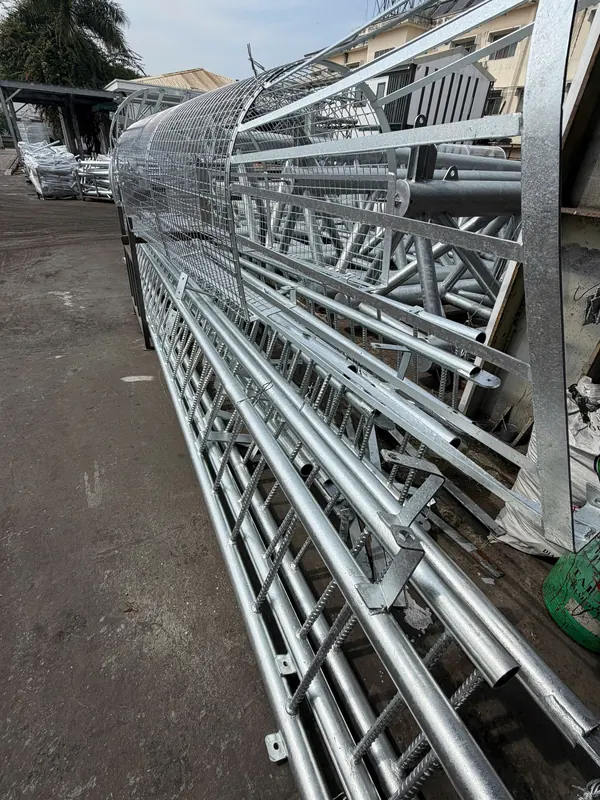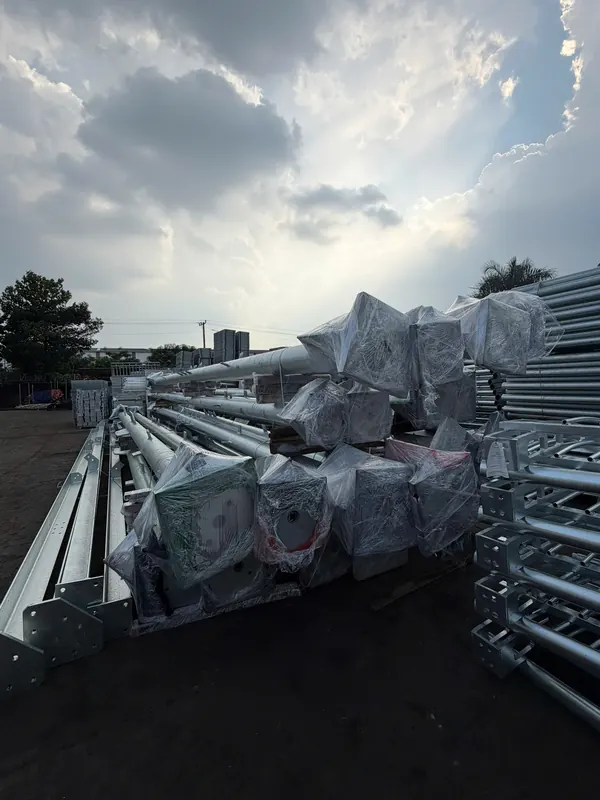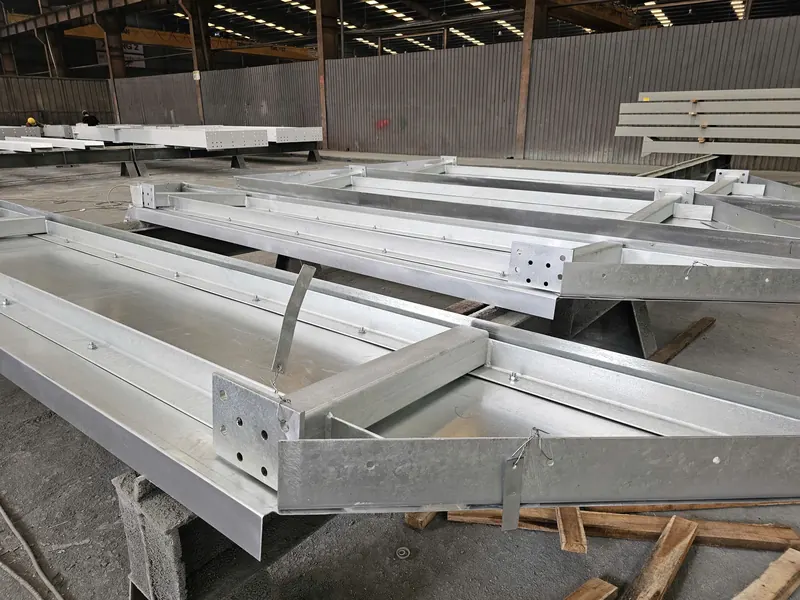
Every galvanizer has a story about a sealed tube that exploded in the kettle. A closed section holds air, and often a little moisture from the pickling and flux tanks. Lowered into zinc at about 450 °C (842 °F), that air expands and the moisture flashes to steam. At best the section balloons or splits; at worst it bursts and throws molten zinc across the floor. Even when nothing breaks, a section that cannot vent will not let zinc in, and one that cannot drain comes out full of zinc it was never meant to carry.
Vent and drain holes solve both problems. This article explains where they go, what ASTM A123 says about who places them, and how we draw them on shop drawings for US projects.
Why it is the fabricator's job
ASTM A123 judges the coating; it does not design the steel. Section 5.2 puts the design and fabrication of the product to be galvanized on the designer and the fabricator. It names three practices, ASTM A143 on embrittlement, ASTM A384 on warpage and distortion, and ASTM A385 on providing high-quality zinc coatings, and says they shall be complied with in both design and fabrication. It adds that consultation between the designer, fabricator and galvanizer at the right stages will reduce future problems.
Section 6.2 closes the loop: surface conditions that come from deficiencies in design, detailing or fabrication, as addressed by A385, are not grounds for rejecting the coating. In other words, if the zinc could not reach a surface because the steel had no way in, the galvanizer has not failed A123. The fix is on the drawing board.
The four jobs a hole has to do
A hole in a galvanized member does at least one of four jobs:
- Let air out as the member is lowered, so the inside can fill.
- Let liquids in: degreaser, pickling acid, rinse water, flux and then zinc must reach every inside surface.
- Let zinc drain as the member is lifted, so excess zinc runs back into the kettle.
- Let the piece hang: a lifting or hanging point so the galvanizer can dip the member at an angle.
Holes that do the first two jobs are vent holes and sit at the high point as the member enters the bath. Holes that do the third are drain holes and sit at the low point as it comes out. A member is usually dipped at an angle, so the same holes often swap roles at the two ends.
Hollow sections
Hollow structural sections, pipe columns and boxed members need holes at both ends, as close to the corners or the wall as possible, so nothing is trapped:
- Open ends are best, where the design allows.
- End plates and cap plates need holes through the plate, or holes in the section wall right next to the plate.
- Base plates on columns need holes in the column wall near the plate, or a hole through the plate inside the column footprint.
- Internal diaphragms need their own holes or cut corners, so each cell connects to the next.
Hole size depends on the size of the section. ASTM A385 and galvanizer guidance size the holes as a share of the inside cross-section, with larger sections needing larger holes; small tubes are often left open-ended instead. Holes that are too small slow the drainage, cool the zinc inside and can leave lumps or a thick, uneven coating. We size them to the guidance for each section and show them on the shop drawings for the Engineer of Record to approve, because holes in a structural member are a structural decision.
Stiffeners, gussets and end plates on open sections
Open sections such as wide flanges and channels are easy to coat on their own. They get pockets as soon as stiffeners, end plates or gussets close off part of the web:
- Clip the corners of stiffeners, gussets and continuity plates where they meet the web and flange, so zinc can pass and air cannot be trapped at the top of the pocket.
- Add a hole near the web where an end plate or bearing plate closes a channel or the end of a beam.
- Watch shallow pockets in base plate and cap plate details, where zinc can pool if the member is dipped flat.
The corner clip also helps welding: it keeps the stiffener weld away from the root of the flange-to-web fillet, which is better practice whether or not the member is galvanized.
Lapped and overlapping plates
Two plates welded flat against each other trap a thin gap. The pickling acid and flux get in, but the zinc does not, and the trapped liquids can weep out later as rust streaks or bloom through the coating.
There are three ways to deal with laps:
- Seal-weld small laps all round, so nothing gets in.
- Vent large laps with a hole through one plate, so the gap can breathe and drain; galvanizers give an area above which a seal weld alone is risky because the trapped air expands.
- Avoid the lap by redesigning the joint, for example with a butt joint or a bolted splice after galvanizing.
The same thinking applies to back-to-back angles and double channels: leave a gap wide enough for zinc to enter, or seal and vent.
Inaccessible surfaces
Note 5 of ASTM A123 defines inaccessible surfaces as those that cannot be reached for surface preparation and application of repair materials under ASTM A780, and gives the internal surfaces of certain tanks, poles, pipes and tubes as examples. Section 6.2.4 says that when areas needing repair are inaccessible, the coating is rejected.
That is why venting matters so much on hollow sections: an uncoated patch inside a tube cannot be touched up, so the piece has to be stripped and galvanized again. Good holes are the cheapest way to avoid it.
Hanging, lifting and the size of the kettle
Galvanizers hang members from a dipping beam or jig with wire, chain or hooks. Two things follow:
- Hanging points. Holes or lugs at the ends of long members let the galvanizer dip them at an angle, so zinc drains to one end. On our jobs, long members of 2,200 mm (7 ft 3 in) and more are hung at 25 to 35 degrees.
- Kettle limits. Every galvanizer has a kettle of fixed length, width and depth. A member longer or deeper than the kettle can sometimes be dipped one end at a time, called progressive or double dipping, but that leaves an overlap band and adds distortion risk. It is better to check the kettle before the member is detailed and splice long members where needed.
Holes and the look of exposed steel
On architecturally exposed steel the owner may not want visible holes. Options include placing holes on faces that will not be seen, using open ends hidden by later cladding, and closing holes after galvanizing with galvanized or plastic plugs. Holes should never be plugged before dipping.
Mistakes caught at receiving
The galvanizer's receiving check is the last chance to catch a detailing problem before the steel is in the acid. The ones we see most often are:
- A hole on one end only of a hollow member, so it can fill but not drain, or drain but not vent.
- Holes placed mid-face instead of at the corners, leaving a pocket of zinc or air at each end.
- A cap plate welded on after the holes were drilled, closing the hole it was meant to serve.
- Stiffeners without clipped corners, leaving a closed pocket at the root of the flange.
- Laps welded on three sides, which trap acid in the open side.
Each of these can be fixed in the shop before galvanizing. After galvanizing, the fix is stripping and redipping.
A checklist for galvanized shop drawings
Before a galvanized member goes for approval, check:
- Every hollow section has vent and drain holes at both ends, close to the walls.
- Every internal diaphragm or cell has its own path for air and zinc.
- Stiffeners, gussets and continuity plates have clipped corners.
- Laps are seal-welded and vented, or avoided.
- Hanging points are shown on long or heavy members.
- The member fits the galvanizer's kettle, or a splice is planned.
- Threads, faying surfaces and field-weld zones to be masked are marked.
- Holes in structural members are approved by the Engineer of Record.
How World Steel details steel for the kettle
On galvanized jobs our detailers add the vent, drain and hanging holes to the shop drawings following ASTM A385 practice, so you see them when you approve the drawings and nothing extra is needed from your design team. Shop drawings are supported on every project at no extra cost, and the holes, clipped corners and seal welds are checked at receiving by the galvanizer before the steel is hung, under World Steel's written galvanizing procedure.
World Steel fabricates up to 2,500 metric tons of structural steel a month in its own IAS AC472-accredited plant in Vietnam, including welded box and built-up members where venting matters most. Galvanizing is arranged in Vietnam with a galvanizer named for the job, and the coating results travel with the steel.
The next design topic is distortion, in galvanizing warpage and ASTM A384. For the full standard at a glance, see our ASTM A123 page.
Quick answers
Why do galvanized hollow sections need vent holes?
Cleaning solutions and molten zinc must flow into and out of the inside, and any trapped air or moisture expands violently at about 450 °C (842 °F). A sealed section can burst in the kettle, and a section without drain holes fills with zinc it cannot drain.
Who is responsible for vent and drain holes under ASTM A123?
Section 5.2 makes the design and fabrication of the product the responsibility of the designer and the fabricator, who must follow ASTM A143, A384 and A385. The galvanizer should be consulted at the right stage.
Should vent holes be plugged after galvanizing?
On exposed members they can be closed with galvanized or plastic plugs if the owner wants a clean look or to keep water out, but only after galvanizing. Plugging before dipping defeats the purpose.
Do stiffeners need clipped corners?
Yes. Stiffeners, gussets and end plates that close off a corner should have their corners cut, so zinc and air can pass and the zinc drains out of the pocket.
Keep building your steel plan
Go further on USPEB.com
On this topic
Across the US market
- Steel fire protectionIntumescent and fire-rated steel packages
- Quality hubCoating inspection by FROSIO Level III inspectors
- Products catalogGalvanized, painted and built-up members
- Download centerSample ITP, design report and approval drawings
- Large projects, 2,500 t a monthCapacity for large US general contractors
- Contractor partnershipLong-term supply for US contractors