"Hot-dip galvanize to ASTM A123" is one of the most common lines in a US structural steel specification. It is also one of the least read. The ASTM A123 specification is only eight pages long, but those pages decide how thick the zinc must be, what a coating inspector may reject, how many pieces are measured and how much bare area may be repaired. This first article in our series explains what the document covers, what it leaves to other standards, and how to use it when the steel is fabricated and galvanized far from the jobsite.
The edition reviewed in this series is ASTM A123/A123M-13. Editions are revised on a cycle, so the edition your project specification names is the one that governs, and the standard itself, bought from ASTM International, is the final word. What follows is our plain-language reading, with the section numbers so you can check each point.
What ASTM A123 is for
Section 1.1 states the purpose: the requirements for a zinc coating applied by the hot-dip process to iron and steel products made from rolled, pressed and forged shapes, castings, plates, bars and strips. In plain terms, A123 is the specification for steel that is dipped in a bath of molten zinc after it has been cut, drilled and welded.
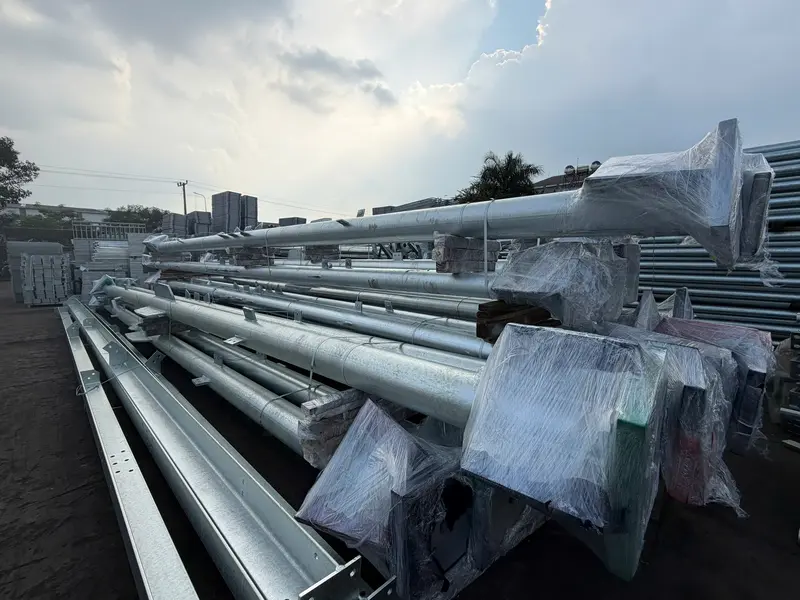
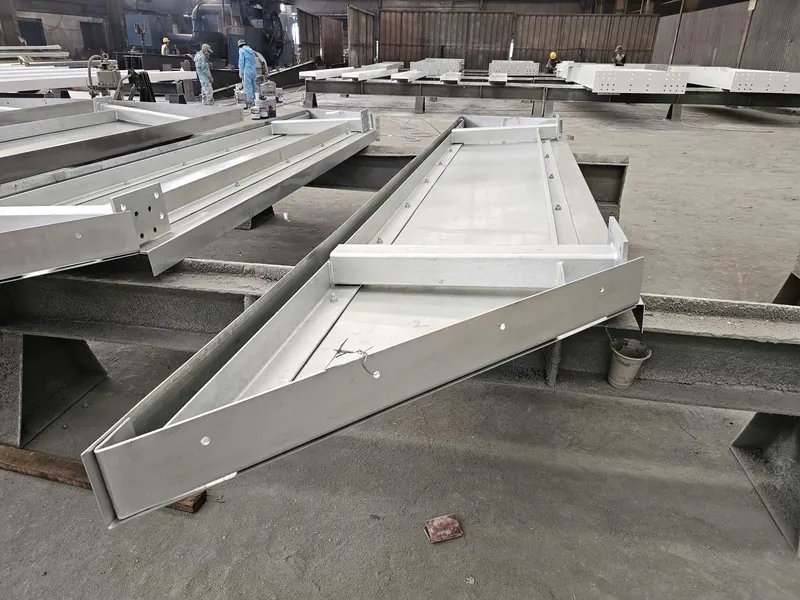
Section 1.2 makes the important point for structural work: the specification covers both unfabricated products and fabricated products. Its own examples include assembled steel products, structural steel fabrications, large tubes already bent or welded before galvanizing, and wire work made from uncoated wire. Steel forgings and iron castings that are part of a fabricated piece, or that are too large to spin in a centrifuge, are covered too.
That is why A123 is the default for:
- Primary frames: columns, rafters, moment frame beams and welded built-up members.
- Secondary framing made from hot-rolled or welded sections: bracing, struts, girts made from angles or channels, and stair stringers.
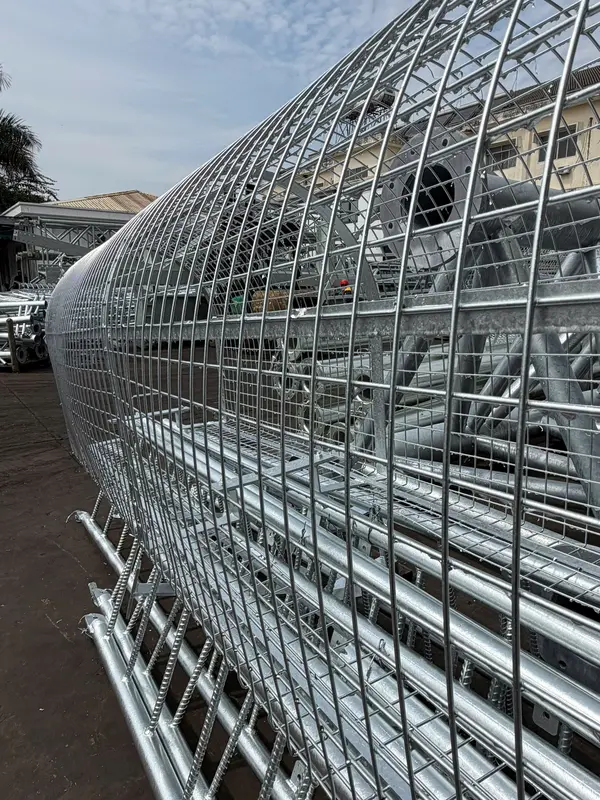
- Assemblies: platforms, handrail panels, ladders with cages, canopy frames and equipment supports.
- Plate parts: base plates, gussets, stiffeners and connection plates, whether loose or welded on.
What it leaves to other standards
The scope is just as useful for what it excludes. Three clauses send work elsewhere.
Hardware goes to A153. Section 1.4 sends hardware that is centrifuged, or otherwise handled to throw off excess zinc, to ASTM A153. Bolts, nuts, washers, small castings and threaded rods are the usual examples. Section 6.3 also says the zinc on threaded parts of an A123 assembly must meet A153, which matters for anchor rod assemblies and welded studs.
Continuous-line products are excluded. Section 1.3 excludes wire, pipe, tube and steel sheet galvanized on specialized or continuous lines, and any steel thinner than 0.76 mm (22 gage). Roll-formed purlins, girts and panels made from pre-galvanized coil therefore follow the coated-sheet specifications, not A123. On a metal building that splits the coating schedule in two, and it should say so.
Separate rebar goes to A767. Section 1.5 keeps fabricated reinforcing bar assemblies inside A123 but sends separate reinforcing bars to ASTM A767.
| Product on a steel job | Coating specification |
|---|---|
| Columns, beams, rafters, built-up members | ASTM A123 |
| Bracing, platforms, stairs, handrail panels | ASTM A123 |
| Bolts, nuts, washers, threaded rods | ASTM A153 |
| Purlins and panels roll-formed from coated coil | ASTM coated-sheet specification |
| Separate reinforcing bars | ASTM A767 |
The documents A123 leans on
Section 2 lists the referenced documents. A handful of them do much of the real work on a structural job, because A123 itself only judges the coating, not whether the steel was designed for the kettle:
- ASTM A385 gives the practice for providing high-quality zinc coatings: venting and draining, steel selection, avoiding closed sections, cleaning welds. Section 5.2 of A123 says it must be complied with in design and fabrication.
- ASTM A384 gives the practice for safeguarding against warpage and distortion of assemblies during galvanizing.
- ASTM A143 gives the practice for safeguarding against embrittlement, and the test used if embrittlement is suspected.
- ASTM A780 gives the methods for repairing damaged and uncoated areas.
- ASTM E376 covers measuring coating thickness with magnetic gauges, the method used on almost every structural piece.
- ASTM B6 and B960 specify the zinc that feeds the bath.
- ASTM A90, B487 and B602 cover weighing coatings, microscopic measurement and statistical sampling.
Later articles in this series take these one at a time. The point for now is that a specification that only says "ASTM A123" has silently adopted all of them.
Inch-pound or SI
Section 1.6 explains the two unit systems. An order placed as A123 uses inch-pound units, and an order placed as A123M uses SI units. They are not exact equivalents, and each system is used on its own without mixing values. When an order is placed in SI units, the testing and inspection must also use the metric version of the method, and the galvanizer must be told when the order is placed.
In practice:
- Under A123M, coating thickness is read directly in micrometres (µm).
- Under A123, the measured value is converted to a coating grade using Table 2, where a grade such as 100 corresponds to 100 µm, about 3.9 mils, about 2.3 oz/ft² or 705 g/m².
We write coating schedules in µm with mils in parentheses, for example "100 µm (3.9 mils)", and confirm in writing which system the project specification uses. On US jobs the specification often names A123/A123M as a pair; the coating grade numbers make the two easy to read side by side.
The terms that matter
Section 3 defines a short list of terms. Five of them come up on every inspection:
- Black means not galvanized or otherwise coated. It describes condition, not color: "black steel" is steel before it reaches the kettle.
- Material category is the general class of material, such as structural shapes, plate, strip and bar, or pipe and tubing. Bar grating counts as strip; handrail counts as pipe.
- Specimen is the surface on which thickness readings are taken. A small piece is one specimen; a large piece is three.
- Test article is one piece chosen from the lot to be examined.
- Coating thickness grade is the number from Table 1 for a given material category and steel thickness.
Getting these words right avoids most arguments. A coating inspector who calls a whole column a specimen will sample differently from one who splits it into three, and the result can swing from accept to reject.
What the specification controls
Read in order, A123 covers six things:
- Ordering information (Section 4): what the purchaser must tell the galvanizer.
- Materials and manufacture (Section 5): the steel, the design and fabrication, castings, the zinc and the bath.
- Coating properties (Section 6): thickness, finish, threads, appearance and adherence.
- Sampling (Section 7): what a lot is and how many pieces are tested.
- Test methods (Section 8): thickness by gauge, stripping, weighing or microscope, plus adhesion and embrittlement.
- Inspection, rejection, retest and certification (Sections 9 and 10).
There is no clause on coating life. A123 sets a minimum coating, not a number of years. How long the zinc lasts depends on the environment, which is why US engineers often pair A123 with an ISO 12944 corrosivity category for the site.
Who is responsible for what
A123 assigns responsibility in a way that matters when the fabricator and the galvanizer are different companies.
- Section 5.1 puts the steel identification on the purchaser: the grade and the surface condition must be given to the galvanizer before galvanizing.
- Section 5.2 puts design and fabrication for galvanizing on the designer and the fabricator, and recommends that designer, fabricator and galvanizer talk at the right stages.
- Section 9.1 puts compliance of the coating on the galvanizer, through an in-plant inspection program.
- Section 9.2 gives the purchaser's inspector access to the galvanizer's plant while the work is done.
On a World Steel job, our plant designs and fabricates the steel and arranges the galvanizing in Vietnam with a galvanizer named for the job, under our own written galvanizing procedure. That puts the design for the kettle, the steel identification and the coating check in one chain of records, instead of three companies each holding part of the story.
How to write the A123 line in your specification
A one-line reference leaves a lot to chance. A better coating section for galvanized structural steel states:
- The specification and year, for example ASTM A123/A123M-13, and ASTM A153 for hardware.
- Which members are galvanized, which are painted and which are duplex.
- Any coating heavier than the Table 1 minimum, agreed before dipping.
- Whether the purchaser wants certification under Section 10 and a report of test results.
- Who inspects: the galvanizer's inspector, the purchaser's inspector or an independent agency.
- Repairs: ASTM A780, with any limits tighter than A123.
The second article in this series, what goes on a galvanizing order, goes through Section 4 line by line.
Galvanizing on large US projects
Galvanized steel is common on coastal plants, agricultural buildings, water and wastewater structures, pedestrian bridges and transmission and telecom towers. On those jobs the tonnage can be large and the schedule tight. World Steel fabricates up to 2,500 metric tons a month in its own plant in Vietnam, an IAS AC472-accredited fabricator, and plans galvanizing as part of the fabrication sequence, so members reach the kettle in the order they will be shipped and erected.
For each project we return a coating schedule listing every galvanized member type with its ASTM A123 material category, steel thickness and minimum coating grade, and we add the vent, drain and hanging holes to the shop drawings for the Engineer of Record to approve. The readings and the certificate of conformance travel with the steel in PEB Studio. The design and fabrication rules behind those holes are covered in vent and drain holes for galvanizing.
Read the full standard summary on our ASTM A123 page, and see how the coating is applied, step by step, on our hot-dip galvanizing page.
Quick answers
What is the ASTM A123 specification?
The ASTM International specification for zinc coatings applied by the hot-dip process to iron and steel products, both single pieces and fabricated assemblies such as structural steel members. It sets coating thickness, finish, appearance, adherence, sampling, test methods, inspection and certification.
Is ASTM A123 the right standard for bolts?
No. Bolts, nuts, washers and other hardware that is spun in a centrifuge after dipping are galvanized to ASTM A153. Threads on parts galvanized under A123 also follow A153.
Does A123 cover galvanized purlins and roof panels?
Not when they are roll-formed from coil galvanized on a continuous line; those follow the ASTM coated-sheet specifications. A123 also excludes steel thinner than 0.76 mm (22 gage).
What is the difference between A123 and A123M?
The same specification in two unit systems. A123 orders use inch-pound units and A123M orders use SI units. The two are not mixed on one order.
Keep building your steel plan
Go further on USPEB.com
On this topic
Across the US market
- Steel fire protectionIntumescent and fire-rated steel packages
- Quality hubCoating inspection by FROSIO Level III inspectors
- Products catalogGalvanized, painted and built-up members
- Download centerSample ITP, design report and approval drawings
- Contractor partnershipLong-term supply for US contractors
- Solutions by stateState-by-state steel solutions