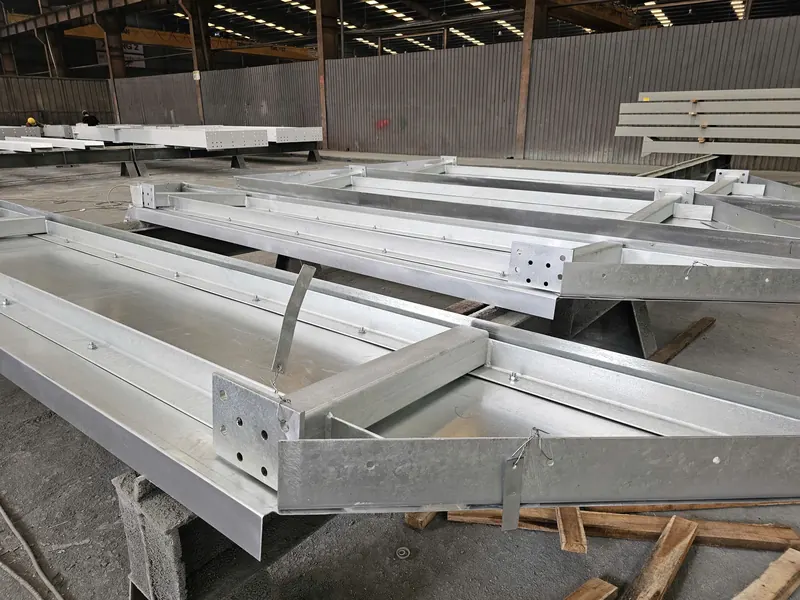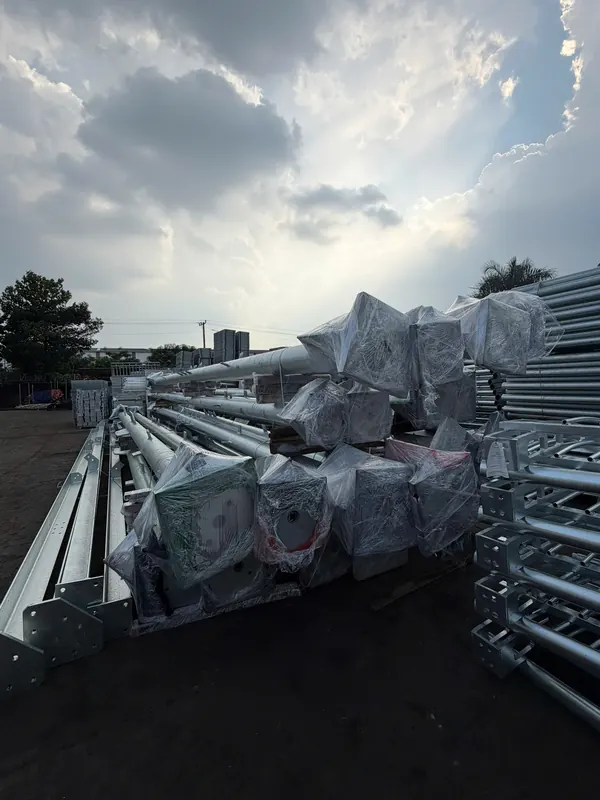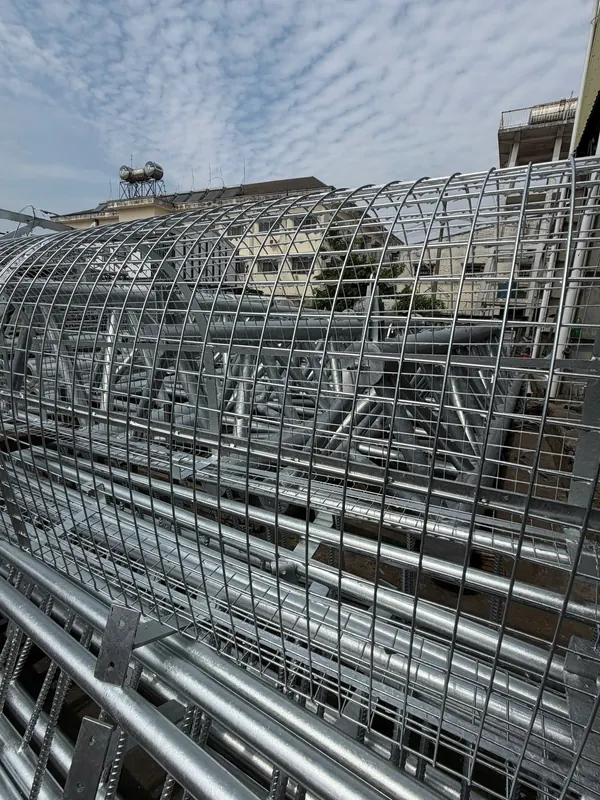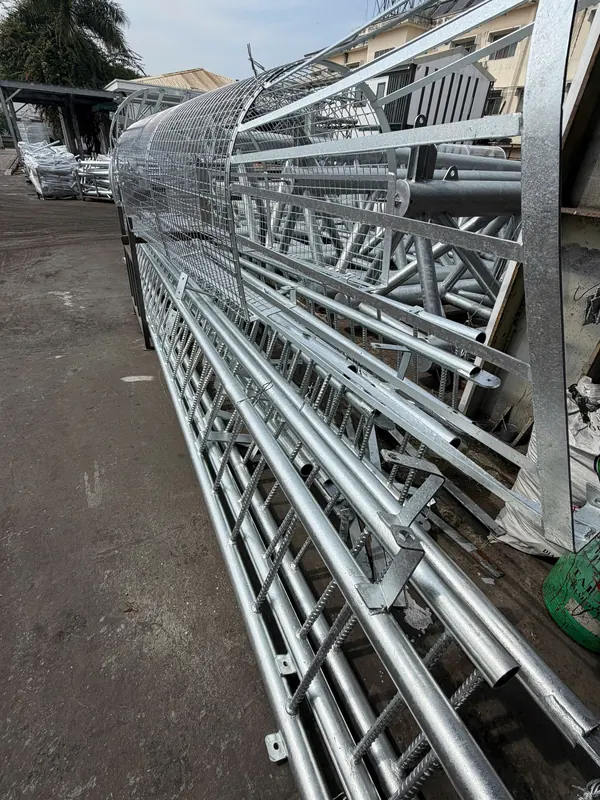
Hot-dip galvanizing heats a steel member to about 450 °C (842 °F) for a few minutes and then cools it. For a heavy wide flange that is no event at all. For a long, thin, asymmetric welded frame, it is a full heat treatment, and the frame can come out bowed, twisted or with its flanges pulled out of square. Galvanizing warpage is predictable, and most of the measures that prevent it are design and fabrication choices. This article explains the causes and the practice ASTM A384 lays out.
ASTM A123 does not set distortion limits for the coating. Section 5.2 makes design and fabrication for galvanizing the designer's and fabricator's job and requires ASTM A143, A384 and A385 to be followed. A384 is the one written for distortion. The editions your specification names govern.
Where the movement comes from
Three things combine in the kettle.
Heat lowers the strength of steel. At galvanizing temperature the yield strength of structural steel is roughly half of what it is at room temperature. Any stress locked into the steel that is higher than that reduced strength relaxes by moving the steel.
Residual stresses are already there. Every member carries stresses from its history: cooling at the rolling mill, cold straightening, flame or plasma cutting, punching and, above all, welding. Welds shrink as they cool and pull the parts they join. The stresses balance at room temperature; at 450 °C (842 °F) they no longer do.
Different parts heat at different rates. A thin plate welded to a thick flange heats faster, expands more quickly and cools faster than the flange. A member lowered into the zinc heats from the bottom up. Those temperature differences create new stresses for as long as they last.
The result depends on shape. Symmetric, uniform members tend to stay straight because the stresses balance. Asymmetric members, mixed thicknesses and one-sided welding are the usual sources of trouble.
The design measures in ASTM A384
ASTM A384 describes the measures designers and fabricators can take. In general terms they are:
- Use symmetric sections where possible, such as wide flanges rather than channels or angles for members that must stay straight.
- Keep thicknesses similar within an assembly. Very thin plate welded to very thick sections is the classic case for distortion.
- Avoid large flat panels of thin plate without stiffening. Thin plate can oil-can or buckle; ribs or a change of thickness help.
- Balance the welding: symmetric welds placed and sequenced so that their shrinkage pulls evenly, and no more weld than the design needs.
- Prefer continuous framing that stays in balance, and split very large assemblies into smaller units that are bolted after galvanizing.
- Use temporary bracing on open frames and U shapes that could spread, removed after galvanizing.
- Pre-camber or pre-set members whose movement is known.
- Fit the kettle so the member can be dipped in one immersion, as quickly as the galvanizer can safely manage.
Double dipping and long members
When a member is longer or deeper than the kettle, the galvanizer can dip it one half at a time, called progressive or double dipping. The half in the bath heats and expands while the other half stays cold, so the member is bent by temperature as well as by residual stress. Double dipping also leaves a band where the two dips overlap, which is thicker and rougher.
Where possible, it is better to:
- check the galvanizer's kettle size before detailing,
- split long members with a bolted field splice that suits the kettle,
- or choose a galvanizer with a kettle long enough for a single dip.
Weld sequence and fabrication habits
On welded assemblies the welding plan matters as much as the shape:
- Tack and weld in a sequence that balances shrinkage, working from the center outward and alternating sides.
- Size welds to the design, not larger. Oversized fillet welds add shrinkage and heat without adding needed strength.
- Intermittent welds on light attachments, where the design and corrosion detailing allow, put less heat into thin plate, but each gap must still be coated or sealed.
- Straighten before galvanizing, so the member enters the kettle straight; galvanizing does not correct shape.
Thin plate and light frames
Thin plate is the most sensitive. Large panels can buckle as the plate heats faster than its supporting frame. Galvanizers handle thin pieces with care: quicker immersion so the piece heats evenly, and gentle cooling. On our jobs, plate 2 mm (about 5/64 in) and thinner is dipped quickly and air-cooled first so it does not distort, and members of similar thickness and requirements are grouped on one dipping beam.
Light welded frames such as handrail panels, gratings and ladder cages are usually galvanized after welding, which A123 allows, but they benefit from temporary ties that hold the frame square until it has cooled.
Cooling and handling after the dip
How a member is cooled also matters. A water or chromate quench cools quickly; air cooling is slower and gentler. Galvanizers choose the method by the steel and the specification, and steel intended for a duplex paint system is often air or water cooled without a chromate passivation. Hot members should not be lifted at a single point or stacked while still hot, where their own weight can bend them.
Straightening afterwards
If a member does move, it can often be straightened cold. Two cautions apply:
- Note 9 of ASTM A123 warns that the zinc coating is generally too heavy to allow severe bending without damage. Gentle straightening is usually fine; sharp bending can crack or flake the coating.
- Any coating damage from straightening must be repaired to ASTM A780 within the limits of Section 6.2, or the piece goes back for regalvanizing.
Distortion is not one of the coating properties in Section 6, so a straightened, fully coated member meets A123. Straightness itself is judged against the fabrication tolerances of the project, such as the AISC Code of Standard Practice and the shop drawings.
Which members move most
Experience on galvanized jobs gives a rough ranking. It helps decide where to spend design effort.
| Member or assembly | Tendency to distort | Why |
|---|---|---|
| Heavy rolled wide flanges and columns | Low | Symmetric, thick and uniform |
| Channels and angles used as long single members | Moderate | Asymmetric section, can bow toward the open side |
| Built-up plate girders with thin webs | Moderate to high | Web thinner than flanges, long weld lines |
| Frames with thin plate welded to heavy sections | High | Uneven heating and weld shrinkage |
| Large flat thin plate panels, covers and floor plate | High | Little stiffness, heats fast |
| Long members dipped in two immersions | High | One end hot, one end cold |
What the galvanizer can do, and what it cannot
A good galvanizer can reduce distortion with handling: hanging members at the right angle, immersing them as quickly as is safe, grouping similar thicknesses, choosing the cooling method and supporting hot steel properly. It cannot remove residual stress that fabrication put into the steel, change the section shape or make a member fit a kettle that is too short.
That split is why Section 5.2 of ASTM A123 assigns design and fabrication to the designer and fabricator and asks all three parties to consult at the right stages. When a frame has a known risk, telling the galvanizer before the steel arrives lets it plan the jig and the dip.
Writing distortion into the specification
Specifications rarely mention galvanizing distortion, and that leaves a gap at acceptance. Three lines close it:
- State that members will be checked for straightness after galvanizing against the fabrication tolerances of the project.
- Allow cold straightening after galvanizing, with coating repairs to ASTM A780 within the limits of Section 6.2.
- Ask the fabricator to identify assemblies at risk and the measures planned, as part of the shop drawing submittal.
A design review for distortion
Before an assembly is released for fabrication, a short review catches most problems:
- Is the section symmetric, or is the asymmetry needed?
- Are the thicknesses in the assembly within a sensible range of each other?
- Are large thin panels stiffened?
- Are the welds balanced and no larger than needed?
- Does the piece fit the kettle for a single dip?
- Is temporary bracing shown for open frames?
- Are bolted splices used to break up very large assemblies?
How World Steel plans galvanized assemblies
World Steel fabricates up to 2,500 metric tons of structural steel a month in its IAS AC472-accredited plant in Vietnam, with laser cutting of plate up to 100 mm thick and controlled welding procedures. For galvanized work, our engineers review each assembly for distortion risk during shop drawing preparation, balance the weld sequence, add temporary bracing where frames could spread, and size field splices to the kettle of the galvanizer named for the job.
Galvanizing is arranged in Vietnam under World Steel's written galvanizing procedure, which groups members of similar thickness on one dipping beam and handles thin plate separately. After galvanizing, straightness is checked against the shop drawing tolerances before the member is released, and the records are posted in PEB Studio.
The next article in the design stage is galvanizing embrittlement and ASTM A143. Venting and draining, the other half of designing for the kettle, is covered in vent and drain holes for galvanizing. For the standard at a glance, see our ASTM A123 page.
Quick answers
Why does steel warp during galvanizing?
The steel is heated to about 450 °C (842 °F), where its yield strength drops. Residual stresses from rolling, cutting and welding relax, and different parts of an assembly heat and cool at different rates. Thin, asymmetric or unevenly welded parts move the most.
Which standard covers galvanizing distortion?
ASTM A384, the practice for safeguarding against warpage and distortion during hot-dip galvanizing of steel assemblies. ASTM A123 Section 5.2 requires designers and fabricators to follow it.
Can a warped galvanized member be straightened?
Often, by cold straightening with care, but the coating can crack where the steel is bent sharply, and repairs must then follow ASTM A780. Prevention in design is far better.
Is double dipping a long member a problem?
It adds a risk of distortion, because one end is heated while the other is cold, and it leaves an overlap band. Splitting long members or choosing a galvanizer with a long enough kettle is usually better.
Keep building your steel plan
Go further on USPEB.com
On this topic
Across the US market
- Steel fire protectionIntumescent and fire-rated steel packages
- Quality hubCoating inspection by FROSIO Level III inspectors
- Products catalogGalvanized, painted and built-up members
- Download centerSample ITP, design report and approval drawings
- Large projects, 2,500 t a monthCapacity for large US general contractors
- Contractor partnershipLong-term supply for US contractors