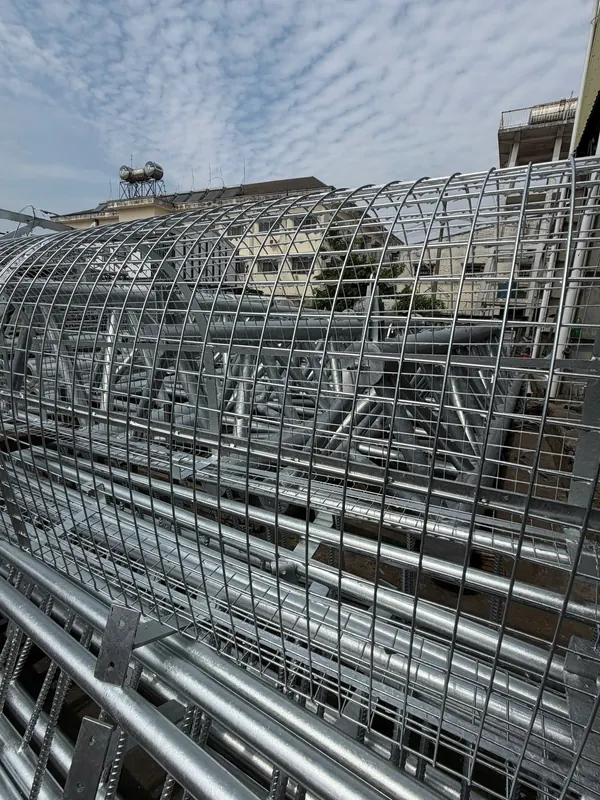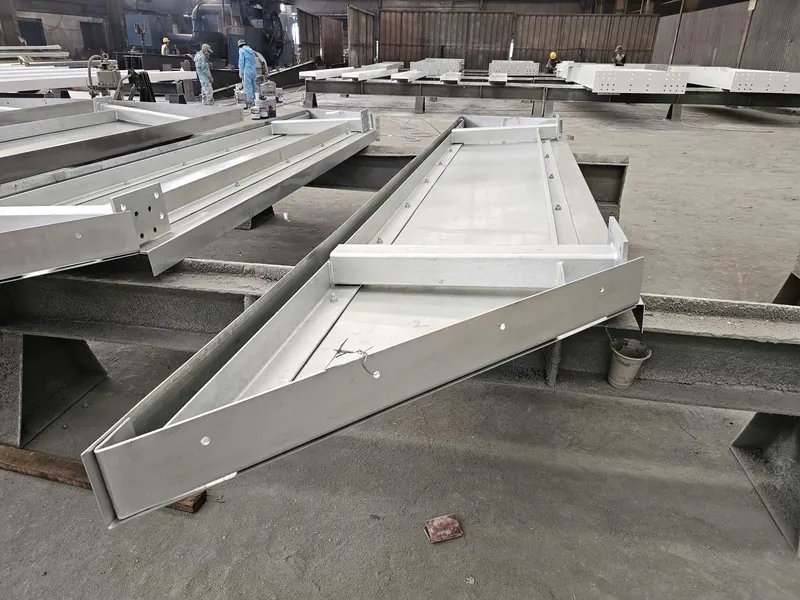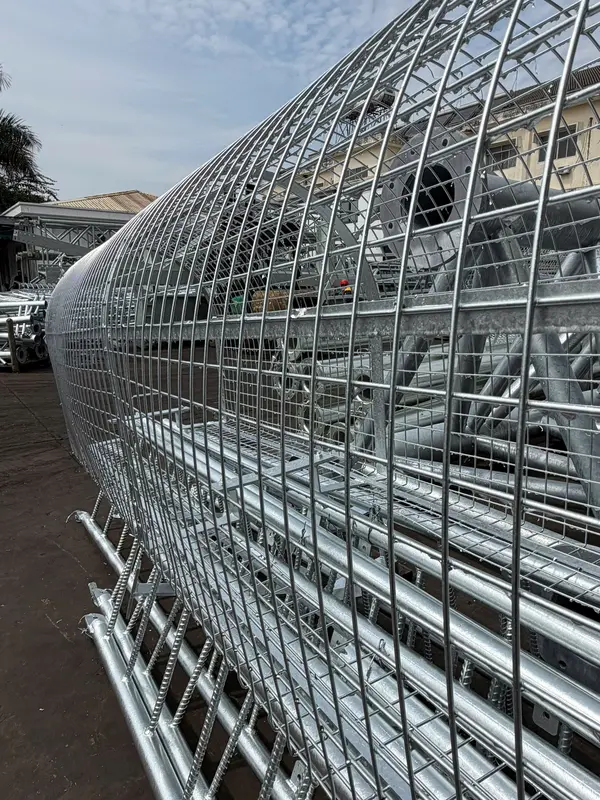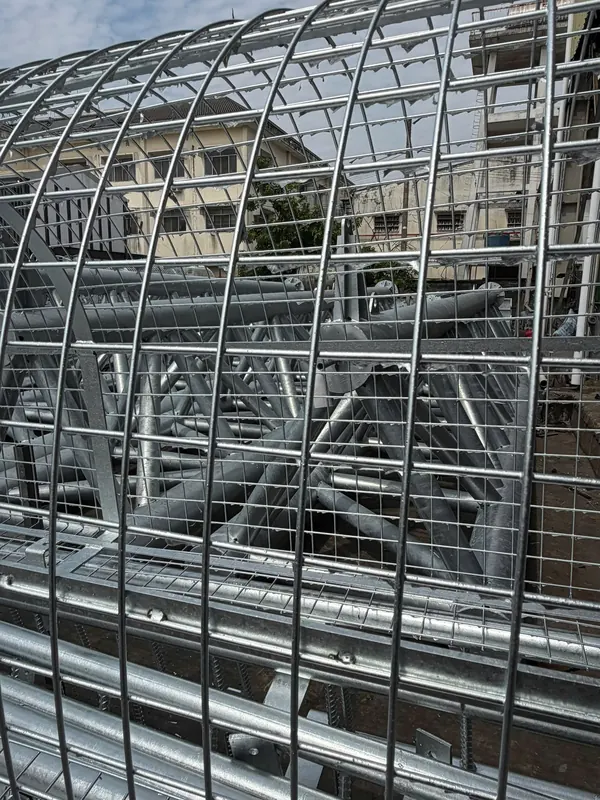
Hot-dip galvanizing looks simple from the outside: a steel member goes into a bath of molten zinc and comes out coated. The dip itself takes only a few minutes. The steps before it take most of the time, and they decide whether the zinc bonds to the steel or leaves bare spots. This article walks through the hot-dip galvanizing process as World Steel's written galvanizing procedure runs it, ten stages from receiving to release, with the ASTM A123 requirement each stage serves.
The values below come from that procedure, which also appears on our hot-dip galvanizing page. Galvanizing on World Steel jobs is arranged in Vietnam with a galvanizer named for the job, working to this procedure. The standard reviewed is ASTM A123/A123M-13; the edition your specification names governs.
Why preparation decides the coating
Molten zinc only reacts with clean steel. Oil, rust, mill scale or an oxide film between the zinc and the steel stops the zinc-iron reaction, and the zinc simply runs off that spot. ASTM A123 Section 6.4 requires galvanized articles to be free from uncoated areas when they leave the galvanizer, so the first six steps exist to deliver a surface the zinc can wet everywhere.
Stage 1: check and hang
Each lot is counted against the order and tagged. Quality control checks the vent, drain and hanging holes before anything else, because a closed section cannot be made safe once it is wired up. The steel is then hung on the dipping beam:
- Long members of 2,200 mm (7 ft 3 in) and more are hung at 25 to 35 degrees, so liquids and zinc drain to one end.
- Rows are spaced at least 10 mm (3/8 in) apart so the solutions reach every face.
- Pieces of similar thickness and requirements go on one beam, so they need the same time in each bath.
Stage 2: degrease
An alkaline degreasing bath, Hydronet Base at about 10 %, lifts the oil and grease left from fabrication and storage, at 30 to 35 °C (86 to 95 °F). The steel is checked every three to five minutes until it is clean. Degreasing comes first because acid cannot remove oil, and oily steel pickles unevenly.
Stage 3: pickle
Hydrochloric acid at 8 to 14 %, at 25 to 30 °C (77 to 86 °F), dissolves rust and mill scale down to bare steel. Pickling usually takes 30 to 120 minutes, with the steel lifted and checked every ten minutes so it never sits long enough to over-pickle and pit. Pickling time depends on how much scale and rust the steel carries; heavily rusted steel or thick mill scale takes longer.
What pickling does not remove is worth repeating: weld slag, paint, silicone spray and marking crayon. Those must be gone before the steel reaches the galvanizer, as welded assemblies for galvanizing explains.
Stage 4: rinse
Clean water, pH 6.5 to 7, washes off the acid and loosened dirt in one to two minutes, with pressure spray into hollows where needed. This is a quality gate: any piece still showing grease, dirt or rust goes back to the start. Rinsing also keeps acid and iron salts out of the flux tank, which would otherwise contaminate it and raise dross in the kettle.
Stage 5: flux
The steel goes into a zinc ammonium chloride flux, ZnCl₂ plus NH₄Cl at 20 to 25 % (16 to 20 °Bé), at 60 to 80 °C (140 to 176 °F) for three to six minutes. The flux does three jobs: it removes the last thin oxide film that forms after pickling, it protects the clean steel from rusting again before the dip, and it helps the molten zinc wet the surface.
Stage 6: dry
The fluxed steel dries and warms at 37 to 65 °C (99 to 149 °F) for five to ten minutes. Drying matters for safety and quality: water carried into molten zinc flashes to steam and splashes, and wet flux leaves flux inclusions in the coating. Section 6.4 of A123 lists flux deposits as a reason for rejection.
Stage 7: dip in molten zinc
The crane lowers the beam slowly into the kettle. The zinc is 99.99 % pure, imported from Australia and Korea with a composition analysis for each shipment, which meets the ASTM A123 Section 5.4 requirement for zinc to ASTM B6 or B960. Section 5.5 requires the working bath to average at least 98.0 % zinc by weight; the bath is sampled every month and analyzed by TÜV Rheinland.
The bath runs at 440 to 450 °C (824 to 842 °F), held within about 5 °C (9 °F). Steel stays in the zinc for three to five minutes, by thickness, until it reaches bath temperature and the zinc-iron alloy layers form. The dross is skimmed off the surface before withdrawal, and the steel is lifted out slowly and shaken so excess zinc drains back into the kettle. The speed of withdrawal sets how much pure zinc stays on the surface: too fast leaves drips and runs, too slow wastes time and lets the zinc cool.
How the layers form, and why some steels grow thicker coatings, is covered in reactive steel and the zinc bath.
Stage 8: cool and passivate
Most steel is quenched in a chromate passivation solution at 1.2 to 1.8 parts per thousand. The quench stops the zinc-iron reaction and leaves a thin film that protects the fresh zinc from wet storage stain, the white rust that forms when new zinc is stored wet.
Steel that will be painted in a duplex system is cooled in water or air instead, with no passivation, because the passivation film can stop the paint bonding. The order must say which members are for painting, which is one of the special requirements discussed in galvanizing order requirements.
Stage 9: inspect and measure
Quality control counts the lot, inspects every piece visually and reads the coating thickness with an Elcometer 456 magnetic-induction gauge. This is the in-plant inspection program that ASTM A123 Section 9.1 requires of the galvanizer, and the gauge method is the magnetic method of Section 8.2.1, which follows ASTM E376.
The visual check looks for the defects A123 Section 6.4 lists: bare spots, blisters, flux deposits and gross dross inclusions, plus burns, drips and early white rust. Steel that fails is stripped in the acid and dipped again.
Stage 10: clean, tag and release
Hanging wires are cut, zinc drips are filed or ground smooth, small bare spots within the limits are touched up to ASTM A780, and each bundle is tagged with customer, product, quantity, item code and date. Final quality control releases the lot for dispatch.
World Steel's own repair limits are tighter than A123 in two ways: no more than 0.5 % of the surface and 250 cm² (about 39 sq in) in total, and no single spot larger than 40 cm² (about 6 sq in). Anything beyond those limits goes back through the acid and the kettle.
Which stage causes which defect
Most coating defects can be traced to one stage of the process. Knowing which helps an inspector ask the right question.
| Defect seen after galvanizing | Usual cause | Stage |
|---|---|---|
| Bare spot with a clean edge | Slag, paint or oil not removed | Before receiving, or degreasing |
| Bare spot with a rough edge | Incomplete pickling or rust left under scale | Pickling |
| Flux inclusion, dark crusty patch | Wet or contaminated flux, steel not dried | Fluxing and drying |
| Rough, lumpy zinc | Dross picked up from the bath | Dipping |
| Drips and runs at edges | Withdrawal too fast, poor drainage | Dipping |
| Thick gray coating | Reactive steel chemistry | Steel selection |
| White powder after storage | Fresh zinc stored wet without air flow | After release |
What your inspector can witness
A purchaser's inspector does not need to stand at the kettle for the whole job. The most useful hold points are:
- Receiving: vent, drain and hanging holes checked against the shop drawings.
- After withdrawal: the visual condition of the first lot of each member type.
- Thickness measurement: gauge calibration and readings on the sampled test articles.
- Repairs: the size and method of any renovated area before release.
Section 9.2 of A123 gives the purchaser's inspector access to the areas where the coating is applied while the order is being worked.
How the tanks are controlled
A process is only as good as its baths. Under World Steel's procedure:
| Bath | Control |
|---|---|
| Molten zinc | Sampled monthly and analyzed by TÜV Rheinland; temperature watched continuously; zinc level kept about 100 mm (4 in) below the rim |
| Flux and passivation | Analyzed weekly by QUATEST 3, the Vietnamese government quality testing center |
| Acid | Component analysis daily; density checked with a Baumé hydrometer every three days |
| Degreaser | Checked every three days, topped up when it drops below 10 % |
The records each stage leaves
A process tracking sheet travels with every dipping beam and logs the time in each tank, the hanging QC sign-off and the pieces accepted or rejected after cleaning and after galvanizing. A thickness inspection sheet records the gauge readings per lot. A nonconformance report logs every defect and holds the piece aside until it is dispositioned. Together they are the evidence your inspector or reviewer sees.
How World Steel runs galvanized projects
World Steel fabricates up to 2,500 metric tons of structural steel a month in its own IAS AC472-accredited plant in Vietnam. On galvanized jobs, members are detailed and fabricated for the kettle, then galvanized in Vietnam with a galvanizer named for the job, working to World Steel's written procedure with the controls above. Your inspector can witness the measurements in person or follow them live by video, and the records are posted in PEB Studio by piece mark.
The next article looks inside the coating itself, at the zinc-iron layers. For the standard at a glance, see our ASTM A123 page.
Quick answers
What are the main steps of the hot-dip galvanizing process?
Surface preparation (degreasing, pickling, rinsing and fluxing), drying, dipping in molten zinc at about 450 °C (842 °F), cooling or passivating, and inspection. Hanging and receiving checks come first, and cleaning, tagging and release come last.
How long is steel left in the zinc bath?
Usually three to five minutes, set by the steel thickness, until the steel reaches bath temperature and the zinc-iron layers form. Heavy sections take longer than light ones.
Why is the steel fluxed before galvanizing?
The flux removes the last oxide film after pickling, keeps the clean steel from rusting before the dip, and helps the molten zinc wet the surface so the alloy layers can form evenly.
Is steel for painting galvanized differently?
It is cooled in water or air instead of a chromate passivation quench, because the passivation film can stop paint bonding. The order must say which members will be painted.
Keep building your steel plan
Go further on USPEB.com
On this topic
Across the US market
- Steel fire protectionIntumescent and fire-rated steel packages
- Quality hubCoating inspection by FROSIO Level III inspectors
- Products catalogGalvanized, painted and built-up members
- Download centerSample ITP, design report and approval drawings
- Large projects, 2,500 t a monthCapacity for large US general contractors
- Contractor partnershipLong-term supply for US contractors