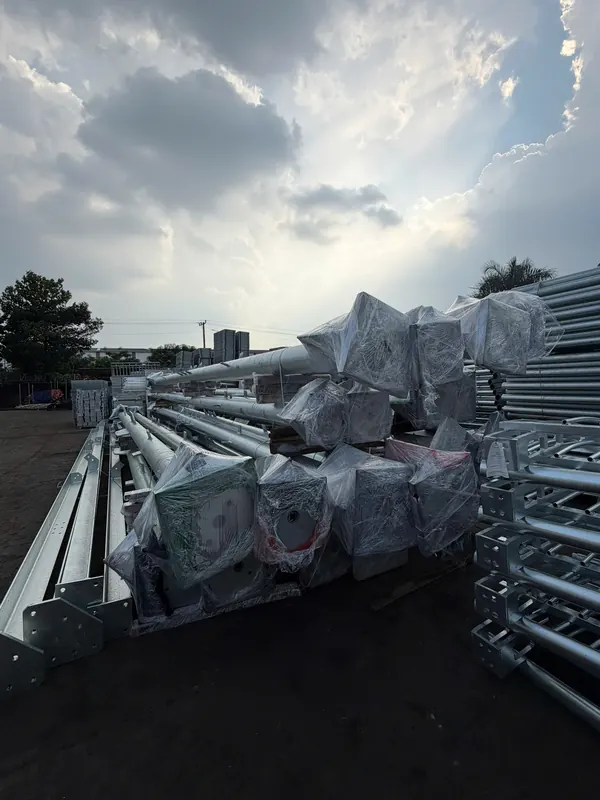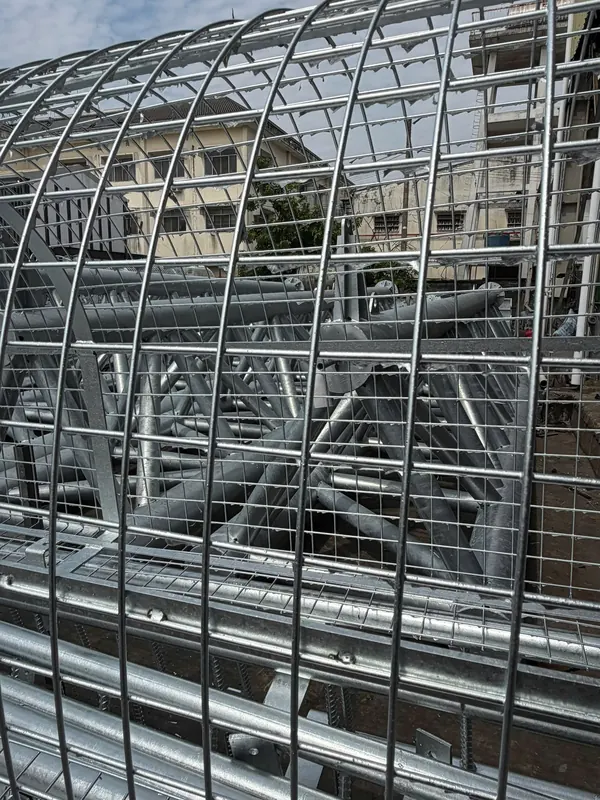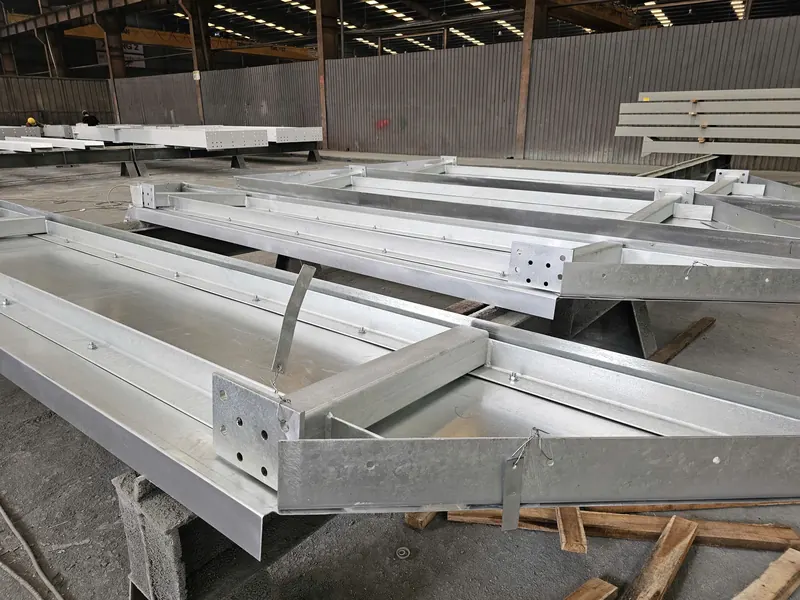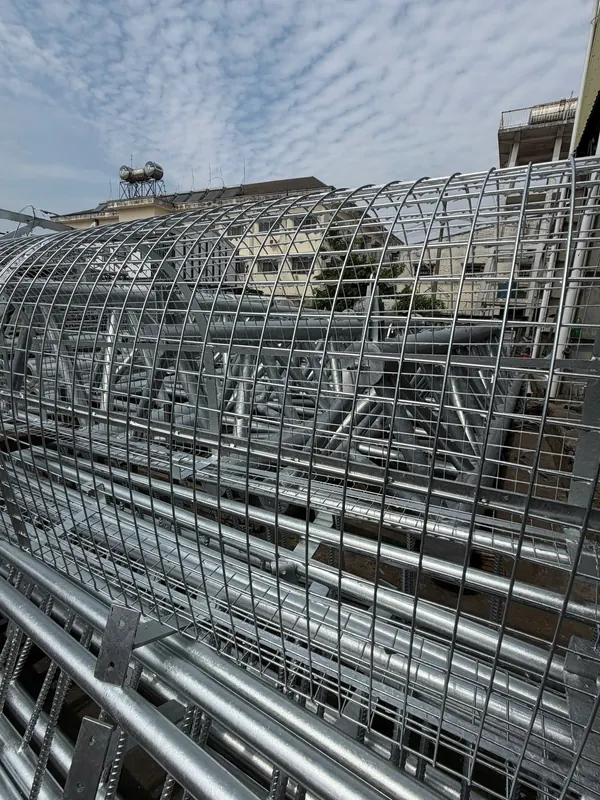
Most galvanized structural steel is welded before it is dipped. ASTM A123 Section 1.2 covers fabricated products, including assembled steel and structural fabrications, so frames, platforms, stairs, towers and handrail are galvanized after welding as a matter of course. The welding itself, though, leaves things on the steel that the galvanizing line cannot remove. This article sets out the shop rules for welded assemblies for galvanizing, and the A123 clauses that make them the fabricator's responsibility.
The edition reviewed is ASTM A123/A123M-13, with the A385 practice it refers to. The editions your specification names govern.
What the galvanizing line can and cannot clean
A galvanizer prepares steel in three chemical steps: an alkaline degreaser removes oil and soil, hydrochloric or sulfuric acid removes rust and mill scale, and a flux removes the last oxide film just before the kettle. These baths are good at what they do, and blind to a few things welding leaves behind:
- Weld slag from flux-cored, stick (SMAW) and submerged arc welding is a glassy, non-metallic crust. Acid does not dissolve it.
- Anti-spatter sprays based on silicone or heavy oils are not removed by the degreaser.
- Weld spatter stays welded to the surface; zinc coats it, but it leaves lumps.
- Paint, marking crayon and lacquer on the steel, including shop marks, are not removed by acid.
Anything the baths cannot remove becomes a bare spot after galvanizing. Section 6.2 of A123 says surface conditions caused by deficiencies in design, detailing or fabrication, as addressed in ASTM A385, are not grounds for rejection of the coating, which makes them the fabricator's problem to prevent.
Rule 1: remove all slag
Every weld made with a slag-forming process must be cleaned before galvanizing: chipped, wire brushed, needle scaled or blasted until bare metal shows. That includes the inside of joints and the back of fillet welds where slag hides. Gas-shielded solid-wire welding (GMAW) leaves little slag, but the silicate islands it can leave on the weld face should be brushed off as well.
On large assemblies a light abrasive blast of the welds before shipping to the galvanizer is the most reliable way to be sure. It also removes heat tint and weld smoke.
Rule 2: keep the spray water-based
Anti-spatter spray keeps spatter from sticking to the steel and the welding nozzle. For galvanized work it must be water-based and silicone-free. If a silicone product has been used by mistake, the areas need solvent cleaning or blasting before the steel goes to the galvanizer.
Rule 3: match the weld metal
Note 2 of ASTM A123 mentions weld metal along with steel: silicon and phosphorus in the weld can speed up the zinc-iron reaction and give a thicker, darker coating. On an exposed frame that shows as a gray line along every weld. ASTM A385 recommends weld consumables with chemistry close to the base metal. When the appearance of welds matters, it is worth checking the silicon content of the wire or electrode before the job starts, and keeping one consumable for the whole job.
Rule 4: make sound welds
Porosity, pinholes and undercut trap pickling acid and flux. During galvanizing the trapped liquid boils off and can leave a pinhole or a rust weep in the coating. Sound welds made to an approved procedure under AWS D1.1, with continuous runs where crevices would otherwise form, avoid most of it. Intermittent welds are fine where the design calls for them, but the gaps between them form crevices on lapped parts, so laps should be sealed.
Rule 5: seal or vent every lap
Plates welded face to face trap a thin gap. Small laps are seal-welded all round so nothing enters. Larger laps are seal-welded and given a vent hole through one plate, because the air in a sealed gap expands at about 450 °C (842 °F) and can blow out the weld or the coating. The alternative is to design the joint without a lap, for example a butt joint or a bolted connection made after galvanizing. The detailing side is covered in vent and drain holes for galvanizing.
Rule 6: allow clearance on moving parts
Hinges, sliding gates, shafts in sleeves and pin connections pick up a coating on each face. If the clearance is too small, the zinc bridges the gap and the parts fuse together. Galvanizers commonly ask for a radial clearance of about 1.5 mm (1/16 in) or more on moving parts. Section 6.4 of A123 also requires pieces to be handled so that they do not freeze together on cooling, which the galvanizer manages on the jig, but the design has to give it room.
Rule 7: plan threads and tapped holes
Section 6.3 of A123 covers threaded components in assemblies. The zinc on external threads must not be cut, rolled or finished with a tool unless the purchaser authorizes it, while internal threads may be tapped or retapped after galvanizing. Threads must meet ASTM A153. In practice:
- Studs and threaded rods welded to an assembly are galvanized with it, then cleaned by brushing or spinning, not re-cut.
- Tapped holes and nuts are tapped oversize, or retapped after galvanizing, so the galvanized bolt fits.
- Threads that must stay clean are masked before dipping, with the masking agreed on the order.
Rule 8: do not mix materials blindly
Assemblies sometimes combine materials that galvanize differently:
- Castings and rolled steel clean at different rates in acid; castings may need abrasive blasting first. Section 5.3 makes the purchaser responsible for casting composition and heat treatment.
- Previously galvanized parts welded into a new assembly need their old zinc removed at the weld, and will come out of the kettle with a double coating.
- Painted or primed parts must be stripped before galvanizing.
- Very different thicknesses in one assembly heat unevenly and can distort, as covered in galvanizing warpage and ASTM A384.
How mixed assemblies are judged
An assembly made of shapes, plate and tubing of different thicknesses has more than one material category. Section 3.2.9 of A123 treats each category and steel thickness range on the article as its own specimen, so each part is measured against its own line of Table 1. Note 6 adds that the visual finish rules do not address the thickness differences that come from different steels or thicknesses in one assembly. An inspector should therefore not expect a uniform coating across a welded frame, only a coating that meets the right grade on each part.
Welding after galvanizing
Sometimes welding happens after galvanizing, in the shop or on site. Zinc fumes are a health hazard, and zinc in the weld pool causes porosity and cracking. The coating is removed from the weld zone by grinding before welding, the welding is done with ventilation and a procedure suited to coated steel, and the weld area is then repaired with an ASTM A780 method. A123 counts this renovation against the repair limits only for galvanizer repairs; site welding repairs follow the project specification. Wherever possible, field connections of galvanized steel are bolted.
Welding processes compared for galvanized work
| Process | Slag left on the weld | Galvanizing note |
|---|---|---|
| GMAW, solid wire | Little, some silicate islands | Brush the weld face before galvanizing |
| FCAW, flux-cored | Heavy slag | Chip and brush or blast every weld |
| SMAW, stick | Heavy slag | Chip and brush or blast every weld |
| SAW, submerged arc | Heavy slag | Remove slag fully, including at weld ends |
The process is chosen for the joint and the welding procedure. Slag removal is then a shop rule that applies to every slag-forming weld, whatever the member.
Who checks the welds before dipping
Three checks happen in sequence. The fabricator's welding inspector accepts the welds to the welding code and the drawings. The fabricator's coating or quality inspector then checks the galvanizing rules above: slag, spatter, laps, holes, threads and marking. Finally the galvanizer's receiving check looks again at holes and surface condition before the steel is hung. Each check has its own record, so a bare spot found after galvanizing can be traced to the step that missed it, and the same mistake is not repeated on the next lot.
A pre-galvanizing checklist for welded pieces
Before a welded assembly leaves for the galvanizer, check:
- All slag removed, inside joints and on the back of fillets.
- No silicone spray, paint or crayon left on the steel.
- Welds sound, with no open porosity or undercut.
- Laps sealed and vented, or avoided.
- Vent and drain holes in every closed section and pocket.
- Clearance on moving parts.
- Threads and holes masked or planned for retapping.
- Piece mark on a tag that survives the kettle.
How World Steel prepares welded steel for the kettle
World Steel fabricates up to 2,500 metric tons of structural steel a month in its IAS AC472-accredited plant in Vietnam, with welding procedures and welders qualified under AWS D1.1 and, where seismic work requires it, AWS D1.8. For galvanized assemblies our QC checks slag removal, spatter, laps, vent holes and threads before the steel leaves for the galvanizer, and welds are cleaned or blasted where needed.
Galvanizing is arranged in Vietnam with a galvanizer named for the job, under World Steel's written galvanizing procedure, which inspects the vent, drain and hanging holes again when the steel is received and reports any steel that arrives with paint, glue or old galvanizing before it is dipped. The coating results travel with the steel in PEB Studio.
The next stage of the series goes into the kettle itself, with the hot-dip galvanizing process, step by step. For the standard at a glance, see our ASTM A123 page.
Quick answers
Does weld slag come off in the pickling tank?
No. Pickling acid removes rust and mill scale but not slag from flux-cored, stick or submerged arc welding. Slag must be removed mechanically, by chipping, wire brushing or blasting, or it leaves bare spots.
Which anti-spatter spray can be used on steel to be galvanized?
A water-based, silicone-free product. Silicone and oil-based sprays are not removed by the degreasing and pickling tanks and leave uncoated patches.
Why do some welds galvanize darker than the steel?
Weld metal with high silicon reacts faster with the zinc and grows a thicker, matte gray coating. Consumables with chemistry close to the base metal give a more even result.
Can moving parts be galvanized assembled?
Yes, if the design allows enough clearance for the zinc, often about 1.5 mm (1/16 in) or more. Otherwise the parts fuse together on cooling, and Section 6.4 requires pieces to be handled so they do not freeze together.
Keep building your steel plan
Go further on USPEB.com
On this topic
Across the US market
- Steel fire protectionIntumescent and fire-rated steel packages
- Quality hubCoating inspection by FROSIO Level III inspectors
- Products catalogGalvanized, painted and built-up members
- Download centerSample ITP, design report and approval drawings
- Large projects, 2,500 t a monthCapacity for large US general contractors
- Contractor partnershipLong-term supply for US contractors