
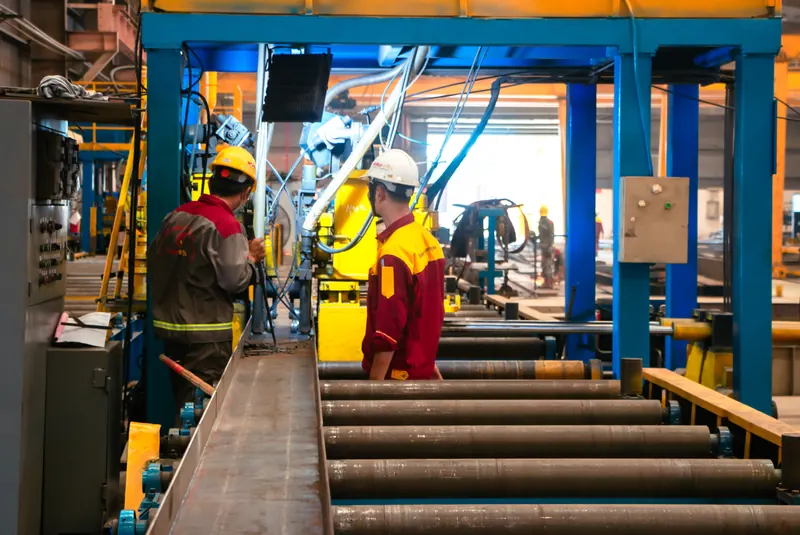
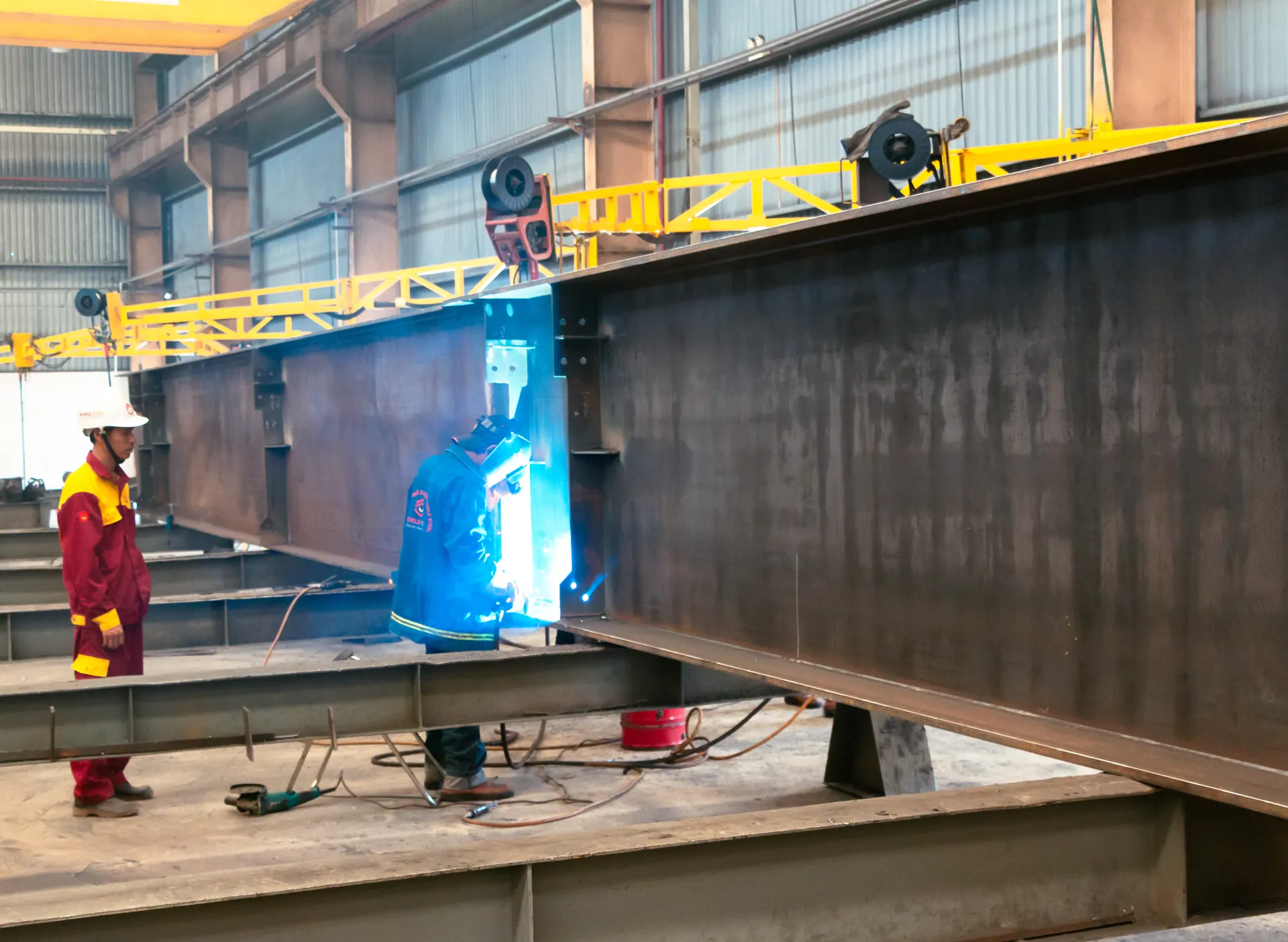
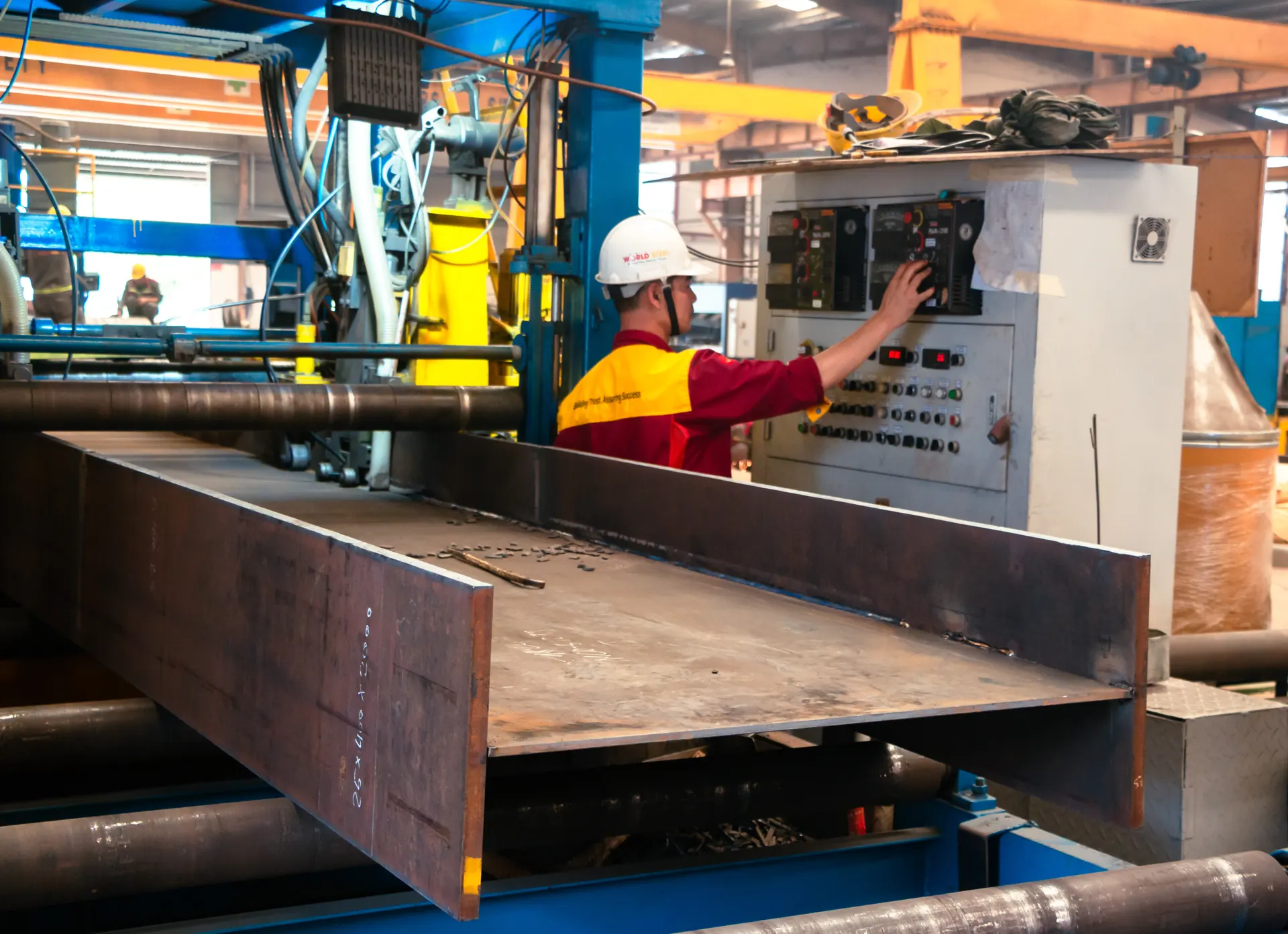
Submerged-arc welding of web-to-flange seams in the Vietnam plant.
Seven weld types, in depth
Every weld type on your steel, explained, welded and inspected to AWS D1.1
Fillet, CJP, PJP, flare, plug and slot, demand-critical and stud welds: how each one works, how we weld it and how it is proven, in a plant that fabricates 2,500 metric tons of structural steel a month.
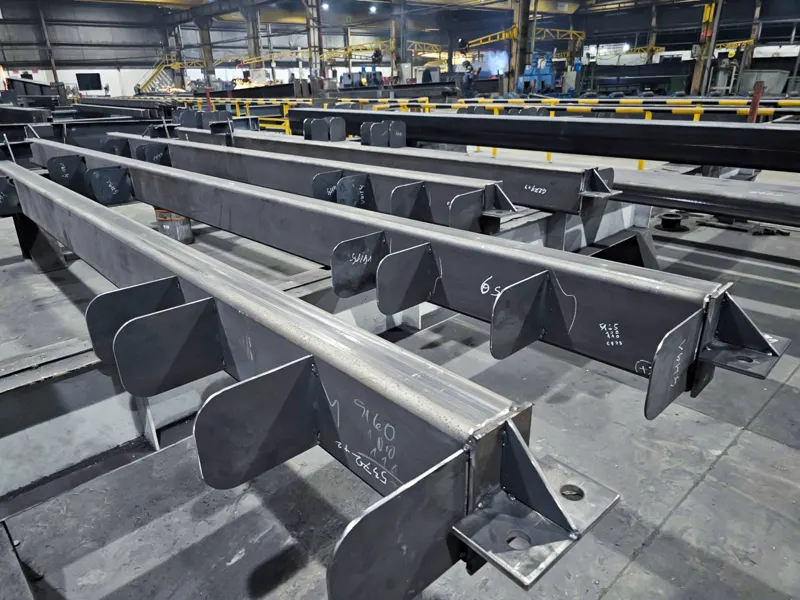
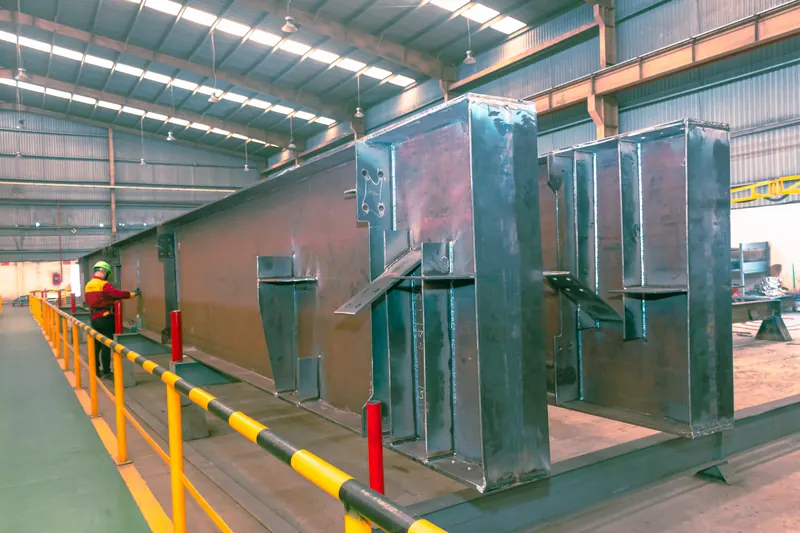
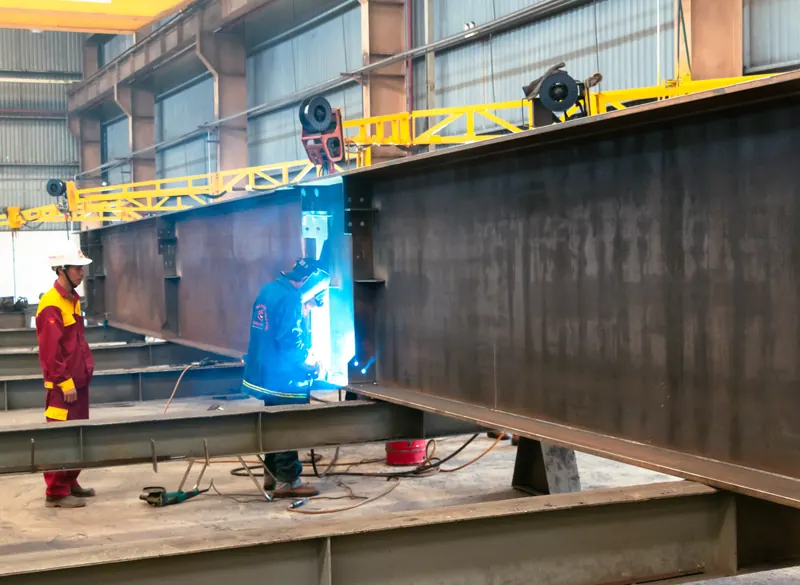
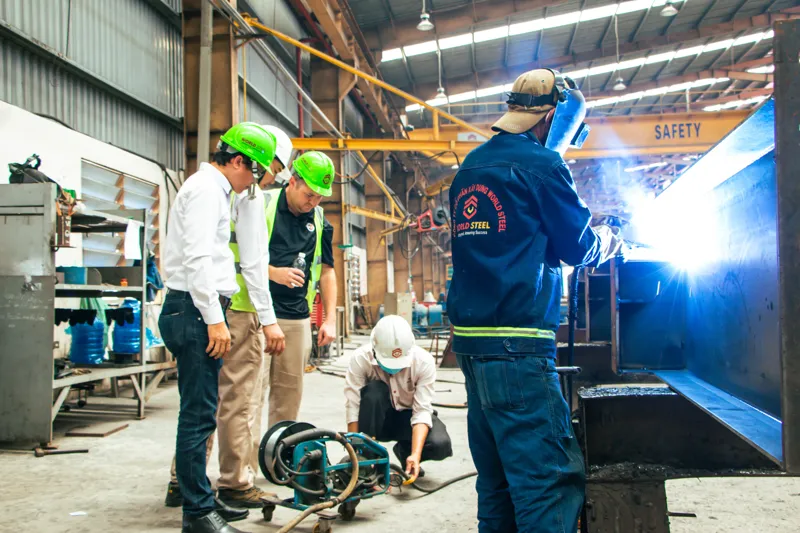
Structural steel weld types
Seven weld types carry almost every load in a steel building
Every connection on your drawings is welded with one of a short list of weld types. Each has its own geometry, its own way of counting strength, its own inspection and its own place in AWS D1.1 and AISC 360. This group explains each one in depth, shows how we prepare, weld and inspect it in our plant in Vietnam, and links it to the tests that prove it.
The Engineer of Record chooses the weld type and size. We detail it on the shop drawings, weld it to a qualified WPS and inspect it against the code before the member moves on.
The symbol chart
Seven weld types, one in-depth page each
Each card shows the weld as it appears on a shop drawing, in the manner of AWS A2.4: the arrow points at the joint, the symbol below the line is the weld on the arrow side.
Fillet welds
How big is the weld, and how much throat does it really have?
The most used weld on any steel job: stiffeners, clips, shear tabs, end plates and lapped parts.
Read the guide CJPCJP groove welds
Does the weld go right through the joint, and how is that proven?
Full-penetration welds for flange splices, moment connections and plate splices, tested by UT.
Read the guide PJPPJP groove welds
Is full penetration needed here, or is a set throat enough?
Partial-penetration welds with a designed effective throat, for splices, box corners and heavy plate.
Read the guide FlareFlare-bevel and flare-V groove welds
How much weld fits against a rounded corner?
Welds against the rounded corner of an HSS, a bent plate or a bar, sized from the bend radius.
Read the guide PlugPlug and slot welds
How are lapped plates joined where no edge is free to weld?
Welds through a round hole or an elongated slot, to carry shear in lap joints and stop plates buckling.
Read the guide DCDemand-critical welds
Which welds must stay tough when an earthquake pulls on them?
Seismic welds named by AISC 341 and welded to AWS D1.8: tougher filler metal, extra steps, more testing.
Read the guide StudStud welds (shear studs)
Are the shear studs welded in the shop or on site?
Headed shear studs arc welded in the shop where the market allows it, tested and bent to AWS D1.1.
Read the guideReading a weld symbol
Eight parts of the symbol on every shop drawing
Our shop drawings show every weld with its symbol, so your reviewer and our welders read the same instruction. This is how to read one.
An 8 mm fillet weld on the arrow side. On a US job in inch units the same weld reads 5/16.
Arrow
Points at the joint. The side it touches is the arrow side.
Reference line
The horizontal line everything else hangs on. Below it means arrow side, above it means other side.
Basic symbol
The shape of the weld: a triangle for a fillet, a V or bevel for a groove, a box for a plug or slot.
Size and length
Size to the left of the symbol, length and pitch to the right, in the drawing units.
Tail
Carries the process, the WPS, CJP or PJP, or a note. Left off when nothing needs saying.
Field weld flag
A flag at the junction means the weld is made on site, by the erector, not in our shop.
Weld all around
A circle at the junction means the weld runs all the way around the joint.
Both sides
A symbol on both sides of the line means the joint is welded from both sides.
Which weld where
Ten common joints and the welds that usually make them
A starting point for reading drawings, not a design rule: the Engineer of Record chooses the weld for each joint.
| Joint | Fillet | CJP | PJP | Flare | Plug | DC | Stud |
|---|---|---|---|---|---|---|---|
| Built-up girder, flange to web | Usual weld | Also used | Also used | ||||
| Beam flange to column, moment connection | Usual weld | Also used | |||||
| Shear tab, clip angle, end plate to beam | Usual weld | ||||||
| Stiffeners and continuity plates | Usual weld | Also used | |||||
| Column splice | Also used | Usual weld | Also used | ||||
| Column to base plate | Usual weld | Also used | Also used | ||||
| Built-up box column corner | Also used | Usual weld | |||||
| HSS brace or post to plate | Also used | Usual weld | |||||
| Cover plate or lapped doubler | Usual weld | Also used | |||||
| Composite beam, embed plate, column face | Usual weld |
Usual weldAlso used, depending on the design
From design to inspection
How a weld gets from the design drawing to your steel
Engineer of Record
Sets the weld type, size and any demand-critical or NDT requirement on the design drawings, or delegates connection design.
World Steel detailers
Show every weld with its symbol and WPS on the shop drawings, sent for your review and approval.
Qualified WPS and welder
Each weld is made to a written procedure, qualified to AWS D1.1 (and AWS D1.8 for seismic welds), by a welder qualified for it.
World Steel QC
Visually inspects every weld, runs the specified NDT and records it by piece mark before coating.
On our floor
Five welding processes, each on a qualified procedure
The process for each weld is the one named on its qualified WPS and shown in the tail of the weld symbol where the drawings need it.
Submerged arc
Automatic lines for long web-to-flange welds on built-up beams, girders and columns.
How we use SAW FCAWFlux-cored arc
Fitting stations: stiffeners, connection plates, groove welds in all positions.
How we use FCAW GMAWGas metal arc
Light members, secondary steel and clean, low-spatter welds where the WPS calls for it.
How we use GMAW SMAWShielded metal arc
Stick welding for short welds, tight access and repairs, to the qualified procedure.
How we use SMAW SWStud arc welding
Drawn-arc stud guns with ceramic ferrules for headed shear studs and anchors.
How we use SW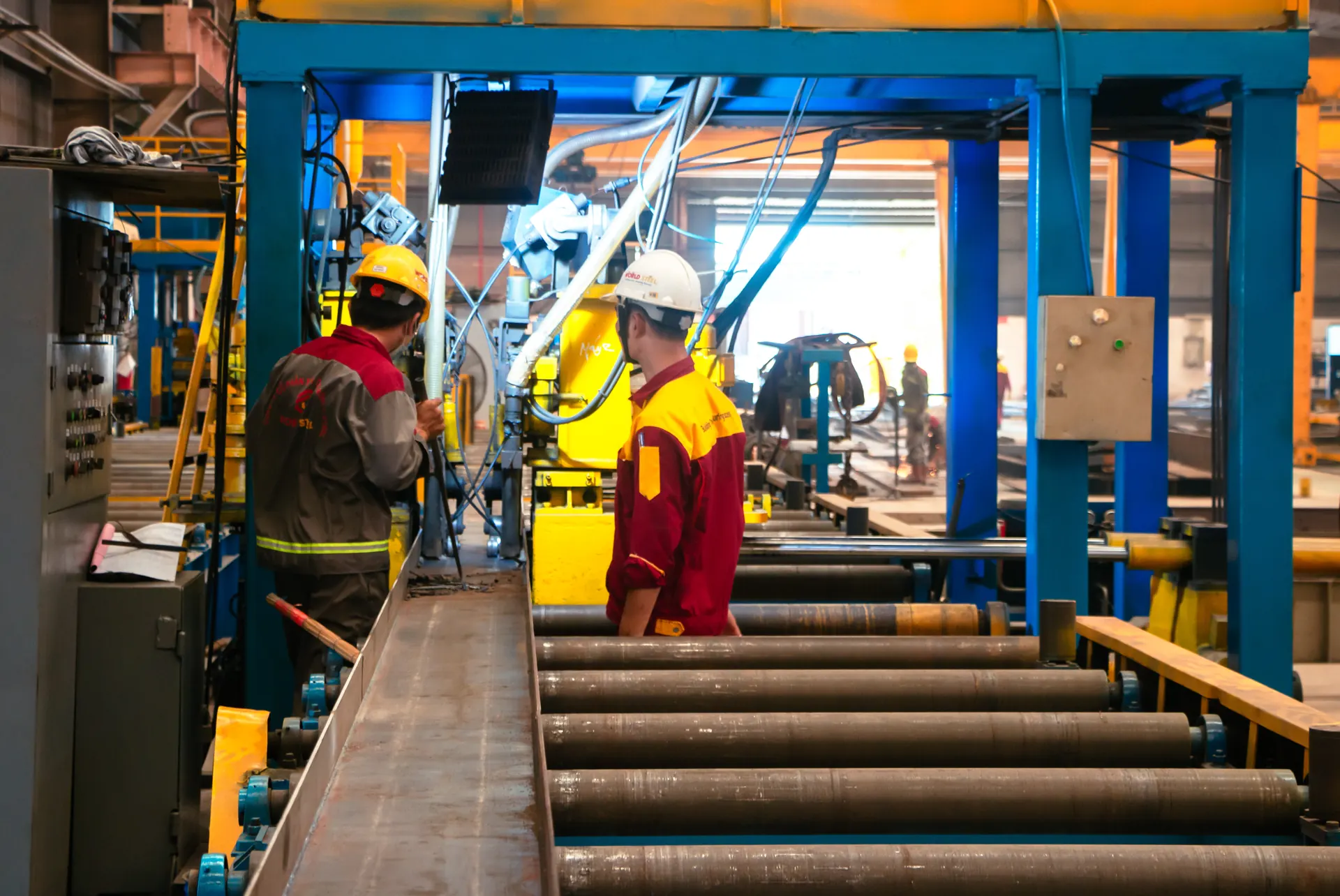
Weld types on large jobs
Hundreds of thousands of welds a year, one set of rules
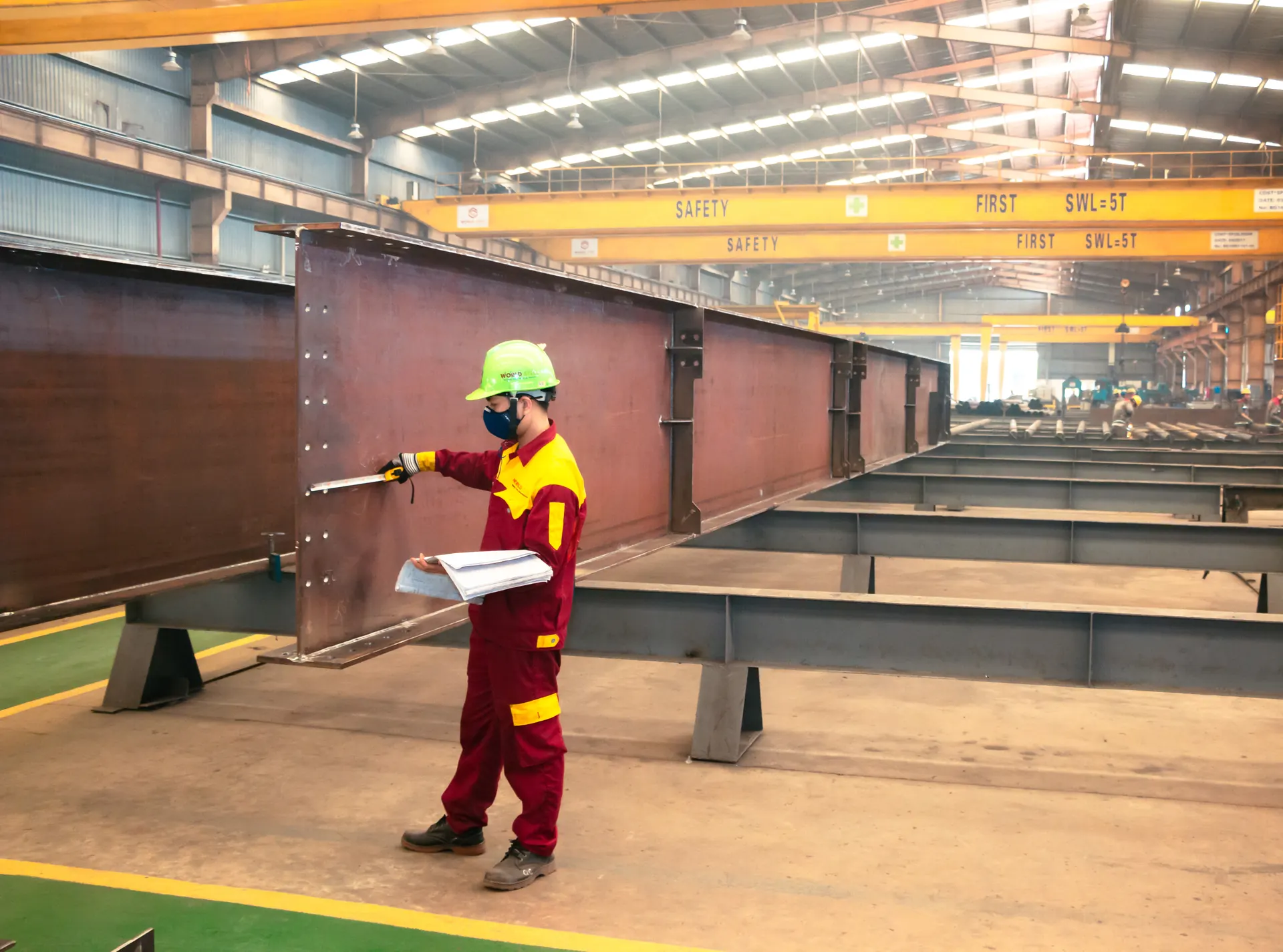
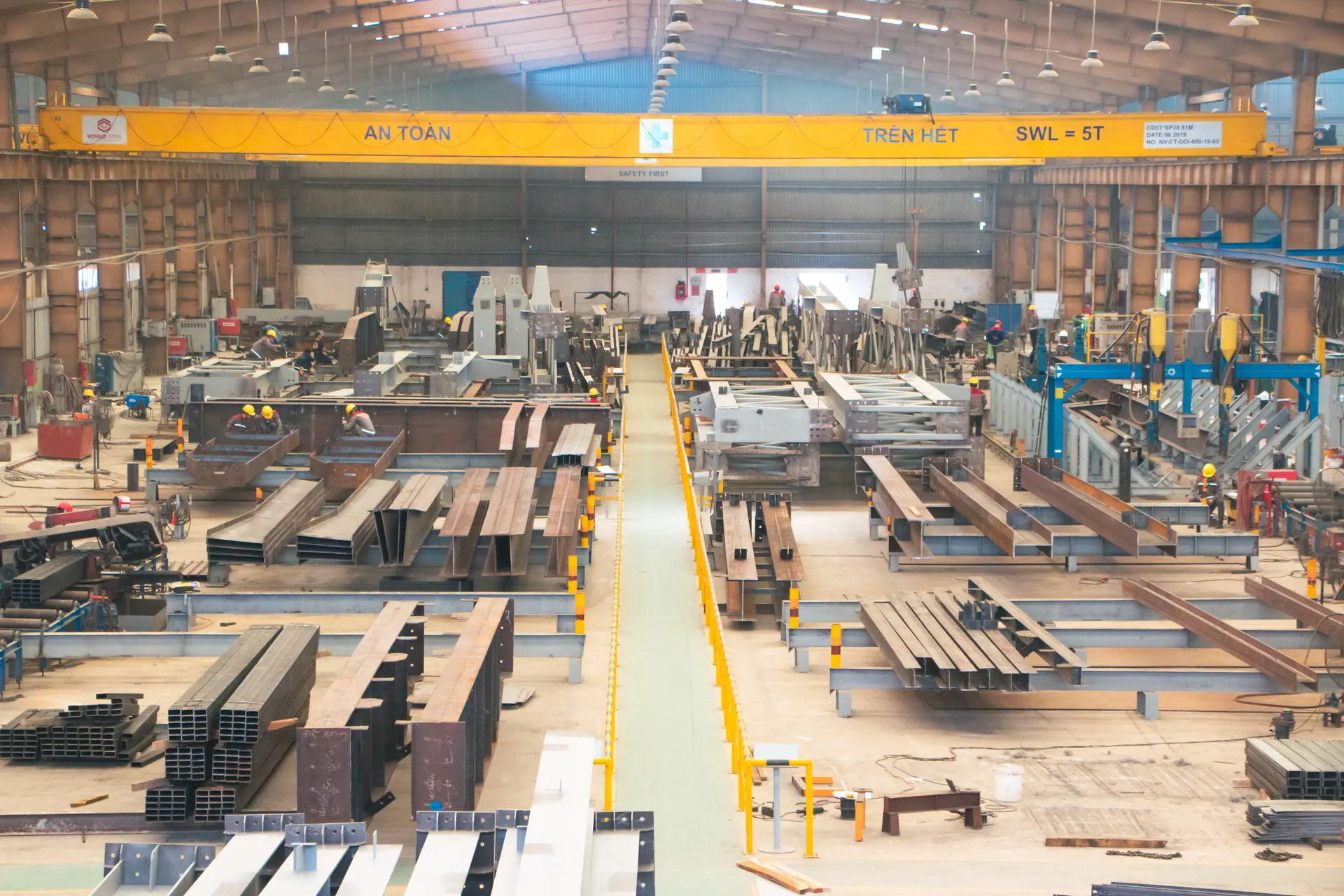
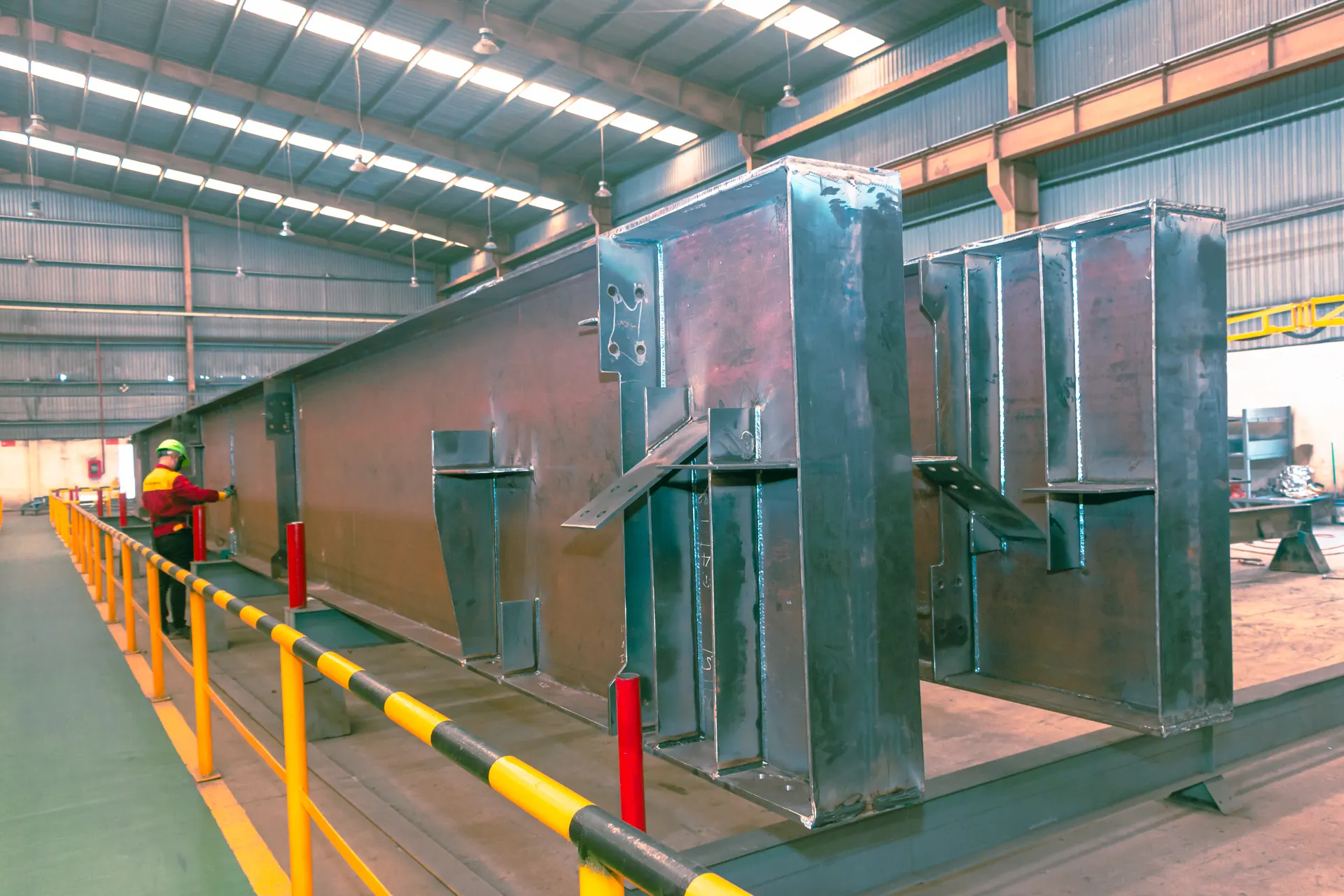
Our plant fabricates 2,500 metric tons of structural steel a month. On a large US job that is tens of thousands of welds per release: fillets on every stiffener, CJP welds on every moment connection, studs on every embed. Each weld type has its own qualified procedures, its own gauges and its own line in the inspection report, so the rules hold at volume.
- 2,500 metric tons of structural steel a month from our own plant
- First and only IAS AC472 accredited fabricator in Vietnam
- AWS D1.8-qualified procedures and welders for seismic work
- Production and inspection tracked live in PEB Studio
Questions from US reviewers
Weld type questions we hear most
Which weld type is used most on a steel building?
The fillet weld, by far. Stiffeners, clip angles, shear tabs, end plates, base plates and most web-to-flange welds on built-up members are fillet welds. Groove welds are used where a weld has to develop the full strength of the part, such as moment connections and splices.
Who decides whether a joint is fillet, CJP or PJP welded?
The Engineer of Record, on the design drawings, or the connection designer where connection design is delegated. Our detailers show the weld on the shop drawings and you review and approve them before fabrication.
Are your welds made to AWS D1.1?
Yes. Structural welds are made to written procedures qualified to AWS D1.1, by welders qualified for the process and position, and seismic welds to AWS D1.8 as well. AWS does not certify fabricators, so we say qualified to, not certified by.
What is the difference between CJP and PJP?
A complete-joint-penetration weld fuses through the full thickness of the joint and develops the strength of the part. A partial-joint-penetration weld is designed with a set effective throat that is less than the thickness. CJP welds usually need back-gouging or backing and are often UT tested; PJP welds are not.
Do you weld shear studs in the shop?
Yes, where the market allows it. We weld headed studs in our shop to AWS D1.1, for example on embed plates, column faces and beams where studs do not get in the way of the erector. Studs on beam top flanges are left for field installation where US erection rules or the contractor require it.
What is a demand-critical weld?
A weld in a seismic force-resisting system that AISC 341 names as critical to the frame’s performance, such as the CJP welds of beam flanges to columns in special moment frames. It needs notch-tough filler metal and the extra steps of AWS D1.8.
How are welds inspected?
Every weld is visually inspected by our QC. Other tests, MT, PT, UT, PAUT and RT, are performed where your specification or the code calls for them, by our QC, by the third party you designate, or, for RT, through our partner.
Can I see the weld symbols before fabrication?
Yes. Shop drawings with every weld symbol are sent to you for review and approval, and the WPS for each weld is part of the welding submittal. Production is tracked live in PEB Studio.
Send us your connection drawings
We will show the weld types, procedures and inspection behind every joint in your quote, from a plant that fabricates 2,500 metric tons a month.