
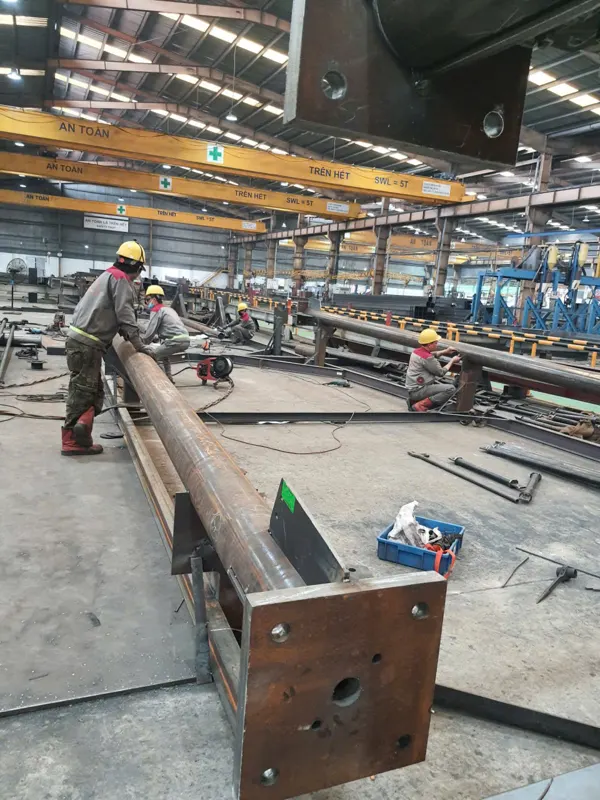
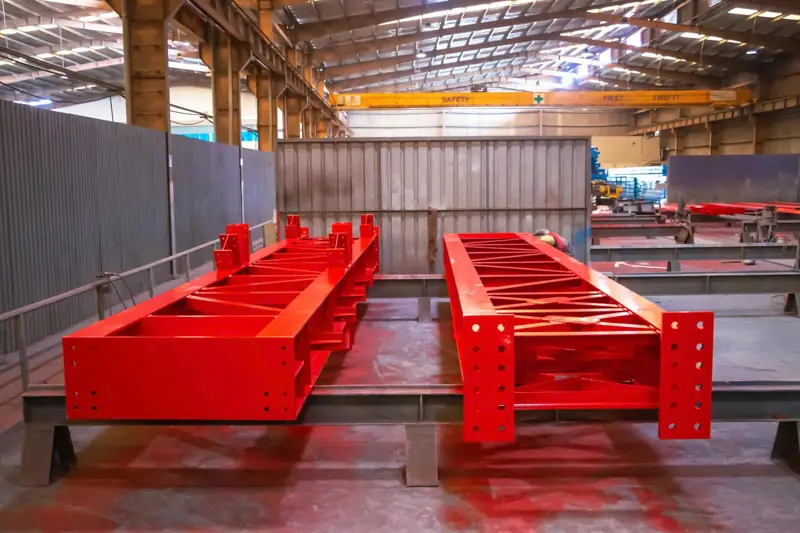
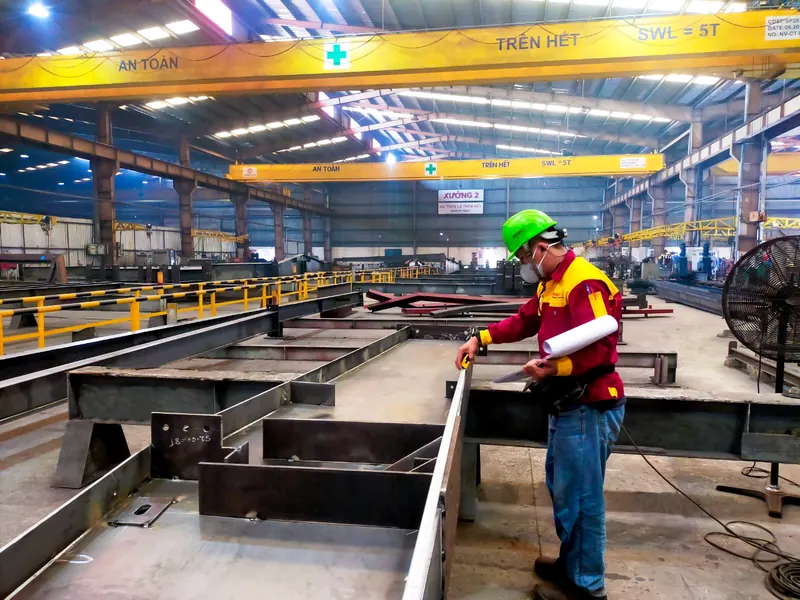
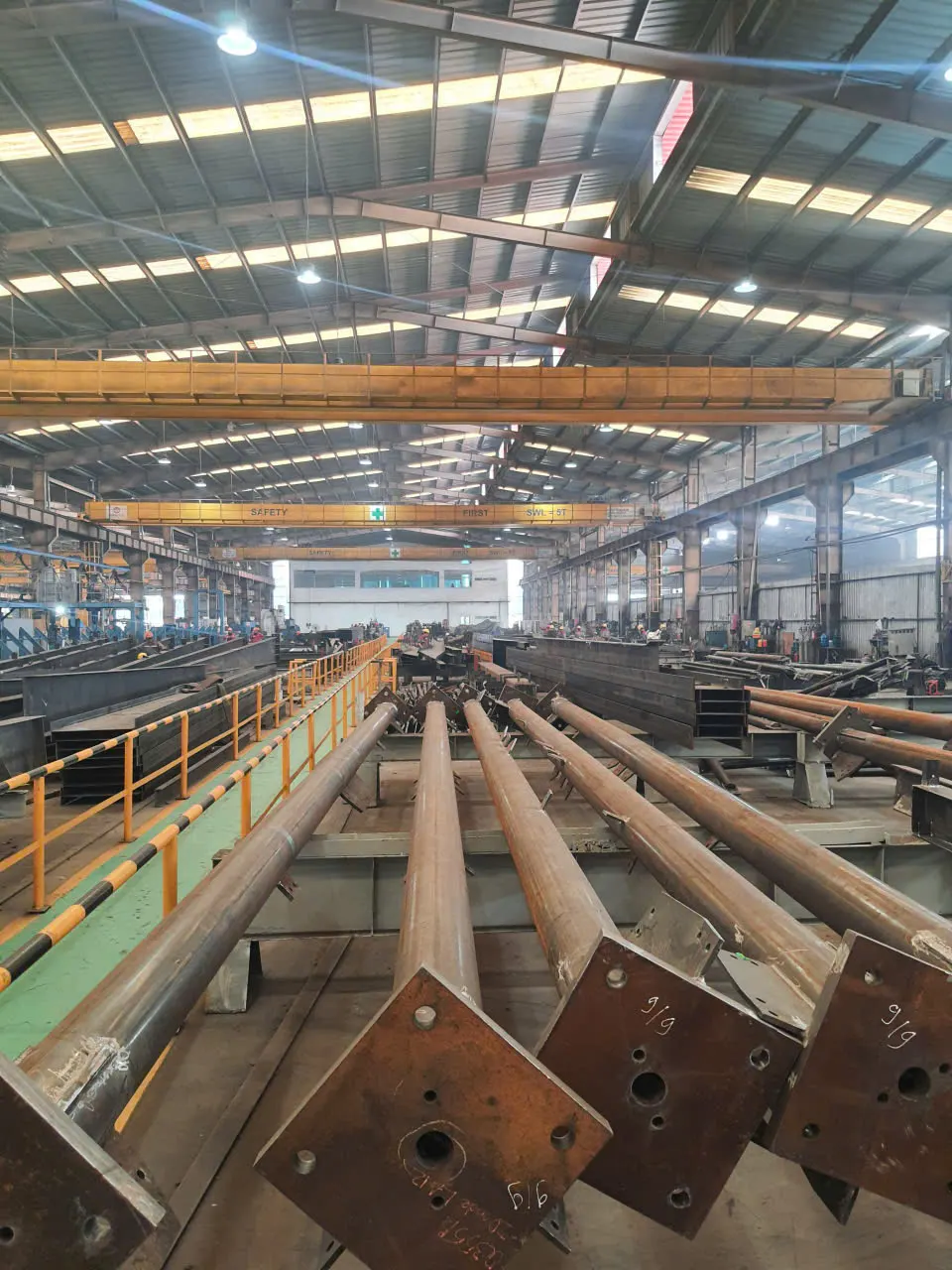
Column with its base plate and anchor-bolt holes, fabricated in the Vietnam plant.
Flare-bevel and flare-V
Flare groove welds on HSS, bent plate and bars, sized from the real corner radius
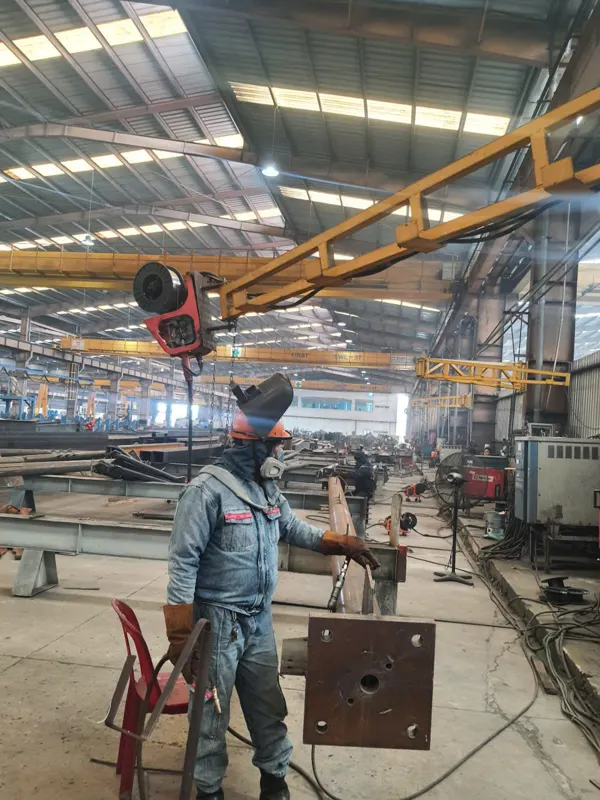
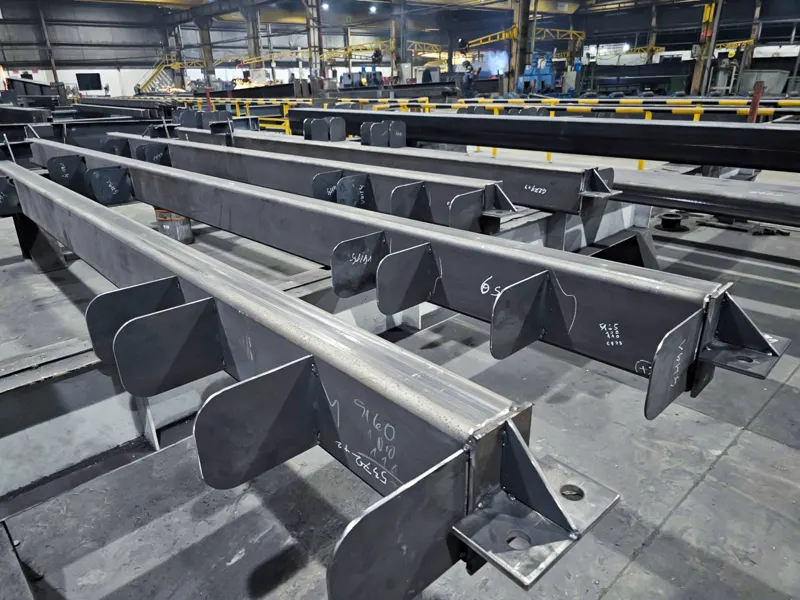
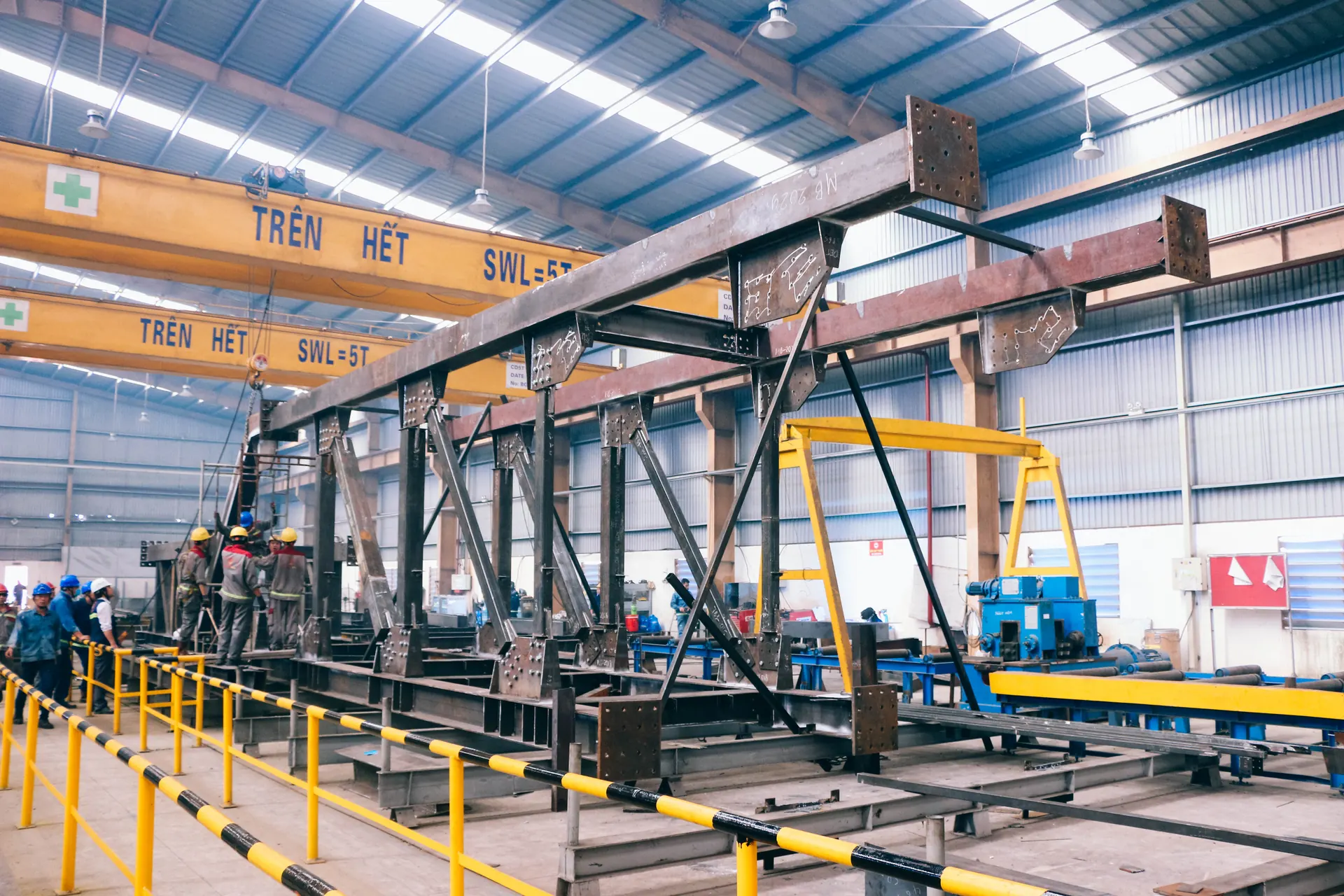
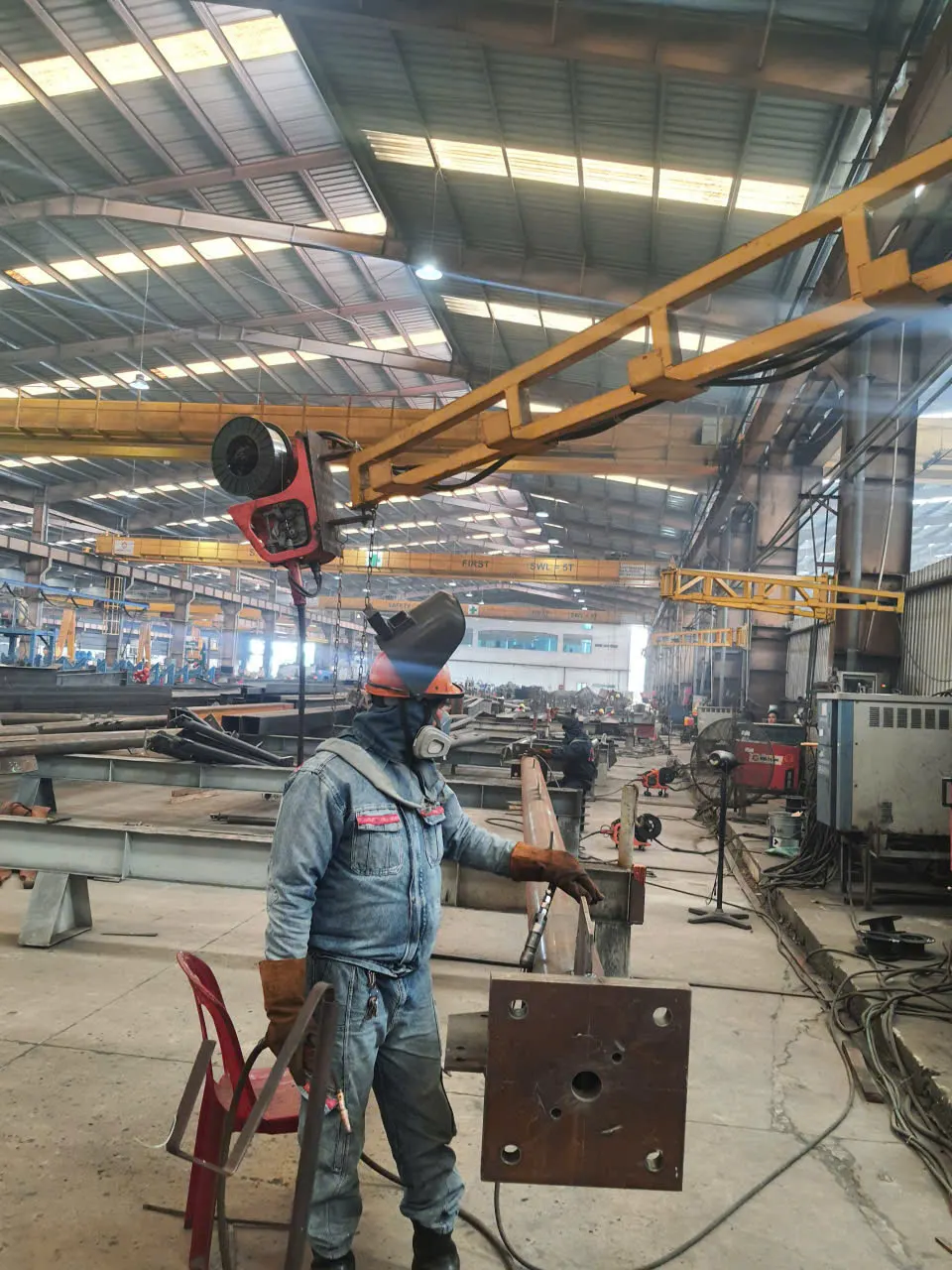
Braces, posts, tubular columns and press-braked members, welded to qualified procedures in a plant that fabricates 2,500 metric tons of structural steel a month.
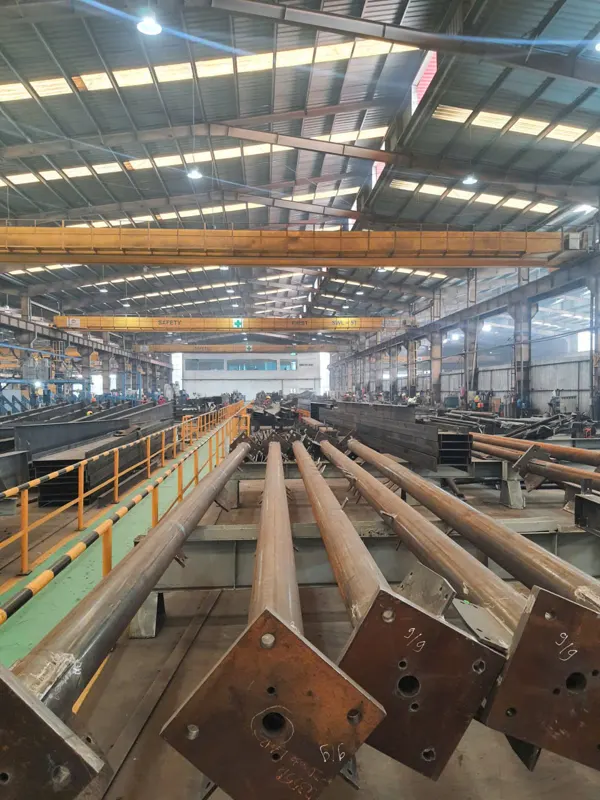
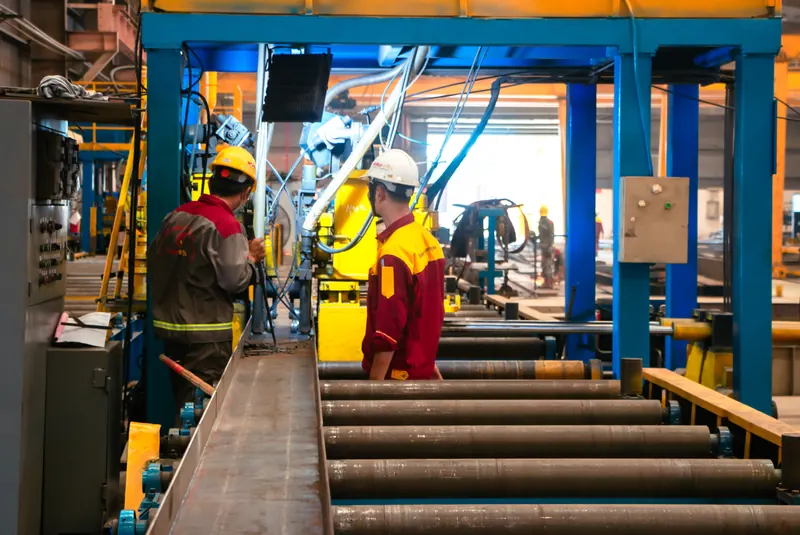
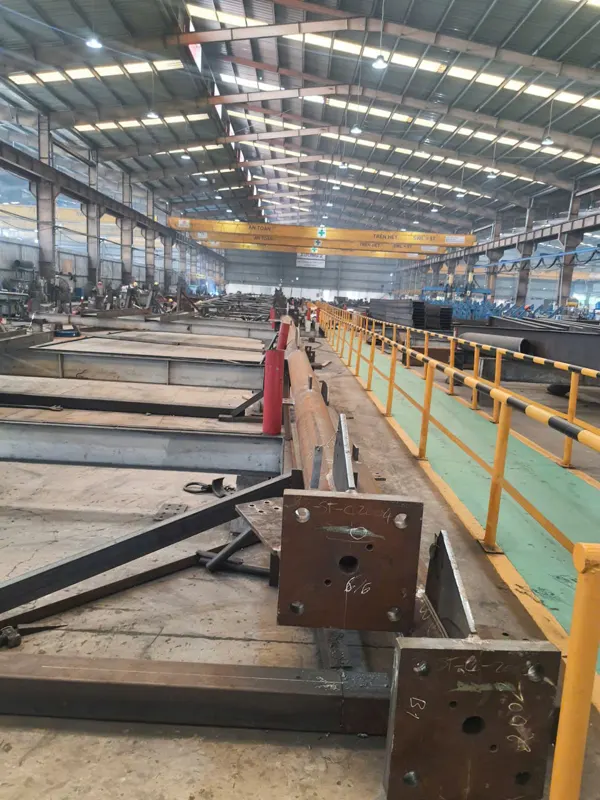
Welding against a curve
A flare weld fills the groove formed by a rounded corner
When a hollow structural section, a bent plate or a round bar meets another part, its rounded corner forms a natural groove. A weld laid in that groove is a flare groove weld: flare-bevel where one part is rounded, flare-V where both are. There is no preparation to cut, but the throat depends on the bend radius, so it has to be counted differently from a fillet or a square groove.
The radius sets the weld. A flare weld on a tube with a tight corner has less throat than the same weld on a generous one, so we read the section size, wall and corner before sizing it on the shop drawing.
Two kinds of flare
Flare-bevel and flare-V, in section
The pink circle is the outside radius R of the rounded part. The weld fills the curved groove up to the surface.
Flare-bevel groove
One rounded part against a flat one: an HSS wall against a plate, a bar against a flange.
Flare-V groove
Two rounded parts side by side: two HSS, two bent channels or two bars.
Throat from the radius
Effective throat as a fraction of R, by process
R is the outside radius of the rounded part. For HSS a radius of about twice the wall thickness is a common assumption, but the actual corner varies by mill and specification. Values paraphrased from AISC 360 Table J2.2 for welds filled flush; the edition in your contract and the qualified WPS govern.
Worked example
How much flare throat on an 8 mm HSS wall
An illustration of the arithmetic, not a design. The real corner radius is read from the section supplied.
HSS wall
8 mm (5/16 in)Outside corner radius, about 2 x wall
16 mm (5/8 in)Process
FCAW-G, flare-bevelEffective throat, 5/8 R
10 mm (0.39 in)Detailing and welding rules
Six things we watch on every flare weld
Filled flush
The tabulated throat assumes the weld is filled flush with the surface of the rounded part. An underfilled flare loses throat.
Matched width
When an HSS sits on a plate of the same width, the weld along the edge is a flare-bevel, not a fillet, and is sized as one.
Not a fillet
A fillet weld size cannot be read off a flare: a gauge on the face over-reads the throat.
Qualified procedure
Flare welds outside the prequalified conditions, or with a larger throat than the table, need a procedure qualified by test, often with sectioned macro-etch coupons.
Sheet steel
On cold-formed sheet under 4.8 mm (3/16 in), flare welds follow AWS D1.3 and AISI S100 instead.
Sections to check
Macro-etch sections of a trial weld show the real throat when the design is tight.
On our floor
Where flare welds sit on the members we ship
HSS braces and posts
HSS meeting gusset or cap plates of the same width.
Tubular columns on base plates
Where the tube corner meets the plate at the matched edge.
Bent plate members
Press-braked channels and angles welded to plates or to each other.
Round bars and rods
Bracing rods, handrail bars and anchors welded to plate.
Back-to-back cold-formed parts
Built-up cold-formed members joined along their corners.
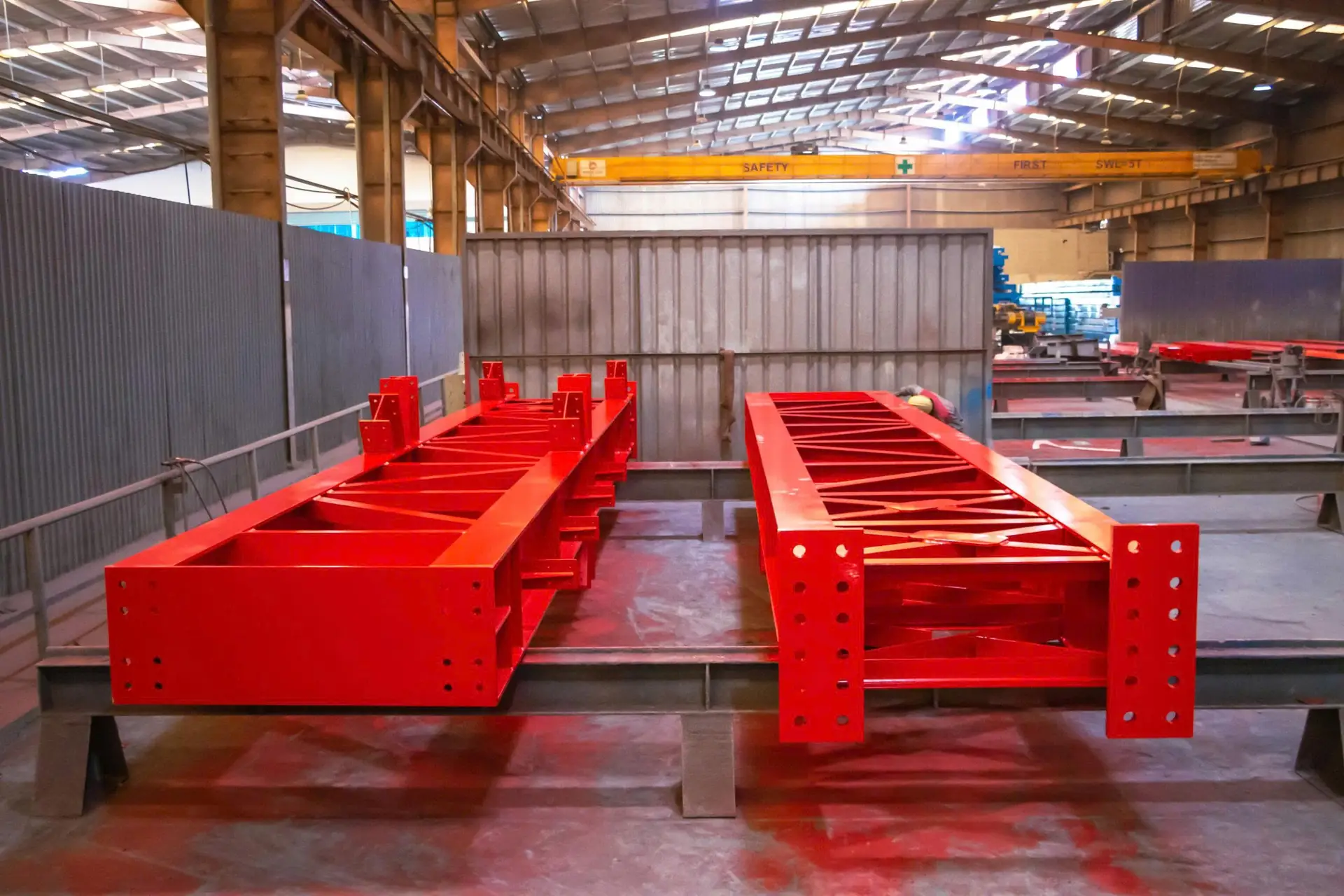
Box sections from bent plate
Closed sections assembled from two press-braked halves.
How it is tested
The NDT methods that check flare-bevel and flare-v welds
Every weld is visually inspected by our QC. The other methods run where your specification or the code calls for them, by our QC, by the third party you designate, or, for radiography, through our partner.
The other weld types
Six more welds that hold your building together
Questions
Flare-bevel and flare-V welds: questions from US reviewers
What is the difference between a flare-bevel and a flare-V weld?
A flare-bevel groove has one rounded side, such as an HSS wall against a flat plate. A flare-V groove has two rounded sides, such as two HSS side by side. Their effective throats are different fractions of the radius.
Why is the throat a fraction of the radius?
Because the depth of the natural groove depends on how tight the corner is. A tight corner leaves a shallow groove and less room for weld; a generous radius leaves more.
Is an HSS-to-plate weld a fillet weld?
Not where the HSS and the plate are the same width. Along that matched edge the tube corner forms a flare-bevel groove, and the weld is sized as one. Where the plate is wider, the weld can be a normal fillet.
Can a flare weld be measured with a fillet gauge?
Not reliably: the gauge reads the face, not the throat. Flare welds are checked for fill flush with the rounded surface and profile, and a macro-etch section is used where the throat must be proven.
Do you weld HSS?
Yes. HSS braces, posts and tubular columns are part of many of our packages, with flare, fillet and groove welds as the joint needs.
Which code covers flare welds on purlins and girts?
For cold-formed sheet steel under about 4.8 mm (3/16 in), AWS D1.3 and AISI S100. Heavier sections follow AWS D1.1 and AISC 360.
Send us your HSS and bracing details
We will size every flare weld from the real section and corner radius, and show it on the shop drawings, from a plant that fabricates 2,500 metric tons a month.