Skip to content
Seeking US contractor partners IAS AC472 ACCREDITED ★ METAL BUILDINGS ★ AC472 IAS AC472 accreditedIAS AC472
World Steel USA
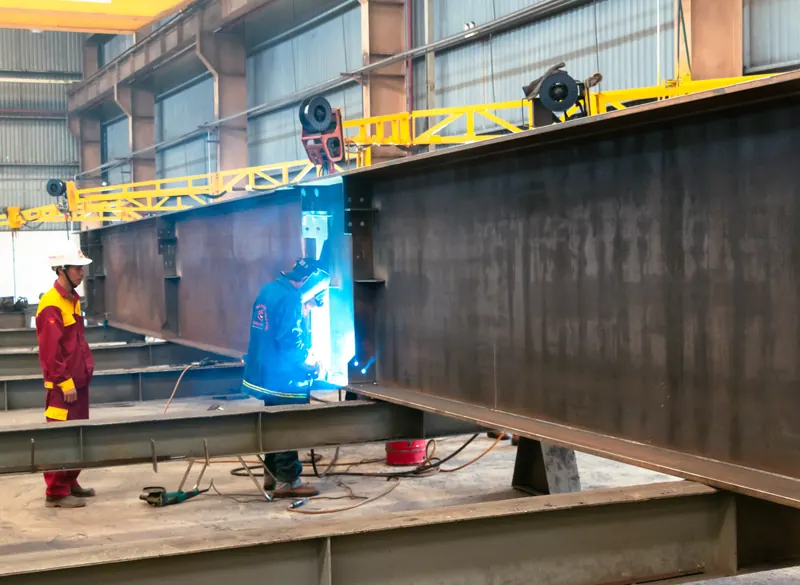
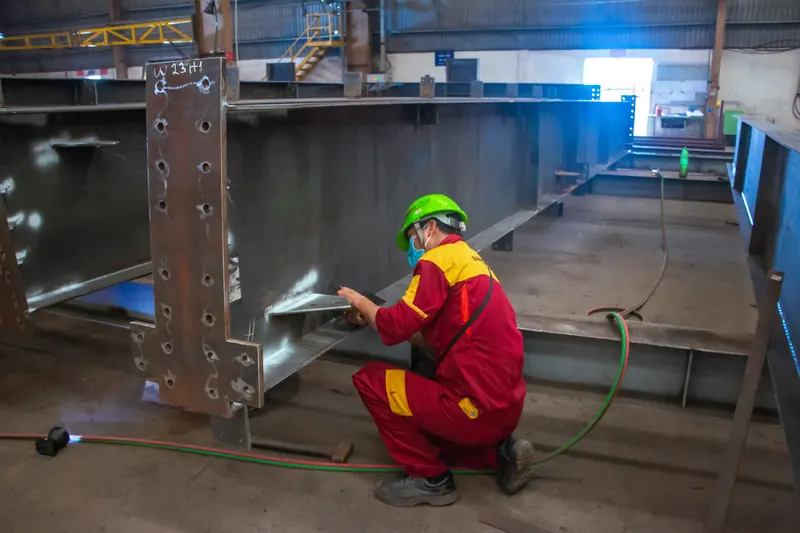
Welder looking over the stiffeners and end plate of a heavy column

Column stiffeners and end plate under inspection at World Steel, Vietnam.

Quality · Welding procedures

WPS, PQR and welder qualification to AWS D1.1, explained for US steel buyers

Every production weld on your steel follows a written procedure, rests on a tested record where the code asks for one, and is made by a welder tested for that work. This is how the three records fit together, and how our plant in Vietnam keeps them true on a US job.

Three records, one weld

WPS, PQR and WPQ: what each one answers

AWS D1.1 does not trust a weld on its looks. Before production welding starts on your members, three records must line up: how the weld is made, proof that this way of welding works, and proof that the person holding the torch can do it.

  • WPS

    Welding Procedure Specification

    How is this weld made?

    The written instruction for one family of joints: process, base metal, filler metal and shielding, joint design, position, preheat and interpass temperature, and the ranges for current, voltage and travel speed.

    Issued by the fabricator, posted at the workstation

  • PQR

    Procedure Qualification Record

    Does that way of welding work?

    The record of a test weld made under controlled conditions: the actual values used during welding, then the results of the visual, NDT and mechanical tests on the coupon. It supports a WPS that is not prequalified.

    Signed by the fabricator, with the test laboratory results

  • WPQ

    Welder Performance Qualification

    Can this welder make it?

    The record of a welder’s, welding operator’s or tack welder’s own test: the process, position and thickness tested, and the range of work it qualifies them for.

    One record per person and process, kept current

  • Kept for every job in our own IAS AC472-accredited plant in Vietnam, which fabricates 2,500 metric tons (2,750 short tons) of structural steel a month for large projects.
  • Matched on every weld report in PEB Studio: a report cannot close unless its WPS, PQR and welder check out.
  • Sent for review: your Engineer of Record approves the welding submittal with the shop drawings, before those joints are welded.

Inside a WPS

What a welding procedure specification holds, field by field

A WPS is written as ranges, not single values, so a qualified welder can work inside it and an inspector can check against it. These are the field groups on every WPS we issue for a US job.

Welding Procedure Specification

Layout for illustration. Values come from the code and the PQR for each joint.

Process and type SAW, FCAW, GMAW or SMAW; manual, semi-automatic, mechanized or automatic. Each process has its own limits and its own welder qualification.
Joint design Joint type, groove angle, root opening, root face, backing and back gouging. Prequalified WPSs must match a listed joint detail within its tolerances.
Base metal ASTM specification and grade, thickness range covered. Groups of steels decide the matching filler and the minimum preheat.
Filler metal AWS A5 specification and classification, electrode diameter, flux or gas. Strength and, where required, notch toughness come from this choice.
Position Flat, horizontal, vertical (up or down), overhead. Out-of-position welding changes heat and fusion, so it is written down.
Preheat and interpass Minimum preheat and the interpass range for the thickest part in the joint. Controls cooling rate and hydrogen, the main causes of cracking in thick steel.
Electrical settings Current type and polarity, amperage, voltage, wire feed, travel speed. Sets the heat input, which governs penetration, profile and toughness.
Technique Stringer or weave, number of passes, cleaning between passes, electrode stick-out. Keeps the weld repeatable from one welder and one shift to the next.

Joint preparation is checked against the WPS before welding at our fit-up checkpoint, and the WPS is posted where the joint is welded at the fitting and welding station.

Two routes to a valid WPS

Prequalified, or qualified by test

AWS D1.1 lists procedures proven by decades of use. A WPS that passes every check below is prequalified and needs no test coupon. Miss any one and the procedure is qualified by test, with a PQR behind it.

  • Process is SMAW, SAW, GMAW (not short-circuit transfer) or FCAWShort-circuit GMAW and other processes always need a test.
  • Base metal is in the code’s list of prequalified steelsMost ASTM A36, A572, A992 and A1011-type structural grades are listed.
  • Filler metal matches the base metal groupThe code pairs each steel group with matching AWS A5 classifications.
  • Joint detail matches a listed figureRoot opening, groove angle and root face inside the listed tolerances.
  • Preheat and interpass at least the table minimumSet by steel group and thickness of the thickest part.
  • Settings inside the prequalified limitsElectrode size, current, layer thickness and bead width as the code allows.

Every check passes

Prequalified WPS

Written, reviewed and followed like any other WPS, and checked in production. No PQR is required. A prequalified WPS does not mean an unwritten one.

Any check fails

WPS qualified by test

A test coupon is welded to the proposed WPS and tested. The PQR records the result, supports the WPS and goes to your Engineer of Record and inspector for review.

What a PQR goes through

One test plate, welded, inspected, cut and broken

For a complete-joint-penetration groove procedure, the code sets the tests below. The PQR records the actual values used to weld the coupon and every result.

Illustrative cut plan of a PQR groove-weld test plate: discard ends, two reduced-section tension specimens and four side bend specimens across the weld Discard T B B T B B Discard Weld runs along the plate; specimens are cut across it
T reduced-section tensionB side bendPositions and sizes follow the code figure for the plate thickness; this layout is for illustration.
  • Visual inspection

    The whole test weld

    No cracks, full fusion, acceptable profile and undercut.

  • Radiographic or ultrasonic testing

    The whole test weld

    No internal defects beyond the acceptance criteria.

  • Reduced-section tension

    Two specimens

    The joint is at least as strong as the specified minimum tensile strength of the base metal.

  • Side bend

    Four specimens (root and face bends on thinner plate)

    The weld and heat-affected zone bend without opening up, which shows ductility and soundness.

  • Macroetch

    Sections through fillet and partial-penetration test welds

    Fusion, penetration and weld size visible to the eye after etching.

  • Charpy V-notch (CVN)

    Only when your contract documents ask for it

    Notch toughness of the weld metal and heat-affected zone at the specified temperature.

Thickness range: a groove coupon 25 mm (1 in) or thicker qualifies the WPS for 3 mm (1/8 in) up to unlimited thickness. Thinner coupons qualify a narrower range. Weld inspection on production members is covered on our weld inspection and NDT checkpoint.

Essential variables

The changes that send a procedure back to the test bench

A PQR qualifies a WPS only inside the essential variables it tested. These changes, beyond the limits in the code’s tables, need a new PQR before the WPS can be revised and used.

  • A change of welding processNew PQR. SAW results never qualify FCAW, and the reverse.
  • A different filler metal classification or flux and wire combinationNew PQR, unless the code treats the two as equivalent.
  • A change in shielding gas or its mix outside the allowed rangeNew PQR for gas-shielded processes.
  • A base metal from a higher-strength group than the one testedNew PQR. A lower-strength group within the code’s rules is covered.
  • Preheat or interpass lowered below the qualified valueNew PQR. Raising preheat within limits is allowed.
  • Current, voltage or travel speed beyond the qualified rangeNew PQR. The code gives the allowed percentage band for each setting.
  • A thickness outside the range the coupon qualifiesA 25 mm (1 in) groove coupon covers unlimited thickness; thinner coupons cover less.
  • Heat input beyond the tested value when CVN is requiredSupplementary essential variable: toughness must be proven again.

Non-essential changes, such as a different electrode brand of the same classification, are made by revising the WPS without a new test. Every revision is controlled and the version in use is the one on the weld report.

Welder Performance Qualification

Who gets tested, in which positions, and for how long

The procedure can be perfect and the weld still poor. So AWS D1.1 qualifies the people too: by process, position and thickness, each with their own record.

  • Welders

    Manual and semi-automatic welding. Tested by process, position and thickness on a groove or fillet coupon, then visually inspected and bend tested or radiographed.

  • Welding operators

    Mechanized and automatic welding, such as the submerged arc beam lines. Tested on the equipment they run, under a qualified WPS.

  • Tack welders

    Tacks become part of the final weld, so tack welders take their own simpler test for the process and position they tack in.

Test position and what it qualifies, plate groove welds

TestWelded inQualifies groove welds in
1GFlatFlat
2GHorizontalFlat and horizontal
3GVerticalFlat, horizontal and vertical
4GOverheadFlat and overhead
3G + 4GVertical and overheadAll positions

Simplified from the code’s qualification tables. Fillet tests (1F to 4F) and pipe tests (such as 6G) have their own ranges.

  • A welder’s qualification stays valid with no expiry date, as long as the welder keeps using the process.
  • If the welder has not used the process for six months, the qualification lapses and the welder is retested.
  • If there is a specific reason to question the welder’s ability, for example repeated rejected welds, the welder is retested.
  • A 10 mm (3/8 in) plate test covers up to 20 mm (3/4 in); a 25 mm (1 in) plate test covers unlimited thickness.

US codes and standards

Where WPS and PQR rules come from on a US job

AWS D1.1 holds the rules. The other documents your specification names decide when they apply, what is added for seismic work and who checks them. Each card opens our full page on that document.

AISC 360 Chapter N

Checked before the first arc

The specification lists inspection tasks before welding for the fabricator’s QC and, where the project has one, the owner’s QA. Our QC performs or observes each one; your inspector observes as the table and your ITP set.

  • Welding procedure specifications available
  • Manufacturer certifications for welding consumables available
  • Material identification, type and grade
  • Welder identification system in place
  • Welder qualification and continuity records
  • Fit-up of groove and fillet welds

At our plant in Vietnam

How World Steel keeps procedures and welders true on your job

Procedures and qualifications are written once. Keeping them true across thousands of welds is the daily work of our QC team, and part of every IAS AC472 audit held twice a year.

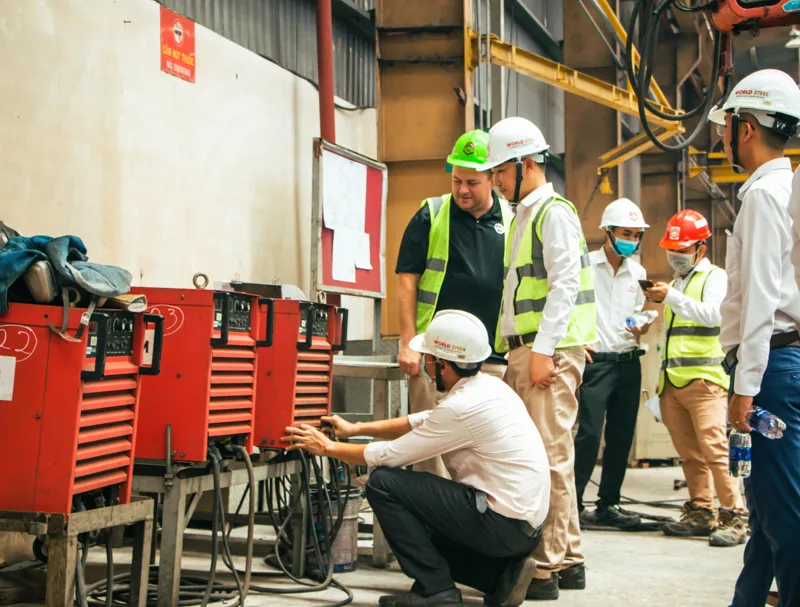
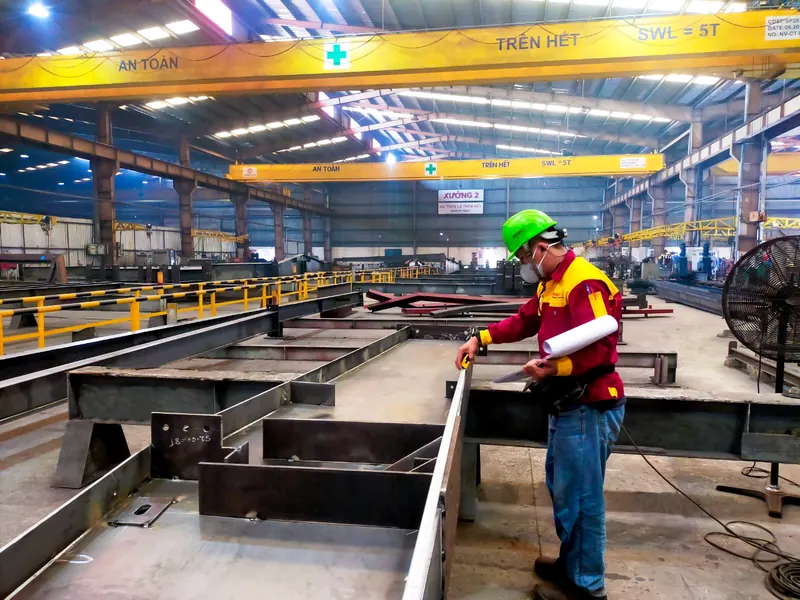
  • Checking welding machines and settings at the welding stations

    A WPS for every joint family

    Each joint type on your shop drawings is matched to a WPS before release. Prequalified procedures are written and checked like any other; anything outside the limits is qualified by test first.

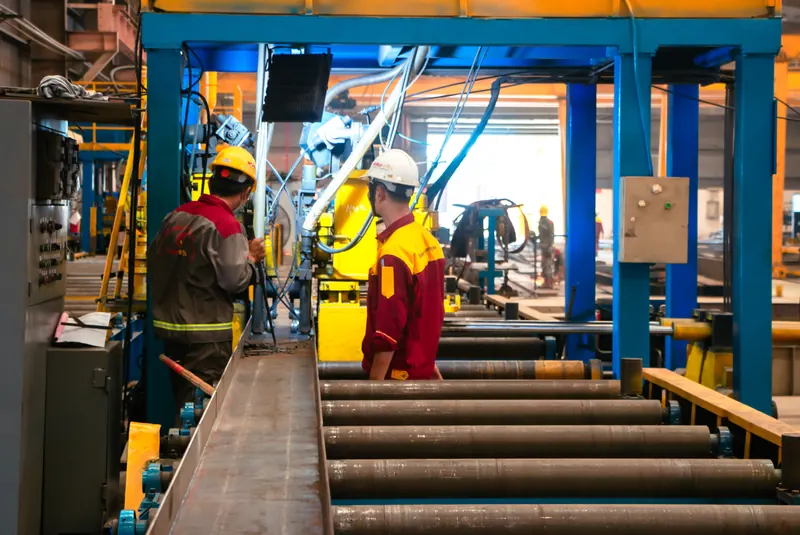
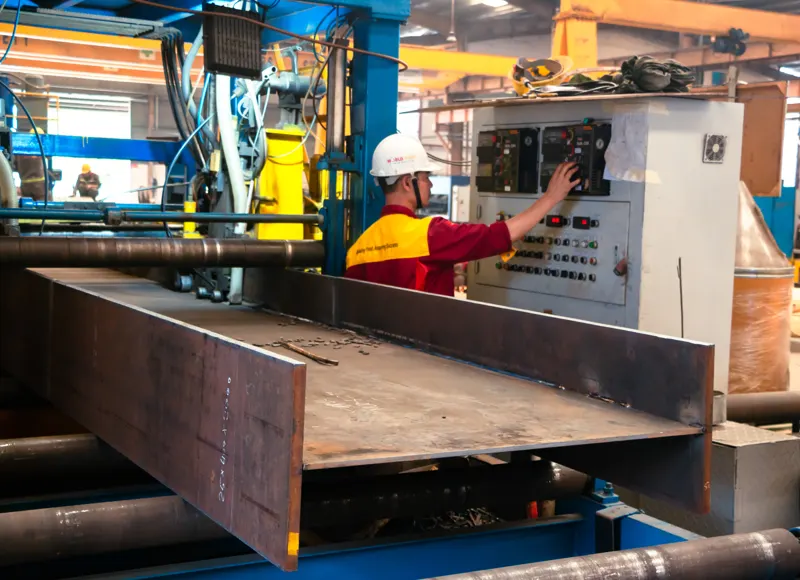
  • Operator at the control panel of an automatic beam welding line, a built-up beam in front

    Submerged arc on the beam lines

    Web-to-flange seams of built-up members run on automatic SAW lines by qualified welding operators. Fitted parts are welded by FCAW or GMAW, each under its own WPS.

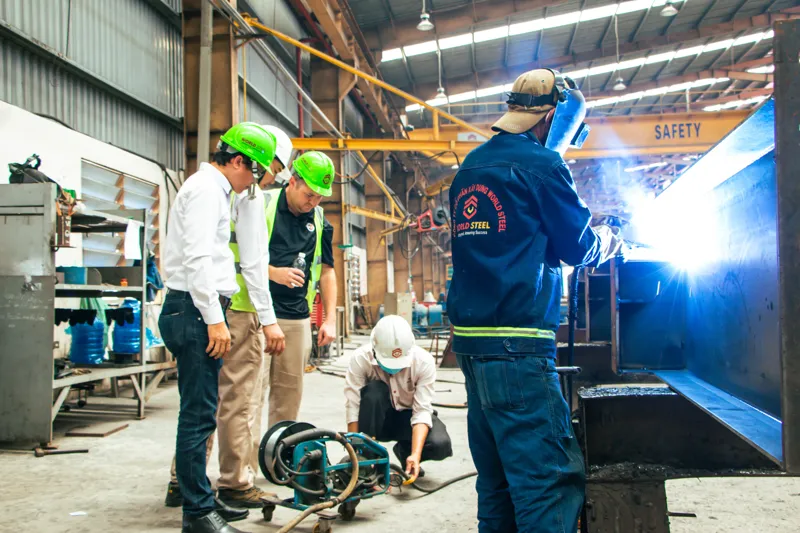
  • Witnessing production welding on a built-up frame member

    Welders tested to AWS D1.1

    Welders are qualified by test in accordance with AWS D1.1 for the processes and positions they weld, and our AWS D1.8-qualified procedures and welders take the demand-critical welds.

  • Welder looking over the stiffeners and end plate of a heavy column

    Settings checked at the machine

    QC inspectors check actual current, voltage and travel speed against the WPS at random during production, and record them in the Welding Inspection Report.

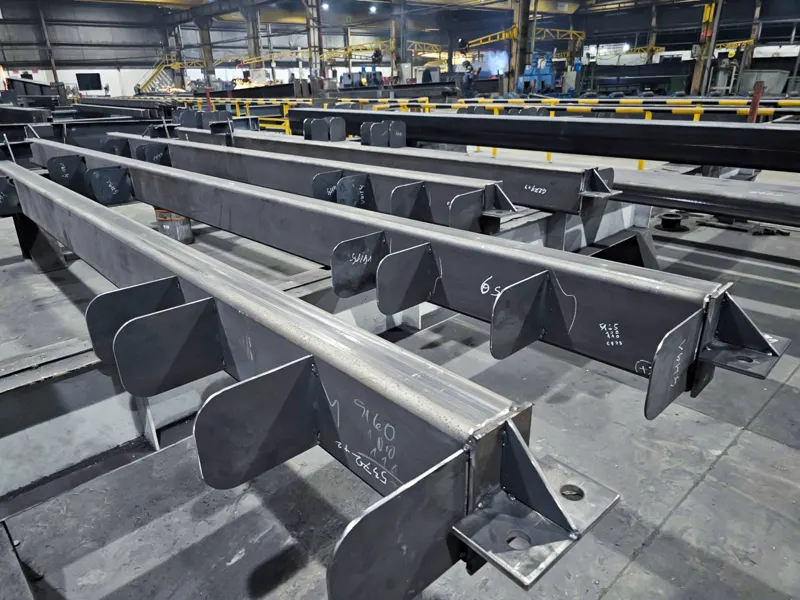
  • Built-up members with welded stiffeners and drilled clip plates on shop supports

    Preheat before the arc

    Base metal is preheated when the WPS calls for it, and whenever it is thicker than 38 mm (1 1/2 in).

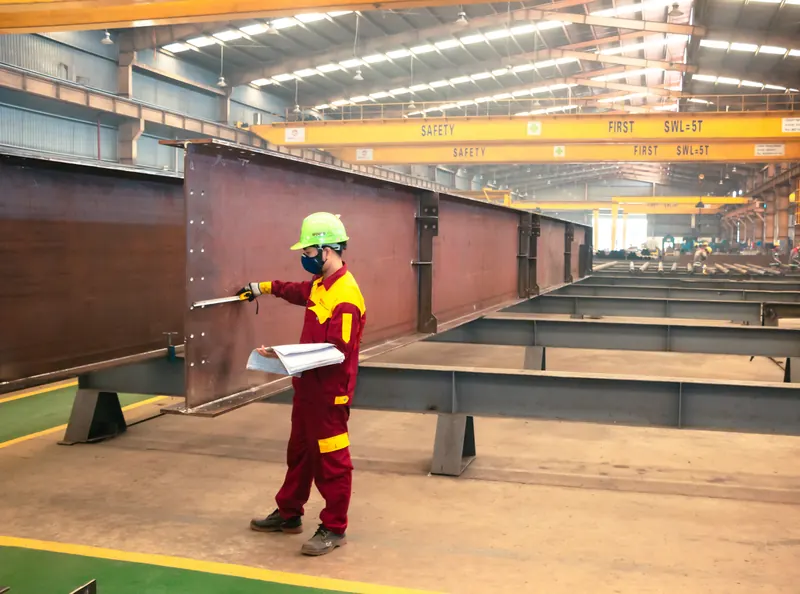
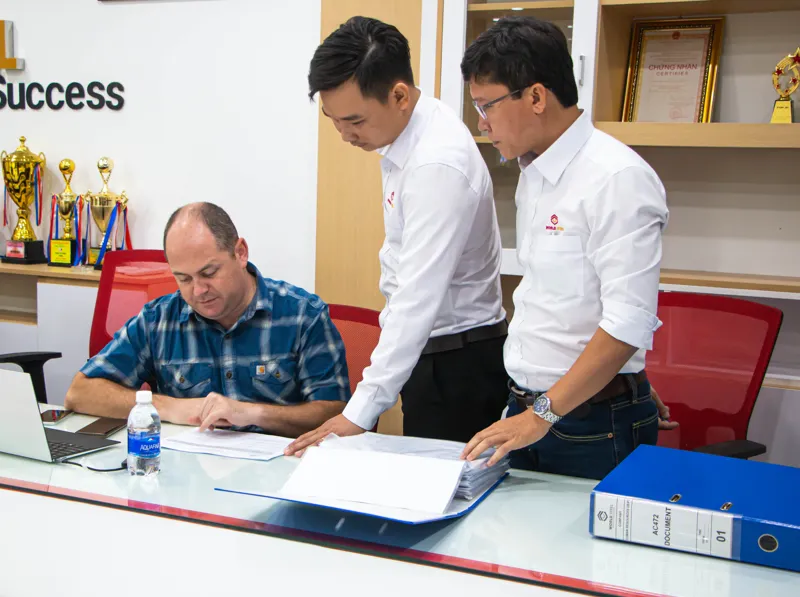
  • Reviewing procedures, qualification records and quality documents

    Every weld report matched

    In PEB Studio a weld report closes only when its WPS, PQR and welder qualification check out. Welding Inspection Reports are kept for three years.

Our welding quality system is also certified to EN ISO 3834-2 by Bureau Veritas. Mill certificates to EN 10204 3.1, with Charpy values on request, match the base metal on each WPS.

Before fabrication

The welding submittal you receive with the shop drawings

AISC 360 Chapter N names these documents. We send them as one package so your Engineer of Record and inspector review the welding of your job in one place.

  • WPS list by joint typeCross-referenced to the weld symbols on your shop drawings.
  • Each WPSPrequalified or qualified, with its code basis named.
  • Supporting PQRsWith laboratory test results, for every WPS not prequalified.
  • Welder and operator recordsWPQ for each person who welds your members, with continuity.
  • Filler metal certificatesAWS A5 conformance, plus toughness and hydrogen data for seismic welds.
  • Inspection and Test PlanWhere your inspector reviews, witnesses or holds the welding.

See where these records sit in the data book on our quality records page, how they are handed over in the project handover documents, and read a sample Inspection and Test Plan.

  • World Steel, fabricator

    • Writes the WPSs and qualifies any that are not prequalified
    • Tests and keeps welders, operators and tack welders qualified
    • Checks settings in production and files every weld report
  • Your inspector or agency

    • Reviews the WPS, PQR and welder records against the job
    • Witnesses a procedure or welder test, in Vietnam or by video
    • Observes the AISC 360 checks before, during and after welding
  • Your Engineer of Record

    • Specifies weld sizes, CJP welds and any CVN requirement
    • Marks demand-critical welds on seismic frames
    • Approves the welding submittal and any qualification outside the code

Questions from US contractors

Questions about WPS, PQR and welder qualification

What is the difference between a WPS and a PQR?

The WPS is the instruction the welder follows on production work. The PQR is the record of the test weld that proved the procedure, with the actual settings used and the test results. A prequalified WPS needs no PQR; a WPS qualified by test must be supported by one.

Is a PQR required for every WPS under AWS D1.1?

No. A WPS that stays inside every prequalified limit of AWS D1.1, from process and base metal to joint detail, filler metal, preheat and settings, can be used without a procedure test. Step outside any one limit and the WPS needs a supporting PQR.

What does WPQ mean on a submittal?

Welder Performance Qualification: the record that a named welder passed the test for a process, position and thickness range. Welding operators on automatic equipment and tack welders have their own qualification records.

Can one PQR support several WPSs?

Yes. A single PQR can support more than one WPS, as long as each WPS stays inside the ranges the PQR qualifies. Equally, one WPS can rest on more than one PQR, for example to cover a wider thickness range.

How long is a WPS or a PQR valid?

A qualified procedure does not expire. It stays valid as long as the essential variables written in it are respected. If a variable changes beyond its range, a new PQR is needed.

Will you accept a WPS qualified under ASME Section IX?

An ASME Section IX qualification is not automatically valid under AWS D1.1. Your Engineer decides whether earlier qualifications can be accepted; otherwise we qualify the procedure to AWS D1.1 before production.

Who witnesses a PQR test?

Our QC team runs the test weld and records the actual values, and the coupons go to a testing laboratory for the mechanical tests. Your inspector or agency can witness the welding and the testing in Vietnam or live by video, if you set it as a witness point in the ITP.

Do you need Charpy testing in the PQR?

Only when your contract documents call for notch toughness, as is common for demand-critical seismic welds and some heavy or low-temperature work. Then the PQR includes CVN tests, and heat input becomes a supplementary essential variable.

Can a welder qualified with another employer weld on our job?

AWS D1.1 lets the Engineer accept properly documented earlier qualifications. In practice every welder on your members is qualified and tracked by World Steel, so their records come with our submittal.

What is a welding operator, and why are they qualified separately?

A welding operator runs mechanized or automatic equipment, such as our submerged arc beam lines, rather than holding the torch. Their skill is in setting up and running the machine, so they are tested on that equipment under a qualified WPS.

Does AWS D1.8 change the WPS for seismic frames?

Yes, for the demand-critical welds. Filler metals must meet notch-toughness and diffusible hydrogen limits, procedures are run inside a tested heat-input envelope, and welders get the supplement’s extra training and tests where required.

Do you send the WPS and PQR before fabrication starts?

Yes. The welding submittal goes with the shop drawings for your Engineer of Record’s review: the WPS list matched to the joints, each WPS, the supporting PQRs, welder records and filler metal certificates. Fabrication of those joints follows approval.

Are the welding records part of the final data book?

Yes. The WPS, PQR and welder records sit in the welding section of the data book with the weld and NDT reports, filed by piece mark in PEB Studio and exported to PDF at handover.

Does AWS certify World Steel as a company?

AWS D1.1 does not certify fabricators as companies. It requires qualified procedures, qualified welding personnel and inspection, which we provide on each job, together with EN ISO 3834-2 certification of our welding quality system by Bureau Veritas and IAS AC472 accreditation of our plant.

Send us the weld schedule for your job

Mark the CJP welds, the seismic welds and any toughness requirement. We will match each joint to a qualified WPS, or qualify a new one and send you the PQR before production.