
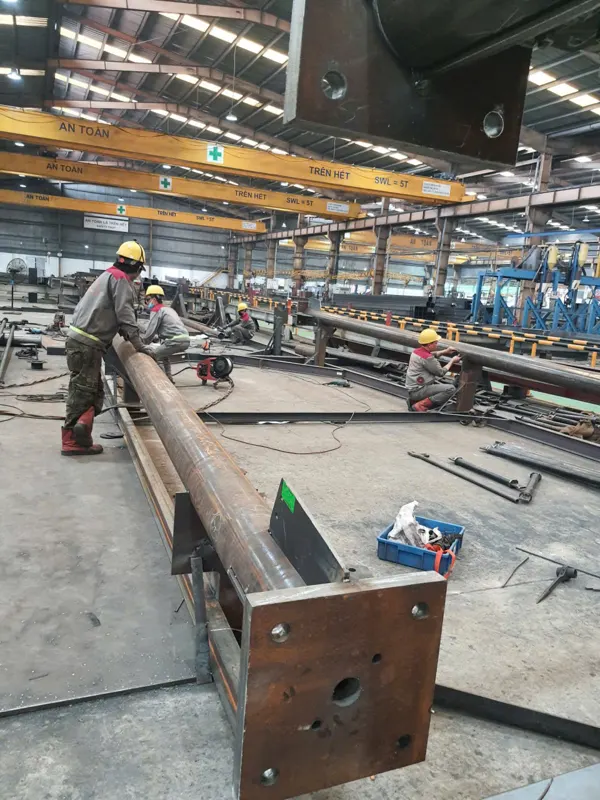
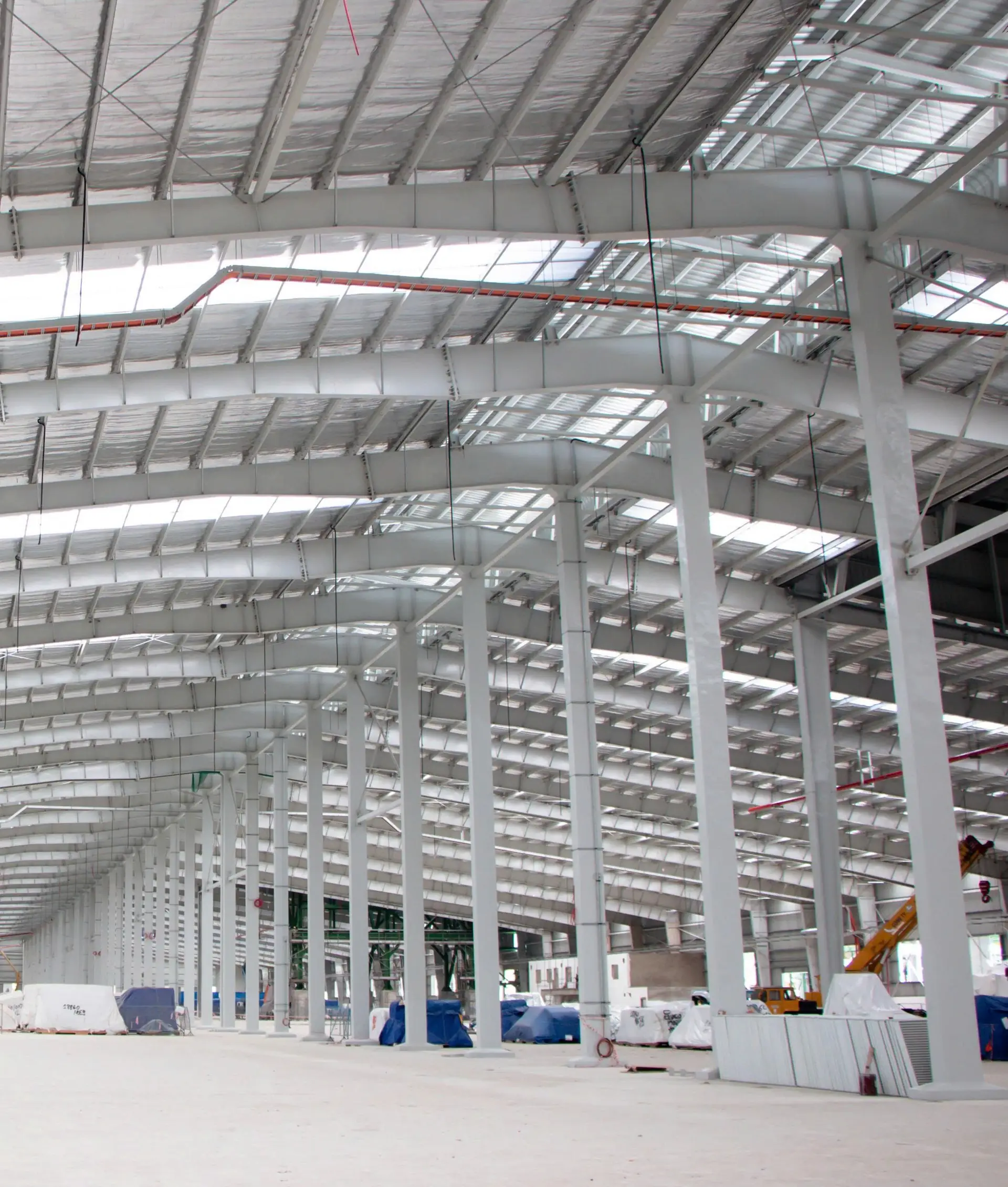
Column with its base plate and anchor-bolt holes, fabricated in the Vietnam plant.
Stud arc welding
Drawn-arc stud welding set up, tested and run to the AWS D1.1 stud clause
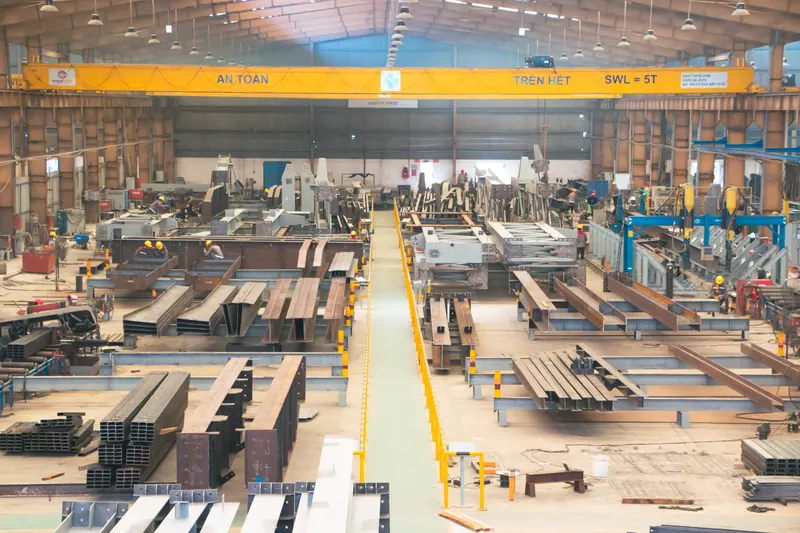
Power sources, controllers, guns and ferrules set from the stud maker’s data and proven on test studs before every run, in a plant that fabricates 2,500 metric tons of structural steel a month.
Behind the gun
Stud arc welding is a timed, automatic weld: the settings do the welding
In drawn-arc stud welding (SW) the operator places the gun and pulls the trigger; the rest is automatic. A DC power source and controller set the current and time, the gun lifts the stud to draw an arc and plunges it into the pool, and a ceramic ferrule shapes the weld. Because the weld takes a fraction of a second, quality is set before production: the right stud, the right settings and a test on the first studs of every run.
A stud weld is decided by four numbers on the controller and gun: current, time, lift and plunge. We set them from the stud maker’s data and prove them on test studs before production starts.
Stud welds: which studs we weld in the shopThe equipment chain
Six parts from the power source to the stud
Each part has a job in a weld that lasts under a second. If one is wrong, the pre-production test shows it before production starts.
DC power source
A transformer-rectifier or inverter sized for the stud diameter, with heavy output current for short times.
Controller
Sets the weld time and, on many units, the current, and switches the arc on and off.
Stud gun
Holds the stud in a chuck, sets lift and plunge, and fires the cycle from the trigger.
Cables and ground
Heavy weld and ground cables, with balanced ground clamps so the arc does not blow to one side.
Ceramic ferrule
A single-use ring that concentrates heat, holds the molten metal and shapes the flash.
Stud with flux load
A headed stud with a flux tip that starts the arc and deoxidises the weld.
On the controller and gun
Four settings make the weld
Starting values come from the stud manufacturer for each diameter. They are adjusted on test studs until the pre-production tests pass, then held for the run.
Current
Set by stud diameter; too low gives a cold weld, too high an undercut, blown flash.
Time
The arc time, a fraction of a second, set with the current.
Lift
How far the gun lifts the stud to draw the arc.
Plunge
How far the stud protrudes past the ferrule, so it drives into the pool.
AWS D1.1
Four checks between the stud box and the finished member
Paraphrased from the AWS D1.1 stud welding clause and its stud base qualification annex.
Stud base qualification
The stud manufacturer qualifies each stud base and ferrule by test under the AWS D1.1 annex and certifies it.
Pre-production test
The first two studs of each set-up and shift are welded and bent; this also serves as operator qualification.
Application qualification
Positions or conditions outside the code’s usual cases, such as welding through deck, are qualified by test.
Production inspection
Every stud is checked for full flash; doubtful studs are bent, and failures replaced.
Weather and surface
When a stud must not be welded
Paraphrased from AWS D1.1. Our shop studs are welded inside the fabrication halls; these limits matter most to field studs welded by the US contractor's crew.
No stud welding when the base metal is this cold.
Extra studs are tested during production while it stays this cold.
No welding on wet steel, or in rain or snow on the joint.
Heavy rust, mill scale, paint or oil at the stud location are removed first.
Two stud processes
Drawn arc for shear studs, capacitor discharge for pins
Both fire a stud from a gun, but only drawn-arc stud welding with a ferrule makes the shear connectors AWS D1.1 and AISC 360 rely on.
| Drawn arc | Capacitor discharge | |
|---|---|---|
| Arc time | About 0.1 to 1 second | A few milliseconds |
| Stud size | Headed shear studs, 13 to 22 mm (1/2 to 7/8 in) and more | Small pins and threaded studs |
| Ferrule | Ceramic ferrule and flux-loaded tip | No ferrule, a small tip on the stud |
| Use on structural steel | Shear connectors and anchors to AWS D1.1 | Insulation pins and light fixings, not shear connectors |
On the WPS
Six things the procedure fixes for SW
Every weld is made to a written welding procedure specification, prequalified or qualified by test to AWS D1.1 (and AWS D1.8 for seismic welds), by a welder or operator qualified for it.
Stud and ferrule
Stud type, diameter and the matching qualified ferrule.
Current and time
Weld current and arc time for the diameter.
Lift and plunge
Gun settings for arc length and stud protrusion.
Polarity and grounding
DC polarity and ground clamp positions.
Position
Flat (downhand) as usual; other positions only as qualified.
Tests and records
Pre-production bend results and production inspection, by piece mark.
The other processes
Four more ways we weld your steel
Questions
SW questions from US reviewers
Who qualifies the stud welding operator?
Under AWS D1.1, the pre-production test of the first two studs of each set-up and shift also serves as the operator’s qualification. The results are recorded with the member.
What is stud base qualification?
A test program, run by the stud manufacturer under an annex of AWS D1.1, that proves a stud base and its ferrule make sound welds. We use studs supplied with that qualification.
Can studs be welded in cold or wet weather?
Not when the base metal is below -18 °C (0 °F) or wet. Below 0 °C (32 °F), extra studs are tested during production. Our studs are welded inside the fabrication halls.
What settings matter most?
Current, time, lift and plunge. They start from the stud maker’s data for the diameter and are adjusted on test studs until the bend tests pass, then held for the run.
Do you use capacitor discharge stud welding?
Not for shear connectors. Headed shear studs are drawn-arc welded with ceramic ferrules to AWS D1.1. Capacitor discharge is for small pins and light fixings.
Which studs do you weld in the shop?
Embed plates, column faces and member sides, plus top flanges where the erection plan allows. Studs on top flanges walked on before the deck are welded in the field. The stud welds page explains the split.
Send us your stud schedule
We will set up the guns for your stud sizes and show the pre-production test records, from a plant that fabricates 2,500 metric tons a month.