
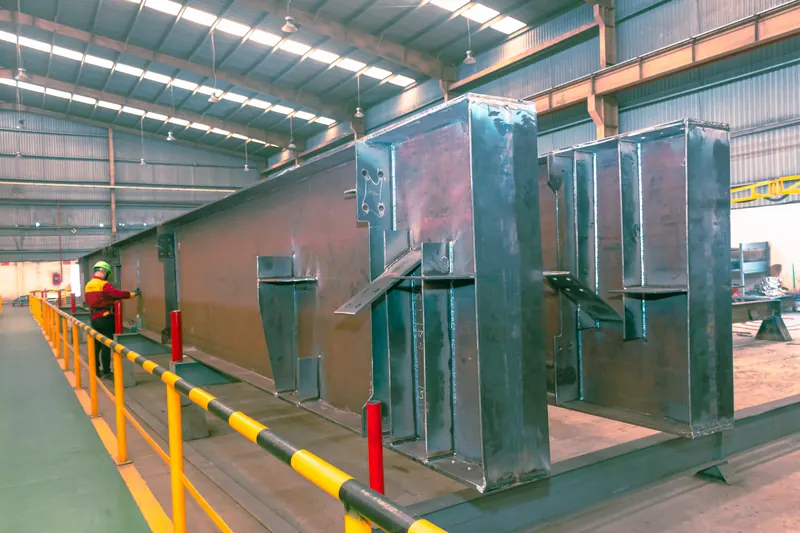
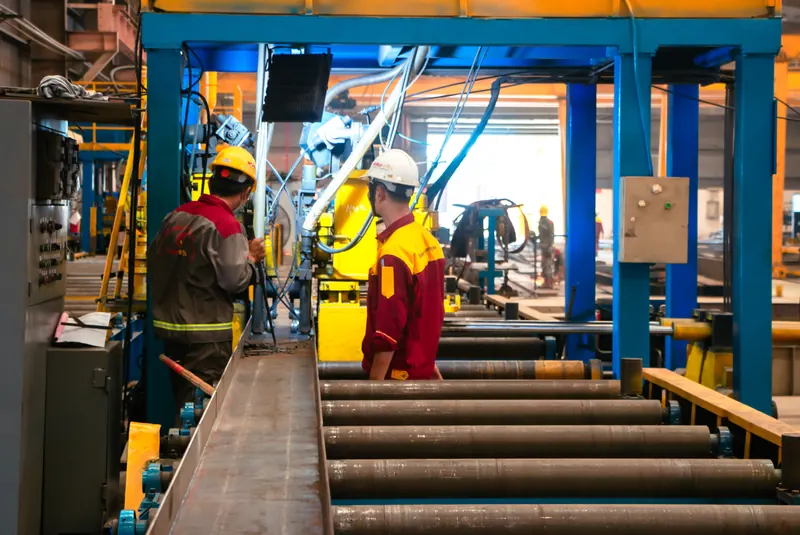
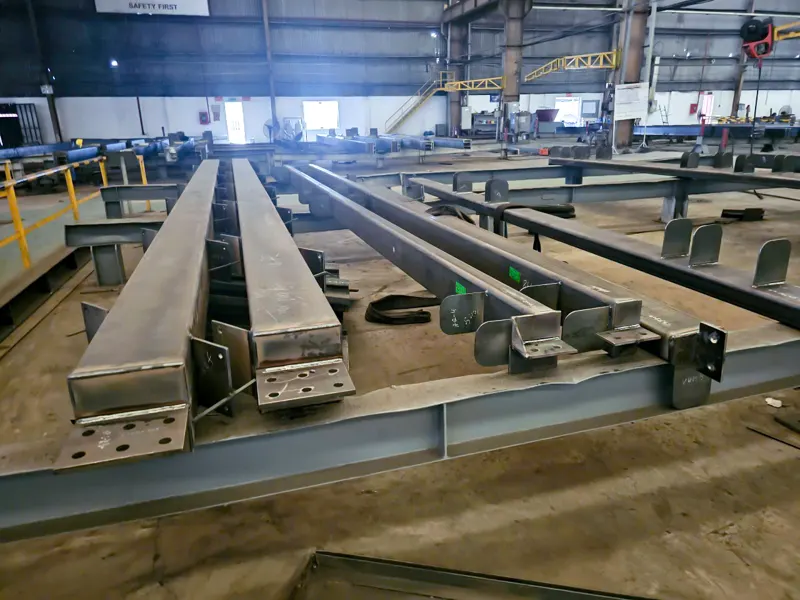
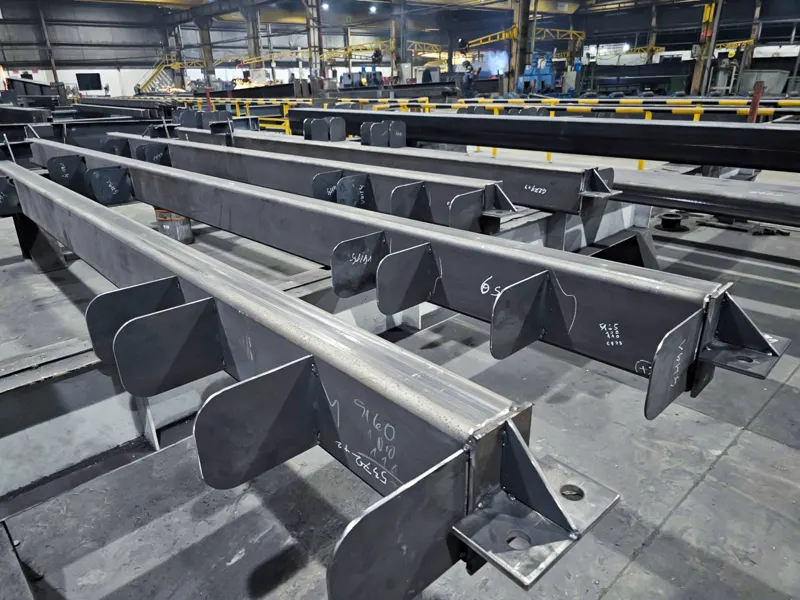
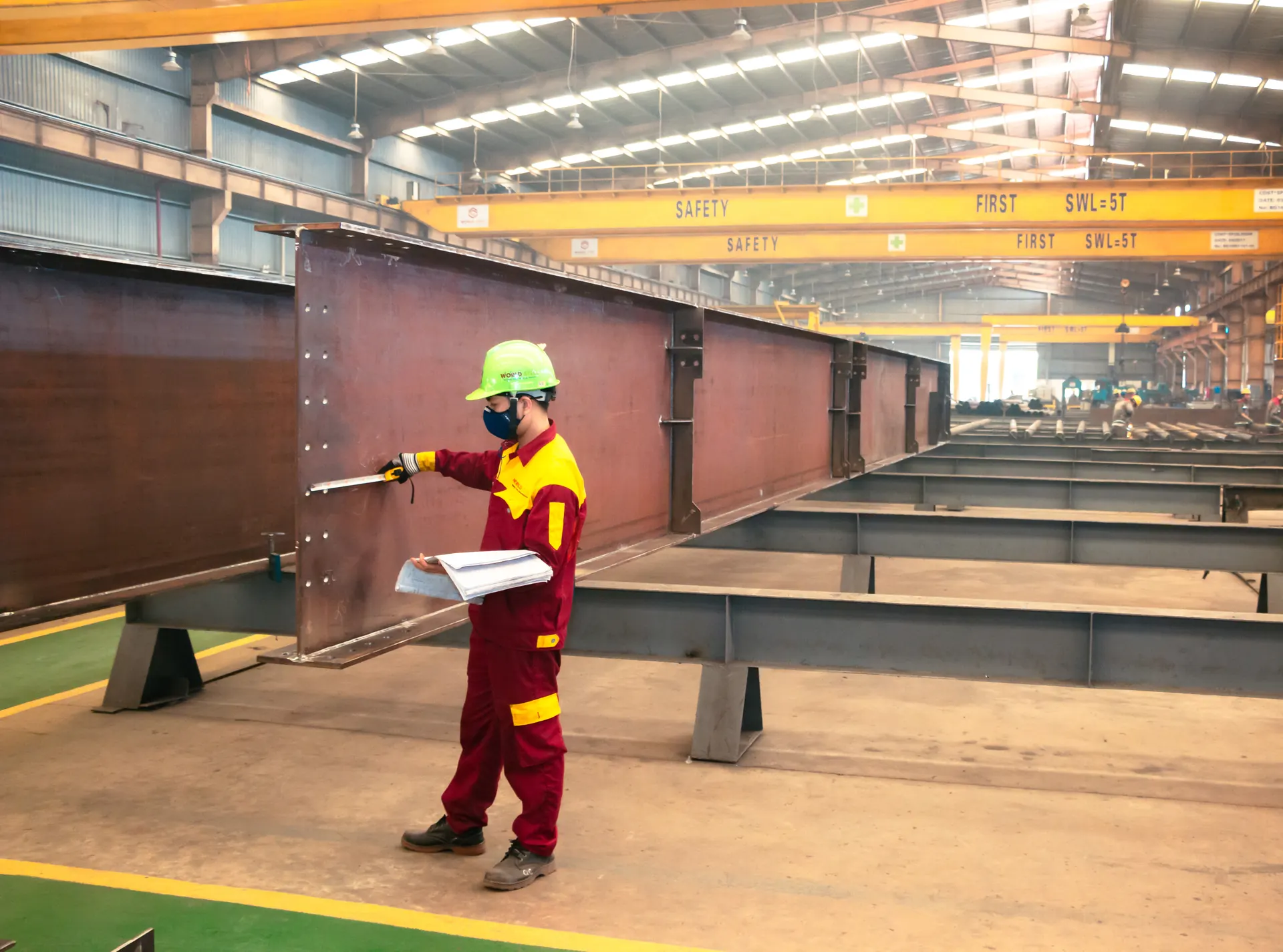
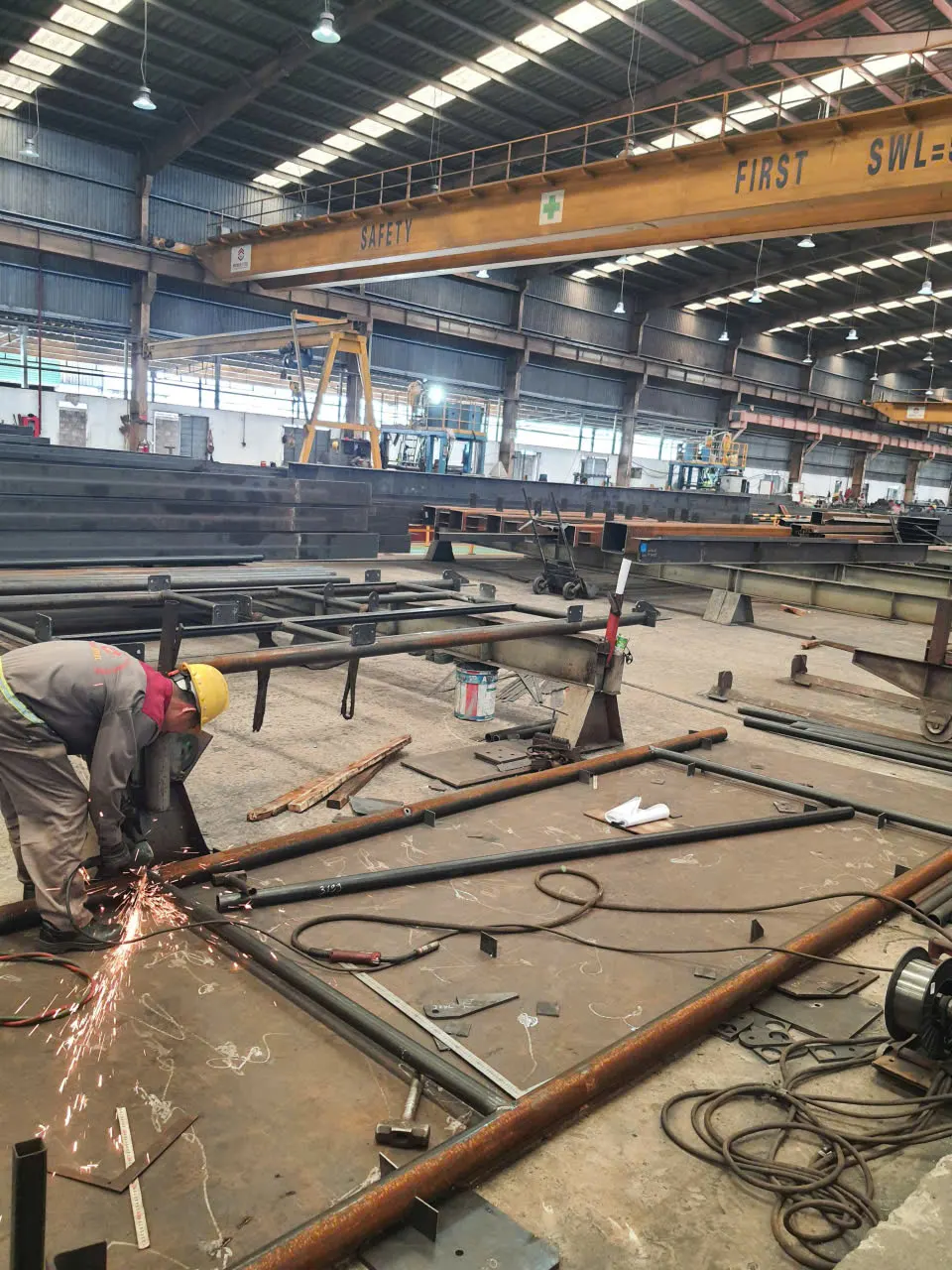
Heavy plate girders with stiffeners, fabricated by World Steel in Vietnam.
Complete joint penetration
CJP groove welds prepared, welded and tested through the full joint thickness
Moment connections, flange splices and plate splices, welded to qualified AWS D1.1 procedures with a planned root, in a plant that fabricates 2,500 metric tons of structural steel a month.
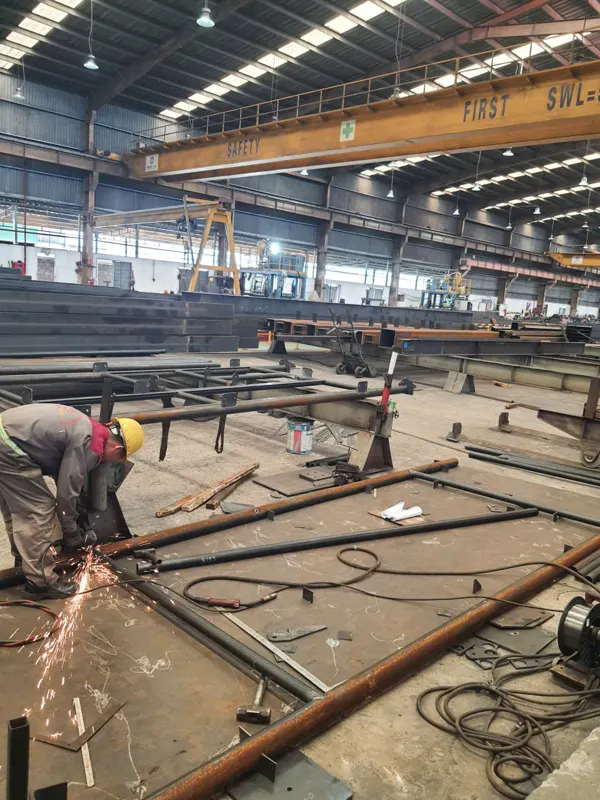
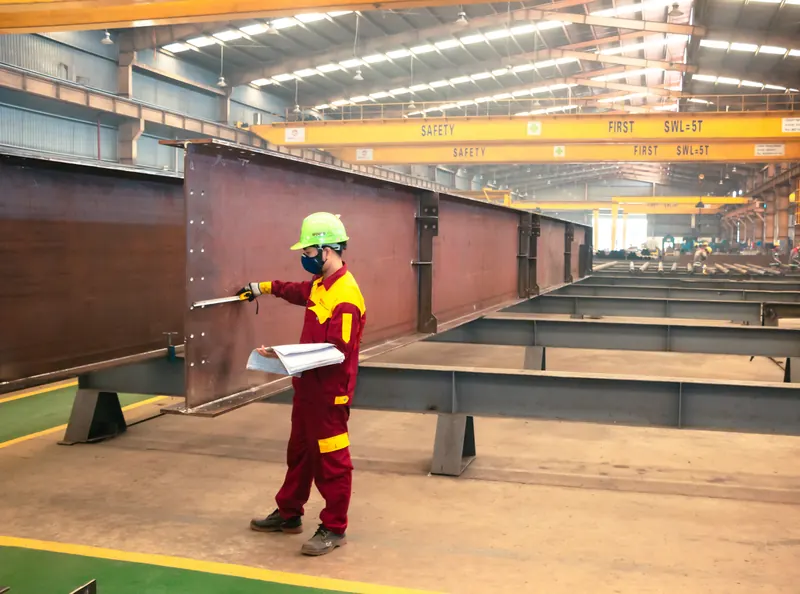
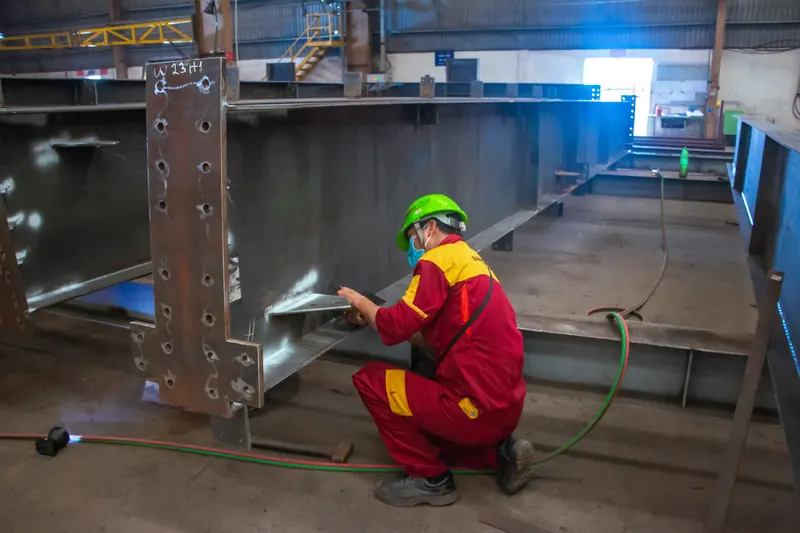
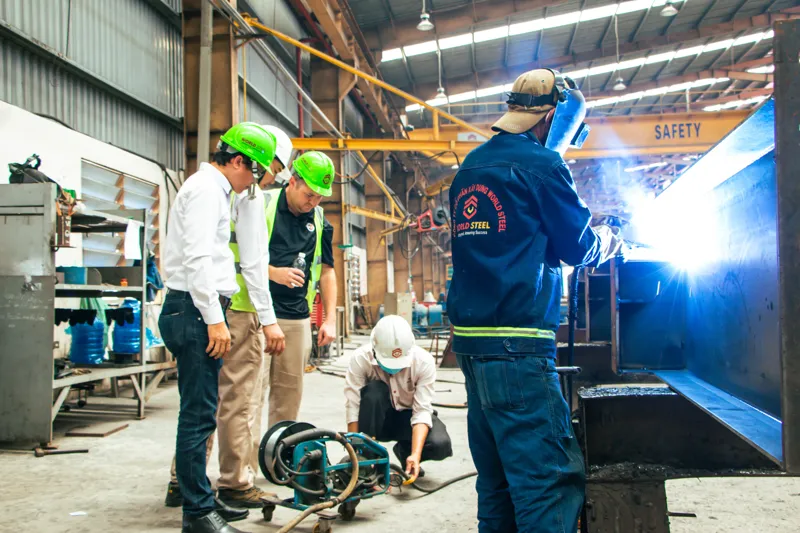
Full penetration, full strength
A CJP groove weld fuses the whole thickness of the joint
A complete-joint-penetration groove weld fills a prepared groove so that weld metal and base metal are fused through the full thickness of the thinner part. Made with matching filler metal, it develops the strength of the part it joins, which is why moment connections, flange splices and plate splices use it. It is also the weld that takes the most preparation, the most skill and the most testing.
A CJP weld is only as good as its root. Every one we make has a plan for the root: a backing bar, or welding from both sides with a back-gouge to sound metal.
Sections through the joint
Six groove preparations for a complete-penetration weld
AWS D1.1 lists prequalified CJP joints by type, with root opening, root face and groove angle ranges for each process. A joint outside those ranges needs a procedure qualified by test.
Section A-A
Single-V, with steel backing
Butt joints welded from one side: flange and plate splices.
Section B-B
Double-V, back-gouged
Thick butt joints welded from both sides, less weld metal and less distortion.
Section C-C
Single-bevel T-joint
Beam flange to column face and continuity plates, on backing or back-gouged.
Section D-D
Double-bevel T-joint
Heavy stiffeners and plates welded from both sides.
Section E-E
J-groove
Thick plate where a curved root saves weld metal over a bevel.
Section F-F
U-groove
Very thick butt joints, welded by submerged arc where access allows.
Weld metalBase metalSteel backing
The root plan
Three ways to make sure the root is fused
Lack of fusion at the root is the defect UT finds most in CJP welds. Each joint on our shop drawings shows which of these it uses.
Steel backing
A backing bar fused into the root lets the joint be welded from one side. It stays in place unless the design or the seismic rules say remove it.
Back-gouge to sound metal
The first side is welded, the root is gouged from the second side by air carbon arc or grinding until sound weld metal shows, then welded.
Spacer
A strip of steel in a double-sided joint keeps the root opening, and is gouged out before the second side is welded.
From bevel to UT
Nine stops on the way to a finished CJP weld
Each stop is in the WPS or the Inspection and Test Plan. Several can be hold points for your inspector.
Bevel
Groove cut by CNC flame or plasma and ground clean to the angle and root face on the shop drawing.
Fit-up
Root opening, alignment and backing contact checked with a hi-lo gauge before any tack.
Preheat
Steel heated to the minimum for its grade and thickness, measured with a contact thermometer.
Root pass
The critical first pass, fusing both groove faces and the backing.
Fill and cap
Passes laid to the WPS, with interpass temperature and cleaning between passes.
Back-gouge
Second side gouged to sound metal and checked before welding, where the joint is double-sided.
Tabs and backing
Weld tabs removed and ground, and backing removed where the design or AISC 341 requires it.
Visual testing
Profile, reinforcement, undercut and cracks checked by our QC on the finished weld.
Ultrasonic testing
UT or PAUT where the code or your specification calls for it, after the required waiting time.
Weld access holes
A hole in the web so the flange weld can run through
Paraphrased from AISC 360 Section J1.6. A rough or notched access hole is where cracks start, so its shape is controlled as tightly as the weld.
Size
At least 1.5 times the web thickness or 38 mm (1-1/2 in) long, and tall enough to deposit sound weld through the hole.
Radius
A smooth curved transition, at least 10 mm (3/8 in) radius, with no notches or sharp corners.
Finish
Thermally cut surfaces ground smooth on heavy shapes, and MT or PT checked where the code calls for it.
How much is tested
Four numbers that set how many CJP welds get UT
Code-minimum UT under AISC 360 is a quality assurance task for the agency working for the owner; it can test in our plant at our hold points. Your specification may add fabricator UT, PAUT or RT.
(5/16 in) and thicker
AISC 360 Chapter N asks for UT of CJP welds in butt, T- and corner joints under transversely applied tension from this thickness.
Risk Category III and IV
All such welds in buildings of higher risk category, by the quality assurance agency.
Risk Category II
Of such welds, with the rate raised or lowered on the results.
on some steels
A waiting time before final inspection on quenched and tempered grades, so delayed cracking is caught.
On our floor
Where CJP welds go on the members we ship
The Engineer of Record decides which joints need full penetration. These are the ones we weld most.
Beam flange to column
Moment connections, often demand-critical in seismic frames.
Flange and web splices
Shop splices of plate girders and long built-up members.
Continuity plates
Where they carry flange forces into the column.
Column splices
Where the design needs full strength in tension.
Column to base plate
Moment bases and heavily loaded columns.
Box columns
Corners in the panel zone, where PJP is not enough.
How it is tested
The NDT methods that check cjp groove welds
Every weld is visually inspected by our QC. The other methods run where your specification or the code calls for them, by our QC, by the third party you designate, or, for radiography, through our partner.
The other weld types
Six more welds that hold your building together
Questions
CJP groove welds: questions from US reviewers
What does CJP mean on a weld symbol?
Complete joint penetration. It is usually written in the tail of the symbol, so the fabricator chooses a prequalified or qualified joint detail that achieves full penetration, and shows it on the shop drawings for your approval.
Do you leave backing bars in place?
Where the design allows it, yes. Backing is removed where the design or AISC 341 requires it, for example at the bottom flange of some seismic moment connections, then the root is gouged, welded and reinforced with a fillet.
Who performs UT on CJP welds?
Code-minimum UT under AISC 360 is a quality assurance task for the agency working for the owner, which can test in our plant. Where your specification assigns UT to the fabricator, our QC performs it, or the third party you designate.
Why are some CJP welds tested days after welding?
Some high-strength steels can crack hours after welding. Final inspection of those welds waits for the time the code sets, so a late crack is still found in the shop.
Is a CJP weld always stronger than a PJP weld?
It develops the full strength of the part, so in tension across the weld it is. Where the full strength is not needed, a PJP weld is often the better choice: less weld metal, less heat, less distortion and no back-gouging.
What filler metal do you use for CJP welds?
Filler metal that matches the base metal strength, as the WPS names it. For demand-critical welds in seismic frames it also meets the notch toughness required by AWS D1.8.
Can my inspector watch a CJP weld being made?
Yes. Fit-up, root pass, back-gouge and final weld can be hold points in the Inspection and Test Plan, witnessed in person or live by video.
Send us your moment connection details
We will show the groove preparation, root plan and testing for every CJP weld in our quote, from a plant that fabricates 2,500 metric tons a month.