
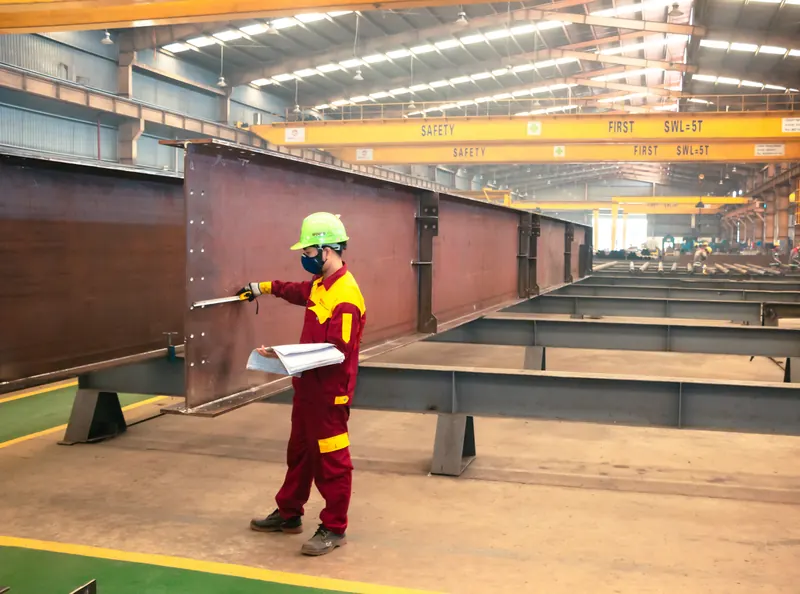
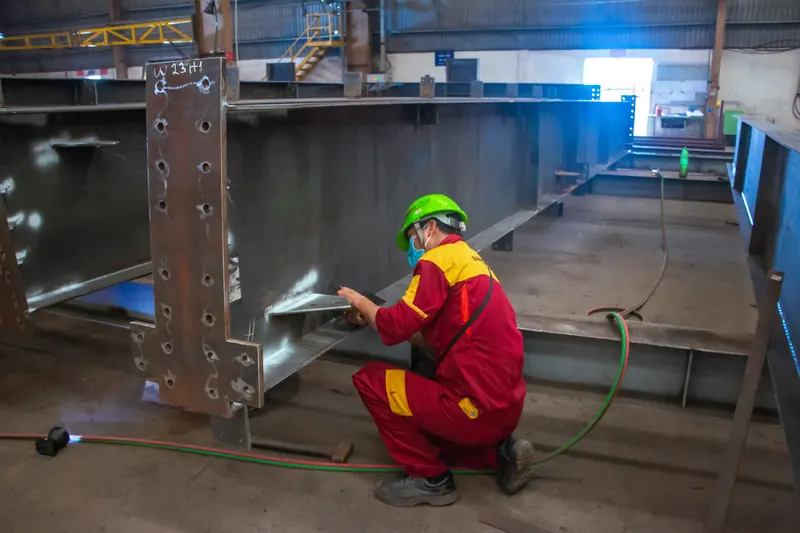
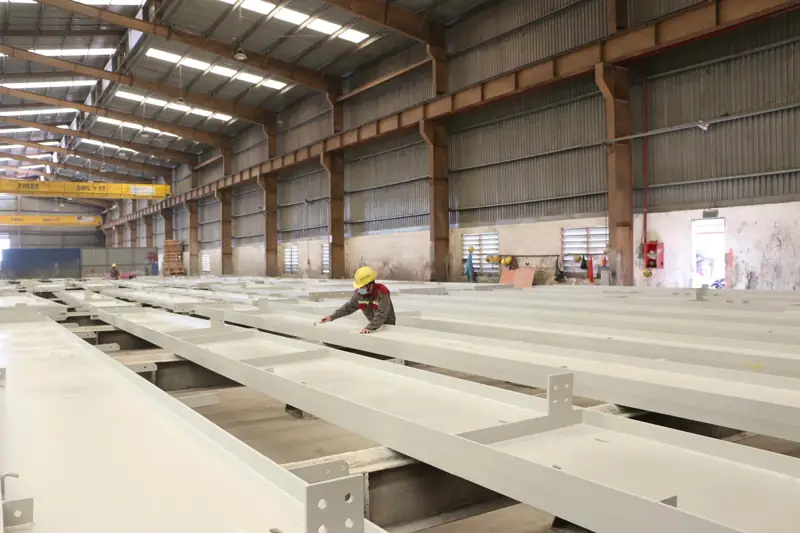
In the Vietnam shop, fit-up is compared with the shop drawing before final welding starts.
Flux-cored arc welding
Flux-cored arc welding of connections, in every position, to AWS D1.1 and D1.8
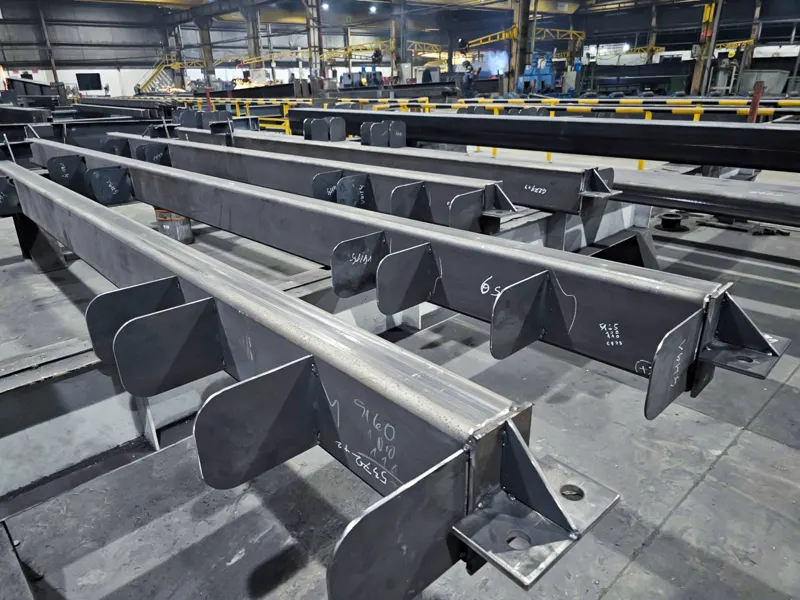
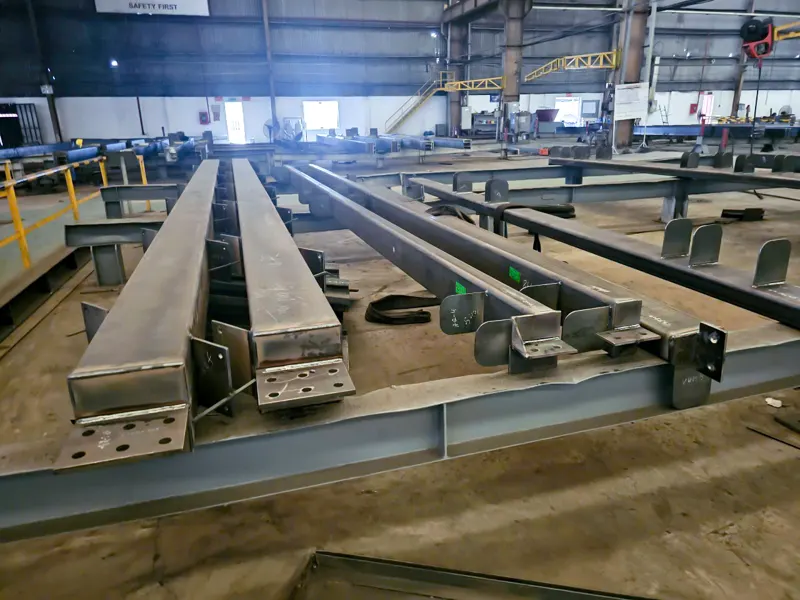
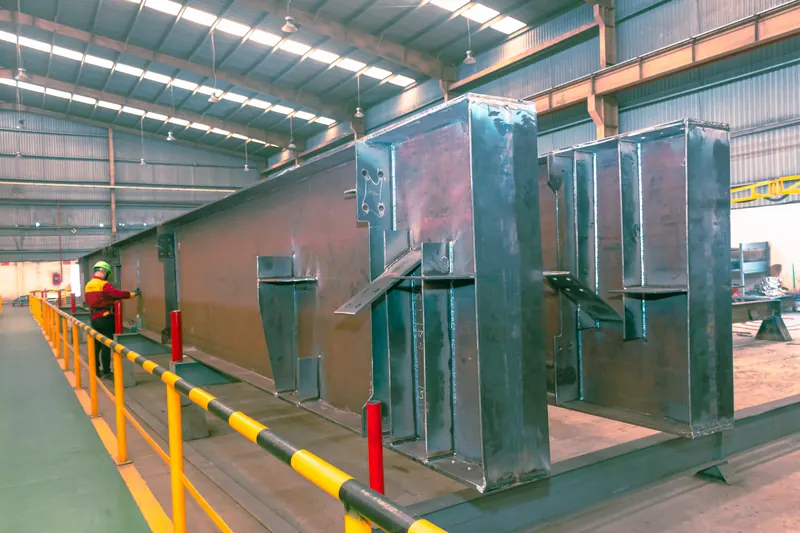
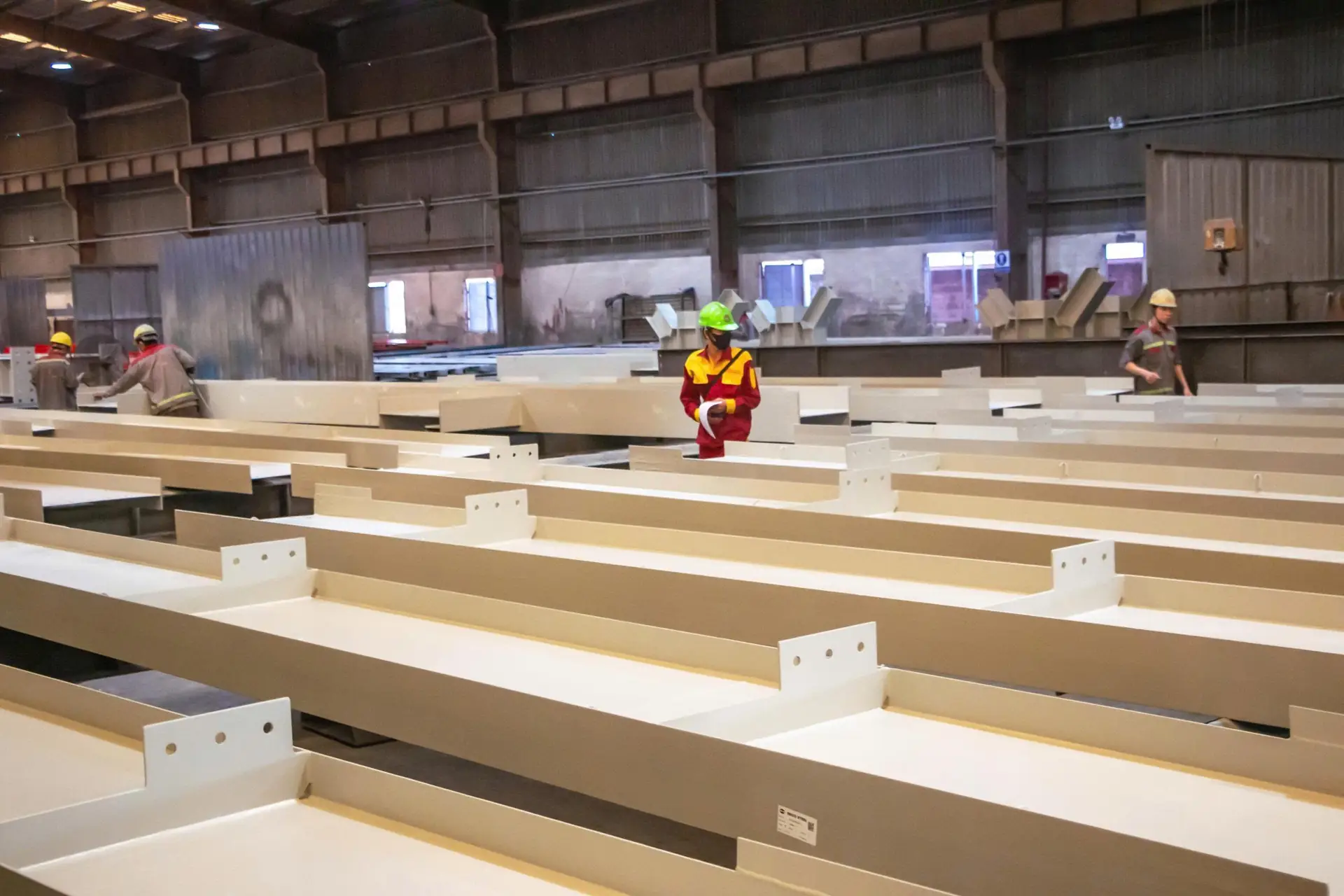
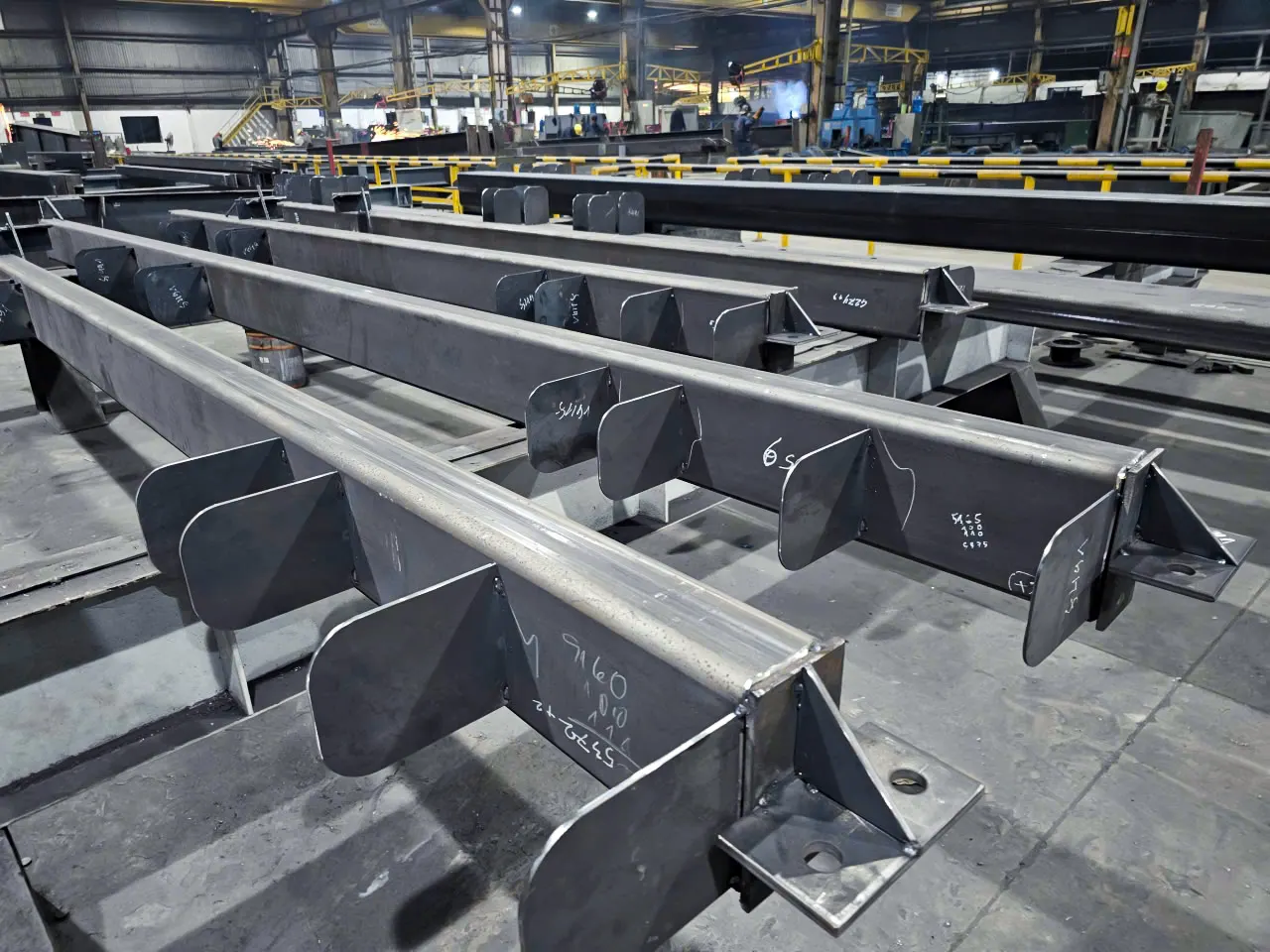
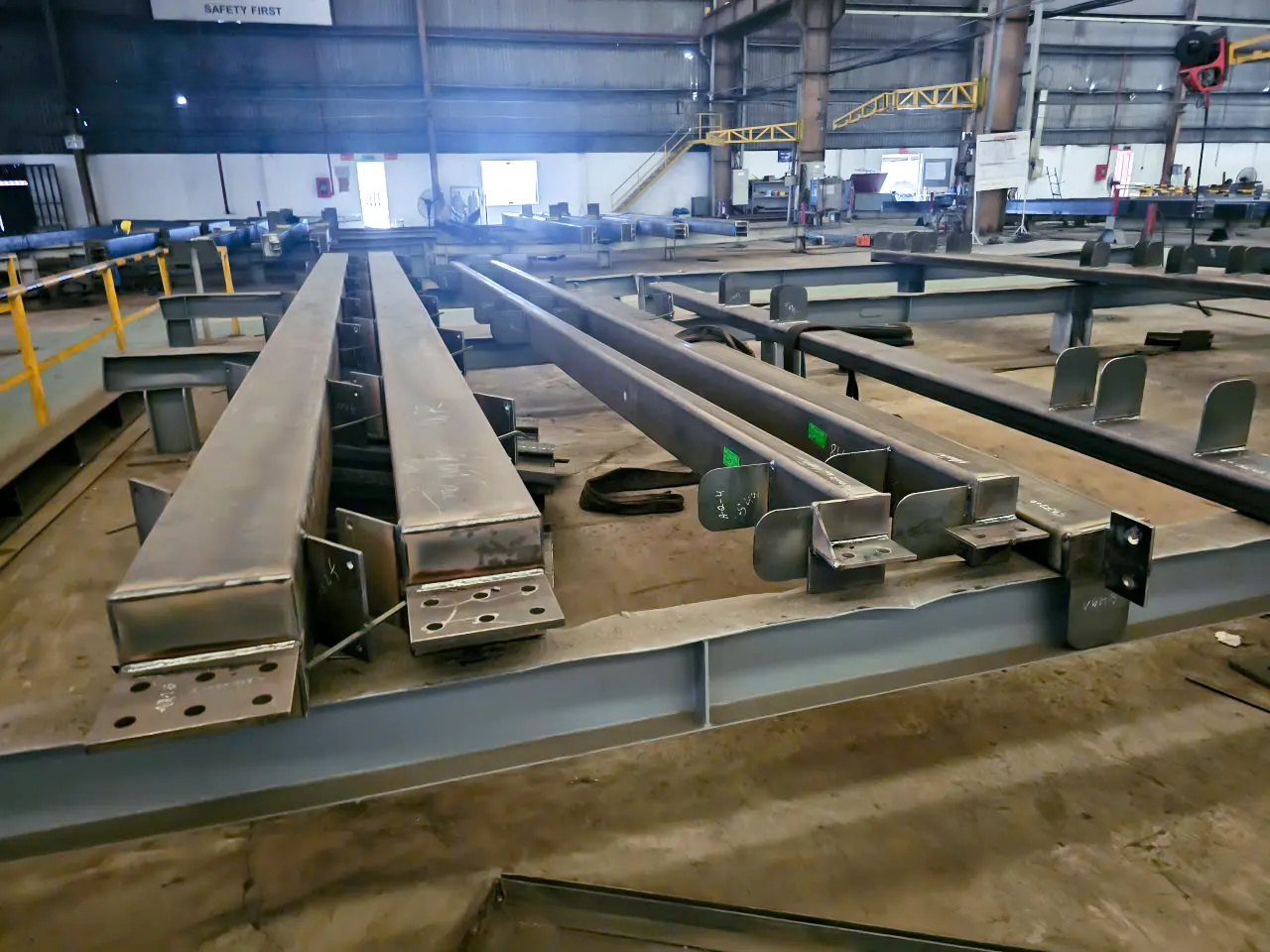
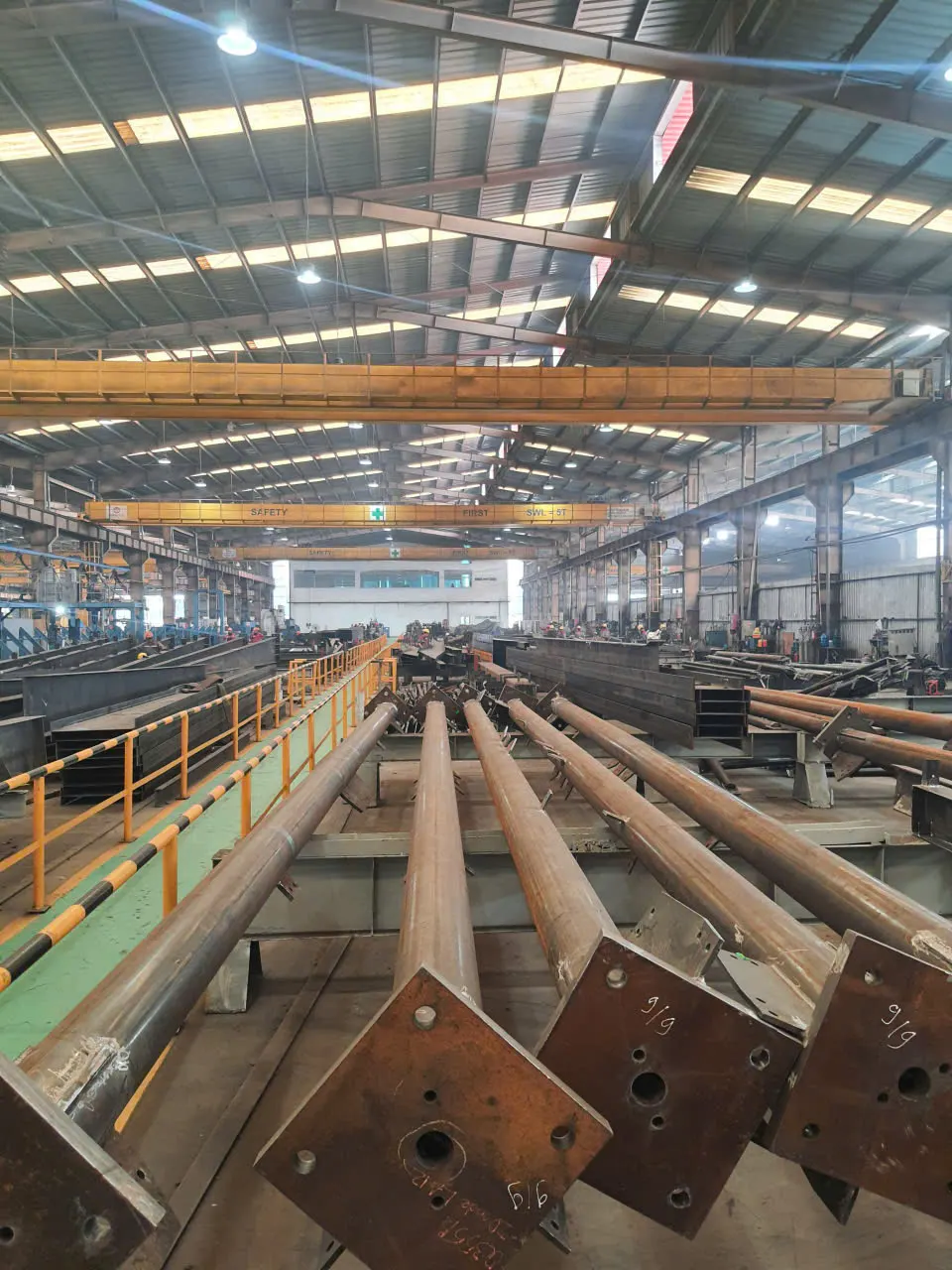
Stiffeners, end plates, shear tabs, gussets and splices, welded with gas-shielded flux-cored wire at our fitting stations, in a plant that fabricates 2,500 metric tons of structural steel a month.
Flux on the inside
Flux-cored arc welding puts the flux inside the wire, so it welds in every position
A flux-cored wire is a thin steel tube filled with flux and alloy powder. Fed through a semi-automatic gun, it melts in the arc and the core makes a thin slag that holds the pool in place, which is why FCAW welds well vertical and overhead. With gas shielding (FCAW-G) it is the main process at our fitting stations: stiffeners, end plates, shear tabs, gussets, splices and groove welds on connections.
Most of the welds a US reviewer sees on a connection, the stiffeners, end plates and gussets, are made with gas-shielded flux-cored wire at our fitting stations.
Inside the wire
A steel tube, a flux core and a cloud of gas
Cross-section of a gas-shielded flux-cored wire at the arc. Self-shielded wire has no gas: its core does all the shielding.
Steel sheath
The tube that carries current and becomes most of the weld metal.
Flux core
Powder that makes slag, stabilises the arc and adds deoxidisers and alloy.
Shielding gas
On FCAW-G, CO2 or an argon-CO2 mix from the gun nozzle.
Slag
A thin layer that supports the pool out of position and is chipped off after each pass.
Gas or self-shielded
FCAW-G in our shop, FCAW-S usually in the field
Both are flux-cored and both are prequalified under AWS D1.1. The difference is where the shielding comes from, and that decides where each one works.
| FCAW-G, gas-shielded | FCAW-S, self-shielded | |
|---|---|---|
| Shielding | External gas plus the flux core | Flux core only, no gas |
| Typical wire | E71T-1C or E71T-1M (AWS A5.20) | E71T-8 and similar (AWS A5.20) |
| Wind | Needs protection from wind and drafts | Tolerates wind, which is why it is used outdoors |
| Where | Our shop fitting stations | Usually field welding, by the US contractor’s crew |
| Seismic note | Common choice for shop demand-critical welds | Mixing with another process in one weld needs intermix testing under AWS D1.8 |
AWS D1.1 does not allow gas-shielded welding in a wind or draft above about 8 km/h (5 mph) unless the weld is protected by a shelter. Our fitting stations are inside the fabrication halls; self-shielded wire is the usual choice for welding outdoors.
Reading the wire
E71T-1C H8, character by character
AWS A5.20 covers carbon steel flux-cored wires and AWS A5.29 low-alloy ones. AWS A5.36 is the newer, open classification for flux-cored and metal-cored wires; a WPS names whichever the wire is classified to.
- EElectrode.
- 7Weld metal tensile strength of at least 480 MPa (70 ksi).
- 1Welding position: 1 for all positions, 0 for flat and horizontal only.
- TTubular, a flux-cored wire.
- -1Usability group: the type of core, shielding and polarity.
- CShielding gas: C for 100% CO2, M for an argon-CO2 mix.
- H8Optional: diffusible hydrogen no more than 8 ml per 100 g of weld metal.
Welder qualification
Four positions, tested one by one
F is a fillet test, G a groove test. A welder qualified in a harder position is qualified for the easier ones that the code lists with it.
Flat
Weld laid from above, the easiest position.
Horizontal
Fillet in a corner, or groove with a horizontal axis on a vertical plate.
Vertical
Welded up the joint, where the slag earns its keep.
Overhead
Welded from below, the hardest position to qualify.
AWS D1.8
What seismic welds ask of the wire
Paraphrased from AWS D1.8, the seismic supplement to AWS D1.1. AISC 341 names the welds it applies to; our WPS and welders for them are qualified to AWS D1.8.
20 ft-lb Charpy toughness, required of all filler metal in the seismic force-resisting system.
40 ft-lb more for demand-critical welds, tested over the procedure’s heat input range.
No more than 16 ml per 100 g of weld metal for seismic welds.
Mixing FCAW-S with another process in one weld needs proof the combination stays tough.
At the fitting stations
Where flux-cored welds go on the members we ship
The Engineer of Record sets the weld; the shop drawing and WPS show which welds are flux-cored.
Stiffeners and continuity plates
Fillet and groove welds inside columns and beams.
End plates and shear tabs
Connection plates welded to beams and columns.
Gussets and bracing parts
Brace connections, often in several positions.
Splices
Flange and web groove welds on spliced members.
Base and cap plates
Column ends to plates, all round.
Demand-critical joints
Where the WPS and welder are qualified to AWS D1.8.
On the WPS
Six things the procedure fixes for FCAW
Every weld is made to a written welding procedure specification, prequalified or qualified by test to AWS D1.1 (and AWS D1.8 for seismic welds), by a welder or operator qualified for it.
Wire classification
AWS A5.20, A5.29 or A5.36 classification and wire diameter.
Shielding gas
Gas type and flow rate for FCAW-G; none for FCAW-S.
Current, voltage, stickout
Wire feed or amperage, voltage, polarity and electrode extension.
Position and progression
The positions allowed, and uphill progression for vertical welds.
Preheat and interpass
Minimum preheat and the maximum interpass temperature.
Joint detail
Joint type, root opening, groove angle and backing.
The other processes
Four more ways we weld your steel
Questions
FCAW questions from US reviewers
Do you use gas-shielded or self-shielded flux-cored wire?
Gas-shielded (FCAW-G) in the shop, at our fitting stations inside the halls. Self-shielded wire is mostly a field process, used by the US contractor’s field crew where wind would blow shielding gas away.
Is FCAW prequalified under AWS D1.1?
Yes. FCAW is one of the processes AWS D1.1 allows on a prequalified WPS, within the code’s limits on joints, positions and settings. Outside them the procedure is qualified by test.
What does E71T-1C mean?
A flux-cored wire classified to AWS A5.20: weld metal of at least 480 MPa (70 ksi), all-position, tubular, usability group 1, for 100% CO2 shielding. An M in place of the C means an argon-CO2 mix.
Which wires do you use on seismic welds?
Wires that meet the AWS D1.8 toughness and diffusible hydrogen requirements, on WPS qualified to AWS D1.8, with welders qualified for them. Their certificates go into your data book.
Why does FCAW weld well vertical and overhead?
The slag from the core freezes quickly and holds the pool in place, so the weld does not sag. Welders are tested in each position they weld in production.
What happens if a welder’s test position does not cover a joint?
They do not weld it. Each welder’s qualification records the process, positions and thickness range, and the joint goes to a welder qualified for it.
Send us your connection details
We will show which welds go to our FCAW stations, on which WPS, from a plant that fabricates 2,500 metric tons a month.