
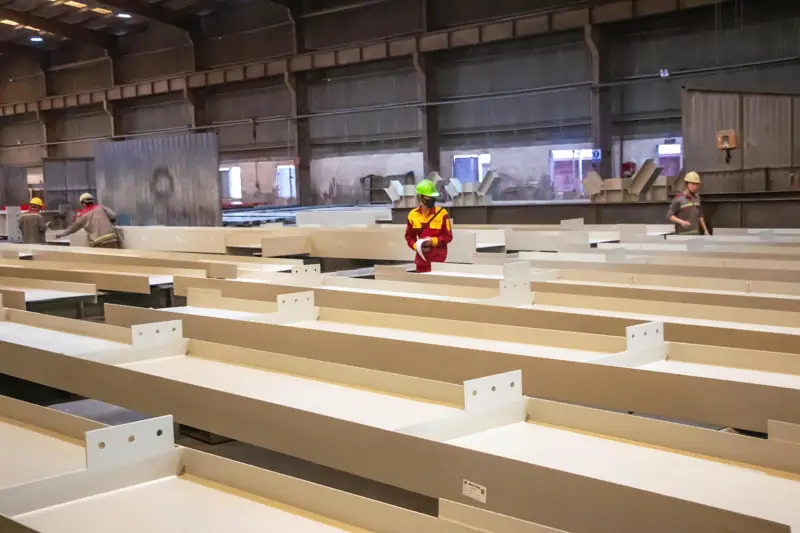
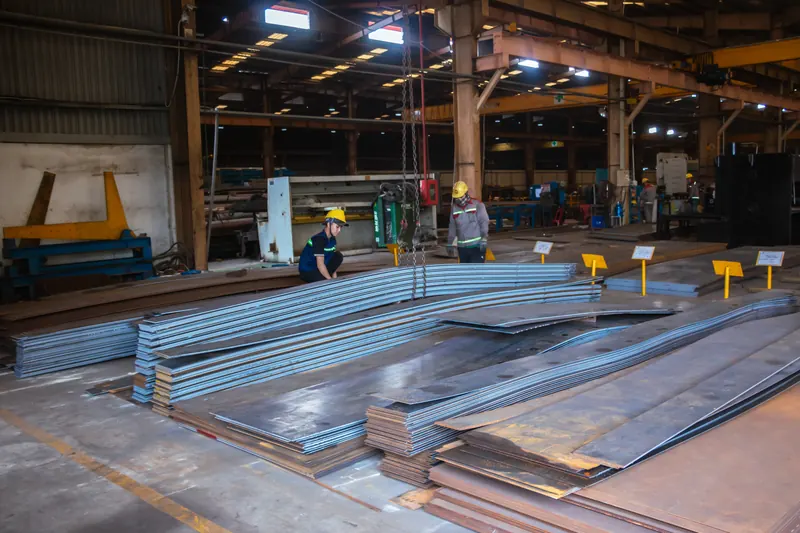
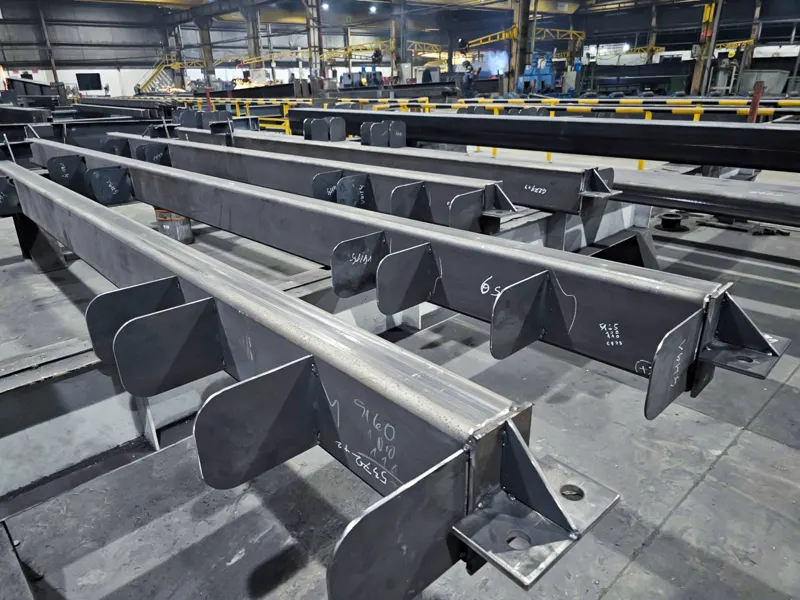
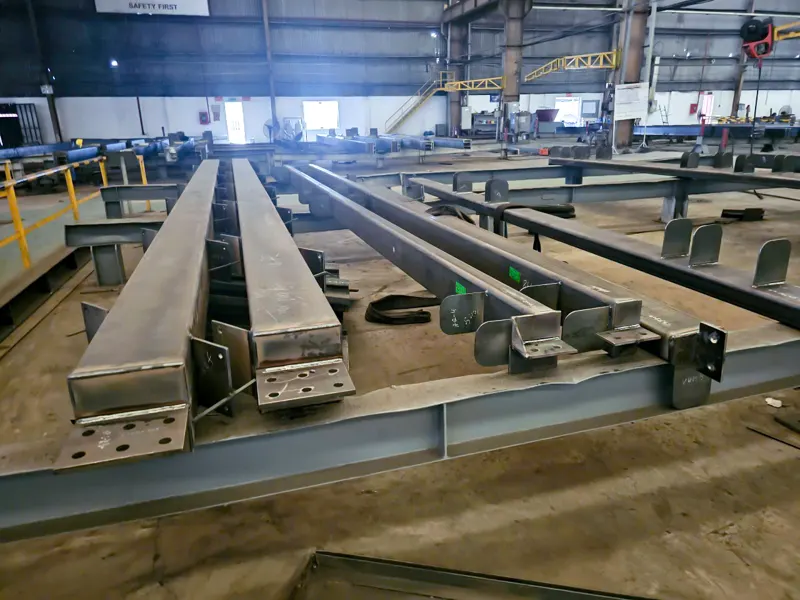
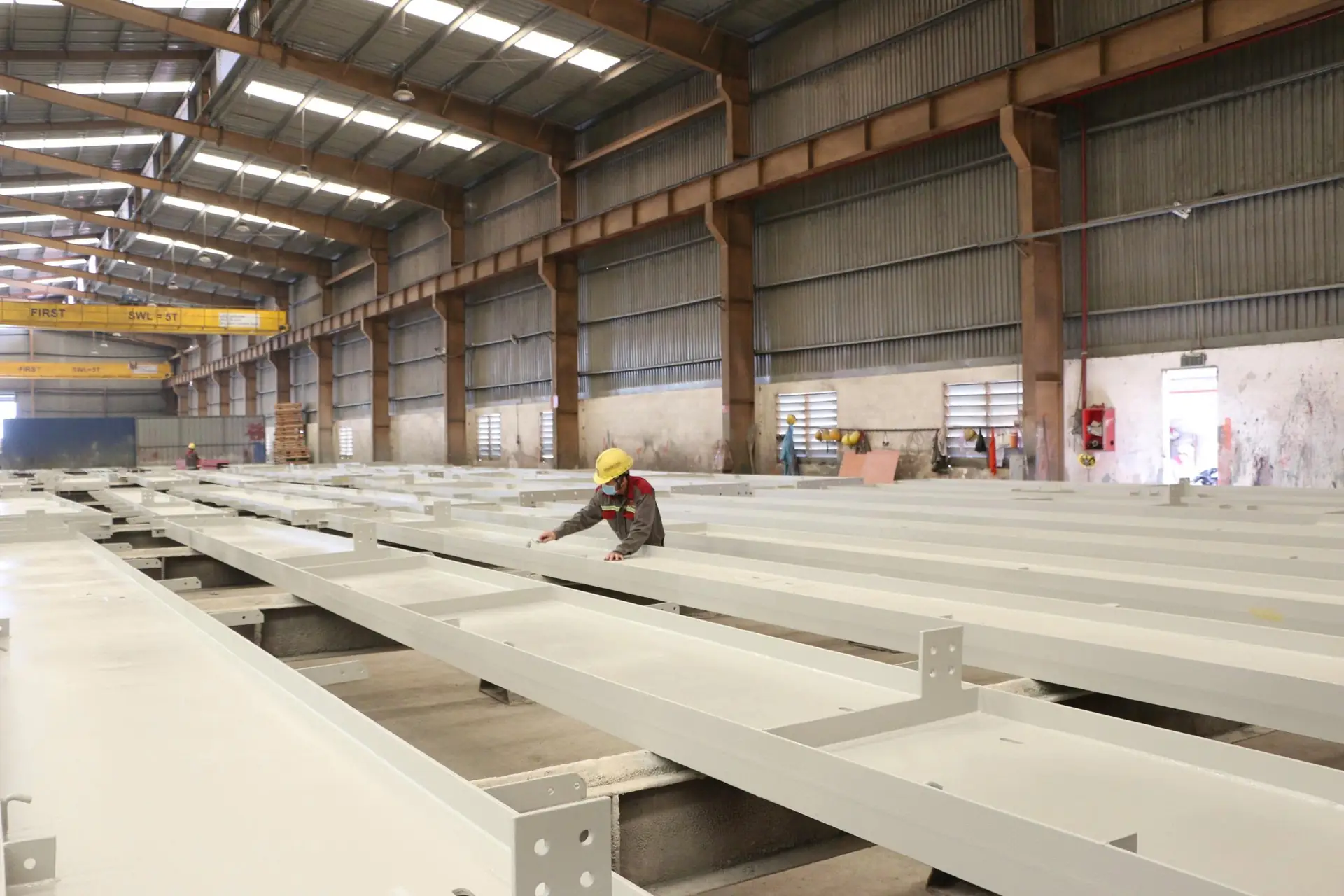
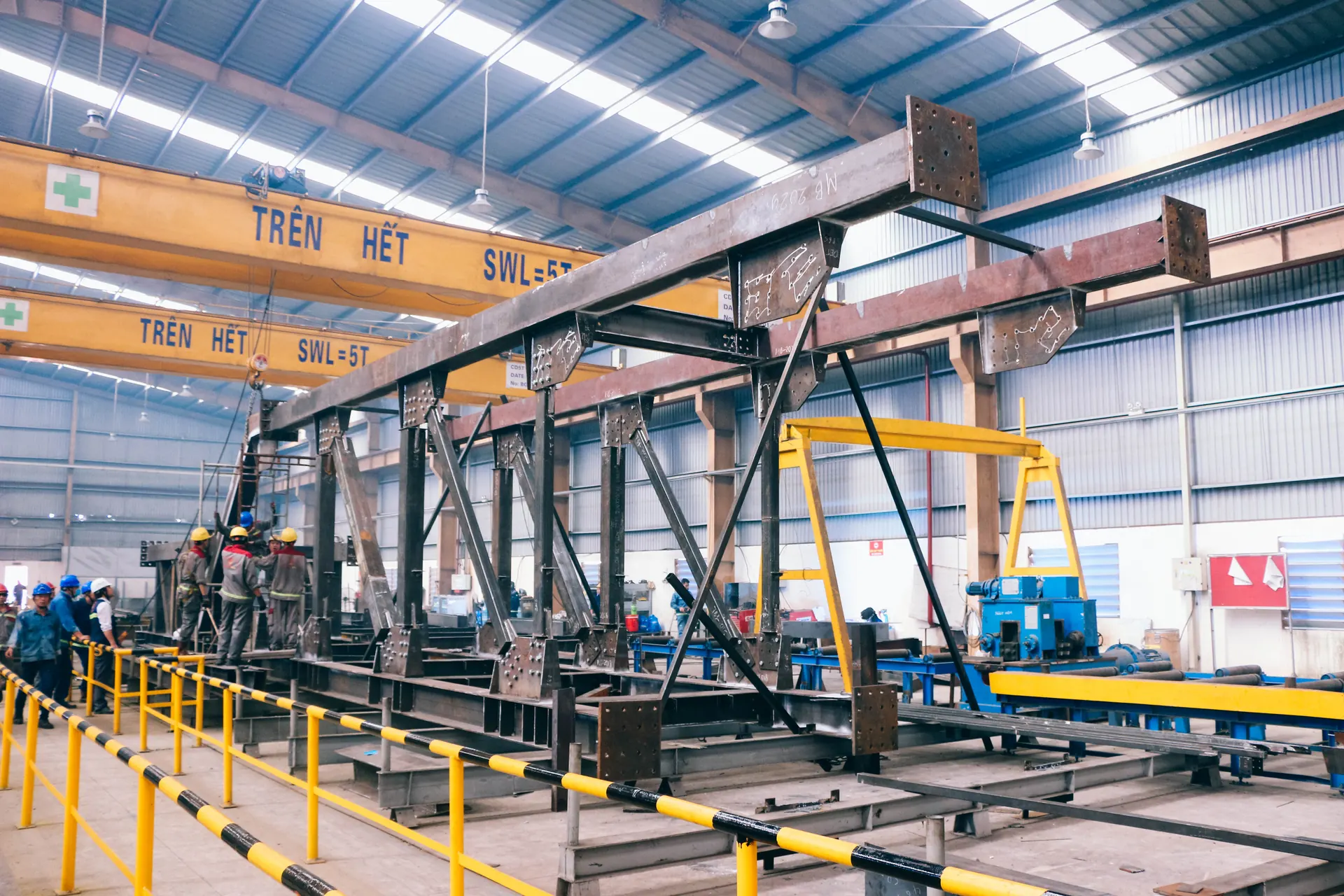
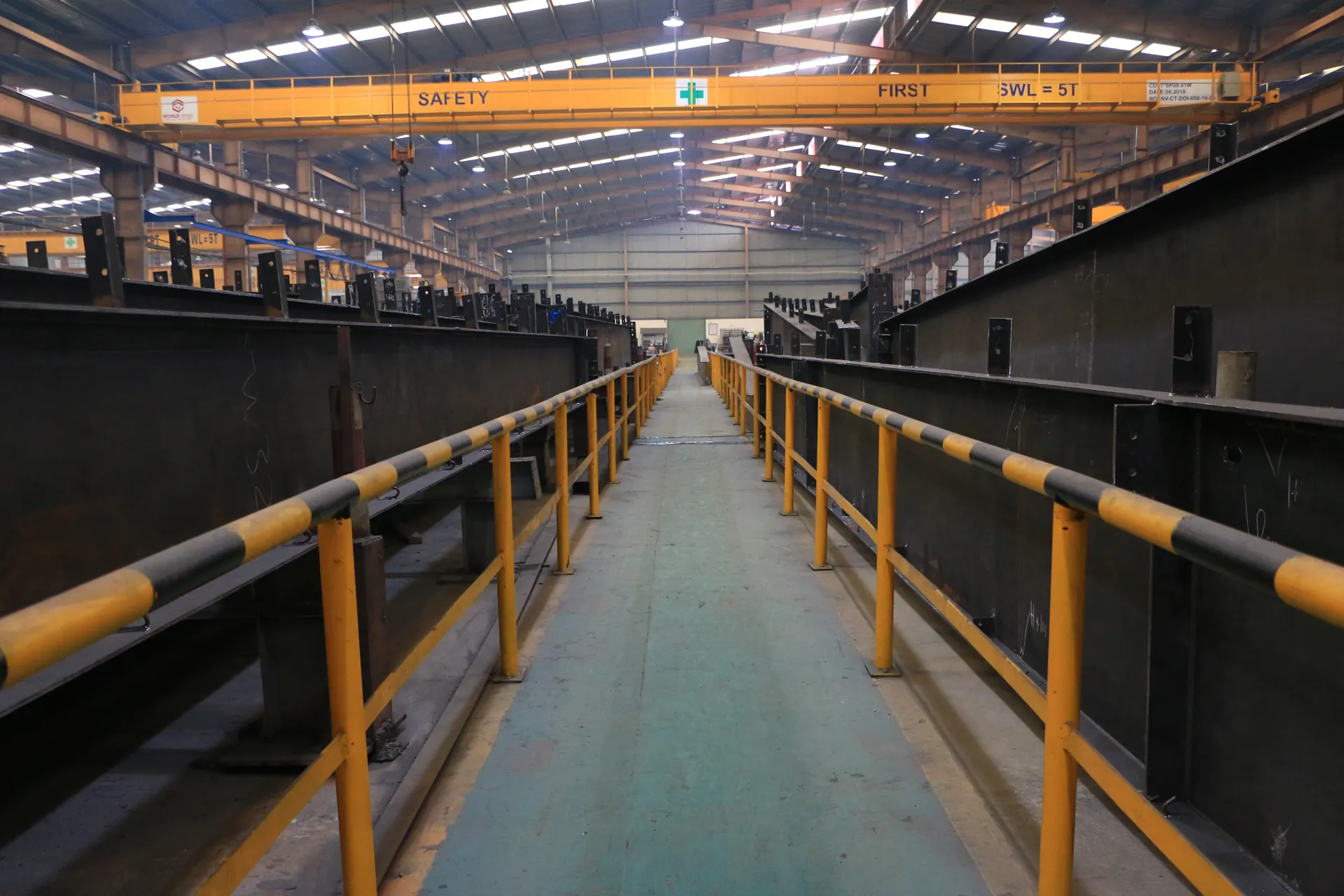
Members coated and staged inside a World Steel fabrication hall, Vietnam.
Gas metal arc welding
Gas metal arc welding with solid and metal-cored wire, to AWS D1.1
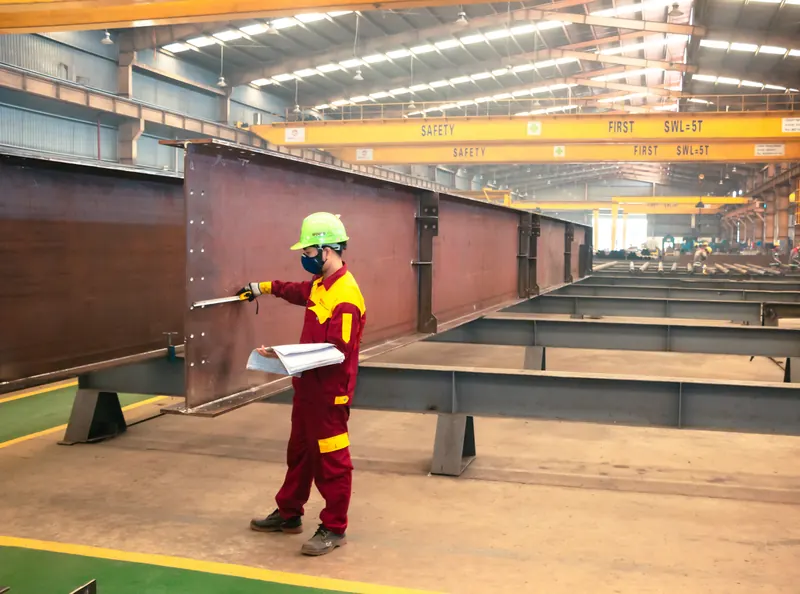
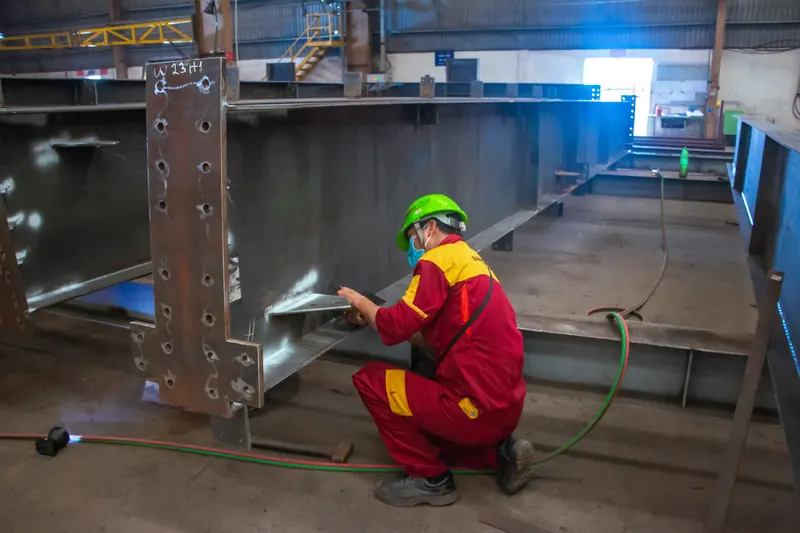
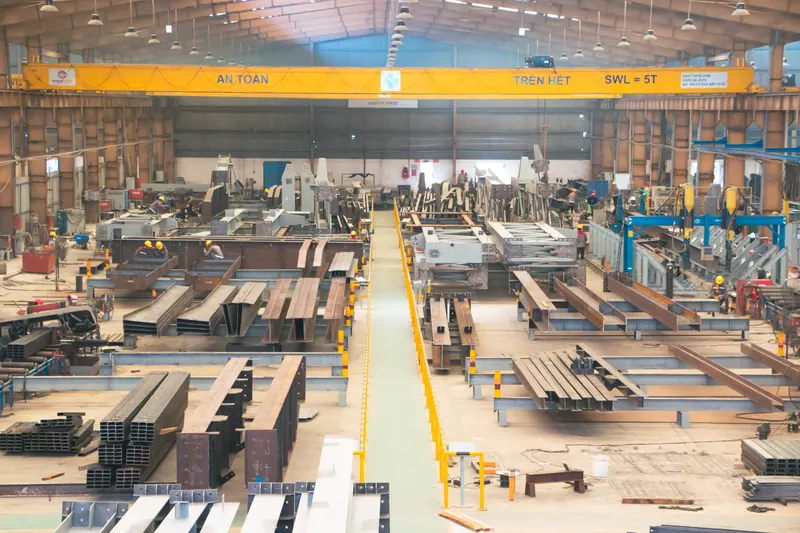
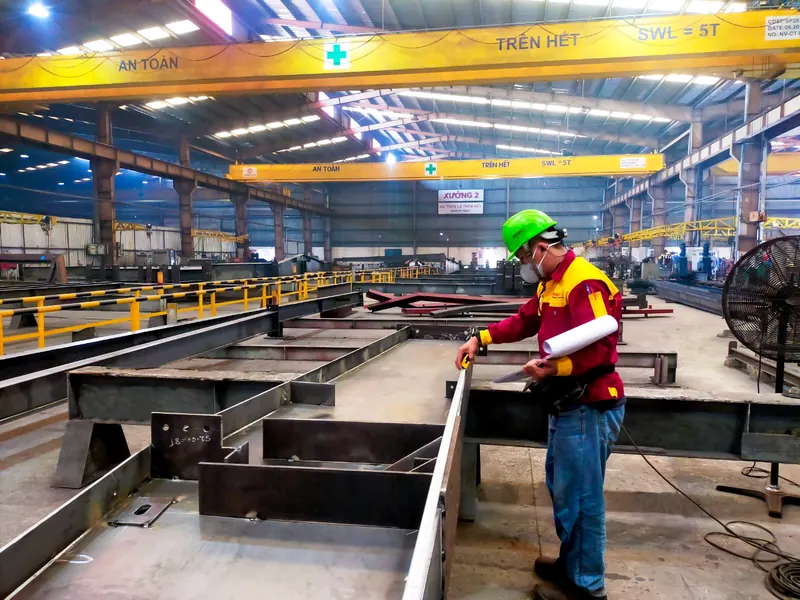
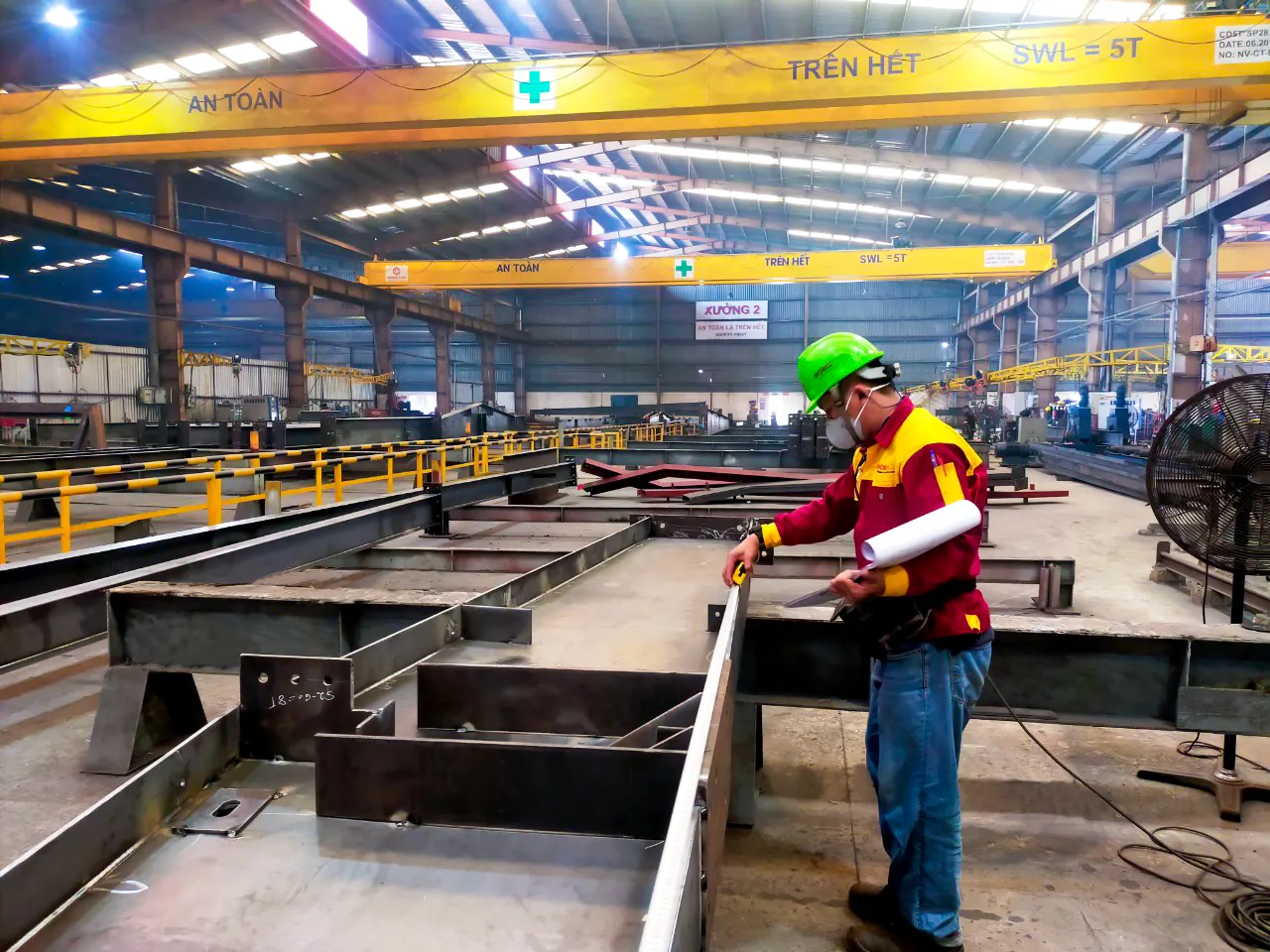
Clean, low-spatter fillet welds on fitted parts, light members and secondary steel, in a plant that fabricates 2,500 metric tons of structural steel a month.
Wire and gas
Gas metal arc welding feeds a solid wire through a cloud of shielding gas
In gas metal arc welding (GMAW, often called MIG or MAG welding) a solid or metal-cored wire is fed continuously through the gun while shielding gas flows around the arc. There is little or no slag, so welds are clean and fast to finish. How the metal crosses the arc, the transfer mode, decides what GMAW can do and whether AWS D1.1 lets it run on a prequalified procedure.
GMAW is clean and quick, but one of its modes, short-circuit transfer, can leave lack of fusion on thick steel. That is why the code makes it prove itself with a qualification test first.
Metal transfer
Four ways the metal crosses the arc
The transfer mode is set by current, voltage and gas. It is the first thing to read on a GMAW procedure, because it decides how the code treats it.
Short-circuit (GMAW-S)
The wire touches the pool and shorts many times a second. Low heat, good for thin sheet, but prone to lack of fusion on thick plate.
Globular
Large drops cross the arc, with more spatter. Common with 100% CO2 shielding.
Spray
A stream of fine droplets at higher current with argon-rich gas. Deep, smooth welds, flat and horizontal.
Pulsed spray
The power source pulses between spray and a low background current, so spray transfer can be used out of position.
AWS D1.1 does not allow short-circuit transfer (GMAW-S) on a prequalified WPS. It can be used only with a procedure qualified by test, with a PQR. Our WPS name the transfer mode.
Shielding gas
The gas mix shapes the arc and the bead
Typical mixes for carbon steel. The WPS names the gas and its flow rate; a change of gas can mean a new procedure.
Low cost, deep penetration
Globular transfer, more spatter.
All-round mix for carbon steel
Smoother arc, less spatter, short-circuit or globular.
Spray and pulsed spray
Fine droplets, flat bead, low spatter.
Spray on clean steel
Very fluid pool, used where the WPS names it.
AWS D1.1
Prequalified, or proven by test first
Paraphrased from AWS D1.1. A prequalified WPS follows the code's tables; a qualified one is backed by a PQR from welded and tested coupons.
Spray, globular, pulsed
Allowed on a prequalified WPS within AWS D1.1 limits on joints, positions, filler and preheat.
Short-circuit (GMAW-S)
Needs a WPS qualified by test, with a PQR showing sound fusion on the thickness used.
Welders
Every welder is qualified for the process and positions they weld, whichever way the WPS was qualified.
Like gas-shielded flux-cored welding, GMAW is not done in a wind or draft above about 8 km/h (5 mph) unless the weld is sheltered. Our GMAW welding is done inside the fabrication halls.
Reading the wire
ER70S-6, one part at a time
AWS A5.18 covers carbon steel solid and metal-cored wires for gas-shielded welding, AWS A5.28 low-alloy ones, and AWS A5.36 is the newer open classification for metal-cored wire.
Electrode or rod: the wire can be used as a GMAW electrode or a filler rod.
Weld metal tensile strength of at least 480 MPa (70 ksi).
Solid wire. C would mean a metal-cored wire, as in E70C-6M.
Chemistry group: higher manganese and silicon to deoxidise steel with some mill scale.
In our shop
Where GMAW welds go on the members we ship
The Engineer of Record sets the weld; the shop drawing and WPS show which welds are made by GMAW.
Fillets on fitted parts
Clips, stiffeners and small plates where the joint suits it.
Light members
Purlin cleats, girts, secondary steel and miscellaneous parts.
Metal-cored wire
High deposition with little slag, on longer fillets.
Tack welds
Fitting tacks to the same WPS rules as the weld they become part of.
On the WPS
Six things the procedure fixes for GMAW
Every weld is made to a written welding procedure specification, prequalified or qualified by test to AWS D1.1 (and AWS D1.8 for seismic welds), by a welder or operator qualified for it.
Transfer mode
Short-circuit, globular, spray or pulsed spray, stated on the WPS.
Shielding gas
Gas mix and flow rate; a change of gas can be an essential variable.
Wire
AWS A5.18, A5.28 or A5.36 classification and diameter.
Settings
Wire feed speed, voltage, polarity and contact tip to work distance.
Preheat and interpass
Minimum preheat and maximum interpass temperature.
Joint and position
Joint detail and the positions the WPS covers.
The other processes
Four more ways we weld your steel
Questions
GMAW questions from US reviewers
Is GMAW prequalified under AWS D1.1?
Spray, globular and pulsed spray transfer can run on a prequalified WPS within the code’s limits. Short-circuit transfer (GMAW-S) cannot: it needs a procedure qualified by test.
Why is short-circuit GMAW treated differently?
Its low heat input suits thin sheet but can leave lack of fusion on thicker steel that is hard to see. The code asks for a qualification test to prove fusion on the thickness used.
What is the difference between MIG and MAG?
Both are GMAW. MIG uses an inert gas such as argon; MAG uses an active gas such as CO2 or an argon-CO2 mix, which is what structural steel uses.
Where do you use GMAW on US jobs?
For fillet welds on fitted parts where it suits the joint, light members and secondary steel. Heavier connection welds are usually flux-cored, and long seams submerged arc.
Can GMAW be used outdoors?
Only with a shelter from wind and drafts above about 8 km/h (5 mph). In our shop it runs inside the fabrication halls.
What does ER70S-6 mean?
A solid carbon steel wire to AWS A5.18 with at least 480 MPa (70 ksi) weld metal and extra manganese and silicon, which tolerates some mill scale.
Ask us which process welds your parts
We will show the process and WPS for each weld on your shop drawings, from a plant that fabricates 2,500 metric tons a month.