
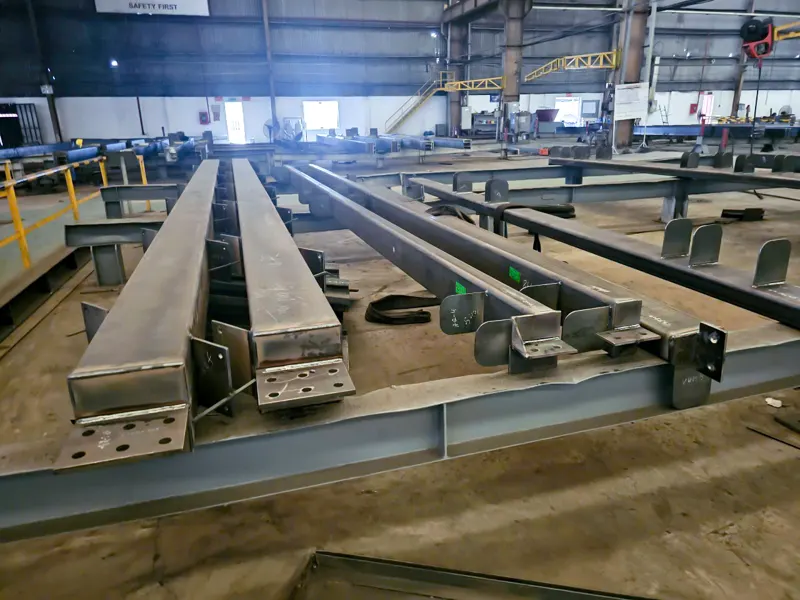
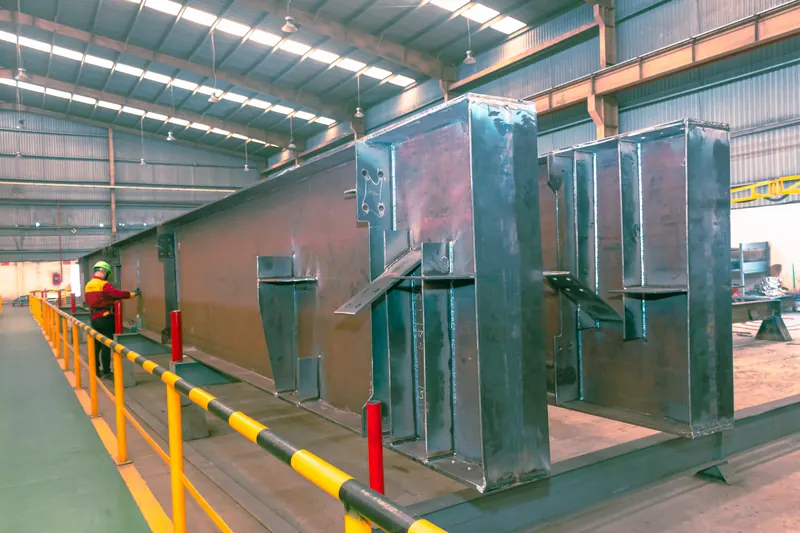
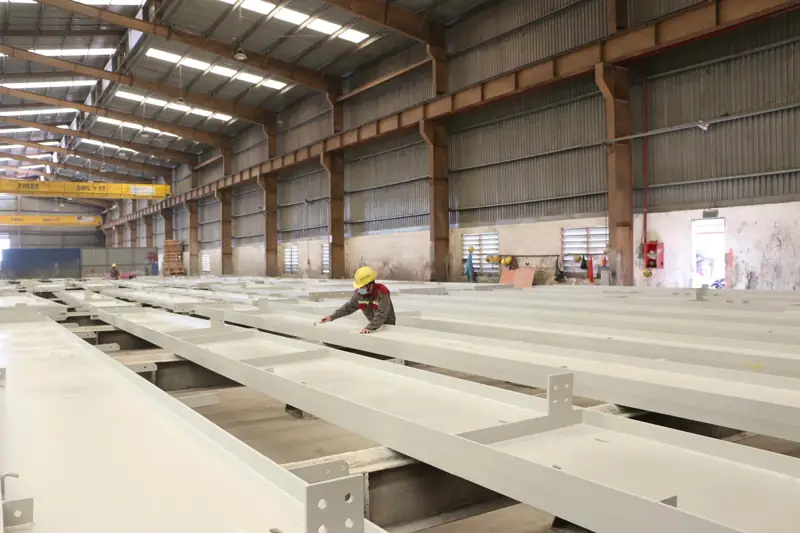
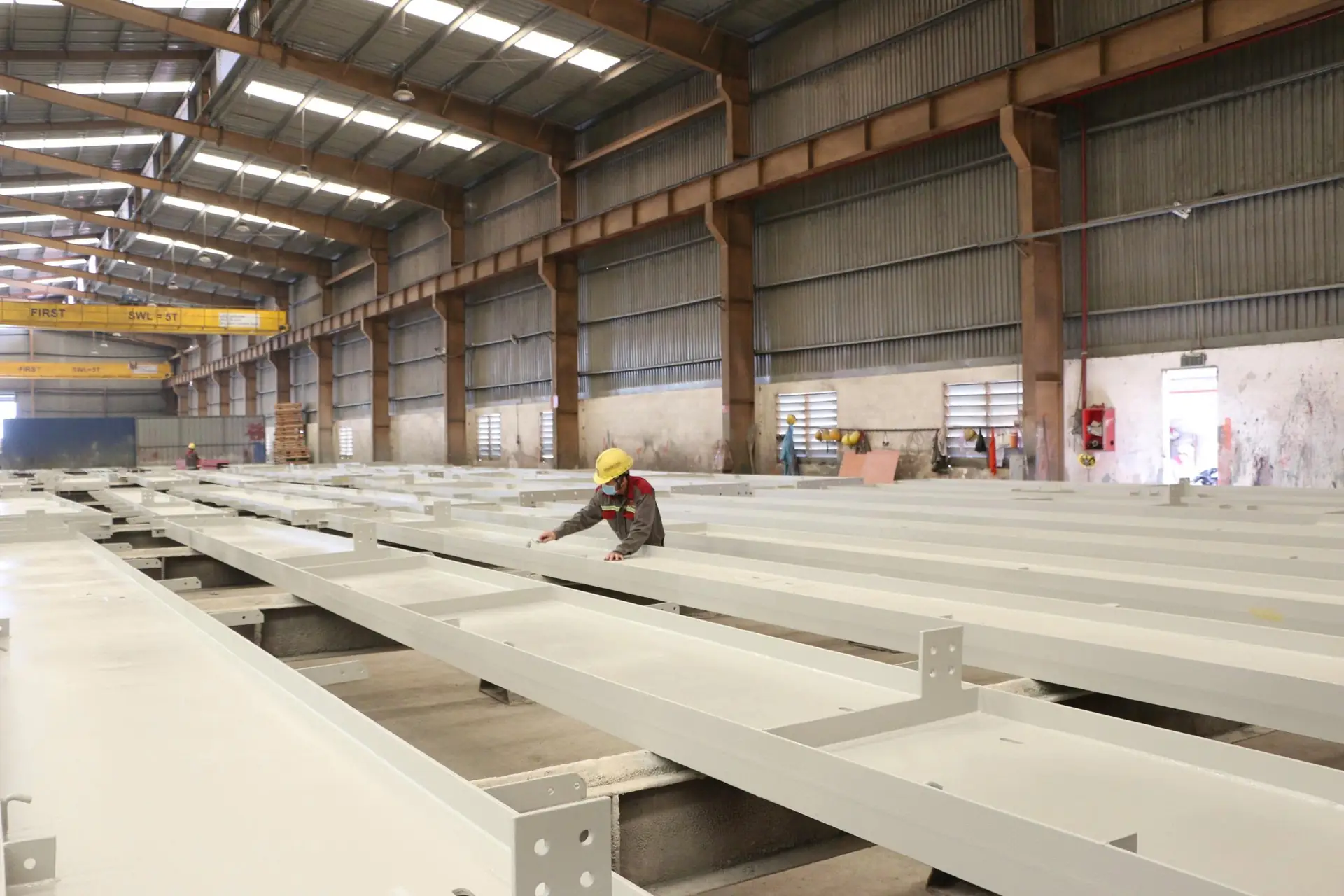
Members with drilled end plates waiting for release, Vietnam plant.
Plug and slot welds
Plug and slot welds cut, filled and inspected to the AISC 360 rules
Cover plates, lapped doublers and built-up plate members joined through the plate, in a plant that fabricates 2,500 metric tons of structural steel a month.
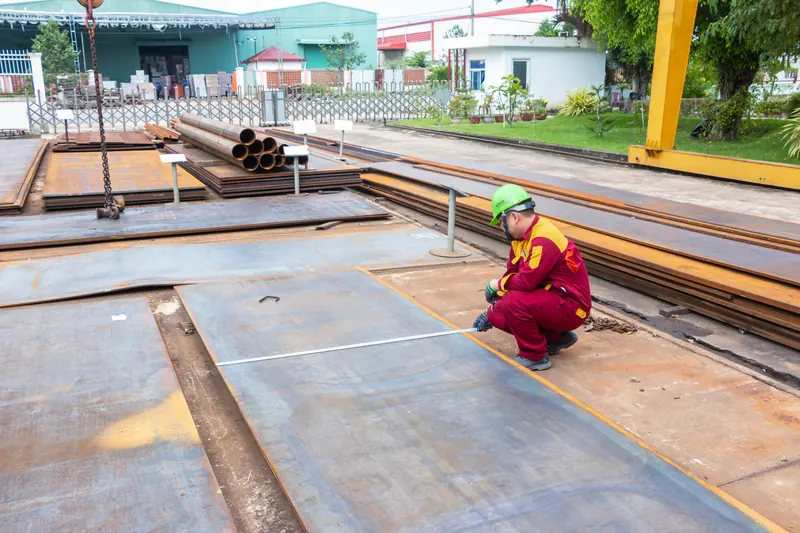
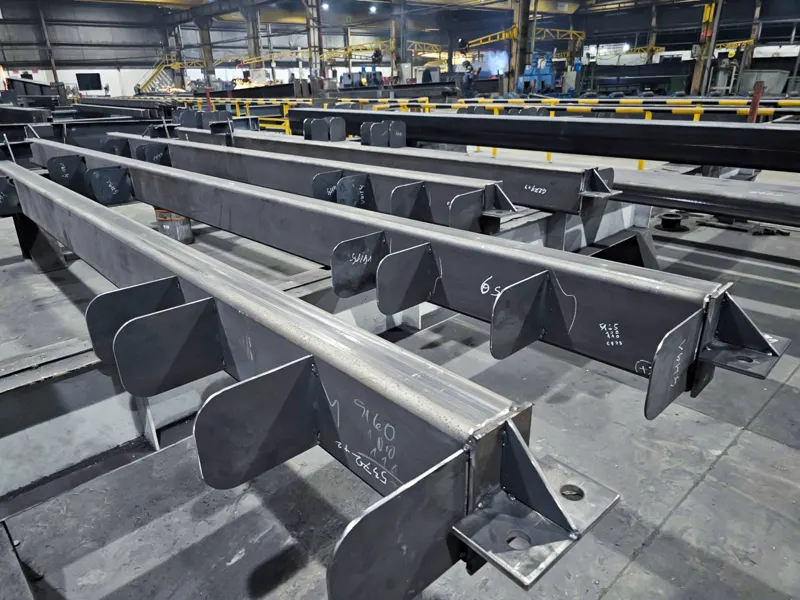
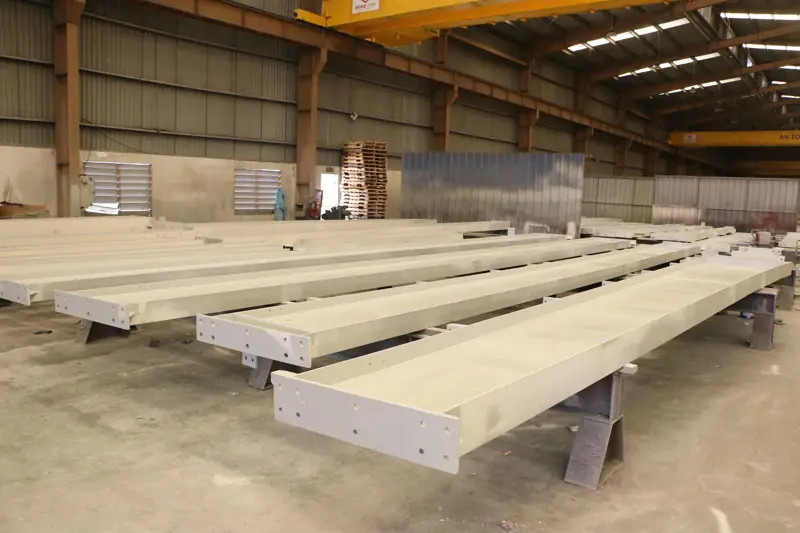
Welding through the plate
A plug or slot weld fills a hole in one plate to join it to the plate below
Where two plates are lapped and there is not enough free edge to weld, a round hole or an elongated slot is cut in the top plate and filled with weld metal fused to the plate underneath. The weld carries shear across the faying surface, holds lapped parts tight so they cannot buckle apart, and joins the parts of built-up members. Size, spacing and depth of fill are all set by AISC 360.
A fillet weld run around the inside of a hole is not a plug weld. A plug weld fills the hole to a set depth, and we cut the hole to the size the code allows for the plate it is in.
Plan and section
A round plug and a long slot through a lapped plate
Plan view above, section below. The weld fills the hole and fuses into the plate underneath.
Plug weld
A round hole, filled. Used in rows or patterns across a lapped plate.
Slot weld
An elongated slot with rounded ends, filled. Spreads the weld along the plate.
The sizing template
Six rules for cutting a plug hole or slot
Paraphrased from AISC 360 Section J2.3. Holes and slots are cut on our CNC and laser machines to the size on the shop drawing.
Plug hole diameter, minimum
t + 8 mmThe thickness of the plate with the hole plus 8 mm (5/16 in), rounded up to the next larger odd 1/16 in (about 2 mm).
Plug hole diameter, maximum
min + 3 mmThe minimum plus 3 mm (1/8 in), or 2.25 times the weld depth, whichever is greater.
Slot width
as a plugThe same limits as the plug hole diameter.
Slot length
≤ 10 x depthNo longer than ten times the depth of the weld.
Slot ends
roundSemicircular, or corners rounded to a radius at least the plate thickness, unless the slot runs out to an edge.
Effective area
hole areaThe nominal area of the hole or slot in the plane of the faying surface.
Spacing
How far apart plug and slot welds sit
- 4 x d
Plug welds, center to center
At least four times the hole diameter.
- 4 x w
Slot welds, across their length
At least four times the slot width between lines of slots.
- 2 x L
Slot welds, along their length
At least twice the slot length, center to center, along a line.
Depth of fill
Filled flush on thinner plate, at least half on thicker plate
Plate up to 16 mm (5/8 in)
Equal to the plate thickness: filled flush.
Plate over 16 mm (5/8 in)
At least half the plate thickness, and not less than 16 mm (5/8 in).
Technique
How a plug weld is laid in each position
Paraphrased from AWS D1.1. The aim is the same in every position: no unfused ring at the bottom of the hole.
Flat position
Weld metal is laid around the root of the joint first, then spiralled to the center, layer by layer, with slag removed between layers.
Vertical position
Started at the root at the bottom and carried upward, each layer fused to the hole wall and the plate below.
Overhead
Laid in thin layers with the same care, avoided where the member can be turned.
Uses and limits
Where plug and slot welds belong, and where they do not
Cover plates and lapped doublers
Plug or slot welds in the middle of a wide plate keep it from bulging away between the edge fillets.
Built-up members
Joining the component plates of a built-up member where edges are not reachable.
Shear in lap joints
Carrying shear across the faying surface where fillets alone cannot fit.
Repairs and plugging holes
Misplaced holes are not simply filled with weld; repairs follow an approved procedure.
Tension across the plates
Plug and slot welds are not used to carry tension pulling the plates apart.
Fatigue-critical details
Avoided on cyclically loaded members unless the design allows them.
How it is tested
The NDT methods that check plug and slot welds
Every weld is visually inspected by our QC. The other methods run where your specification or the code calls for them, by our QC, by the third party you designate, or, for radiography, through our partner.
The other weld types
Six more welds that hold your building together
Questions
Plug and slot welds: questions from US reviewers
What is the difference between a plug weld and a slot weld?
A plug weld fills a round hole; a slot weld fills an elongated slot. Both join a lapped plate to the plate below through the hole, and follow the same size and depth rules.
Is a fillet weld inside a hole a plug weld?
No. A fillet weld around the inside of a hole is a fillet weld, sized and counted as one. A plug weld fills the hole to the required depth.
How deep is a plug weld filled?
Flush with the surface on plate up to 16 mm (5/8 in). On thicker plate, at least half the plate thickness and not less than 16 mm.
Why are plug welds used on cover plates?
Edge fillets hold the sides of a wide cover plate. Plug or slot welds in the middle stop the plate bulging or separating between them and help carry shear.
How are plug and slot welds inspected?
Visually, for complete fill, fusion at the walls and profile, by our QC on every weld, with MT where the specification calls for it.
Can a misplaced bolt hole be plug welded shut?
Not as a routine fix. Misplaced holes are a nonconformance, repaired only to a procedure the Engineer of Record accepts.
Send us your cover plate and doubler details
We will cut every hole and slot to size and fill it to the required depth, from a plant that fabricates 2,500 metric tons a month.