
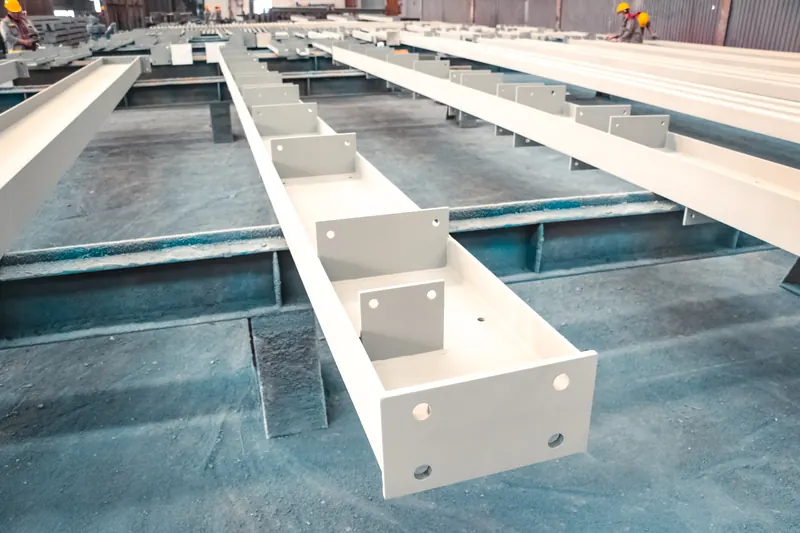
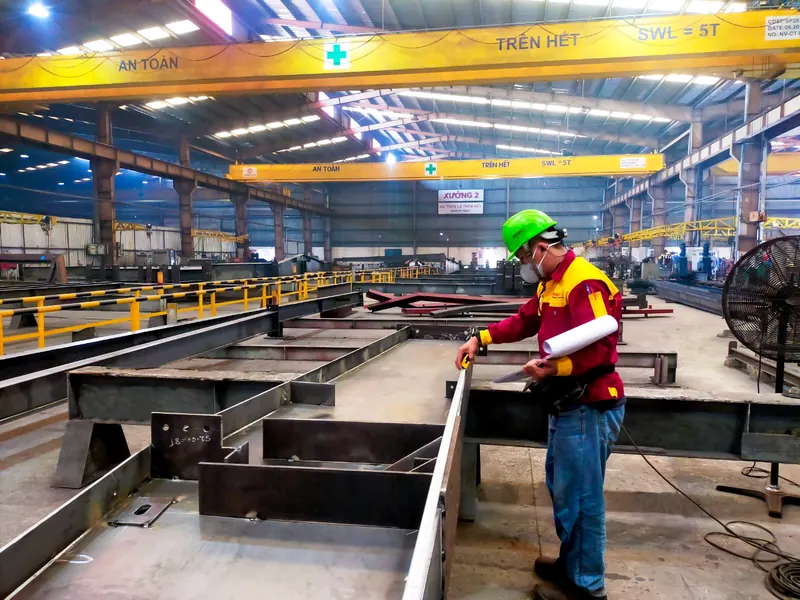
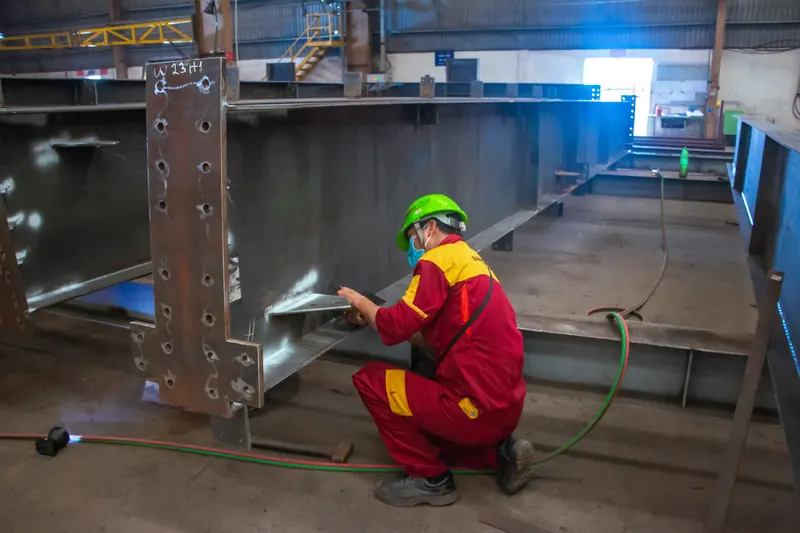
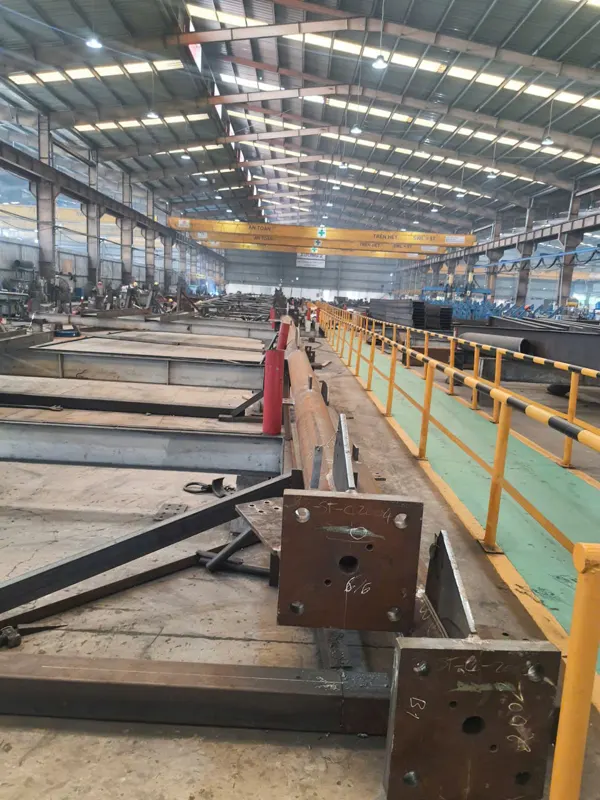
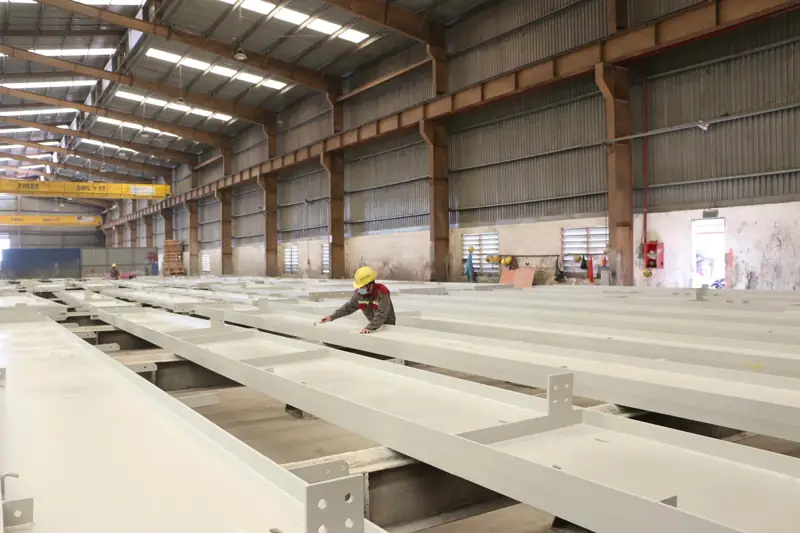
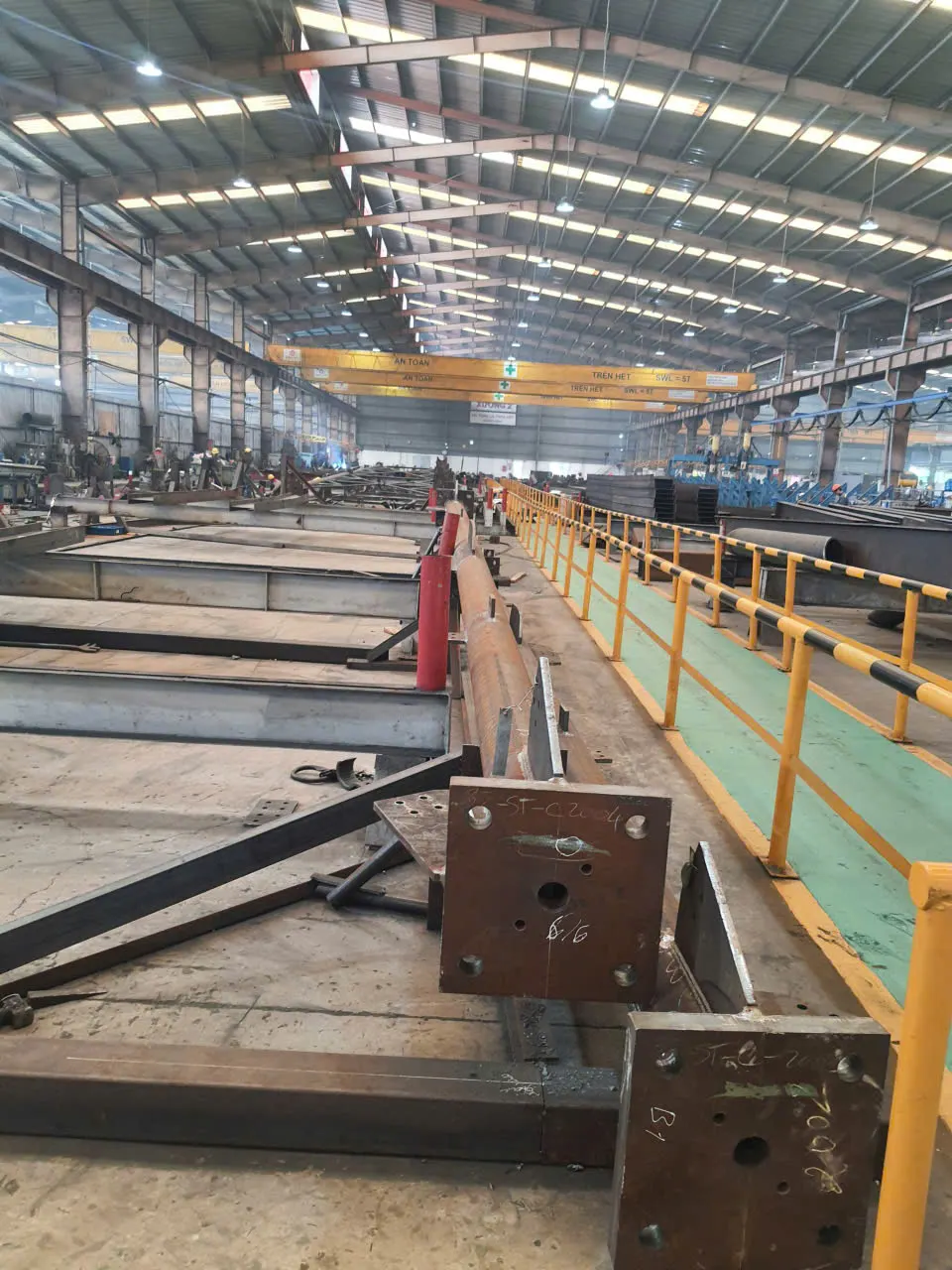
Primer on a column and its end plate at the Vietnam plant, ready for the next coat.
Shop-welded shear studs
Headed shear studs welded in our shop and bend tested to AWS D1.1
Embed plates, column faces and composite members get their studs before they ship, following US market rules on where studs may go, in a plant that fabricates 2,500 metric tons of structural steel a month.
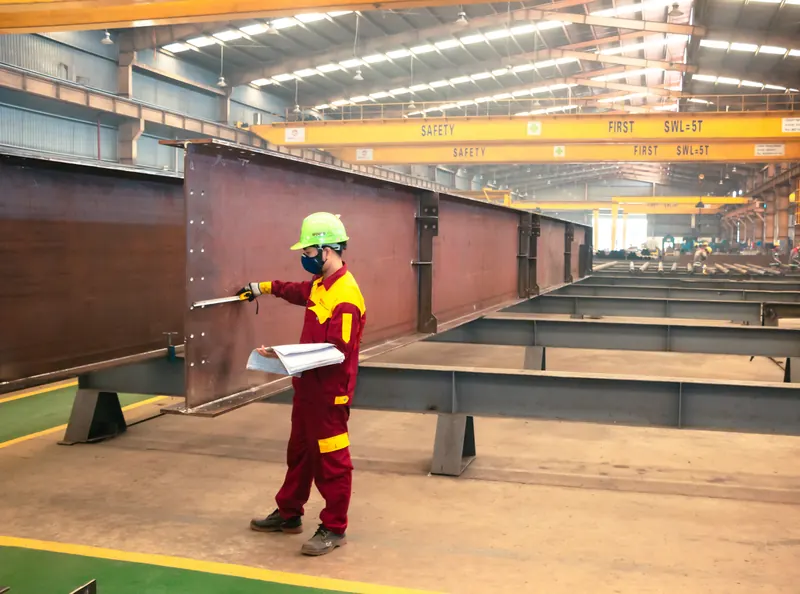
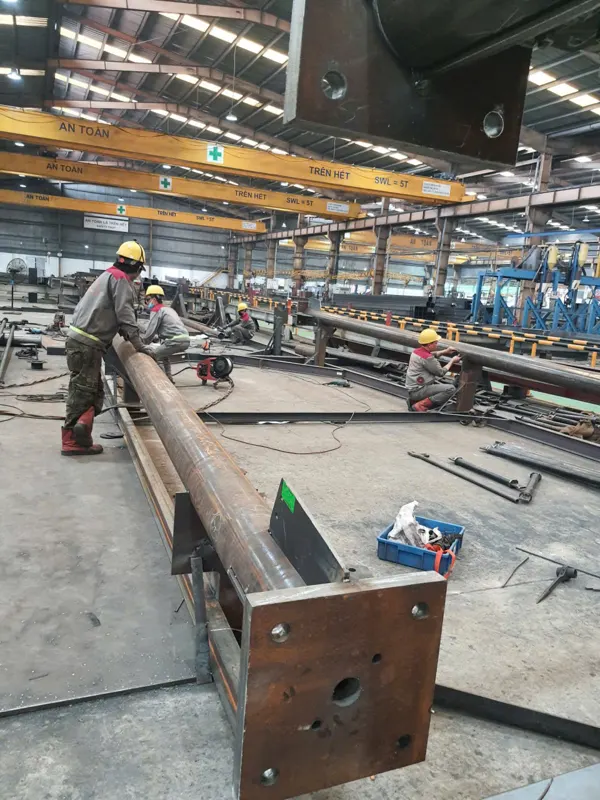
A stud, a gun and a ceramic ring
A stud weld fuses the whole end of a steel stud to the plate in under a second
Headed shear studs tie steel to concrete: a composite floor slab to its beams, an embed plate into a wall, a column into its encasement. Each stud is welded by a stud gun in the drawn-arc process: the stud lifts, an arc melts its end and the plate under it, and the gun plunges it into the molten pool inside a ceramic ferrule. World Steel welds studs in its shop, following US market requirements on where they may be fitted before erection.
Where a stud can go on in the shop, we weld it there, test it and ship it. Where US erection rules keep studs off a walking surface until the deck is down, we leave it for the field and say so on the drawings.
The drawn-arc cycle
Four stages of a stud weld, start to finish
Set by the gun’s time and current for the stud diameter, and proven by the bend test at the start of every run.
Position
The stud, with its flux-loaded tip, is set in the gun and placed on the plate inside a ceramic ferrule.
Lift and arc
The gun lifts the stud and draws an arc that melts the stud end and a pool in the plate.
Plunge
At the set time, the gun plunges the stud into the pool. The ferrule shapes the molten metal into a fillet.
Solidify and break
The weld solidifies in a fraction of a second; the ferrule is broken off to show the 360° flash.
The stud
Headed stud anchors, as specified on your drawings
Paraphrased from AWS D1.1 and AISC 360 Chapter I. The diameter, length and spacing come from the Engineer of Record’s design.
- Type
- Type B headed stud anchor
- Material
- ASTM A108 cold-finished bar
- Tensile strength
- 450 MPa (65 ksi) minimum
- Common diameters
- 13, 16, 19, 22 mm (1/2, 5/8, 3/4, 7/8 in)
- Length after welding
- At least 4 times the diameter for composite anchors
- Diameter limit
- Up to 2.5 times the flange thickness unless over the web
Bend tests
Four numbers behind every stud we ship
Paraphrased from the stud welding clause of AWS D1.1. Bent studs that pass may be left bent where the design allows; failures are replaced.
at the start of every run
Before production with a set-up, and at the start of every shift, the first two studs are welded and tested.
pre-production bend
Those studs are bent 30° from their axis. If either weld fails, the set-up is corrected and two more are tested.
flash all round
Every production stud is checked for a full flash all the way around its base.
bend on doubtful studs
A stud without full flash, or repaired, is bent 15° away from the missing flash to prove the weld.
Shop or field
Which studs we weld in our plant, and which wait for the deck
US erection rules (OSHA 1926.754(c)) do not allow shear connectors on beam top flanges until the deck or another walking surface is in place, so ironworkers are not tripping over them. Those studs are installed in the field by the erector, the US contractor’s scope.
- Embed plates cast into concrete walls, piers and slabs.
- Column faces and encased or composite columns.
- Sides and bottoms of members, away from walking surfaces.
- Transfer plates, brackets and connection plates set in concrete.
- Top flanges where the contractor’s erection plan and the rules allow it.
- Top flanges of beams that will be walked on before the deck is placed.
- Studs welded through metal deck onto the beam below.
- Any stud the US contractor, our customer, asks to install on site.
Inspection and repair
How every stud is checked before the member ships
Flash and seating
Full 360° flash, stud seated square to the plate, length after welding within tolerance.
Bend test where in doubt
Studs without full flash are bent 15°; those that fail are replaced.
Fillet repair
Where allowed, a missing flash may be repaired with a fillet weld to a qualified procedure, then tested.
Recorded
Pre-production tests and inspection recorded with the member, for your data book.
How it is tested
The NDT methods that check stud welds
Every weld is visually inspected by our QC. The other methods run where your specification or the code calls for them, by our QC, by the third party you designate, or, for radiography, through our partner.
The other weld types
Six more welds that hold your building together
Questions
Stud welds: questions from US reviewers
Do you weld shear studs in your shop?
Yes. We weld headed studs in our shop to AWS D1.1 wherever US market requirements allow it: embed plates, column faces, member sides and any top flanges the contractor’s erection plan allows.
Why do some beams arrive without studs?
US erection rules do not allow shear connectors on beam top flanges until the deck or another walking surface is in place. Those studs are welded on site, often through the deck, by the erector.
How are stud welds tested?
The first two studs of every set-up and every shift are bent 30°. Every production stud is checked for a full 360° flash, and any stud without it is bent 15° to prove the weld or replaced.
Which studs do you use?
Type B headed stud anchors of ASTM A108 steel, 450 MPa (65 ksi) minimum tensile strength, in the diameter and length on the drawings. Common sizes are 13 to 22 mm (1/2 to 7/8 in).
Can a stud with poor flash be repaired?
Where allowed, with a fillet weld to a qualified procedure and a bend test afterwards. Otherwise the stud is removed and replaced.
Do studs need to be painted?
Studs and the flange area under concrete are normally left unpainted so the concrete bonds; the coating plan on the shop drawings shows where paint stops.
Send us your stud layout
We will mark which studs we weld in the shop and which are left for the field, following US erection rules, from a plant that fabricates 2,500 metric tons a month.