
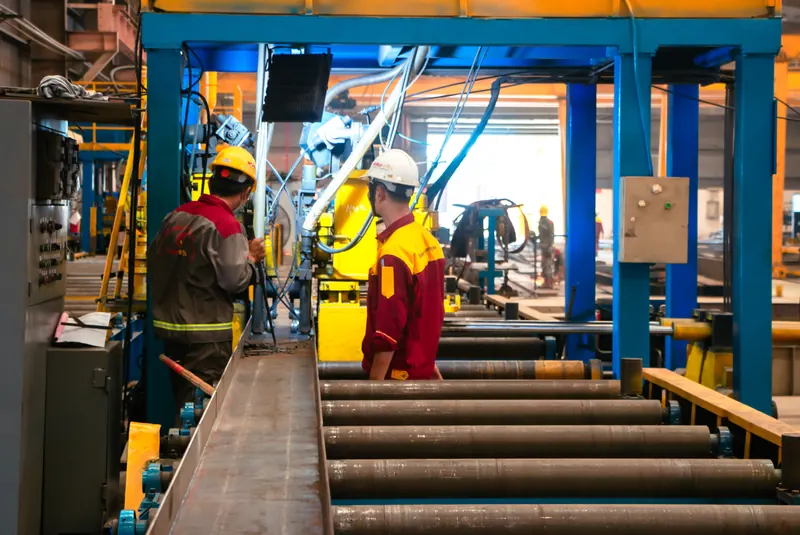
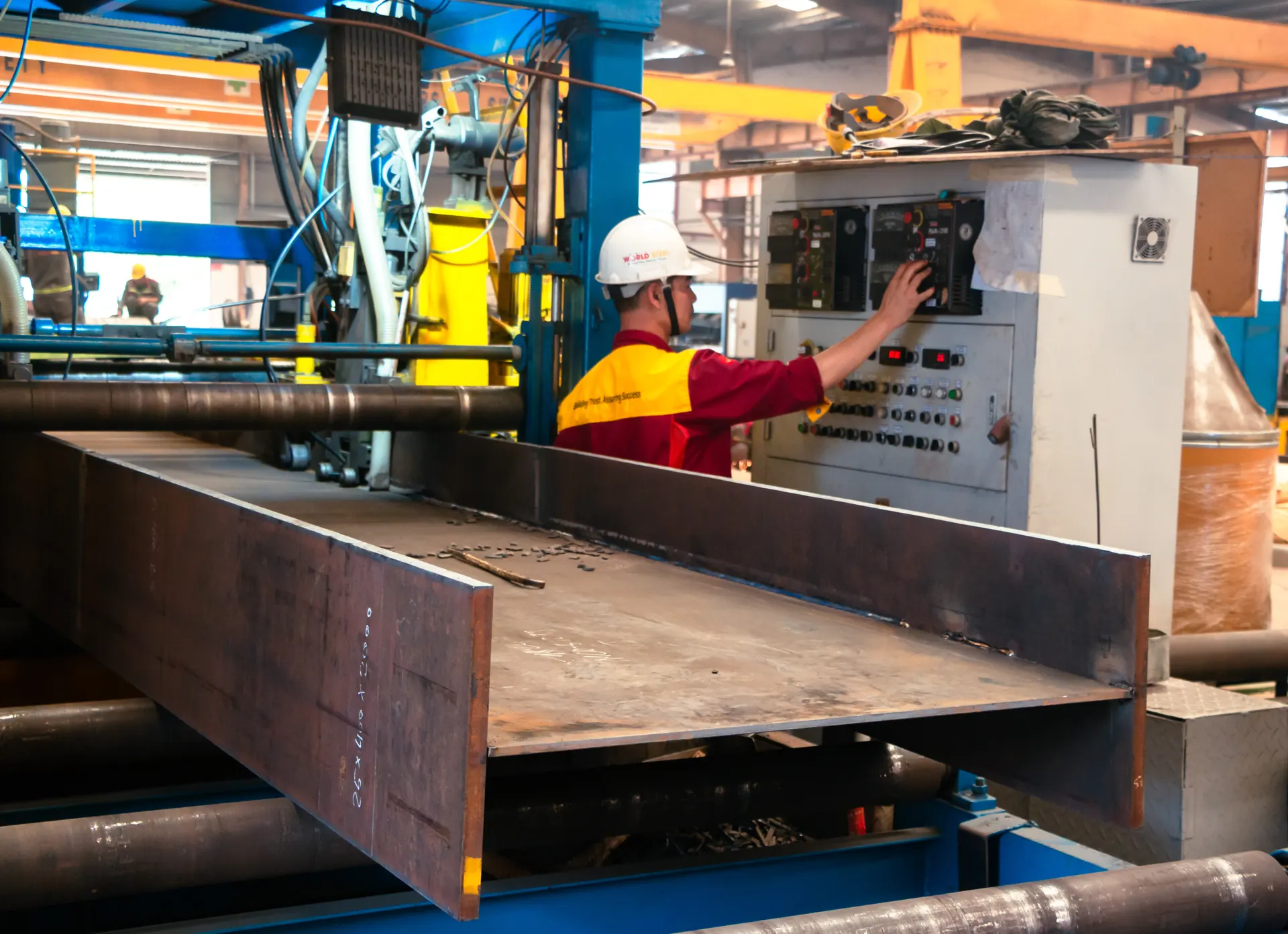
Submerged-arc welding of web-to-flange seams in the Vietnam plant.
Submerged arc welding
Submerged arc welding on automatic beam lines, to AWS D1.1 procedures
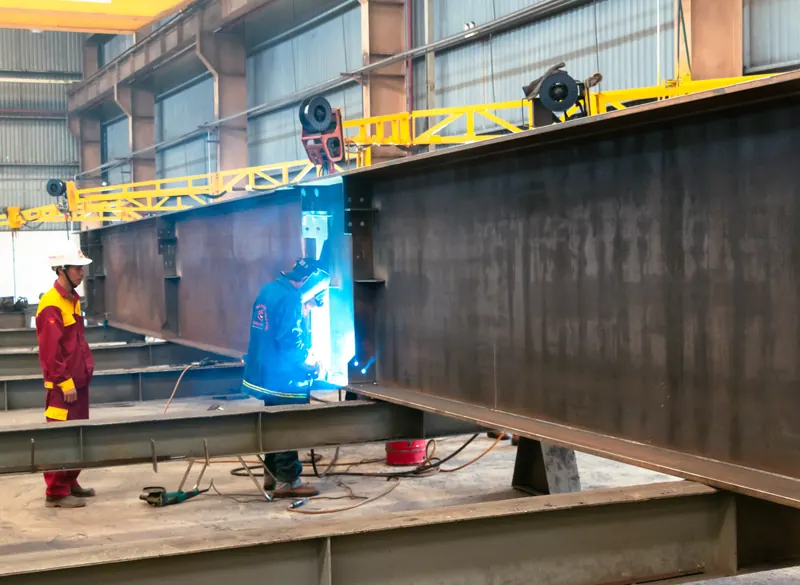
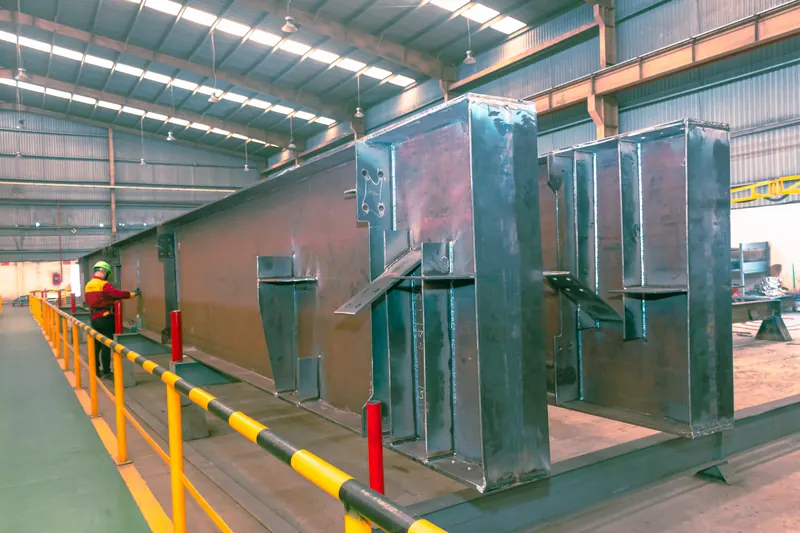
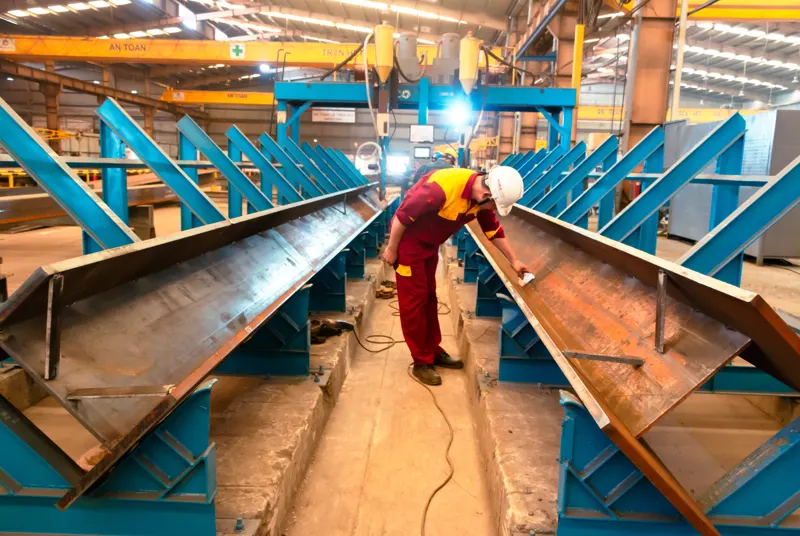
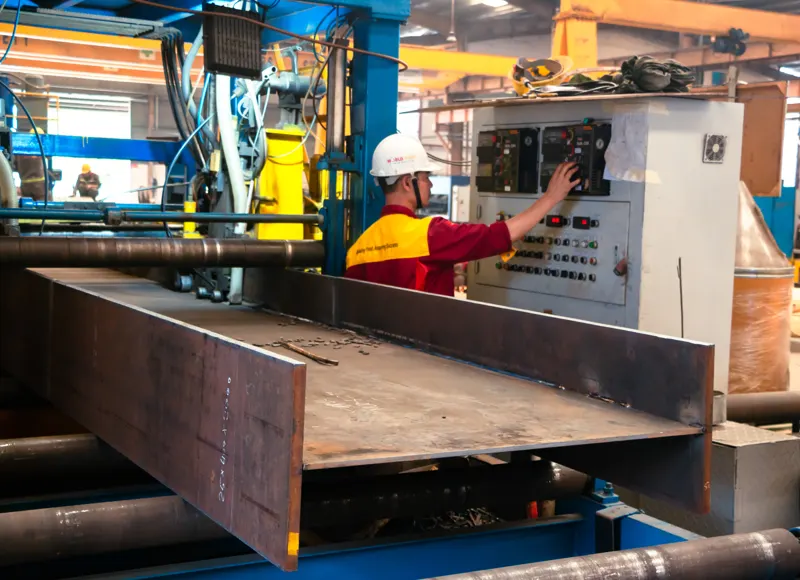
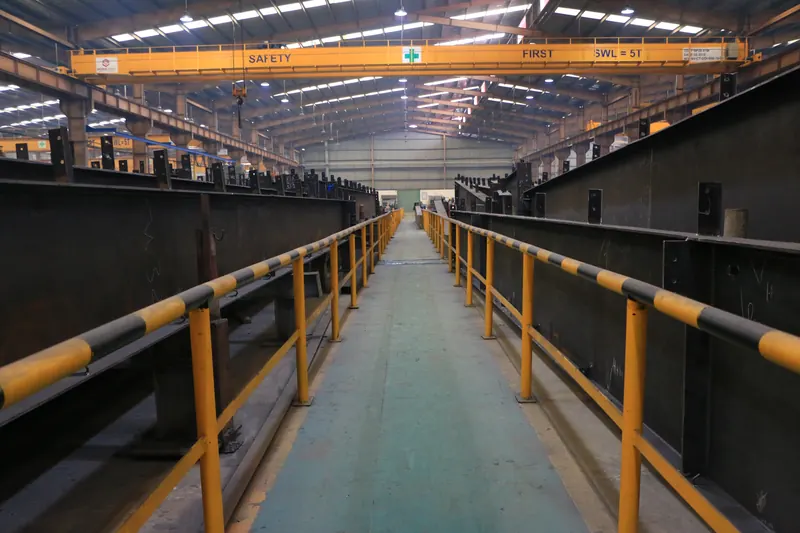
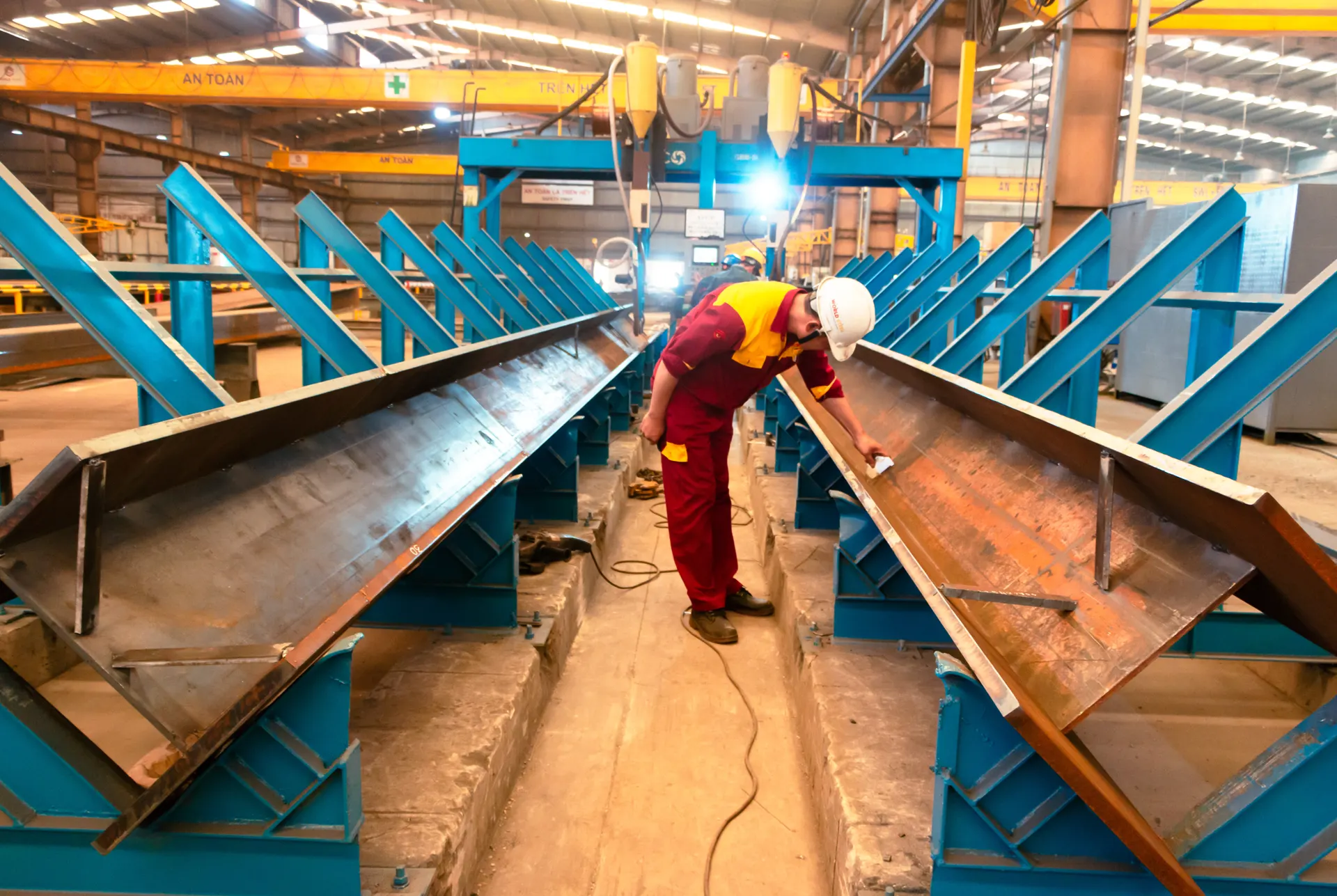
Web-to-flange seams on built-up columns, rafters, plate girders and box columns, welded under granular flux in a plant that fabricates 2,500 metric tons of structural steel a month.
The arc you never see
Submerged arc welding lays long, deep welds under a blanket of flux
In submerged arc welding (SAW) a bare wire is fed into the joint while granular flux pours over it from a hopper. The arc burns under the flux, out of sight, melting wire, flux and plate together. The melted flux floats up as slag and protects the weld as it cools. With no open arc, no spatter and very high deposition, SAW is the process for the long web-to-flange seams that carry most of the tonnage in a large steel package.
The automatic head runs at the same speed, current and voltage from one end of a 15 m girder to the other, so the weld on the hundredth rafter matches the first.
Under the flux
Five parts of a submerged arc weld
A section along the seam as the head moves left to right. The flux is cut away to show the arc.
Wire
A bare solid or composite wire fed from a coil through the contact tip, usually 3.2 to 4.8 mm (1/8 to 3/16 in).
Flux blanket
Granular flux poured ahead of the arc from a hopper. It shields the arc, adds alloy and shapes the bead.
Arc and pool
The arc burns under the flux. High current gives deep penetration and a large, smooth pool.
Slag
Melted flux that floats to the top, protects the weld while it cools and peels off afterwards.
Flux recovery
Unfused flux is vacuumed back, screened and returned to the hopper.
On the beam lines
Four SAW setups, matched to the member
Every setup runs on its own WPS, prequalified within AWS D1.1 limits or qualified by test.
Single wire
One wire, one head. The basic setup for fillet and groove welds on built-up members.
Built-up columns and raftersTwo wires, tandem
A lead wire for penetration and a trail wire for fill, one behind the other in the same pool.
Long girder seams at higher speedTwin heads
Two heads welding both fillets of a web-to-flange joint at once, so the member stays straight.
H-beam lines, both sides togetherGantry
A head carried on a gantry over heavy members, for thick plate and box column corners.
Heavy girders and box columnsFlux and wire, classified together
Reading a SAW classification: F7A2-EM12K
AWS A5.17 covers carbon steel wires and fluxes, AWS A5.23 low-alloy ones. Newer editions use an updated designation; the meaning is the same: a tested flux-wire pair, with its strength, heat treatment condition and toughness.
Flux. The classification is for a flux and wire combination, not the flux alone.
Weld metal tensile strength of at least 480 MPa (70 ksi).
Tested as-welded. P means tested after post-weld heat treatment.
Charpy toughness of at least 27 J (20 ft-lb) at -29 °C (-20 °F).
The wire: E for electrode, M for medium manganese, 12 for nominal carbon, K for silicon-killed.
Heat input
Volts, amps and travel speed, in one number
Heat input = volts x amps x 60 / travel speed. It is one of the variables the WPS controls, and on demand-critical welds AWS D1.8 ties the filler metal to the heat input range it was tested at.
An illustration of the arithmetic. The real ranges come from the qualified or prequalified WPS for each joint.
Flux handling
Dry flux makes a sound weld
Moisture in the flux brings hydrogen into the weld. AWS D1.1 requires flux to be dry and free of contamination; this is how we keep it that way.
Dry and sealed
Flux is stored dry in its sealed bags. Damp or contaminated flux is not used.
Dried when needed
Flux that has picked up moisture is dried to the manufacturer’s instructions before use.
Recovered flux screened
Recovered flux is screened for slag, fines and debris and mixed with new flux as the WPS allows.
Crushed slag only if classified
Fused slag is not crushed and reused unless the crushed product is itself classified for it.
On our floor
Where SAW welds the members we ship
The Engineer of Record sets the weld; the shop drawing and WPS show where it runs on our SAW lines.
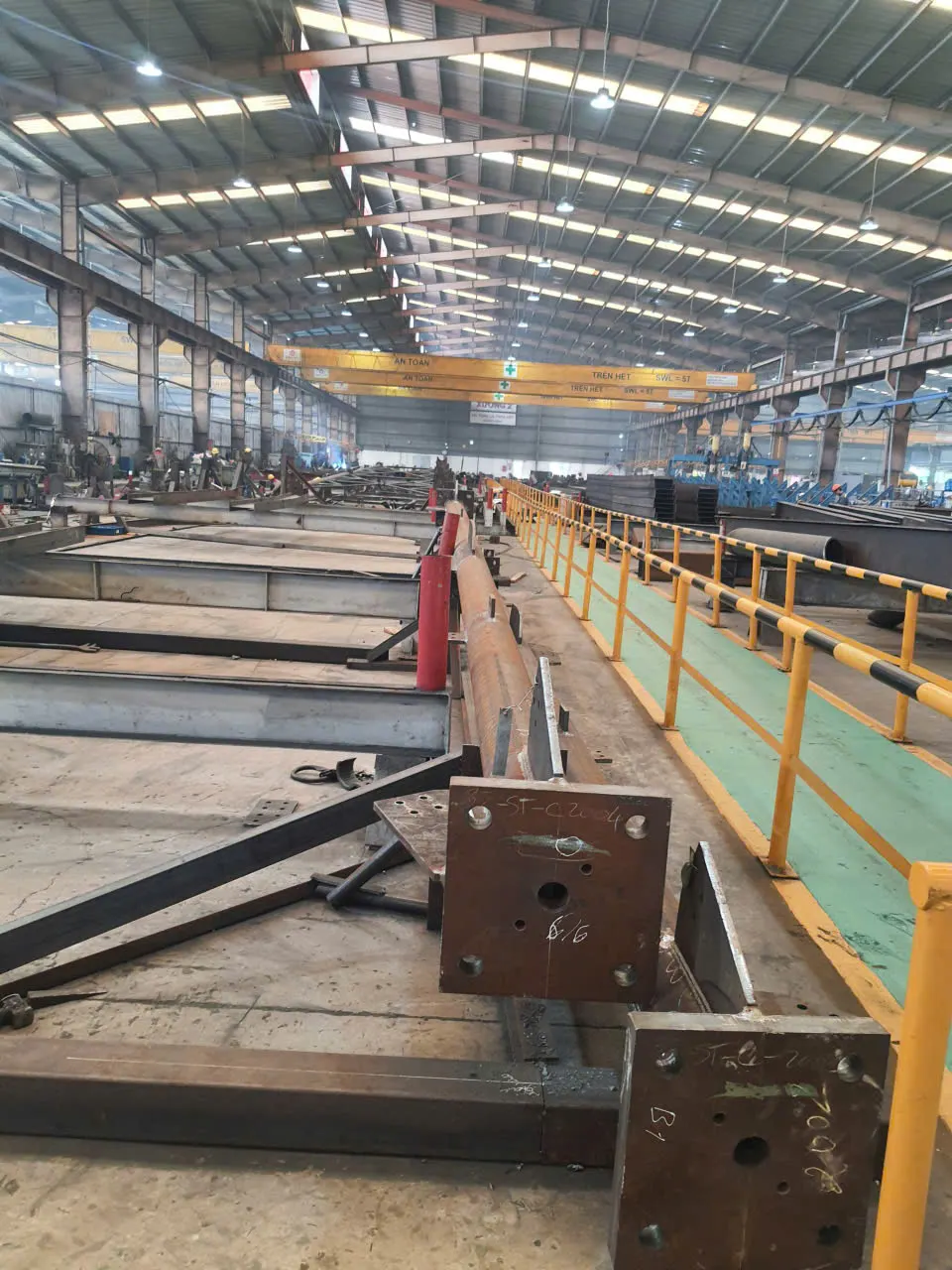
Built-up columns
Web-to-flange fillet and PJP welds along the full length.
Plate girders
Long web-to-flange seams and flange plate splices.
Tapered rafters
Web-to-flange welds that follow the taper, knee to ridge.
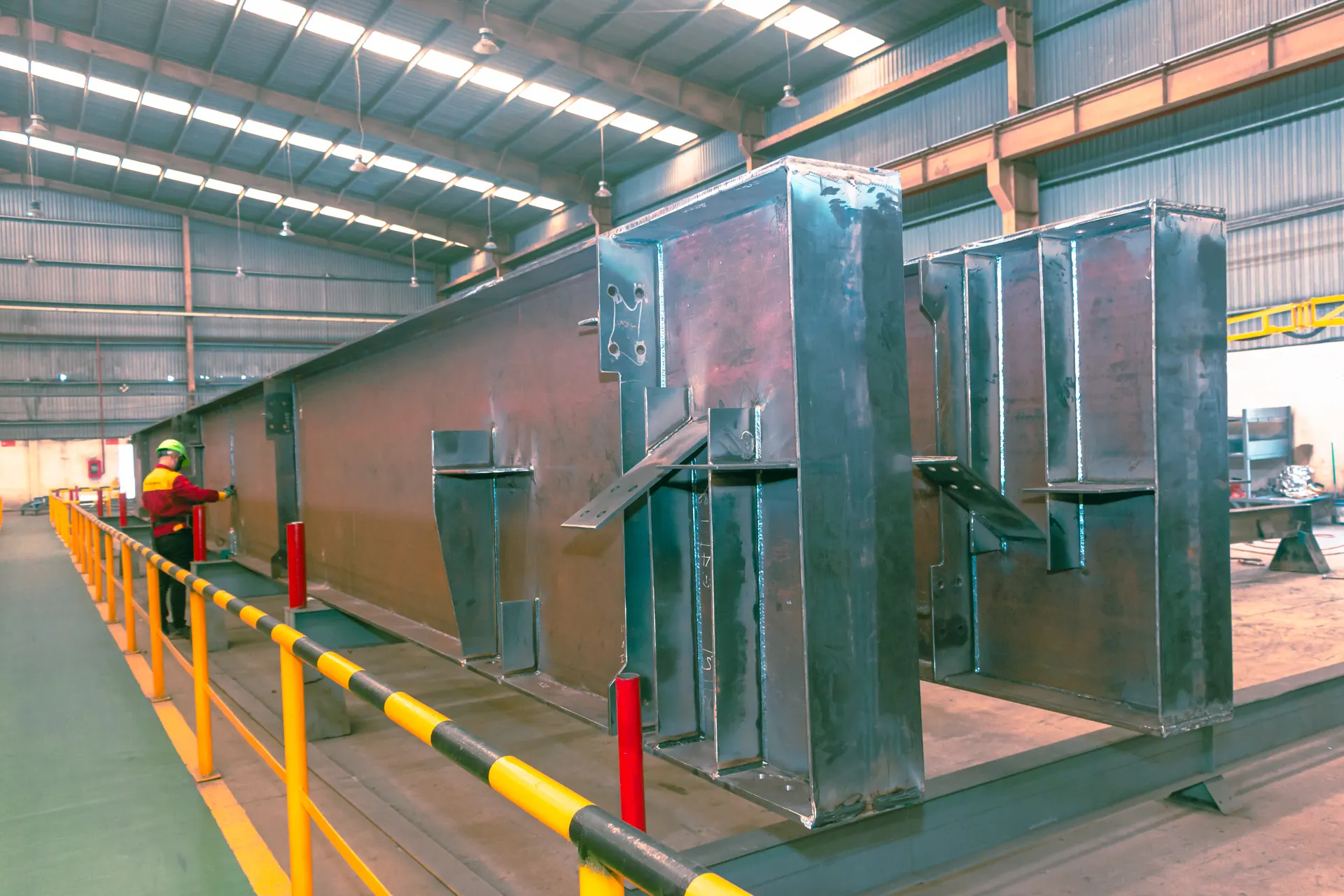
Box columns
Corner welds on the gantry, PJP or CJP as designed.
Thick plate splices
Groove welds on heavy flange and web plates, flat position.
Crane runway girders
Top flange welds that carry wheel loads, as the design sets.
Where SAW does not fit
Flat and horizontal only
The flux has to sit on the joint, so SAW works in the flat position, and horizontal fillets.
Long, accessible seams
It pays on long, straight welds the head can track. Short welds and stiffeners go to FCAW.
Fit-up matters
A deep, hot pool can burn through a wide root gap. Joints are fitted tight or backed.
Those welds go to flux-cored arc welding or gas metal arc welding at the fitting stations.
On the WPS
Six things the procedure fixes for SAW
Every weld is made to a written welding procedure specification, prequalified or qualified by test to AWS D1.1 (and AWS D1.8 for seismic welds), by a welder or operator qualified for it.
Wire and flux
The classified flux-wire combination, wire diameter and number of wires.
Current and voltage
Amperage, voltage and polarity, within the ranges qualified or prequalified.
Travel speed
Head travel speed and, with it, the heat input of each pass.
Preheat and interpass
Minimum preheat for the steel and thickness, and the maximum interpass temperature.
Bead and layer limits
Bead width and layer thickness limits for a prequalified WPS, or the qualified values.
Joint detail
Groove type, root opening, bevel angle and backing, as on the shop drawing.
The other processes
Four more ways we weld your steel
Questions
SAW questions from US reviewers
Which members do you weld by SAW?
Built-up columns, rafters, plate girders and box columns: the long web-to-flange and corner welds. Short welds, stiffeners and connection plates are welded by FCAW or GMAW at the fitting stations.
Is SAW prequalified under AWS D1.1?
Yes. SAW is one of the processes AWS D1.1 allows on a prequalified WPS, within limits on wire size, current, bead width and layer thickness. Outside those limits, the procedure is qualified by test with a PQR.
What does F7A2-EM12K mean?
It is a flux and wire combination classified to AWS A5.17: weld metal of at least 480 MPa (70 ksi), tested as-welded, with Charpy toughness of at least 27 J (20 ft-lb) at -29 °C (-20 °F), using an EM12K wire.
Can SAW be used on demand-critical welds?
Yes, with a flux-wire combination that meets the AWS D1.8 toughness requirements over the heat input range of the procedure, and a WPS qualified to AWS D1.8.
How do you keep SAW welds consistent?
The heads run on fixed settings from the approved WPS, and QC checks current, voltage and travel speed against it during production. Every member is then visually inspected and tested as specified.
Why does a SAW weld look so smooth?
The flux shapes the bead and the slag protects it while it cools, so the face is smooth and even with almost no spatter. It still gets a full visual inspection.
Send us your built-up members
We will tell you which seams run on our SAW lines and which welds go to the fitting stations, from a plant that fabricates 2,500 metric tons a month.