
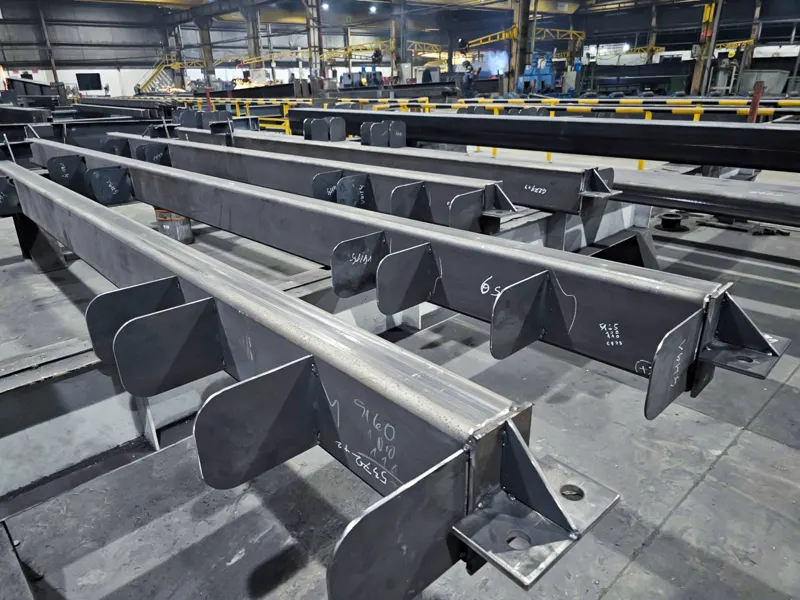
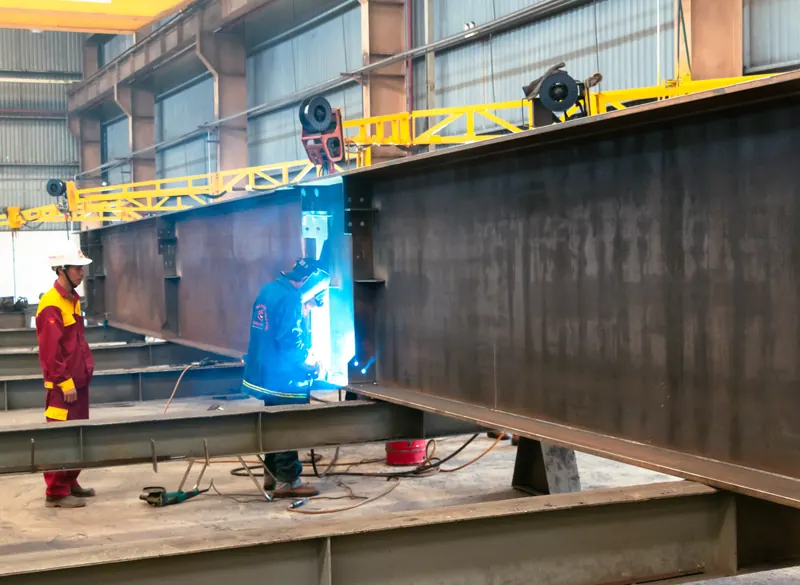
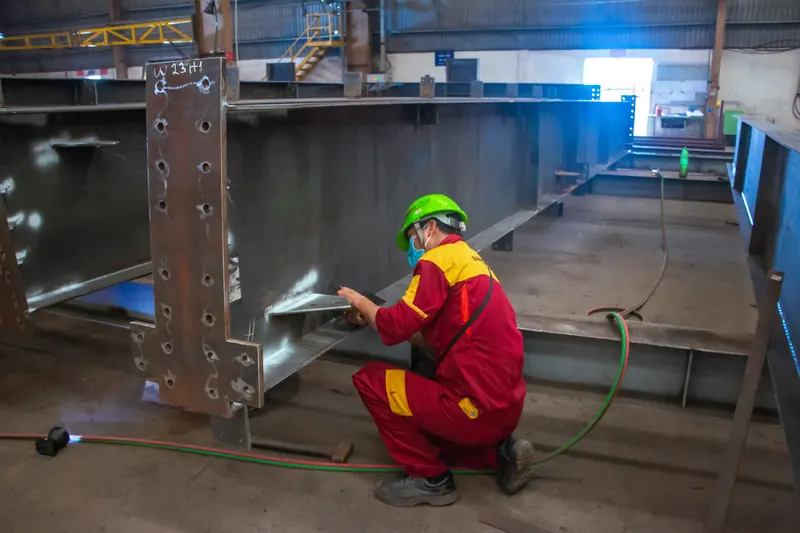
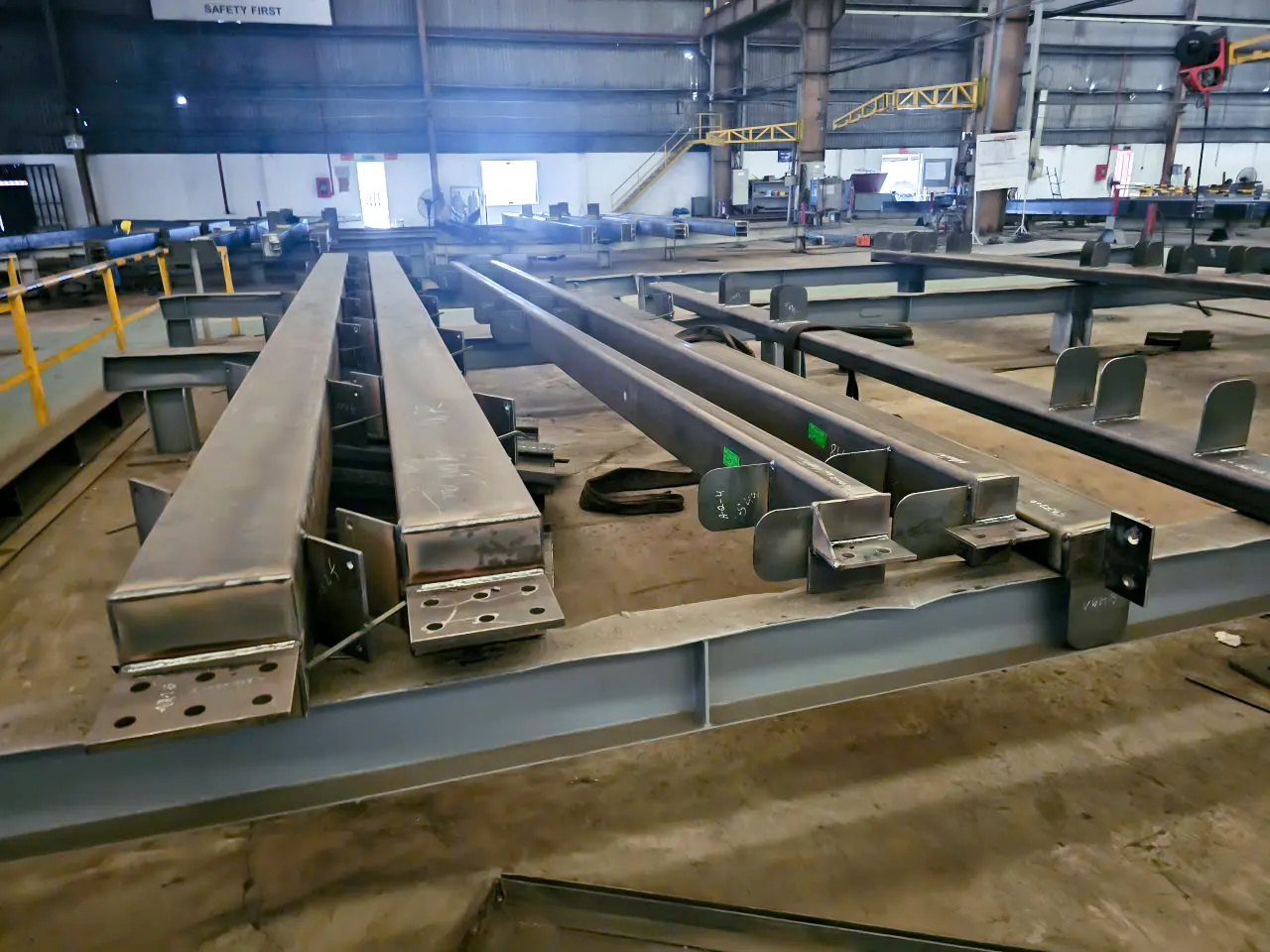
Stiffeners and drilled clip plates welded on, World Steel plant in Vietnam.
Fillet welds to AWS D1.1
Fillet welds sized to the drawing, gauged on every member and recorded
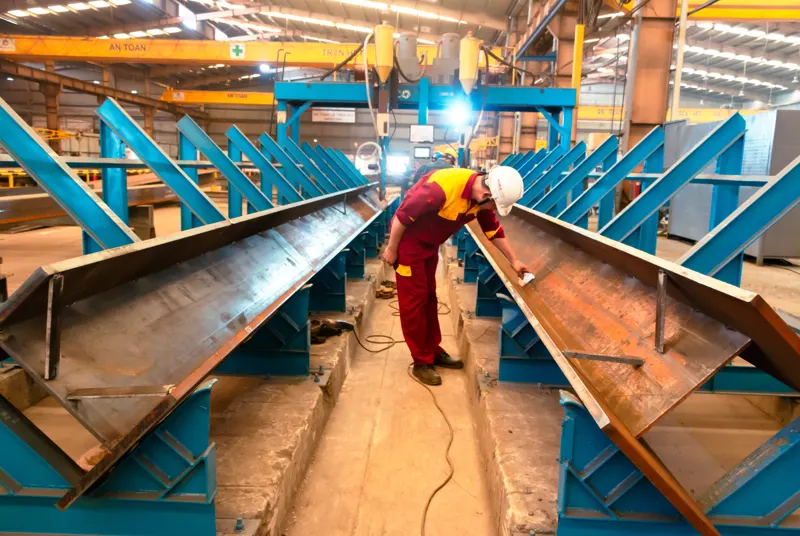
Stiffeners, shear tabs, end plates and web-to-flange welds: the most common weld on your steel, welded to qualified procedures in a plant that fabricates 2,500 metric tons of structural steel a month.

The weld on almost every member
A fillet weld is a triangle of weld metal. Its strength is in the throat
A fillet weld joins two surfaces at an angle, usually 90°, in a T-joint, a lap joint or a corner joint. It needs no groove preparation, which is why it is the cheapest and most common weld on a steel building. It is specified by its leg size, but it carries load through its throat, the shortest distance from the root to the face.
Bigger is not better. An oversized fillet adds weld metal, heat and distortion without adding the strength the design asked for. We weld the size on the drawing, and gauge it.
Anatomy
Leg, throat, root, toes and face
Six words that every fillet weld inspection report uses. The drawing gives the leg; the strength is in the throat.
Leg
The distance from the root to the toe on each plate. The size on the weld symbol is the leg.
Throat
The shortest distance from the root to the face. For an equal-leg 90° fillet it is 0.707 times the leg.
Root
The corner where the two plates meet, where fusion has to reach.
Toes
Where the weld face meets the base metal. Undercut and sharp convexity start here.
Face
The exposed surface of the weld: flat, slightly convex or concave within limits.
Fusion
Weld metal fused into both plates and to the root, with no cold lap at the toes.
Leg to throat
How much throat does your fillet weld have?
Move the slider to the leg size on your drawing. The result is the effective throat of an equal-leg 90° fillet, the minimum plate it suits and the US size nearest to it.
Typical sizes: 5, 6, 8, 10 and 12 mm (3/16, 1/4, 5/16, 3/8 and 1/2 in).
Effective throat
5.7 mm(0.22 in)
Leg in inches
5/16 innearest 1/16 in
Meets the minimum size for a thinner part of
any thicknessFor illustration. Unequal legs, skewed joints, penetration credit and strength are calculated by the Engineer of Record.
The gauge card
Minimum fillet weld size, by the thinner part joined
The minimum makes sure enough heat goes into thick plate to fuse it without cracking. Single-pass welds are expected for these sizes. Values paraphrased from AISC 360; your edition governs.
| Thinner part joined | Minimum fillet size |
|---|---|
| Up to 6 mm (1/4 in) | 3 mm (1/8 in) |
| Over 6 mm to 13 mm (1/4 to 1/2 in) | 5 mm (3/16 in) |
| Over 13 mm to 19 mm (1/2 to 3/4 in) | 6 mm (1/4 in) |
| Over 19 mm (3/4 in) | 8 mm (5/16 in) |
Detailing rules
Six rules our detailers apply to every fillet weld
Paraphrased from AISC 360 Section J2.2. They decide how a fillet is drawn before anyone strikes an arc.
Maximum size along an edge
Along the edge of material under 6 mm (1/4 in), no more than the thickness. At 6 mm and over, the thickness less 2 mm (1/16 in), so the edge stays visible for the gauge.
Minimum length
At least four times the leg size. A shorter weld is counted as if its size were a quarter of its length.
Lap joints
Lap at least five times the thinner part, and not less than 25 mm (1 in). Both ends of the lap are welded where the joint carries axial load.
Intermittent welds
Allowed where the design permits, each segment at least four times the size and at least 38 mm (1-1/2 in) long.
End returns
Turned around the corner where the design asks for it, at least twice the size, for example at the top of a clip angle.
Skewed T-joints
Where the plates meet at an angle other than 90°, the throat changes on each side and is calculated for the dihedral angle.
How it is counted
Four numbers behind a fillet weld’s strength
Weld design is the Engineer of Record’s. These figures show how a fillet is counted, not a substitute for the calculation.
x leg = throat
Effective throat of an equal-leg 90° fillet. An 8 mm (5/16 in) leg gives about 5.7 mm (0.22 in) of throat.
x FEXX
Nominal stress on the throat, where FEXX is the filler metal strength: 480 MPa (70 ksi) for E70 electrodes.
x for transverse load
A fillet loaded at 90° to its axis is stronger than one loaded along it; AISC 360 allows up to 1.5 times.
sides on most stiffeners
Double fillets, one each side of the plate, balance the joint and halve the size needed on each side.
On our floor
Where fillet welds sit on the members we ship
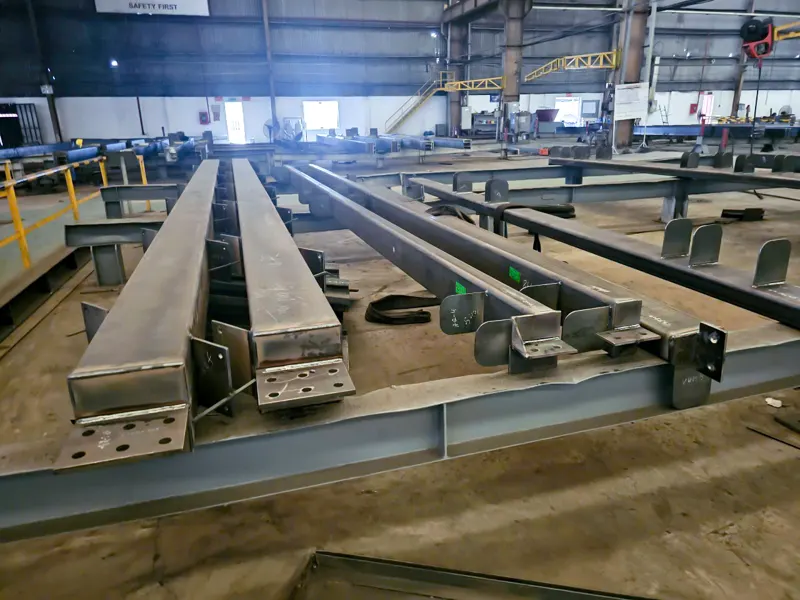
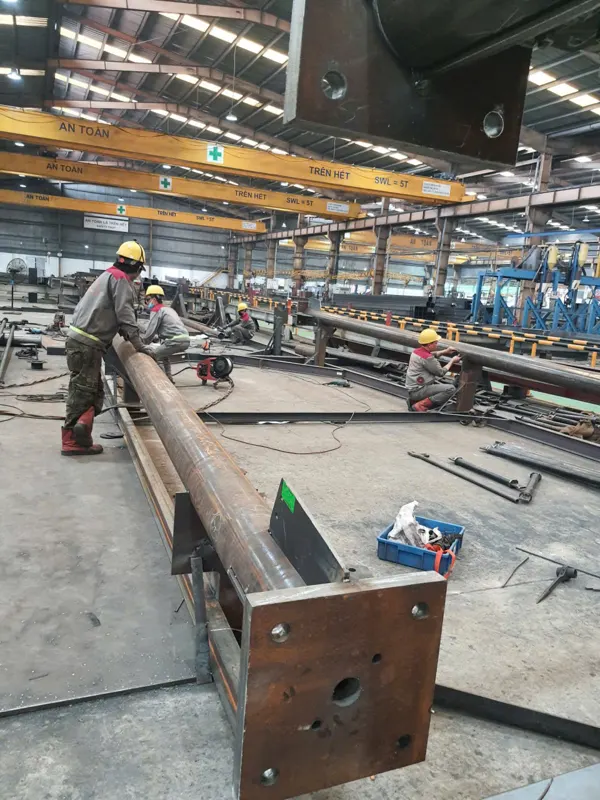
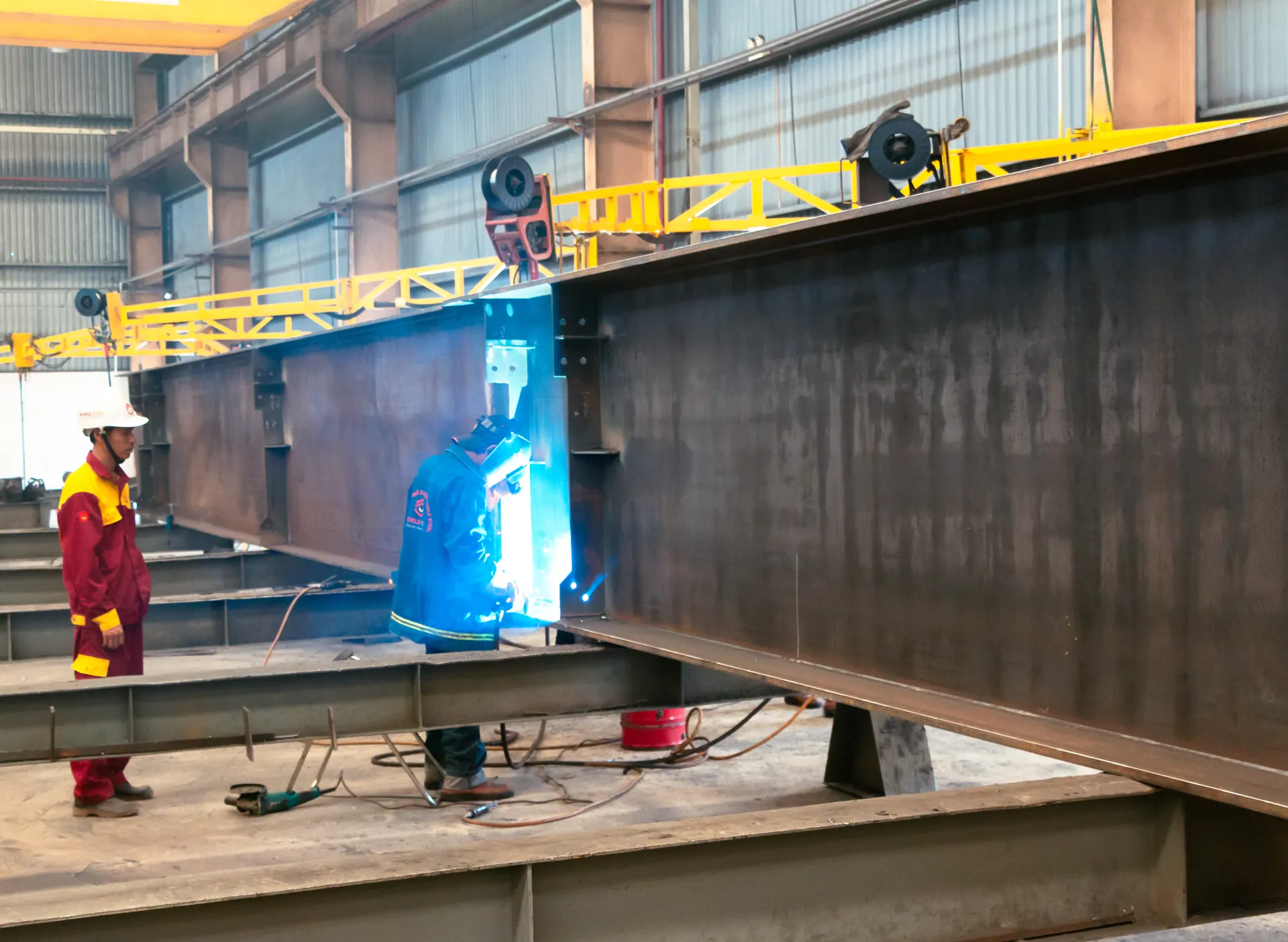
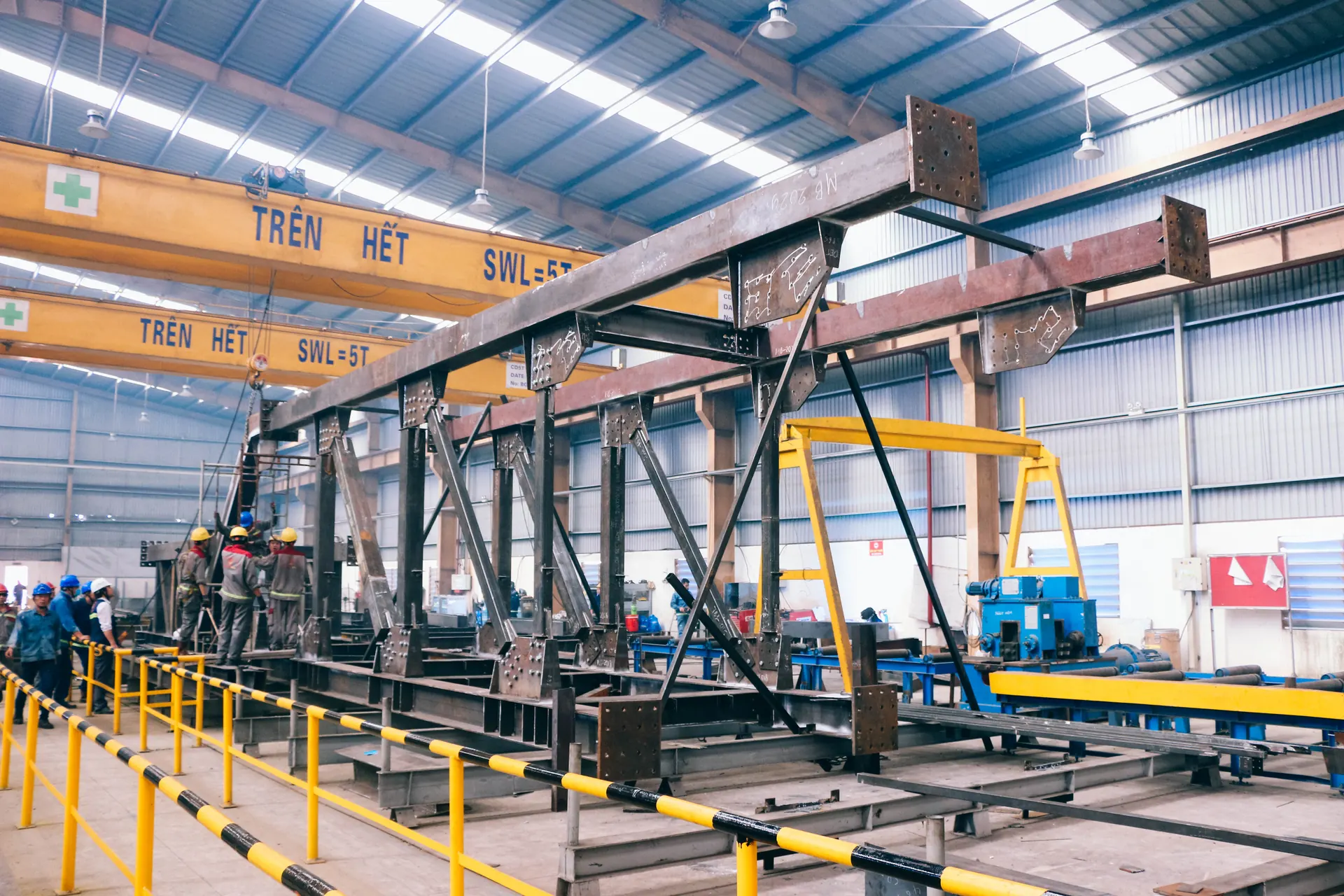
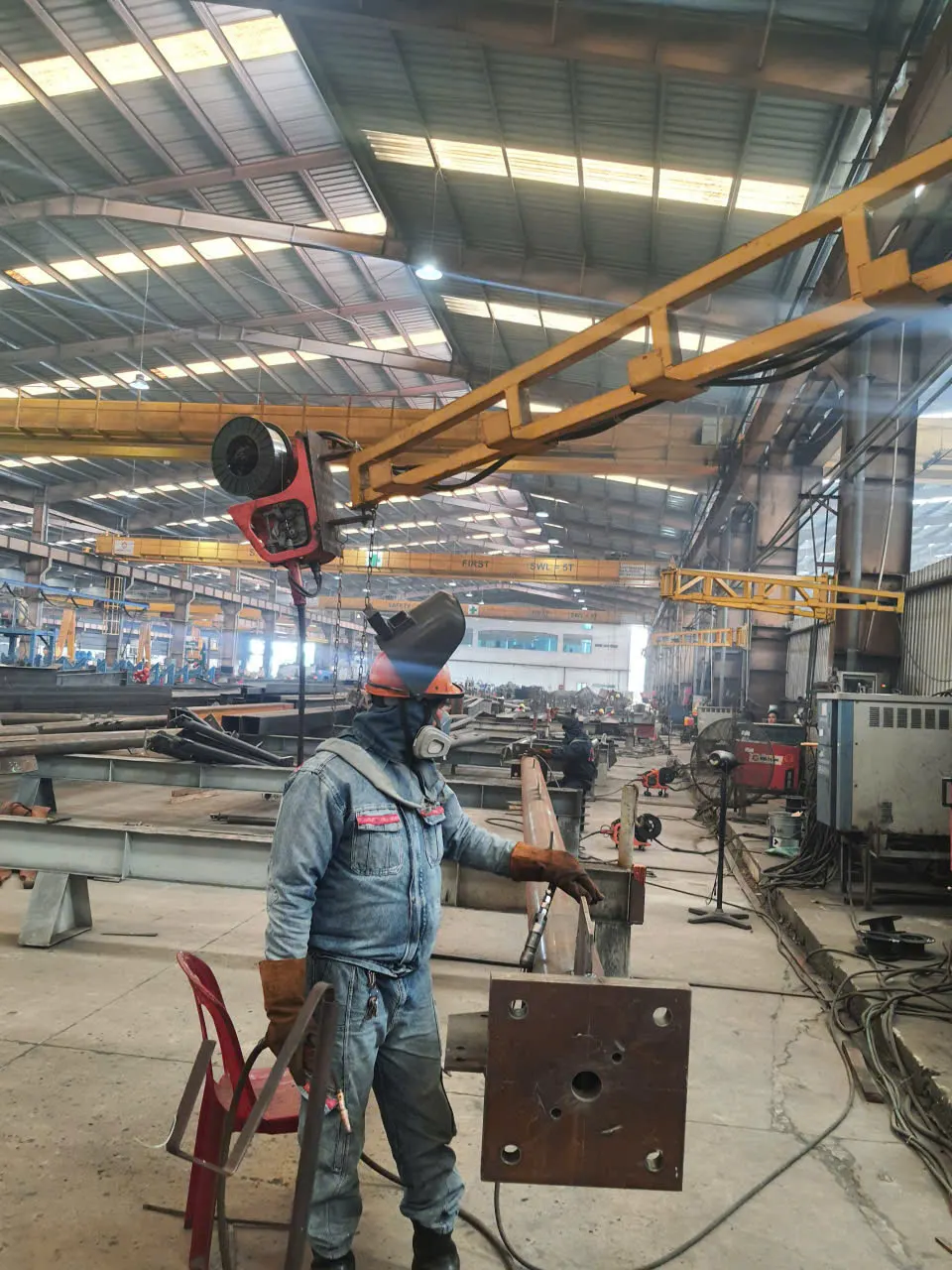
Fillet welds are made on our automatic lines and at the fitting stations, to the size and WPS on the shop drawing.
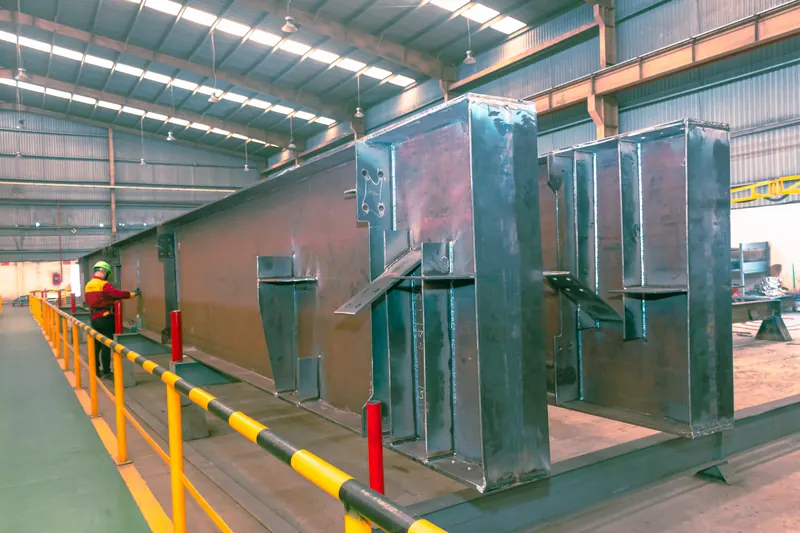
Web to flange of built-up members
Double fillets run by submerged arc on our beam lines, the full length of the girder or column.
Stiffeners and continuity plates
Fillet welded to web and flanges where the design allows; CJP where it does not.
Shear tabs, clips and end plates
Connection plates fillet welded to the member, sized on the shop drawing.
Base plates and cap plates
All-around fillets on many columns, groove welds where moment or uplift demands it.
Cover plates and doublers
Longitudinal fillets along the edges, with plug or slot welds in the middle where specified.
Purlin clips, girts and bracing
Short fillets on secondary steel, gauged like every other weld.
Fillet profiles
One acceptable fillet, three that are repaired
The shape of the face and the toes is read on every fillet weld against the AWS D1.1 visual acceptance criteria.
Flat or slightly convex
Full leg on both plates, smooth blend at the toes.
Excessive convexity
A heavy crown makes a notch at the toe.
Undersized or concave
Throat smaller than the design size.
Undercut at the toe
A groove melted into the plate, measured in depth.
How it is tested
The NDT methods that check fillet welds
Every weld is visually inspected by our QC. The other methods run where your specification or the code calls for them, by our QC, by the third party you designate, or, for radiography, through our partner.
The other weld types
Six more welds that hold your building together
Questions
Fillet welds: questions from US reviewers
What does the size on a fillet weld symbol mean?
The leg size. An 8 mm (5/16 in) fillet has two 8 mm legs. The throat, which carries the load, is about 0.707 times the leg for an equal-leg 90° fillet.
Why is there a minimum fillet weld size?
Thick plate draws heat out of a small weld so fast that it may not fuse and may crack. The minimum size, set by the thinner part joined, makes sure enough heat goes in. It is a workmanship rule, not a strength rule.
Can a fillet weld be bigger than the drawing?
A little oversize is usually accepted, but it is not better. Extra weld metal adds heat and distortion. We weld the size on the shop drawing and gauge it; the Engineer of Record decides any change.
How do you check fillet weld size?
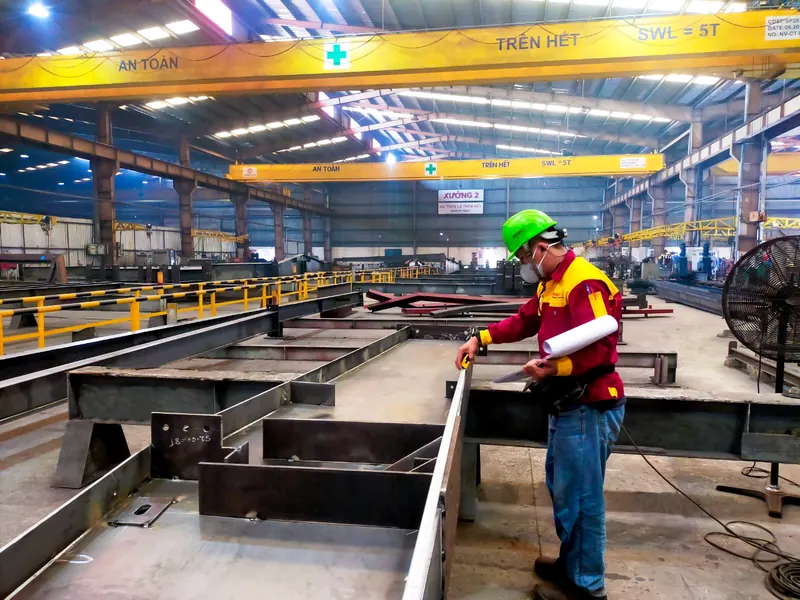
With fillet weld leaf gauges and a multi-purpose weld gauge, on every weld, by the foreman and by our QC, and recorded in the Welding Inspection Report.
Is a fillet weld undersize ever accepted?
AWS D1.1 allows a small underrun for a short part of the weld length, within set limits. Anything beyond that is repaired by adding weld metal and inspected again.
Are fillet welds tested by UT?
Not normally. Fillet welds are visually inspected, and MT or PT is used where the specification calls for a surface crack check, for example at toes on heavily loaded or fatigue-sensitive joints.
Are your fillet welds prequalified?
Most fillet welds on structural steel are made to prequalified WPSs under AWS D1.1, and our welders are qualified for the processes and positions they weld.
Send us your weld schedule
We will detail every fillet on the shop drawings and weld it to a qualified WPS, from a plant that fabricates 2,500 metric tons a month.