
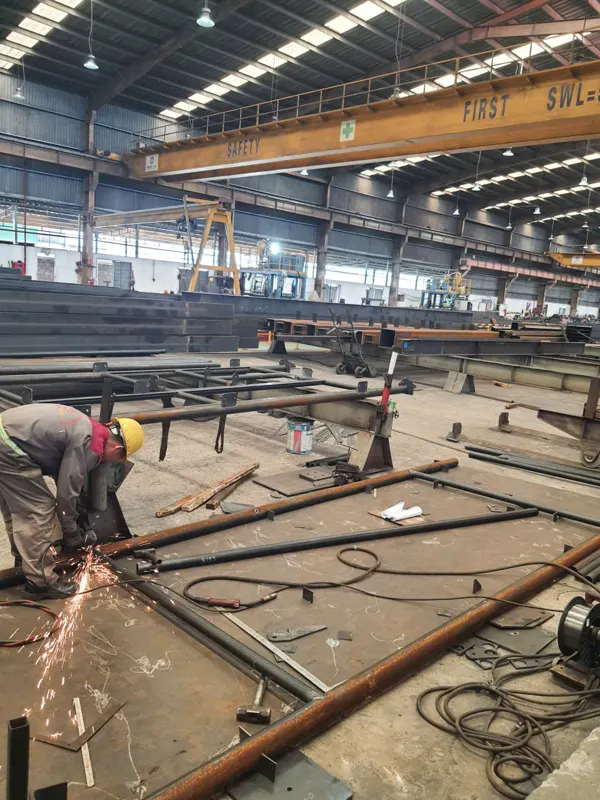
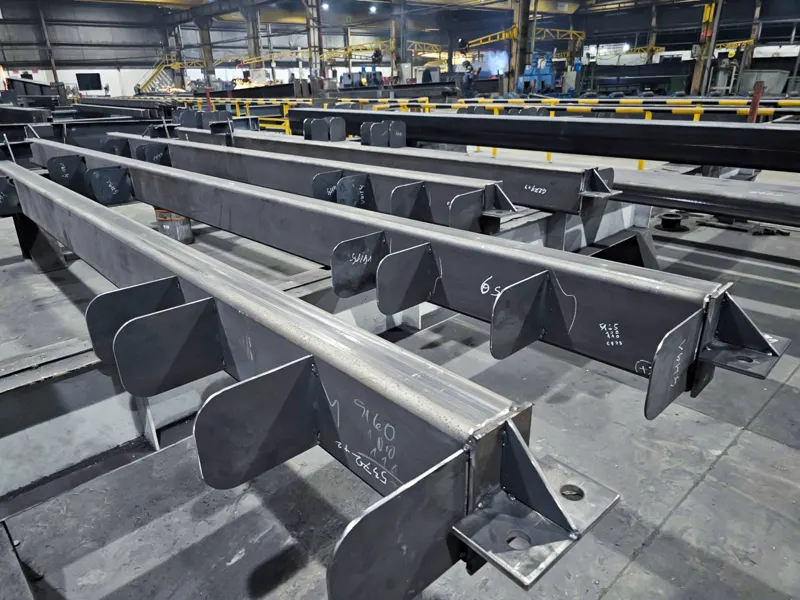
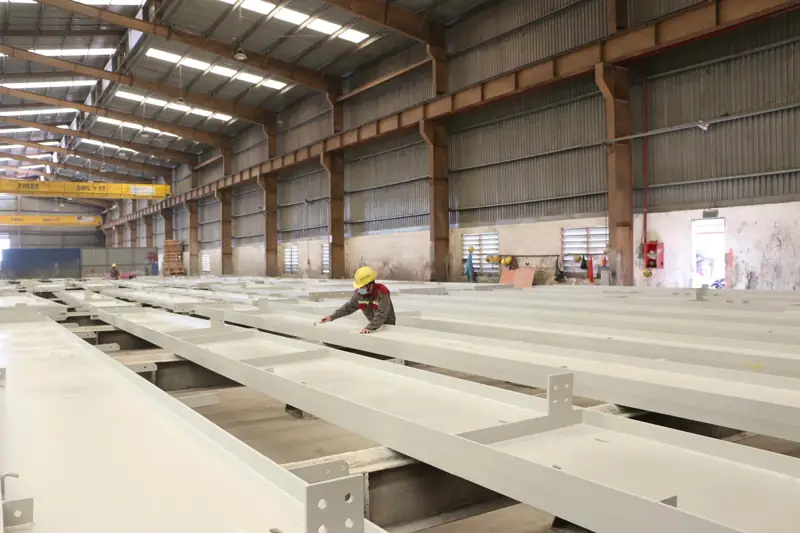
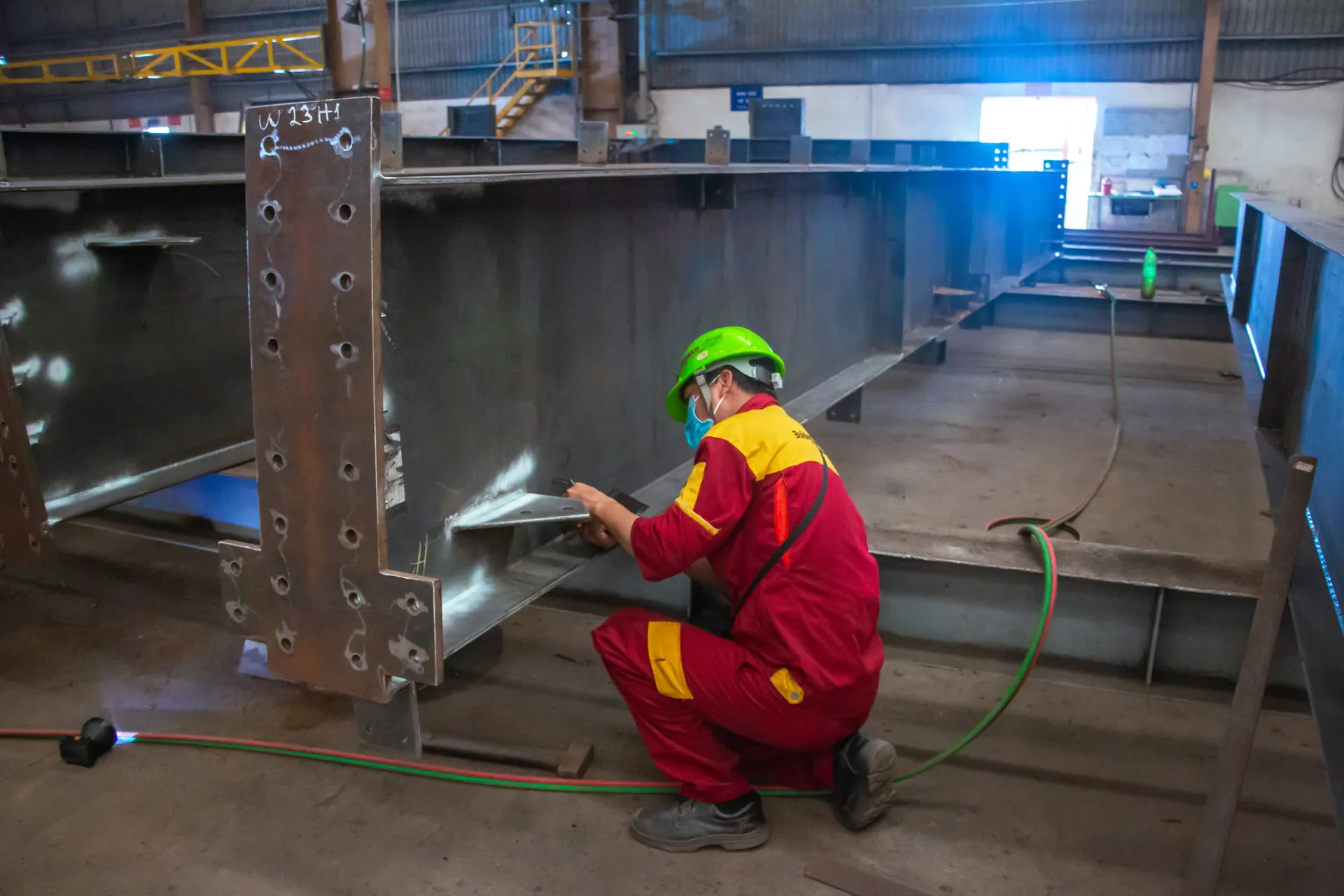
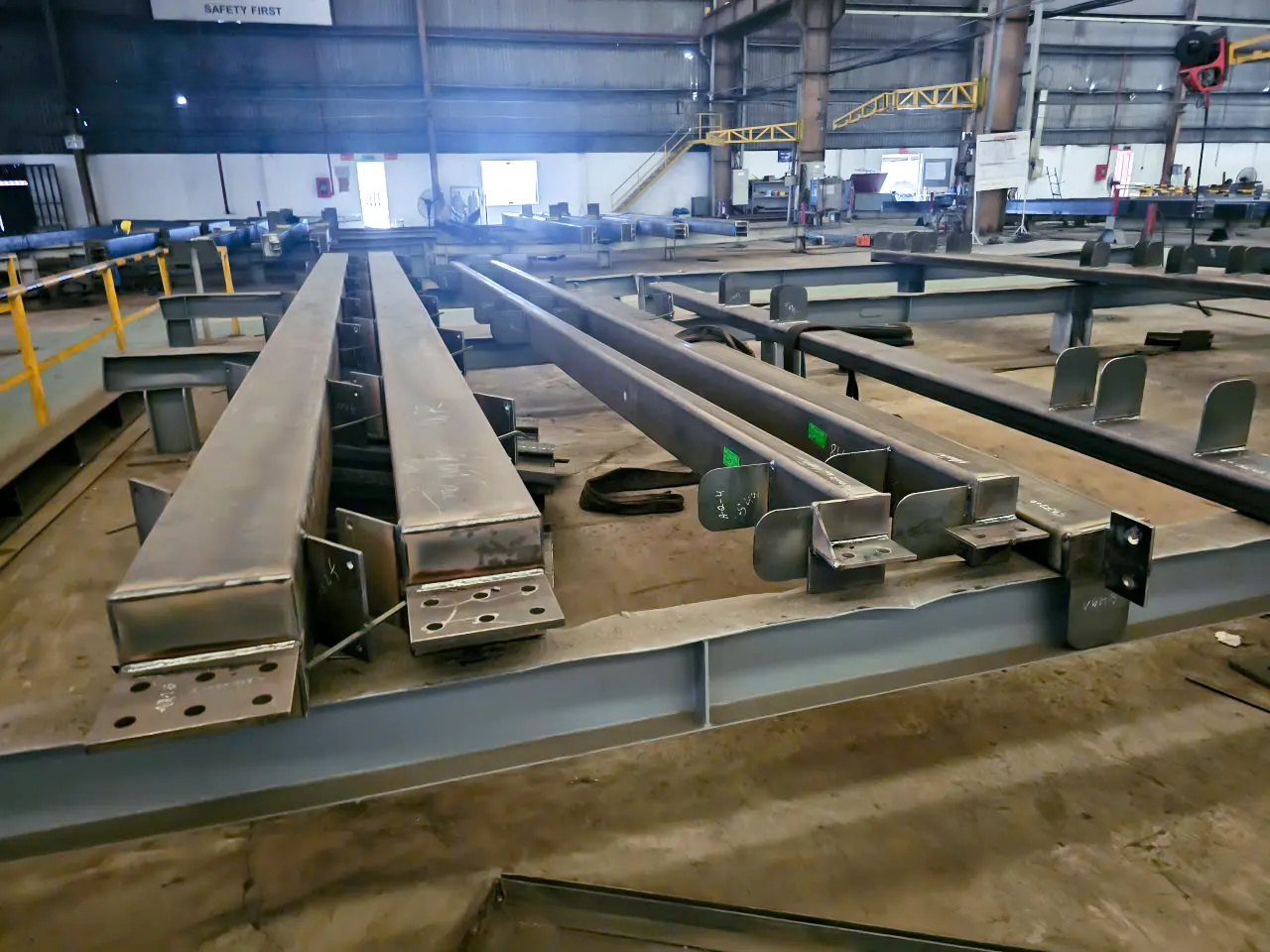
Cut edges are dressed before fit-up, World Steel plant in Vietnam.
Shielded metal arc welding
Shielded metal arc welding for repairs, tacks and tight access, with low-hydrogen electrodes
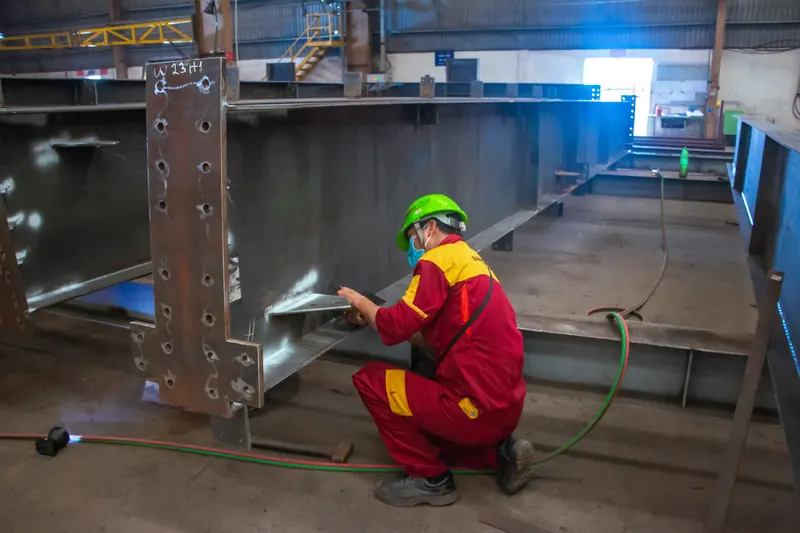
Stick welding where a wire gun cannot reach, always with dry low-hydrogen electrodes and qualified procedures, in a plant that fabricates 2,500 metric tons of structural steel a month.
The oldest arc in the shop
Shielded metal arc welding needs only a stick, a holder and a power source
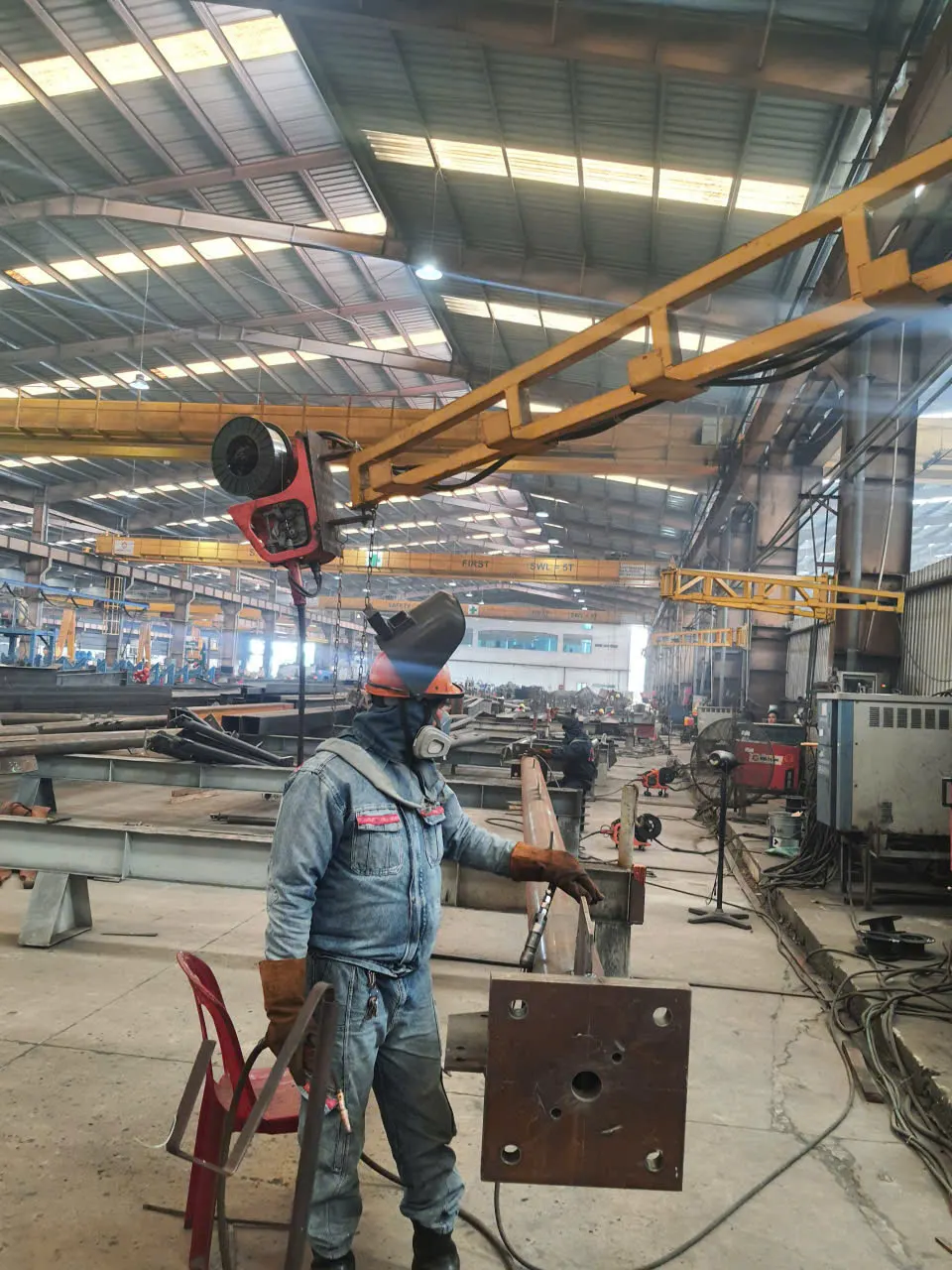
In shielded metal arc welding (SMAW, or stick welding) a coated electrode is struck against the steel. The core wire melts into the joint and the coating burns to make gas and slag that shield the weld. It is slower than the wire processes, but needs no wire feeder or gas, reaches where a gun cannot, and is the process of choice for short welds, tight corners and repairs. On structural steel it is done with low-hydrogen electrodes, kept dry in ovens.
A low-hydrogen electrode is only low-hydrogen while it is dry. Ours go from sealed cans or ovens to the welder, and back into the oven or the bin when their time is up.
The covered electrode
A steel core, a flux coating and the arc they make
As the stick burns, the coating turns to gas and slag. The welder feeds it down and along the joint by hand.
Core wire
Carbon steel rod that carries current and melts into the weld.
Coating
Flux that makes shielding gas and slag, stabilises the arc and adds alloy.
Gas shield
Formed as the coating burns, keeping air away from the arc.
Slag
Covers the bead as it cools, then is chipped off before the next pass.
Reading the stick
E7018 H4R, printed on every electrode
AWS A5.1 covers carbon steel covered electrodes, AWS A5.5 low-alloy ones (E8018, E9018 and so on). Structural welds to AWS D1.1 use low-hydrogen electrodes such as E7018.
Electrode.
Weld metal tensile strength of at least 480 MPa (70 ksi).
Usable in all positions.
Coating type: low-hydrogen potassium with iron powder, AC or DC electrode positive.
Optional: diffusible hydrogen no more than 4 ml per 100 g, and R for resistance to moisture pick-up.
| E70XX (AWS A5.1) | 4 hours |
| E70XXR (moisture resistant) | 9 hours |
| E80XX | 2 hours |
| E90XX | 1 hour |
| E100XX and E110XX | 30 minutes |
Low hydrogen
How long an electrode can be out of the oven
After leaving a sealed can or holding oven. Electrodes exposed longer are re-dried to the code and manufacturer’s rules, or scrapped. Holding ovens are kept at 120 °C (250 °F) or more, and an electrode is re-dried only once. Wet electrodes are discarded.
In our shop
Where stick welding still earns its place
The Engineer of Record sets the weld; the WPS shows when SMAW is used, mostly for the short, tight and repair work.
Repairs
Re-welding after a defect is removed, to the repair WPS.
Tight access
Corners and short welds a wire gun cannot reach.
Tack welds
Fitting tacks that become part of the final weld or are removed.
Stud fillet repairs
A fillet weld round a stud with incomplete flash, where allowed.
Short welds
Odd short welds where setting up a wire process would cost more.
Root passes
Where the WPS calls for a stick root under a wire fill.
Fitting
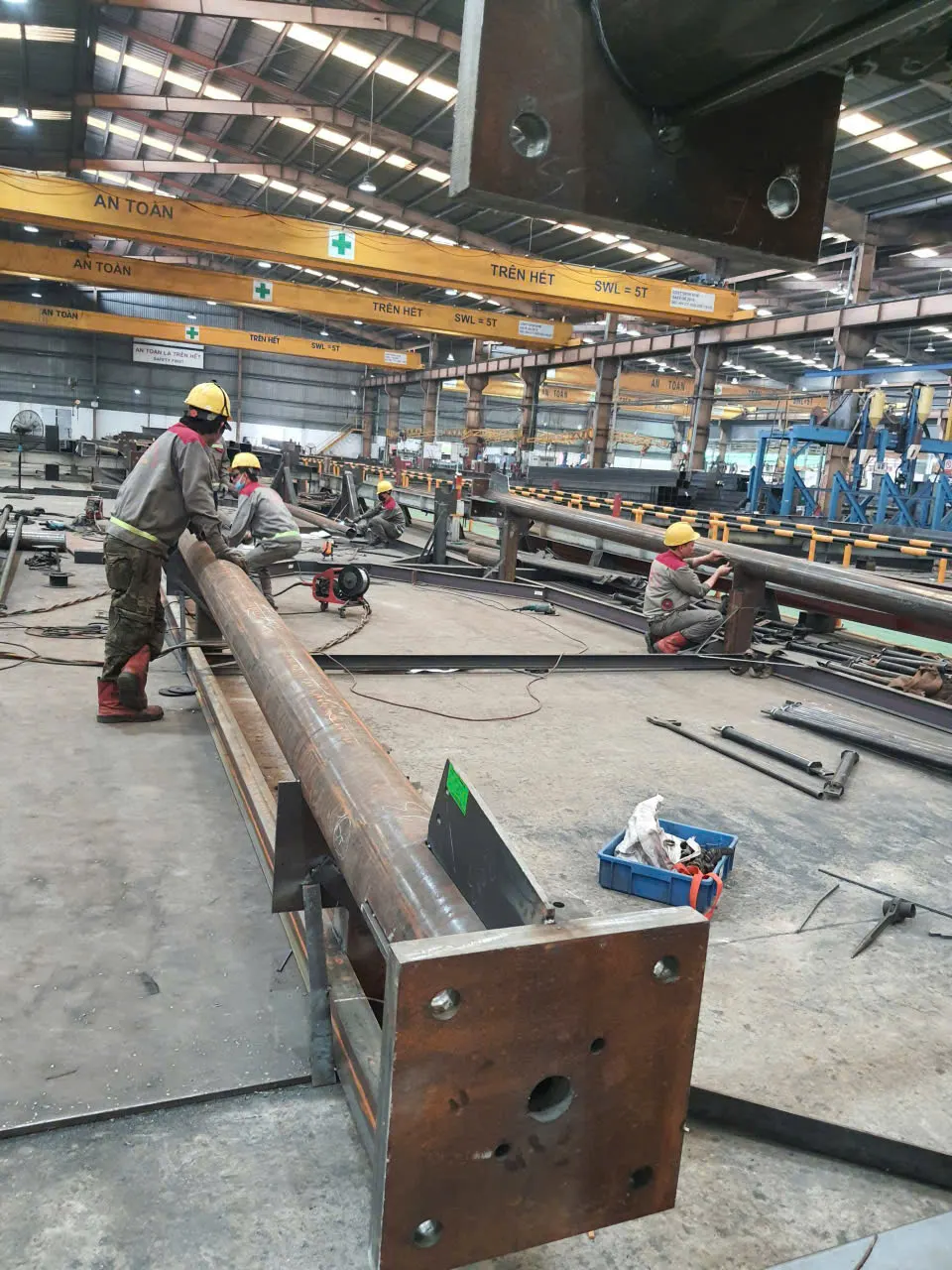
Tack welds are welds too
Paraphrased from AWS D1.1. A tack that stays in the joint becomes part of the final weld, so it is held to the same rules.
By qualified welders
Tack welders are qualified for tacking, or are qualified welders.
Same preheat
Tacks that become part of the weld get the same preheat as the weld.
Same quality
Cracked or defective tacks are removed before the weld is made over them.
Removed where needed
Tacks outside the final weld are removed where the code or design says so.
Weld repairs
From a found defect to a re-inspected weld
Every repair follows a repair WPS and is recorded against the piece mark, so your inspector can trace it.
Find and mark
VT, MT or UT locates the defect and its extent.
Remove
The defect is gouged or ground out to sound metal, with a smooth, open profile.
Prove it is gone
MT or PT on the excavation where cracks were found.
Re-weld
Welded to the repair WPS, with preheat, by a qualified welder.
Re-inspect
Tested again by the same method that found the defect, and recorded.
On the WPS
Six things the procedure fixes for SMAW
Every weld is made to a written welding procedure specification, prequalified or qualified by test to AWS D1.1 (and AWS D1.8 for seismic welds), by a welder or operator qualified for it.
Electrode
AWS A5.1 or A5.5 classification, diameter and the low-hydrogen requirement.
Current and polarity
Amperage range for each diameter, AC or DC electrode positive.
Position and progression
Positions allowed, and uphill progression on vertical welds.
Preheat and interpass
Minimum preheat by steel and thickness, maximum interpass.
Electrode care
Storage, oven and exposure rules for the electrodes.
Joint detail
Joint type, root opening, groove angle and backing.
The other processes
Four more ways we weld your steel
Questions
SMAW questions from US reviewers
Do you still use stick welding?
Yes, for repairs, tack welds, short welds and joints a wire gun cannot reach. Production welds on long seams and connections are made by SAW, FCAW or GMAW.
Is SMAW prequalified under AWS D1.1?
Yes. SMAW is one of the processes AWS D1.1 allows on a prequalified WPS, using low-hydrogen electrodes and the code’s limits on joints and electrode sizes.
How long can an E7018 electrode stay out of the oven?
Under AWS D1.1, up to 4 hours for E70XX electrodes and 9 hours for moisture-resistant E70XXR, after leaving a sealed can or holding oven. Then they go back for re-drying or are scrapped.
Why do low-hydrogen electrodes matter?
Hydrogen from a damp coating can cause cracking under the weld, hours after welding, especially on thick or high-strength steel. Dry low-hydrogen electrodes and preheat prevent it.
How is a weld repair controlled?
The defect is removed to sound metal, checked by MT or PT where cracks were found, re-welded to a repair WPS by a qualified welder, then re-inspected by the method that found it and recorded.
Who qualifies the tack welders?
Tack welds are made by welders qualified for them, with the same preheat as the weld they become part of. Defective tacks are removed before welding over them.
Ask how we control repairs
We will walk your inspector through our repair procedure and records, from a plant that fabricates 2,500 metric tons a month.