Chapter 7 of the Data Center Handbook edited by Hwaiyu Geng (2nd edition, Wiley, 2021) begins with a blunt statement: the biggest barriers to reducing risk in any system are human unawareness of risk, a lack of formal channels for passing knowledge along a facility's life cycle, and design complexity. It cites research by Duffey and Saull across nuclear, aviation, space and power industries finding that about 80% of failures involve the human element, and Uptime Institute findings that over 70% of data center failures are caused by human error, many of them by management decisions. Data center risk management is therefore less about adding equipment and more about learning, sharing and simplifying. This article looks at what that means for the structural package.
Risk is a learning problem
The handbook frames risk with Duffey and Saull's universal learning curve: failure rates fall as both the organization's accumulated experience and each operator's depth of experience grow. It then uses the Kolb cycle of experience, reflection, theory and application to show how a data center team should learn at each stage, from design to construction to operation.
The key idea is knowledge transfer. Information created during design, such as why a system was laid out a certain way, what it can and cannot carry, and how it should be maintained, must reach the people who build and operate the facility. When it does not, operators make decisions without knowing the limits, and that is where failures come from.
Topology and the cost of failure
The handbook quantifies the cost of failure and then compares infrastructure topologies, from no redundancy to fault-tolerant designs:
| Level | Description in the handbook's terms |
|---|---|
| 1 | No plant redundancy (N) |
| 2 | Plant redundancy (N+1), no system redundancy |
| 3 | Concurrently maintainable: redundant active and passive paths allow maintenance without shutdown |
| 4 | Fault tolerant: redundant active paths, no single point of failure from any single event |
It also lists site risks that should be analyzed for every location: security threats, floodplains, extreme weather such as tornadoes or typhoons, poor access for disaster recovery, earthquake zones, flight paths, motorways and railways nearby. Most of these become structural load cases or detailing decisions.
Single points of failure and fault trees
Two analysis tools from the chapter are worth knowing:
- Single point of failure (SPOF) analysis. Remove all SPOFs and a failure can only happen when two or more events coincide. Where a SPOF cannot be removed economically, knowing it exists still helps, for example by shaping the maintenance plan. The handbook recommends repeating the analysis at the end of design, because complexity can introduce new SPOFs.
- Fault tree analysis (FTA). A structured way to find combinations of events that cause failure. It is powerful, but the handbook notes it is hard to model complex designs and human behavior accurately.
Structure has its own SPOFs. A single roof beam carrying both redundant cooling units, a single pipe rack carrying both chilled water loops, or one platform supporting both A and B switchgear can turn a redundant system into a single point of failure in a fire, impact or overload. Routing redundant systems on separate structural supports, and making sure the steel is not the shared weak link, is part of the risk review.
Complexity cuts both ways
The handbook warns that although redundancy improves reliability, a more complex system can undermine it. Complex designs need more training to operate, and every extra interface is a chance for error. The simpler a system, the more reliable it can be.
For steel, simplicity means:
- repeatable bays and connection types across a hall and across phases;
- consistent member marks and erection sequences;
- clear separation of structure for each redundant system;
- drawings that show loads, capacities and limits in a way an operator can find years later.
Our guide to data hall frames explains how a repeatable module reduces both design and erection complexity.
Commissioning and the structural record
The handbook describes commissioning as a process that runs alongside installation, not a single event, with five levels: factory acceptance testing of critical equipment, installation testing, site acceptance testing, systems testing of interfaces, and integrated systems testing. It stresses that commissioning is often rushed and should not be.
Structure is not commissioned the way a UPS is, but it has its own equivalent: shop inspection and testing, receiving inspection at site, special inspection during erection, and the final record of what was built. When that record is complete and easy to read, the facilities team knows the capacity of every platform, the hung-load allowance in every bay and the location of every embed. When it is missing, every future change starts with guesswork.
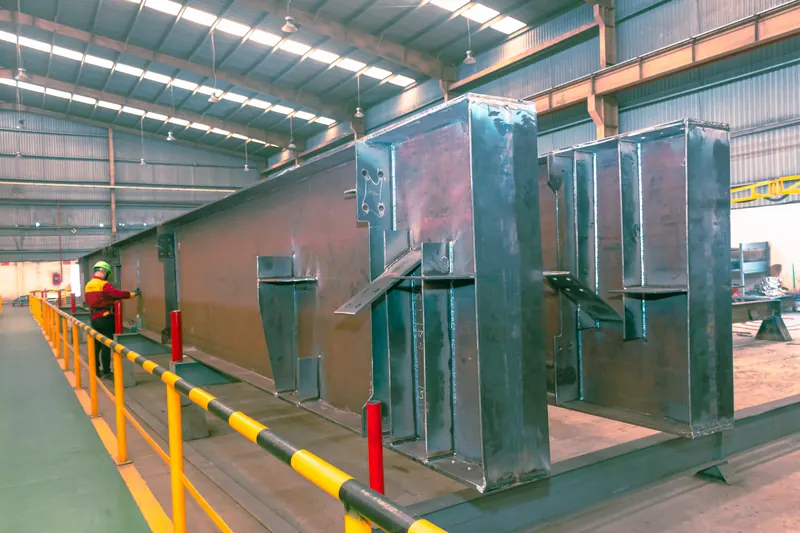
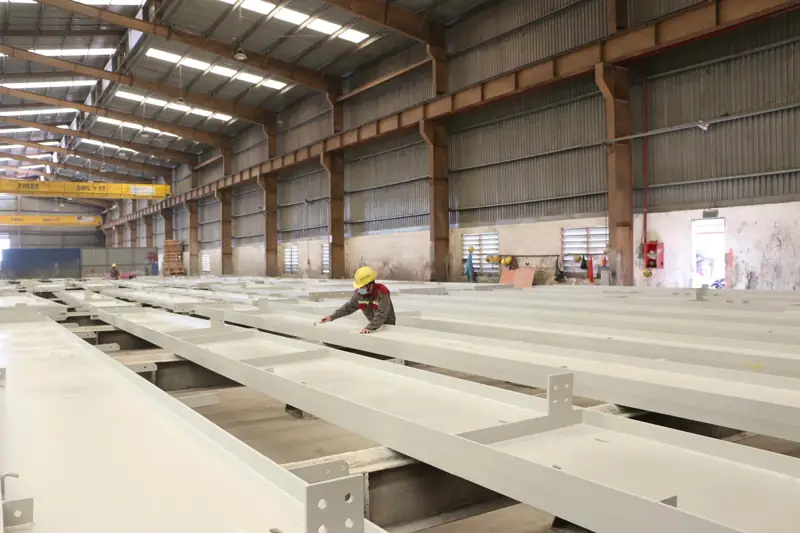
World Steel's quality process supports that record. Every member is inspected in our plant under IAS AC472 accreditation, with mill certificates traced to each heat, weld inspection and coating records, and a Manufacturing Data Record delivered with the steel. See quality records. Fabrication progress is visible in real time in PEB Studio, so the US contractor sees status and documents before the steel ships; see digital project control.
Operations: learning never stops
The chapter ends with vulnerability analysis of the organization and its operators, and with the need for continuous learning once the facility is running. For the structure, two habits help operations teams:
- Keep load information visible. A simple plan showing allowable loads on roof zones, platforms and hanger points prevents unplanned overloads during upgrades.
- Treat structural changes as changes. Adding equipment, cutting an opening or hanging new trays should go through the same review as an electrical change, with the structural engineer consulted.
Our guide on tolerance and vibration covers another area where clear criteria up front prevent problems in operation.
Where World Steel fits
World Steel designs and fabricates structural steel for US data center projects. Our customers are US contractors; site work, including erection, is their scope, and their Engineer of Record approves and seals the drawings. To reduce risk we provide clear shop drawings at no extra charge, consistent details across phases, complete quality documents, and real-time tracking of every fabrication step. See the data center building package for the full scope.
Key takeaways
- The handbook puts the human element at the center of data center risk; most failures trace back to people and decisions.
- Risk falls when knowledge moves cleanly from design to construction to operation.
- SPOF and fault tree analysis apply to structure too: redundant systems should not share a single structural support.
- Simple, repeatable steel details and a complete structural record reduce risk for the whole life of the facility.
Source: H. Geng (ed.), Data Center Handbook, 2nd ed., Wiley, 2021, Chapter 7. Ideas are paraphrased; consult the handbook and your design team for project decisions.
Quick answers
What causes most data center failures?
People. The Data Center Handbook cites research across industries finding about 80% of failures linked to the human element, and Uptime Institute figures attributing over 70% of data center failures to human error, much of it from management decisions.
What is a single point of failure?
A component or path whose failure alone stops the system. Removing all single points of failure means at least two things must fail at once before the service is lost.
Does more redundancy always mean less risk?
No. The handbook warns that complexity can undermine the benefit of redundancy, because complex systems are harder to model, operate and maintain correctly.
How does the steel package reduce risk?
Through clear drawings, consistent details, complete quality records and tracked fabrication, so that what was designed is what is built, and the operator can see what is in the walls and on the roof.
Keep building your steel plan
Go further on USPEB.com
On this topic
Across the US market
- Quality hubInspection, testing and sign-off at the plant
- IAS AC472 accreditationThe first and only AC472 plant in Vietnam
- Accredited testing labsILAC ISO/IEC 17025 testing on every project
- Online factory auditWalk the shop live with our QA team
- Large projects, 2,500 t a monthCapacity for large US general contractors
- Contractor partnershipLong-term supply for US contractors