For two decades the story of data centers was one of consolidation: bigger halls, bigger campuses, hyperscale cloud. Chapter 5 of the Data Center Handbook edited by Hwaiyu Geng (2nd edition, Wiley, 2021) describes the counter-trend that is now growing alongside it: edge computing, which places small data centers close to the people and machines that create data. Edge data center buildings are compact, numerous and usually unstaffed. This article explains why they exist, what the handbook says about them, and what they ask of the steel that protects them.
Why computing is moving to the edge
The handbook's site selection chapter makes a point that no technology can change: signals cannot travel faster than the speed of light. Over long fiber routes, that sets a floor on latency before any network equipment adds its own delay. For storage replication, financial transactions, real-time video analysis, autonomous machines and many 5G services, that delay matters.
Chapter 5 explains the response. Instead of sending every piece of data to a distant cloud region, processing happens at the edge of the network, close to the device. The handbook places the edge data center at the midpoint between the edge device and the central cloud. It performs the same functions as a central facility, but it is smaller and spread over many physical locations. Several edge sites can be linked in a mesh so that they share capacity and fail over to each other, acting as one virtual data center.
The handbook also notes the role of 5G: higher speeds, more bandwidth and many more devices per square kilometer, all of which push demand for local computing.
What an edge site looks like
According to the handbook, edge data centers typically range from 50 to 150 kW of power consumption. They are lights out, operating autonomously with local resilience, and they appear in non-traditional places: at the base of cellular towers, inside larger tower structures, in 6 m or 12 m (20 ft or 40 ft) shipping containers, on industrial sites and on small urban lots. The handbook adds that these unusual sites open the door to non-standard technologies such as liquid cooling and fuel cells.
Put simply, an edge site is a small, critical facility that nobody visits very often. That changes how the structure should be designed.
What the structure must do when nobody is there
Protect the equipment on its own
At a central campus, staff can respond to a leaking roof or a damaged door within hours. At an unstaffed edge site, the structure is the first and often the only line of defense. Its envelope must stay weathertight, its doors and louvers must resist wind-driven rain, and its frame must survive the local wind, snow and seismic loads without help. The handbook's structural chapter warns that light metal buildings housing data equipment deserve a careful wind evaluation; that warning applies directly to small edge shelters. Our high-wind steel buildings page explains the main design checks.
Resist corrosion without maintenance
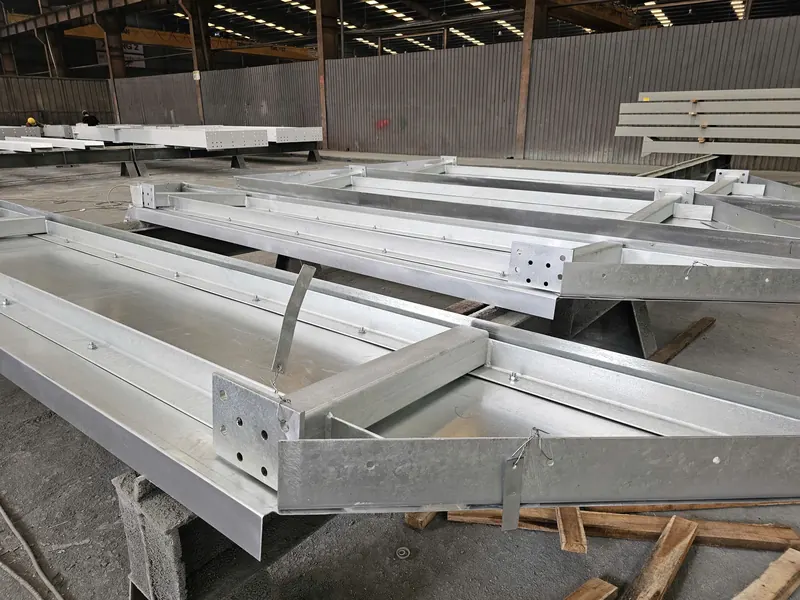
Edge sites sit outdoors, often next to roads, coasts or industrial plants. Steel that will see little maintenance should be protected for the life of the site. Hot-dip galvanizing is the usual answer for platforms, frames, stairs and posts, with a paint system over the galvanizing where a duplex system is needed. See hot-dip galvanizing.
Carry concentrated equipment loads
A 150 kW site still has heavy items: a generator or fuel cell, a battery cabinet line-up, a cooling unit, a transformer. These are concentrated loads on a small footprint, often on a raised platform or skid to keep them above flood level and to make cable entry easier. Platforms must be designed for the real equipment weights and anchor patterns, plus vibration from generators. See steel platforms.
Be repeatable
Edge networks are rolled out in dozens or hundreds of sites. The best structural solution is a standard kit: the same shelter frame, platform and canopy, adapted to each site's wind, snow and seismic values with a small set of variants. Repetition lowers engineering effort, simplifies inspection and makes spare parts predictable.
Typical steel scope for an edge site
| Element | Purpose | Notes |
|---|---|---|
| Shelter or small building frame | Encloses IT, power and cooling | Weathertight envelope, secure doors, wind-rated |
| Equipment platform or skid | Raises equipment above grade and flood level | Designed for equipment weight and anchors |
| Generator or fuel cell support | Backup power | Vibration and fuel containment considered |
| Canopy | Shades and protects outdoor units | Snow, wind and uplift checks |
| Cable bridge | Carries fiber and power between tower, shelter and yard | Galvanized, sized for future cables |
| Stairs, walkways, guardrails | Safe access for technicians | Galvanized, OSHA-style dimensions coordinated by the engineer |
Edge and the central campus are one system
The handbook's view of cloud and edge as layers of one stack is useful for planning. Edge sites do not replace central data halls; they feed them. A US contractor working for a network operator or a hyperscaler may build both: a central hall with long-span frames and a heavy roof, and a family of edge shelters with platforms and canopies. Using one fabricator and one design approach for both keeps details consistent across the network.
Where World Steel fits
World Steel designs and fabricates the structural steel for edge programs: shelter frames, platforms, canopies, cable bridges and access steel, hot-dip galvanized or painted for the exposure. Everything is fabricated in our own plant in Vietnam under inspection accredited to IAS AC472 and shipped to the US port, packed by site so each kit arrives complete. Our customers are US contractors; site work, including setting and assembling the steel, is their scope, and their Engineer of Record approves and seals the design. For a standard kit, we design a base model and site variants to US codes, with shop drawings at no extra charge.
Look at our equipment shelter buildings for small enclosures, and the data center building package for the central halls the edge connects back to.
Key takeaways
- Edge data centers bring computing close to users to beat the latency set by the speed of light.
- The handbook puts typical edge sites at 50 to 150 kW, lights out and spread over many locations.
- With no staff on site, the structure must protect the equipment on its own: weathertight, wind-resistant and corrosion-protected.
- A standard, galvanized steel kit with site variants is the most practical way to roll out an edge network.
Source: H. Geng (ed.), Data Center Handbook, 2nd ed., Wiley, 2021, Chapters 5 and 22. Ideas are paraphrased; consult the handbook and your design team for project decisions.
Quick answers
How big is an edge data center?
The Data Center Handbook gives a typical range of 50 to 150 kW of power use, far smaller than a central data hall, deployed in many locations rather than one.
Why do edge data centers exist?
To cut latency. Signals cannot travel faster than light, so applications that need very fast responses, from 5G services to industrial control, need computing close to where data is created.
Who is on site at an edge data center?
Usually nobody. Edge sites are typically lights out, managed remotely and designed to operate on their own, which puts more weight on a robust, low-maintenance structure.
What steel does an edge site need?
A protective shelter or small building, equipment platforms or skids, canopies, cable bridges, fencing posts and access stairs, usually galvanized for outdoor exposure.
Keep building your steel plan
Go further on USPEB.com
On this topic
Across the US market
- Projects by typeWarehouses, plants, data centers and more
- Industries we serveSteel packages by US industry
- Data center steelHyperscale and colocation framing
- Sunpro steel mill, 5,000 tOur largest single steel package
- Large projects, 2,500 t a monthCapacity for large US general contractors
- Contractor partnershipLong-term supply for US contractors