For decades, data halls were designed around air: raised floors, perforated tiles, containment and big air handlers. Chapter 14 of the Data Center Handbook edited by Hwaiyu Geng (2nd edition, Wiley, 2021), on rack-level and server-level cooling, explains why that is changing. When a rack of high-density servers passes about 100 kW, the handbook says, air cooling cannot meet the requirement. Liquid takes over, by cold plate or immersion cooling. For the structure, the important difference is simple: liquid is heavy. This article summarizes the handbook's account and explains what it means for floors and steel.
Cold plate cooling
The handbook describes cold plates as conduction cooling: liquid, usually water, flows through small plates mounted on or near the hottest components, carrying heat directly to the facility cooling loop. The approach is efficient and lets room air conditioning be turned down. It is not new; supercomputers have used direct liquid cooling for decades.
Structurally, cold plate systems add manifolds and hoses in each rack, coolant distribution units (CDUs) in or near the rows, and secondary piping loops between CDUs and the facility water. The cabinets get heavier, and filled piping runs overhead or under the floor. Chapter 23 notes that liquid-to-chip lines are preferably routed below the equipment, which is one argument for keeping a raised floor.
Chapter 3 adds a caution: liquid-cooled systems can still reject a significant amount of heat to air, from about 6 kW to over 30 kW per system, so the air side cannot be forgotten.
Immersion cooling
In immersion cooling, the handbook explains, servers are placed vertically in a customized tank and fully submerged in a coolant. Pumps circulate the coolant through a heat exchanger, which passes heat to a water loop and on to cooling towers or dry coolers. Three coolant families are described:
| Coolant | Notes from the handbook |
|---|---|
| Deionized water | Widely available but conductive, so only usable in indirect systems |
| Mineral oil | Single-phase, inexpensive, nontoxic and not volatile, but viscous and harder to maintain |
| Fluorinated liquid | Inert, insulating and noncombustible; the most widely used immersion coolant but also the most expensive |
The benefits the handbook lists are large: no server fans, very low noise, cabinet densities from about 20 kW up to 200 kW in a 42U-equivalent space, PUE easily below 1.2 and test results near 1.05, and no need for room air handlers, chillers or humidity control in some designs. It describes the room architecture as simpler.
The disadvantages are practical: costly coolant, new maintenance routines for lifting servers out and handling residual fluid, preventing coolant loss, protecting staff, balancing coolant flow, and compatibility problems for some components such as optical modules and ordinary solid-state drives. At the time of writing, the handbook noted, large-scale deployments were still rare. Chapter 11's summary of ASHRAE's Liquid Cooling Guidelines covers direct, rear door and immersion approaches in more depth.
What liquid does to the loads
Air weighs almost nothing. Liquid does not. Consider the elements an immersion hall adds:
- Tanks full of coolant and servers, lying horizontally, with a larger footprint than a cabinet but far more mass on it;
- CDUs, pumps and heat exchangers, often in the row or in an adjacent gallery;
- Filled piping between tanks, CDUs and the facility loop, sometimes overhead, sometimes in trenches or under a raised floor;
- Spill containment, such as curbs or drip trays, and coolant storage for top-ups;
- Maintenance equipment, such as lifting arms or hoists for pulling servers out of tanks, and drip racks.
An illustrative calculation shows the scale. A tank holding 1,000 liters of a coolant with a density near 0.85 kg/L carries about 850 kg of fluid before adding servers and the tank itself. Spread over a footprint of about 1.5 m², fluid alone is roughly 5.5 kPa; with servers and tank, the total can approach or exceed the 12 kPa (250 lb/ft²) that TIA guidance recommends for computer rooms. Fluorinated liquids are much denser than oil, which increases the load further. The real numbers depend entirely on the product chosen, which is why the tank supplier's data must feed the structural design.
Designing the floor and support steel
- Prefer slab on grade for immersion. A ground-bearing slab handles concentrated tank loads most economically. Upper floors in multi-story halls can carry immersion, but the composite floor must be designed for the tank loads and spill containment from the start. See composite floor support steel and our floor load article.
- Plan for mixed halls. Many facilities will mix air-cooled, cold plate and immersion zones. A floor designed uniformly for the heaviest likely zone keeps the layout flexible.
- Support filled piping properly. Water-filled pipes are heavy and need supports, guides and anchors designed for thermal movement and, in seismic regions, bracing. See pipe and cable racks.
- Allow for lifting. Server removal from tanks may use overhead hoists or gantries, which need their own support or runway steel.
- Watch vibration and deflection. Pumps and CDUs introduce vibration sources; elevated floors need stiffness. See tolerance and vibration.
- Keep the roof simpler. With less air handling plant, the roof may carry fewer large units, but dry coolers or cooling towers for heat rejection still need dunnage or yard platforms.
Where World Steel fits
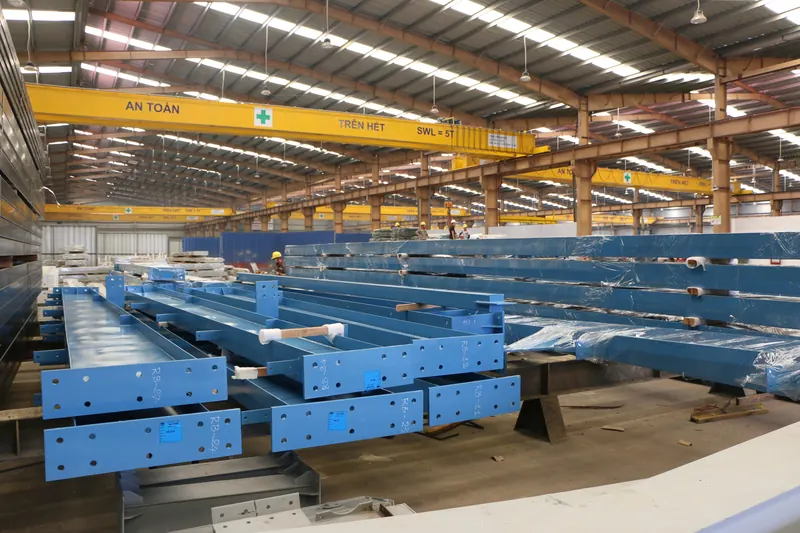
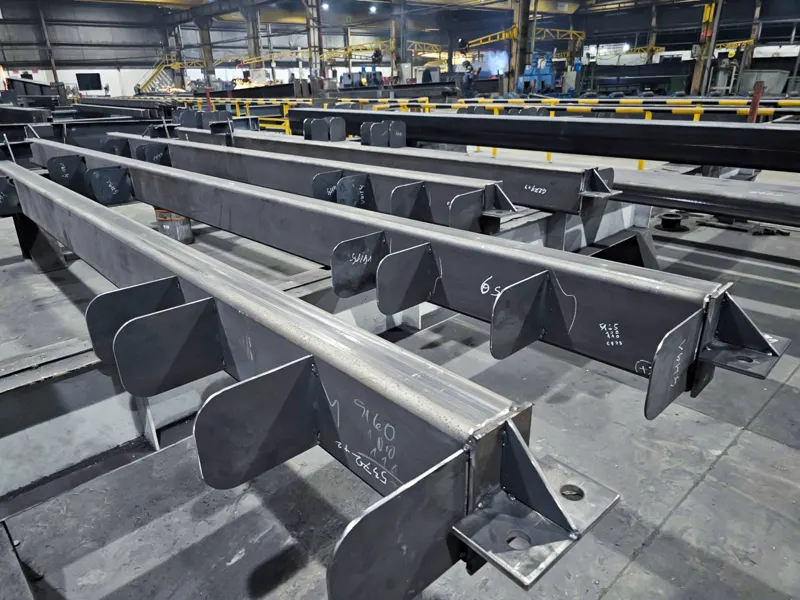
World Steel designs and fabricates steel for liquid-cooled and immersion-ready data halls: composite upper floors designed for tank loads, pipe rack and pipe support steel for coolant loops, platforms for CDUs and heat exchangers, hoist and gantry supports, and yard or roof platforms for heat rejection equipment. Fabrication takes place in our own plant in Vietnam, with inspection accredited under IAS AC472. Our customers are US contractors; site work, including erection, is their scope, and their Engineer of Record approves and seals the design. See the data center building package and our data hall frames guide.
Key takeaways
- The handbook notes that above about 100 kW per rack, air cooling falls short and liquid cooling takes over.
- Immersion cooling supports densities up to about 200 kW per cabinet and very low PUE, with coolant cost and new maintenance practices as the main hurdles.
- Fluid-filled tanks, CDUs and piping raise floor and support loads well beyond air-cooled halls.
- Design floors, pipe supports and lifting steel from the tank supplier's data, and prefer slab on grade or purpose-designed composite floors.
Source: H. Geng (ed.), Data Center Handbook, 2nd ed., Wiley, 2021, Chapters 3, 11, 14 and 23. Ideas are paraphrased; the load example is illustrative only; consult your Engineer of Record for project decisions.
Quick answers
When does a data center need liquid cooling?
The Data Center Handbook notes that when a rack of high-density servers exceeds about 100 kW, air cooling cannot meet the requirement, and liquid cooling, by cold plate or immersion, takes over.
What coolants are used for immersion?
Water for indirect systems only, since it conducts electricity; mineral oil, which is inexpensive but viscous; and fluorinated liquids, which are inert and noncombustible but the most expensive.
Why does immersion cooling change the structure?
Tanks full of fluid and servers are far heavier per square meter than air-cooled cabinets, and they add piping, pumps and heat exchangers. Floors, slabs and supports must be designed for those loads.
Does liquid cooling remove the need for air cooling?
Not entirely. The handbook notes that liquid-cooled systems can still reject a significant share of heat to air, from about 6 kW to over 30 kW per system, which must be included in the air cooling design.
Keep building your steel plan
Go further on USPEB.com
On this topic
Across the US market
- US codes and standardsIBC, AISC, AWS and MBMA, designed to
- Seismic steel structuresSDC D to F framing for West Coast jobs
- Crane building designUS crane standards for mill and bay buildings
- Design ReportWhat our US-code design report contains
- Large projects, 2,500 t a monthCapacity for large US general contractors
- Contractor partnershipLong-term supply for US contractors