
100 mm
about 4 in, the thickest plate our laser machines cut, holes included
2,500 t
of structural steel fabricated a month in our own plant
Bolted
field splices, drilled in the shop as matched sets
Anatomy
Six parts of a welded plate girder
A plate girder is designed one plate at a time. Each part below has its own job, and each is sized for it.
Flange plates
Width and thickness set for bending, local buckling and lateral stability. Thicker plate can be used only where the moment peaks, joined by a full-penetration shop splice.
Web plate
Depth set for stiffness and economy, thickness set against shear. A thinner web with stiffeners often weighs less than a thick unstiffened one.
Bearing stiffeners
Pairs of plates over supports and under heavy point loads, fitted to bear on the loaded flange.
Intermediate stiffeners
Plates spaced along a slender web so it can carry shear, including post-buckling strength where the design uses it.
Web-to-flange welds
Continuous fillet welds made by submerged arc, sized for the shear flow between web and flange.
Bolted field splice
Flange and web splice plates drilled in the shop, so a girder longer than the container travels in pieces and goes back together with bolts.
Proportioning
Four decisions that set the weight of a girder
Most of the steel a girder carries is decided before anyone draws a weld. These are the choices our engineers test against your loads, and show you in writing.
Depth first
Depth drives stiffness more than any plate thickness. A deeper web often lets both flanges get lighter, and deflection limits are easier to meet.
Web: thick or stiffened
A stocky web needs no stiffeners but weighs more. A slender web plus stiffeners saves steel and adds fitting. We price both and show you the difference.
Flanges that follow the moment
On long girders the flange thickness can step down toward the supports. Each change is a shop splice placed away from the peak stress.
Unequal flanges
A wider top flange can brace a girder against lateral-torsional buckling or carry a slab or rail; the bottom flange is sized for its own job.
See how this works on whole frames in design optimization.
Design checks
What AISC 360 asks of a plate girder
Every girder we design is checked against AISC 360-22 with loads from ASCE 7 at the edition your jurisdiction uses. The calculations go to your Engineer of Record for review and approval.
Welding follows AWS D1.1 or the code your specification names.
| Check | AISC 360-22 | What it decides |
|---|---|---|
| Flexure | Chapter F (F2 to F5) | Yielding, lateral-torsional buckling and flange local buckling; slender webs are checked under F5. |
| Shear | Chapter G | Web shear strength, with or without tension field action, which sets stiffener spacing. |
| Proportion limits | Section F13 | Limits on web slenderness and flange proportions for I-shaped members. |
| Concentrated forces | Section J10 | Web local yielding, crippling and sidesway buckling where loads enter, which decides where bearing stiffeners go. |
| Combined forces | Chapter H | Girders that also carry axial load, such as frame girders and truss chords. |
| Fatigue | Appendix 3 | Where loads cycle, for example under cranes or vibrating equipment, details are classed and checked. |
In our plant
From plate to girder in six moves
The same sequence for every girder, recorded by piece mark in PEB Studio.
-
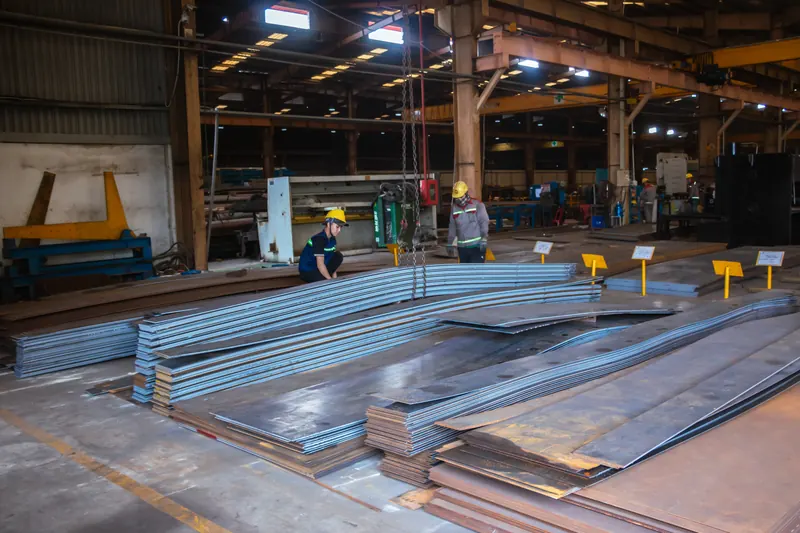
Cut
Webs, flanges and stiffeners cut on CNC laser, plasma and gas machines from plate traced by heat number.
-
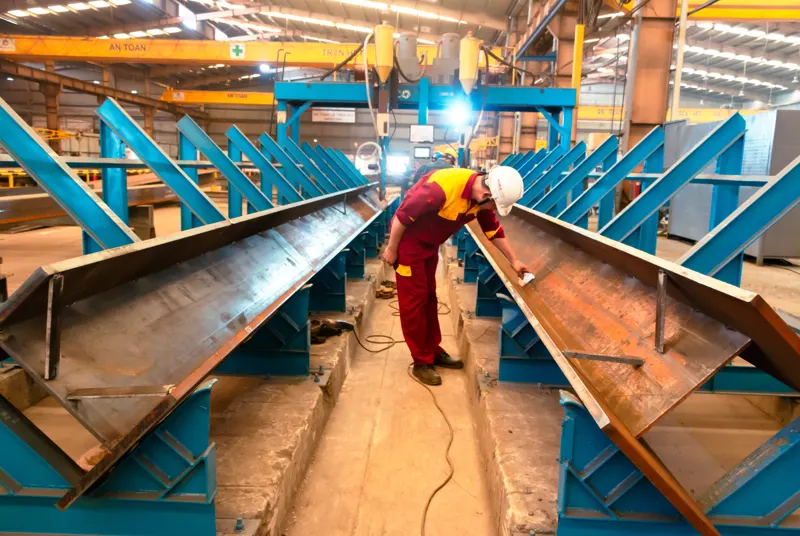
Fit up
Web and flanges set in the assembly jigs and checked against the shop drawing.
-
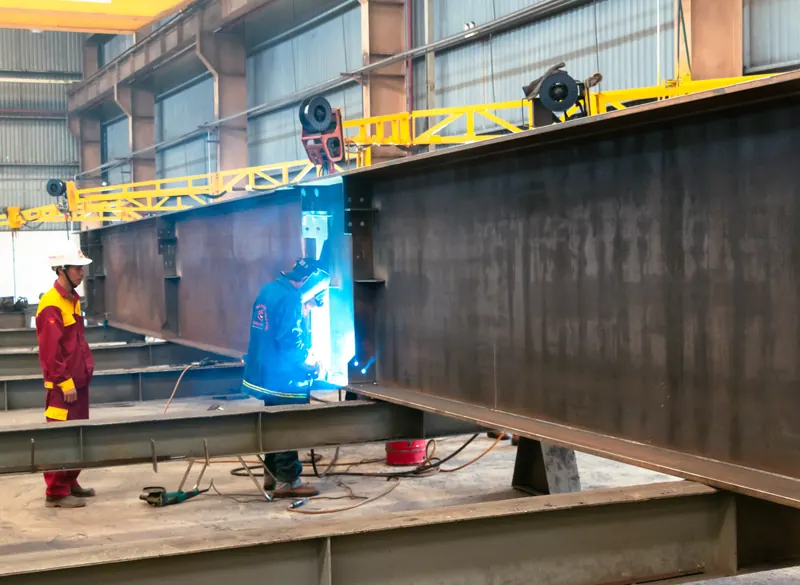
Weld
Web-to-flange fillets on the automated beam line or the gantry welder, by submerged arc.
-
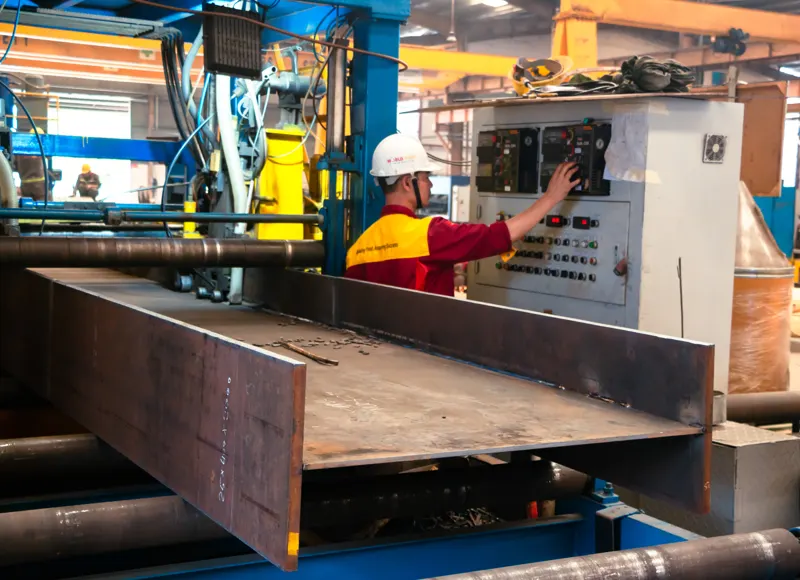
Straighten
Flange tilt from welding heat corrected on the beam straightening machine.
-
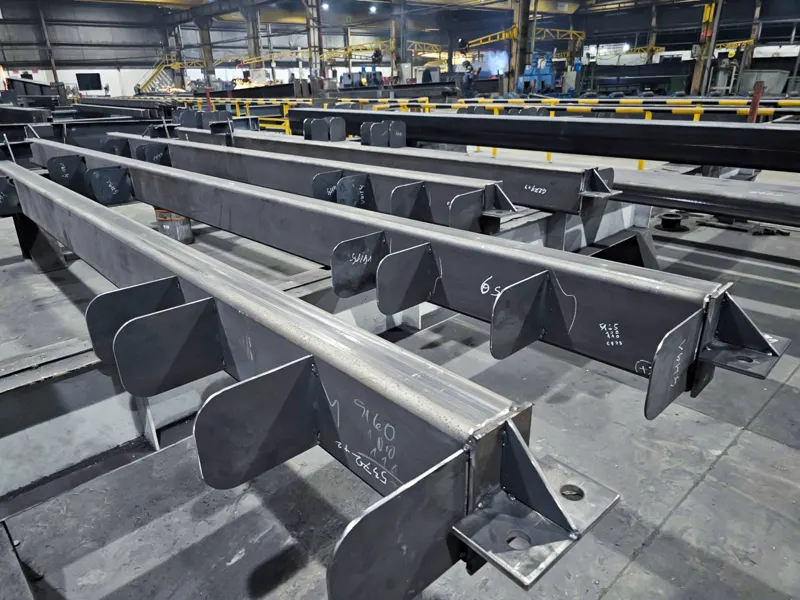
Stiffen and drill
Stiffeners, splice holes and clips added to written procedures by qualified welders.
-
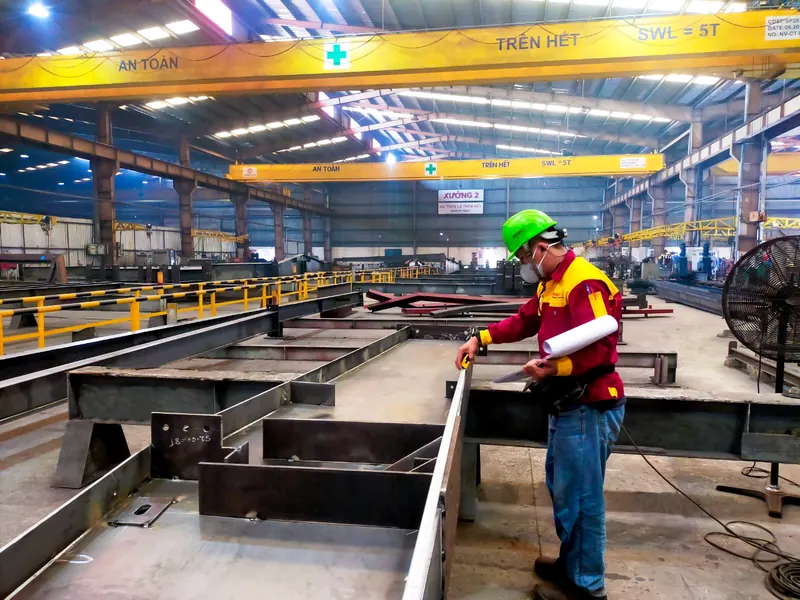
Inspect
Every weld checked visually, dimensions and camber measured, NDT to your specification.
Photos: World Steel plant, Vietnam. Follow each station on the factory tour.
Splices and shipping
Long girders travel in pieces and bolt back together
A girder longer than a container or flat rack is split in design, not on the shop floor. Splice positions are picked where bending is low and access for the bolting crew is easy.
Set by the box
A 40 ft high-cube container is about 12.0 m (39 ft 5 in) inside. Longer pieces go on flat racks or as breakbulk.
Bolted, slip-critical where needed
Flange and web splice plates are drilled in the shop as a set, joined under the RCSC Specification.
Match-marked
Each half carries its piece mark and the mark of its partner, so the right ends meet on site.
Weights for every lift
Piece weights in kg (lb) on the erection drawing and the tag help your erector size the crane.
Where they go
Plate girders on large US structures
Equipment and process floors
Girders under mills, presses and process lines, often with heavy point loads and vibration.
Long floor spans
Column-free floors in offices, parking decks and retail where a rolled beam would be too deep or too heavy.
Pipe and conveyor bridges
Long girders spanning roads and plant areas between towers.
Heavy roofs
Main girders carrying roof trusses, rooftop plant or snow drift over a wide bay.
Send for a girder quote
- Girder elevations, or loads, spans and support conditions
- Deflection limits and any camber your Engineer of Record wants
- Plate grade, for example ASTM A572 Grade 50, and Charpy needs if any
- Coating system and the NDT extent in your specification
Questions
Plate girder questions
How deep can a welded plate girder be?
As deep as the design and the trip to site allow. We do not publish a size table: depth is set by your loads and deflection limits, then checked against container, flat-rack and road limits before the shop drawings are issued.
When is a plate girder cheaper than the heaviest rolled beam?
Usually once the span or load needs more depth than the rolled range offers, or when a rolled beam would carry far more steel than the load needs. A plate girder uses less steel but more fabrication hours, so our engineers compare both and show the numbers.
Do you use tension field action to save web steel?
When your Engineer of Record accepts it. AISC 360 allows a stiffened web to carry extra shear after it buckles, which can save web steel. We design it only with closely spaced stiffeners and your engineer’s approval.
Can the girder be cambered?
Yes. Camber is set by your Engineer of Record, built into the fit-up and measured before release, with the reading recorded on the dimensional check sheet.
How are long girders delivered?
In segments joined by bolted field splices that are drilled in the shop. Each segment is sized to fit a container, flat rack or breakbulk slot, and match-marked to its partner.
Built for large jobs
Plate girders for your next large package
Our own plant in Vietnam fabricates 2,500 metric tons of structural steel a month, is accredited under IAS AC472 since 2019 and is audited twice a year. Shop drawings are included on every project.
- 5,000 tSunpro Steel Factory
- 2,500 tCPV Food Processing Factory
- 2,000 tLong Son petrochemical complex
- 2,000 tM&D (MD Factory)
Request a quote
Send drawings, a model or a member schedule. Our engineers check the US code basis, size or verify the members and price the fabricated steel, delivered to your US port.
Become our partner in the US
You erect and own the customer; we design, fabricate and ship. Engineering support on your bids and supply under your brand.
Who approves the design. We prepare calculations and drawings ready for your Engineer of Record’s review and approval. The PE seal and the permit stay with the US contractor, our customer.
Shop drawings, included