Many US mills and heavy plants were built decades ago for cranes that are now too small. Raising capacity often means putting a heavier crane on an old runway, adding a crane, or changing what the bay does. Appendix C of AIST Technical Report No. 13 (2021) gives a recommended practice for that work. This article walks through planning a crane runway upgrade, from data gathering to reinforcing.
When an upgrade is on the table
TR-13 lists the usual triggers: more production and heavier use of existing cranes, extra cranes or jib cranes, a new or modified process that needs bigger cranes or equipment, added floors or heavier floor loads, and new material stored at grade near the foundations. Every one of them starts with an inspection of what is there; see our article on crane runway inspection.
What to establish first
Appendix C asks the engineer to pin down:
- the grade of steel in the original and any later work (ASTM A7, A36 and so on), with samples tested where it is unknown;
- the crane loads and operation used in the original design, compared with today's code and the proposed cranes;
- the original dead and live loads against present and proposed loads;
- the allowable stresses used at the time, compared with present values for steel, concrete, soil and piles;
- the condition of the structure from the inspection.
For discontinued rolled shapes, the report points to older AISC manuals and Iron and Steel Beams 1873 to 1952.
Calculations and drawings
Complete calculations are prepared, either as a supplement to the original set or new if none exist. Where there are no reliable drawings, the structure is field measured and new drawings made. Foundations may need to be exposed to confirm type, size and condition, and soils sampled where no data exists. Expect this phase to take real time on an old plant.
Loads for an existing runway
TR-13 is candid that the crane loads in its Section 3.7, explained in crane side thrust, impact and traction, are deliberately conservative, which suits new design. For an existing structure, the engineer may apply judgment when setting the criteria, without giving up current safety levels. A precise crane data sheet for the new crane, wheel loads, weights and bumper forces, makes that judgment much easier; see the crane data sheet.
Reinforce or replace
Worn, corroded, damaged or bent material is replaced or reinforced. When parts are removed, check what that does to the rest of the structure. For reinforcing, Appendix C warns:
- the dead load stress already in a member stays in the original steel; new plates only share it if the member is propped or jacked while they are added;
- where old and new steel differ in grade, check stresses in each against its own limits;
- the connections at each end must carry the forces in both the original and the added material.
Welding to old steel
Welding is often the easiest way to add material, but TR-13 lists the checks first:
- weldability of the existing steel;
- the effect of new welds on the member's fatigue life, critical on crane girders (see crane girder fatigue details);
- the effect of welding heat on nearby rivets;
- where rivets are doubtful, carry the whole force by welding.
In practice, a heavily loaded old girder with many cycles behind it is often better replaced with a new girder designed to current rules than reinforced in place. Simple-span girders, which TR-13 prefers, make that swap easier.
Coatings
The appendix treats repainting an upgraded structure as a matter of preference and economics, with SSPC procedures as the reference.
Where World Steel fits
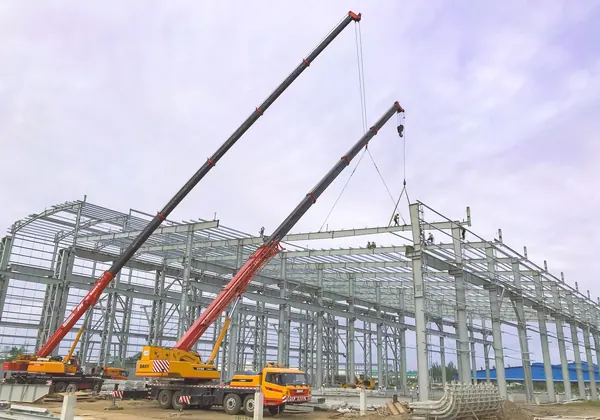
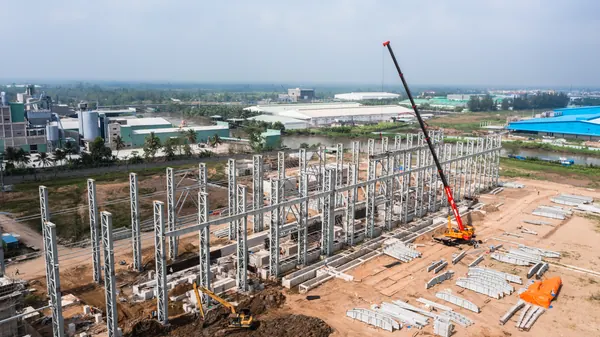
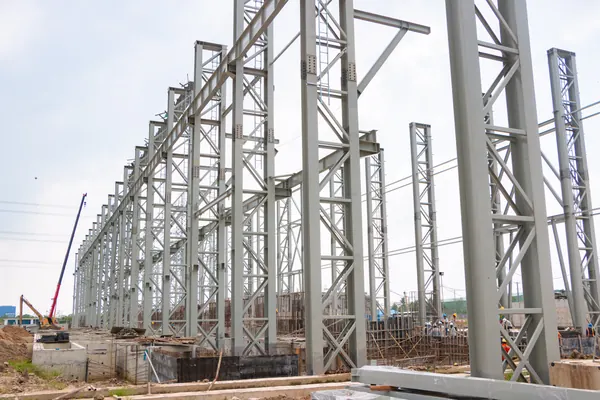
For upgrade projects, World Steel designs and fabricates replacement crane runway girders, reinforcing members, new crane columns and bracing to the US contractor's survey and the Engineer of Record's criteria, and can supply the new overhead crane as well. Field measurement, removal and site work remain with the US contractor. Existing-building code questions in the US usually run through the IEBC. Our largest crane building, the Sunpro Steel mill, runs cranes up to 150 t. See also our crane design standards page.
Solutions and the Sunpro Steel project
See how this fits a complete job: the crane building system for runways, columns and cranes, manufacturing plants with crane bays for factory layouts, and heavy industrial plants for mills and process plants. All of it was put to work on the Sunpro Steel mill project, a 5,000 t steel production plant designed for overhead cranes up to 150 t.
Source and limits
This article paraphrases AIST Technical Report No. 13 (2021), Appendix C, Sections C4 and C5. Each upgrade is designed by the engineer responsible for the existing structure and approved by the Engineer of Record.
Quick answers
Can lower crane loads be used when checking an old runway?
AIST TR-13 accepts that its new-design crane loads may be conservative. For an existing structure the engineer may use judgment on the forces, as long as the safety level of current codes is kept.
Is it safe to weld to old mill steel?
Only after checking weldability of the existing steel, the effect of the new welds on fatigue life and the effect of welding heat on nearby rivets. Old grades such as ASTM A7 may need testing.
Keep building your steel plan
Go further on USPEB.com
On this topic
Across the US market
- US codes and standardsIBC, AISC, AWS and MBMA, designed to
- Seismic steel structuresSDC D to F framing for West Coast jobs
- Design ReportWhat our US-code design report contains
- Large projects, 2,500 t a monthCapacity for large US general contractors
- Contractor partnershipLong-term supply for US contractors
- Solutions by stateState-by-state steel solutions