Welds are where crane girders crack, so how they are tested matters as much as how they are designed. AIST Technical Report No. 13 (2021), Section 5.16 with its commentary, sets a clear scope: which welds use the stricter cyclic acceptance criteria, and which get 100% non-destructive testing (NDT). This article lays it out, weld by weld.
Static versus cyclic acceptance
AWS D1.1 has two sets of acceptance criteria. Ordinary building welds use the limits for statically loaded structures. Welds that see repeated stress use the stricter limits for cyclically loaded structures, because a small flaw that is harmless under one load grows into a fatigue crack under a million.
TR-13 asks that all crane runway girder welds meet AWS D1.1 for cyclically loaded structures. The commentary to Section 1.5.1 adds that the contract documents should identify which elements take the stricter criteria, so the shop and the inspector both know.
The 100% NDT list
For crane runway girders, TR-13 calls for:
| Weld | Method | Extent |
|---|---|---|
| Web and flange splice welds | Radiographic (RT) or ultrasonic (UT) | 100% |
| Complete-penetration flange-to-web welds | Ultrasonic (UT) | 100% |
| Fillet flange-to-web welds | Magnetic particle (MT) or liquid penetrant (PT) | 100% |
| Other girder welds, unless specified | Visual by an AWS certified welding inspector | All |
The design drawings should mark any other welds that need NDT or cyclic criteria.
Backup systems and tiebacks
For backup trusses and other lateral load elements, TR-13 asks the design drawings to say which welds take cyclic acceptance criteria. The commentary helps:
- Tieback welds see repeated load and take the stricter criteria.
- Rail clip welds to the top flange do not: the top flange is mainly in compression, so fatigue cracks there do not tend to grow.
- Backup system welds are judged one by one on whether they see significant repeated load.
Our article on backup bracing and box girders explains those parts.
Rail welds
Crane rail welding is done to AWS D1.1 by qualified welders with qualified procedures, and as a minimum every weld is visually inspected by an AWS certified welding inspector to static criteria. Continuously welded rail joints themselves (flash or thermite) are made and tested to AWS D15.2; see crane rail joints, clips and pads.
Why this scope makes sense
The listed welds are the ones that carry wheel load through the girder: the splices that carry full flange and web stress, and the web-to-flange weld that sees every wheel pass. Testing them 100% costs little against a girder replacement and a shutdown. The weld details themselves are covered in crane girder fatigue details.
Writing it into the contract
TR-13 leaves any inspection it does not list to the contract documents, so the specification should close the gaps. A practical crane girder clause names the acceptance criteria (AWS D1.1 cyclic) for each weld group, the NDT method and extent for splices, web-to-flange welds and tiebacks, the qualification of the NDT technicians, who reviews the reports, and whether third-party or special inspection witnesses the testing at the shop. Stating this at bid stage avoids arguments, and extra cost, once the girders are already welded.
Testing at the plant before shipping
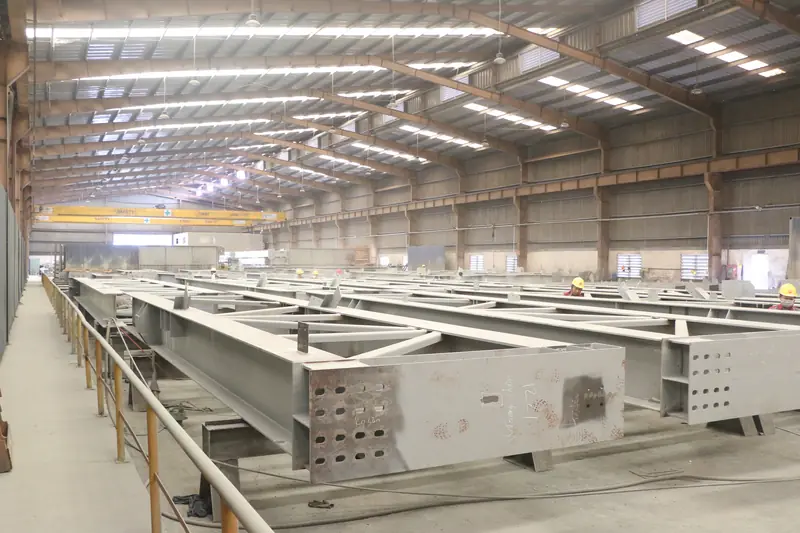
On a mill project World Steel runs the NDT in our plant in Vietnam, before the girders are painted and shipped, so a reject is fixed in the shop and not on a US jobsite:
- UT, MT and PT by qualified technicians, recorded weld by weld against the girder mark;
- reports, WPS and welder qualifications in the shop records package for the Engineer of Record and the special inspector;
- remote inspector access on request, and progress you can follow in PEB Studio.
Our plant is accredited under IAS AC472 and audited twice a year, and our quality program is built around this kind of traceable record. The girders for the Sunpro Steel mill, with cranes up to 150 t, followed this route. See also the AWS D1.1 standard page and our crane design standards page.
Solutions and the Sunpro Steel project
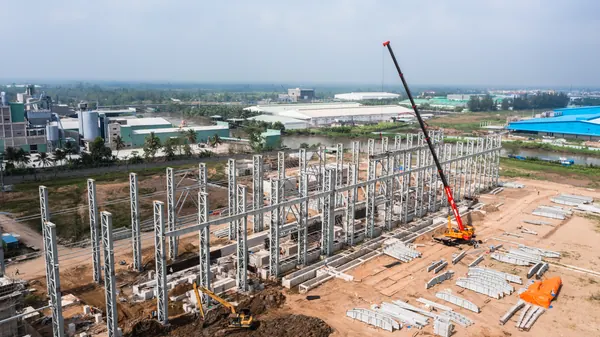
Our heavy industrial plants solution shows how World Steel handles a full mill or heavy plant, and the crane building system page shows the runway package itself. For a factory with bridge cranes, start from manufacturing plants with crane bays. The Sunpro Steel mill project, about 5,000 t with 150 t cranes, is where these TR-13 points were applied at full scale, and our large projects page explains how we run jobs of that size.
Source and limits
This article paraphrases AIST Technical Report No. 13 (2021), Sections 1.5.1 and 5.16 and the commentary. The project specification and the Engineer of Record set the inspection scope on each job.
Quick answers
Which crane girder welds need 100% testing?
Under AIST TR-13: web and flange splice welds by radiography or ultrasonics, complete-penetration flange-to-web welds by ultrasonics, and fillet flange-to-web welds by magnetic particle or liquid penetrant.
What are cyclic acceptance criteria?
The stricter AWS D1.1 acceptance limits for cyclically loaded structures. Small flaws allowed in static work are rejected, because under repeated load they grow into fatigue cracks.
Do rail clip welds need cyclic criteria?
TR-13 says no: the top flange is mainly in compression, so cracks there do not tend to grow. Tieback welds, which see repeated load, do need them.
Keep building your steel plan
Go further on USPEB.com
On this topic
Across the US market
- IAS AC472 accreditationThe first and only AC472 plant in Vietnam
- Accredited testing labsILAC ISO/IEC 17025 testing on every project
- Online factory auditWalk the shop live with our QA team
- Large projects, 2,500 t a monthCapacity for large US general contractors
- Contractor partnershipLong-term supply for US contractors
- Solutions by stateState-by-state steel solutions