Load combinations are where all the separate loads on a mill building meet. The building code supplies the familiar ones for dead, live, snow, wind and seismic loads, but it stops short of cranes. AIST Technical Report No. 13 (2021), Section 3.11, adds the crane terms. This article walks through how those crane runway load combinations are put together and the decisions behind them.
Why crane combinations need their own list
The IBC and ASCE 7 define crane loads but do not place them in their standard combinations. TR-13 writes combinations that track the current ASCE 7 forms, then adds crane loads with load factors and companion factors chosen by the AIST Mill Buildings Subcommittee. It gives both LRFD and ASD sets, and the designer uses whichever method governs the project.
The crane load symbols
TR-13 splits crane loads into pieces so each can carry its own factor:
- Cds / Cdm: crane dead load (bridge, end trucks, trolley) for a single crane or for multiple cranes, positioned for the worst effect.
- Cvs / Cvm: lifted load for one crane or several.
- Css: side thrust from one crane.
- Cls: longitudinal traction from one crane.
- Ci: vertical impact from one crane in one aisle.
- Cbs: bumper impact from one crane at 100% speed.
The commentary notes that in LRFD the crane's self-weight can be treated as dead load, while the lifted load, lateral, longitudinal and impact forces are live loads. The individual force values come from Section 3.7, explained in our article on crane impact and side thrust.
How the combinations are structured
The combinations follow a clear pattern. Each base ASCE 7 combination gets a crane version:
- Gravity with cranes: dead load plus several cranes with their lifted loads, side thrust and traction, with either the cranes or the floor live load as the principal load.
- One crane at full dynamic effect: dead load plus one crane with vertical impact and traction as the principal load. This is the case that often governs a girder.
- Cranes with roof loads, wind or seismic: crane terms carried at reduced companion factors when snow, wind or earthquake is the principal load.
- Bumper impact: one crane, its lifted load and its full-speed bumper force, at a factor of 1.0 (LRFD) or 0.67 (ASD), because a full-speed hit is a malfunction, not normal service.
- Uplift and stability checks: 0.9D (LRFD) or 0.6D (ASD) with a crane carrying its minimum lifted load and maximum side thrust or traction, to catch tieback and anchor cases.
Crane impact applies only to the runway girders and their connections, not to columns and foundations. Loads should be listed separately on the design (dead, live, crane eccentricity, crane thrust, wind) so each combination can be built cleanly.
Impact and side thrust are no longer added
One important change in the 2021 edition: vertical impact is not combined with side thrust. The commentary explains that impact comes from hoisting and side thrust from travel, two different crane actions with very short peaks, so their maxima are very unlikely to coincide. Earlier designs that added both were conservative; a modern design following TR-13 takes them separately.
The fatigue combination
For fatigue, TR-13 uses a single crane: Cds + Cvs + ½Css, its dead load, its lifted load and half of its side thrust. The number of cycles comes from the mill building class (see mill building class A to D), and the owner can raise it where production may grow. Fatigue resistance itself comes from AISC 360. Our article on crane girder fatigue details shows where those cycles do their damage.
Seismic mass with cranes
For seismic design, TR-13 counts the dead load of one crane per aisle, placed for the worst effect, in the seismic weight. The suspended load is generally excluded unless it is rigidly held during travel. Along the direction of travel, the crane's seismic force is limited by wheel friction or traction unless the crane is locked down; the report suggests 0.6 as a conservative wheel-to-rail friction coefficient. ASCE 7 also lets industrial buildings that mainly enclose equipment be treated as nonbuilding structures similar to buildings, which opens other design options.
Mill floor and roof loads
Section 3 of TR-13 also suggests minimum live loads for mill floors well above office values, for example about 24 kPa (500 psf) for casting and charging floors and 48 kPa (1,000 psf) for motor room floors, with a non-reducible roof live load of about 0.96 kPa (20 psf). The owner and equipment suppliers confirm the actual values.
How we apply it
World Steel designs crane buildings to AISC 360 and ASCE 7, with TR-13 combinations where the owner specifies them, and sends the full calculation set with the drawings for the Engineer of Record's review and approval. See our crane design standards page and the standards hub.
Solutions and the Sunpro Steel project
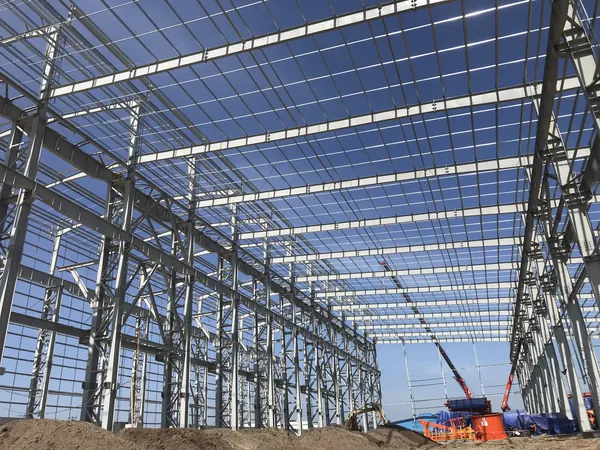
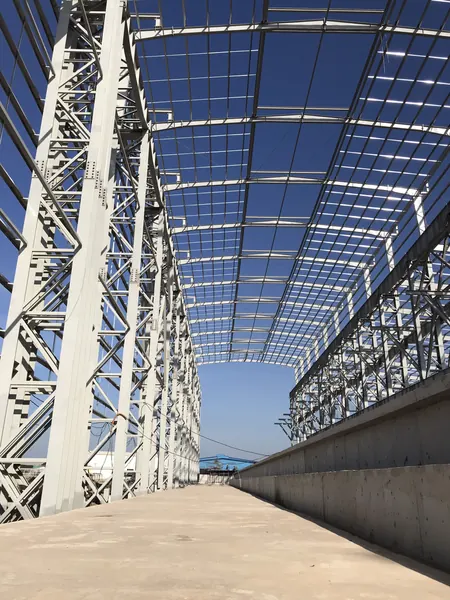
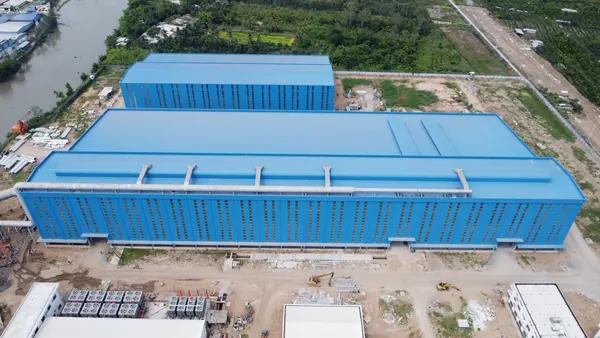
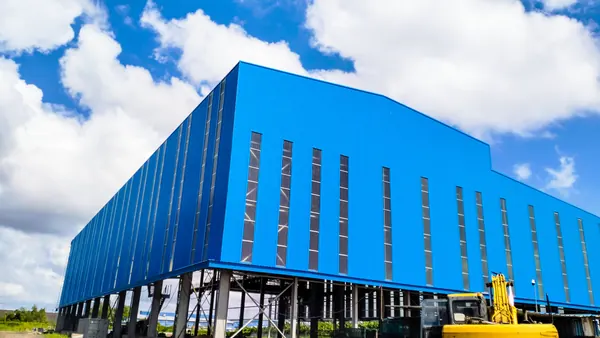
See how this fits a complete job: the crane building system for runways, columns and cranes, manufacturing plants with crane bays for factory layouts, and heavy industrial plants for mills and process plants. All of it was put to work on the Sunpro Steel mill project, a 5,000 t steel production plant designed for overhead cranes up to 150 t.
Source and limits
This article paraphrases AIST Technical Report No. 13 (2021), Sections 3.4 to 3.11 and the commentary to Section 3.11. It describes the structure of the combinations; use the full report for the exact factors.
Quick answers
Does ASCE 7 include crane load combinations?
No. ASCE 7 and the IBC define crane loads but do not place them in their standard combinations. AIST TR-13 adds crane terms to combinations that mirror ASCE 7.
What crane load is used for fatigue under TR-13?
One crane: its dead load, its lifted load and half of its side thrust, applied for the number of cycles that matches the mill building class.
Is the bumper impact a normal design case?
It is treated as a rare event, a crane hitting the end stop at full speed through malfunction or operator error, so it carries a load factor of 1.0 in LRFD and 0.67 in ASD.
Keep building your steel plan
Go further on USPEB.com
On this topic
Across the US market
- US codes and standardsIBC, AISC, AWS and MBMA, designed to
- Seismic steel structuresSDC D to F framing for West Coast jobs
- Design ReportWhat our US-code design report contains
- Large projects, 2,500 t a monthCapacity for large US general contractors
- Contractor partnershipLong-term supply for US contractors
- Solutions by stateState-by-state steel solutions