
Crane loads
Three forces a runway girder must carry on top of the wheel loads
ASCE 7-22 Section 4.6 sets these minimum crane forces. Your crane supplier’s data and your Engineer of Record decide the final values.
25%
Vertical impact
Added to the maximum wheel loads of powered overhead cranes (10% for pendant-operated powered bridge cranes, 0% for hand-geared cranes).
20%
Lateral force
Of the rated capacity plus the trolley and hoist weight, applied at the top of the rail, shared by the two runways.
10%
Longitudinal force
Of the maximum wheel loads, applied at the top of the rail along the runway.
Service class
How hard the crane works sets how the girder is detailed
Crane service classes come from CMAA 70 and 74. The higher the class, the more cycles the girder sees, and the more its welds and stiffener ends are shaped by fatigue.
- AStandby or infrequent service
- BLight service
- CModerate service
- DHeavy service
- ESevere service
- FContinuous severe service
Details
What we build into a runway girder before it ships
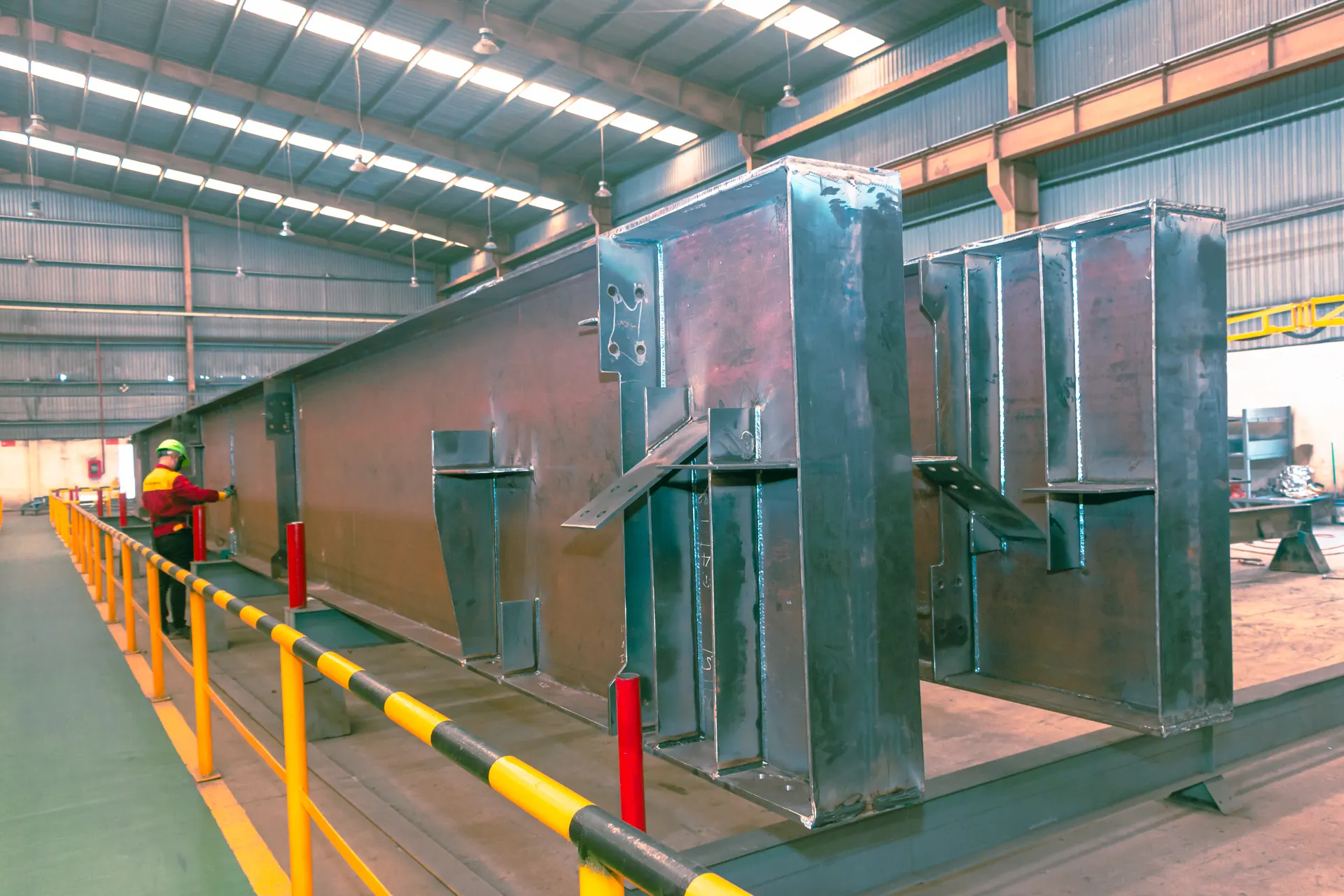
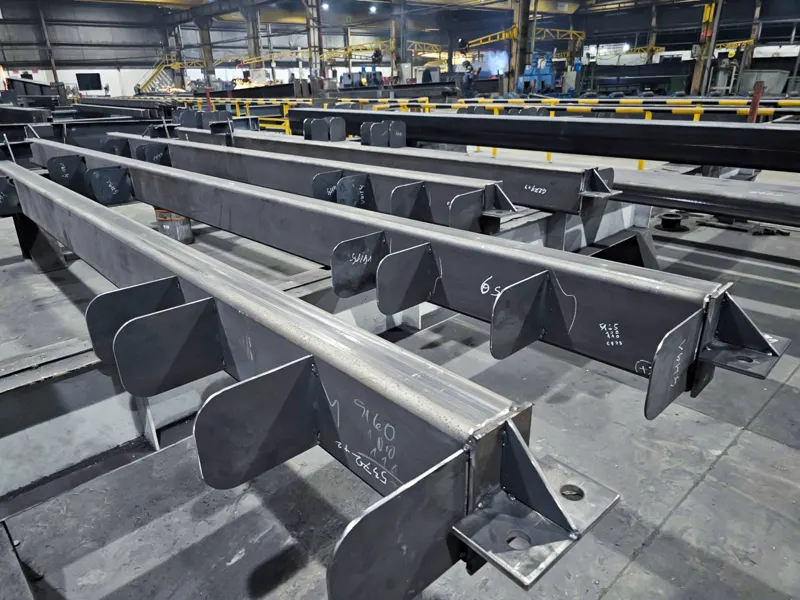
A top flange made for the crane
Wider or thicker than the bottom flange, so it resists lateral wheel thrust and stays stable between supports.
Top flange-to-web weld by design
Fillet or complete joint penetration, as your Engineer of Record sets for the service class and fatigue category.
Stiffeners kept clear of the flange
Stiffener details near the loaded top flange follow the fatigue design, so they do not start cracks under rolling wheels.
Rail clip holes drilled in the shop
Clip and stop holes are drilled on CNC machines from the model, at the gauge the rail and clips need.
Crane stops and bumpers
End stop plates and their connections are shop-welded or bolted as the crane supplier’s data requires.
Seats and tie-backs
Bearing plates, column brackets and lateral tie-back plates are prepared to match the crane columns.
Design references
The documents a runway is designed to
Industrial buildings: roofs to anchor rods. The working reference for runway girder and crane column design.
Fatigue: details are classed and checked for the number of load cycles the crane will apply.
Crane loads: vertical impact, lateral and longitudinal forces.
CMAA 70 and 74
Crane service classes and crane data, from the crane manufacturer.
For the crane building as a whole, see plants with crane bays and crane supporting columns. The short product sheet is crane runway beams.
Questions
Crane runway girder questions
Why are crane runway girders checked for fatigue?
Because every lift loads and unloads the girder. Over many years that adds up to a very large number of cycles, and welds and stiffener ends can crack long before the girder runs out of strength. Fatigue is checked under AISC 360 Appendix 3 for the cycles your crane service class implies.
Which crane data do you need to design the runway?
Crane capacity, bridge span, maximum wheel loads and spacing, trolley and hoist weight, rail size, service class under CMAA 70 or 74, and the crane manufacturer’s runway tolerances. Without wheel loads the girder cannot be sized.
Is the top flange-to-web weld always full penetration?
No. It depends on the service class and the fatigue design. Light service runways often use fillet welds; heavy and severe service runways often call for complete joint penetration welds at the top flange. Your Engineer of Record sets it.
Do you supply the crane rail and clips?
We supply the runway girders with the clip and stop holes drilled to suit the rail and clips your crane supplier specifies. The crane, rail and clips are usually part of the crane package.
Can runway girders be made continuous over the columns?
They can, but simple spans are more common because continuous runways are sensitive to settlement and fatigue at the supports. The choice belongs to your Engineer of Record; we detail and fabricate either.
Built for large jobs
Crane runway girders for your next large package
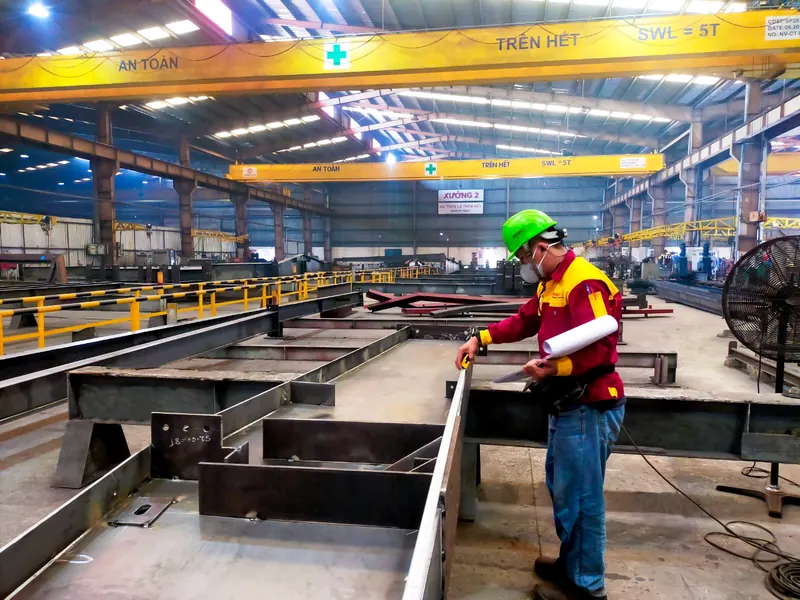
Our own plant in Vietnam fabricates 2,500 metric tons of structural steel a month, is accredited under IAS AC472 since 2019 and is audited twice a year. Shop drawings are included on every project.
- 5,000 tSunpro Steel Factory
- 2,500 tCPV Food Processing Factory
- 2,000 tLong Son petrochemical complex
- 2,000 tM&D (MD Factory)
Request a quote
Send drawings, a model or a member schedule. Our engineers check the US code basis, size or verify the members and price the fabricated steel, delivered to your US port.
Become our partner in the US
You erect and own the customer; we design, fabricate and ship. Engineering support on your bids and supply under your brand.
Who approves the design. We prepare calculations and drawings ready for your Engineer of Record’s review and approval. The PE seal and the permit stay with the US contractor, our customer.
Shop drawings, included