
On the line
Plate in at one end, a straight built-up member out the other
Five stages, run on machines in the order below. A member leaves the line only after its weld and dimension checks are signed.
-
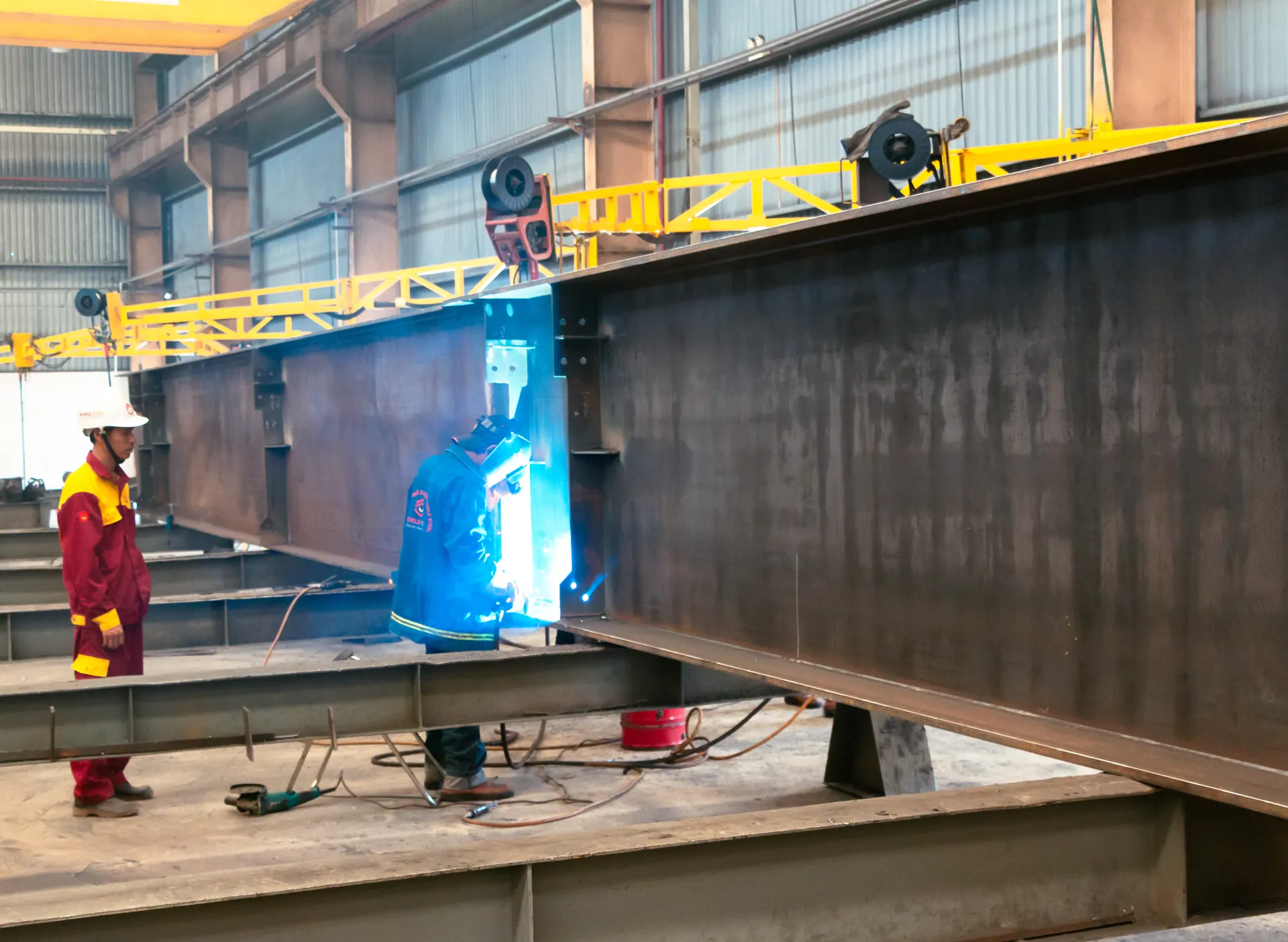
Cut web and flanges
Web and flange strips are cut together from plate, then spliced to length with full-penetration butt welds where a member is longer than the plate.
-
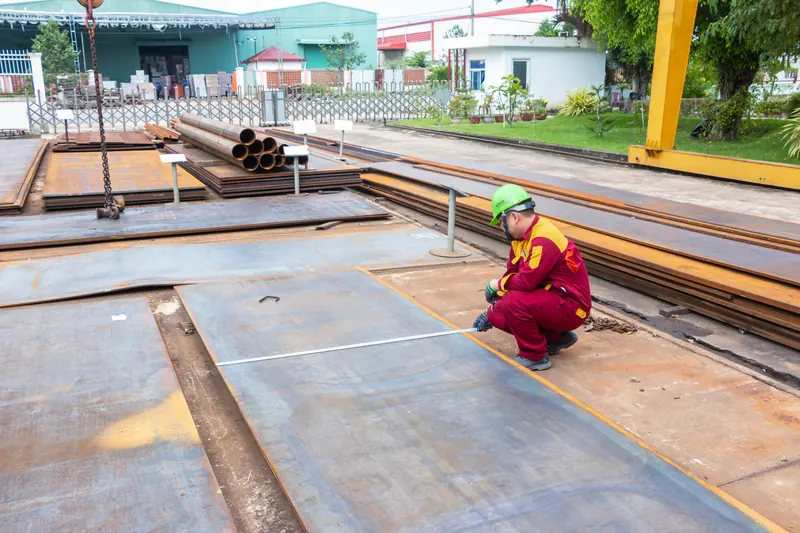
H-beam assembly
Flanges and web are set in the assembly jigs and tacked into an H, with the web on the centerline of the flanges.
-
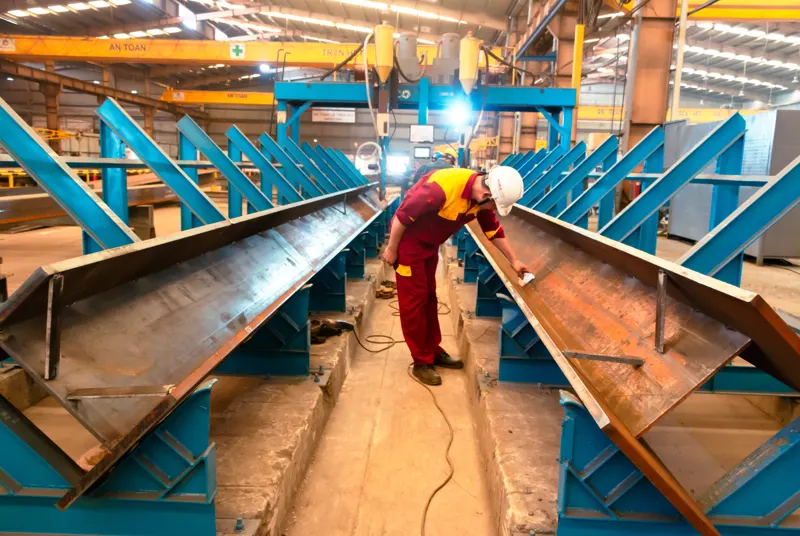
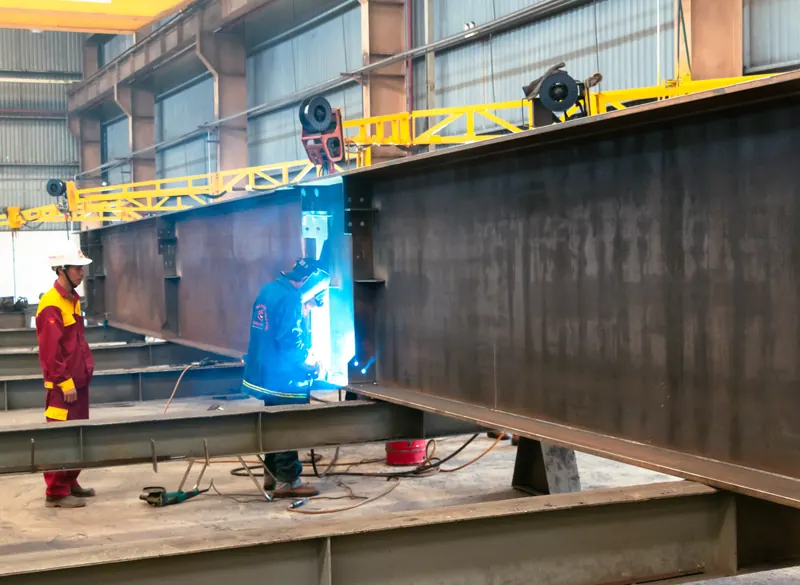
SAW web-to-flange welding
Automatic submerged-arc heads, fed with one or two wires, weld web to flange under granular flux in long, steady runs.
-
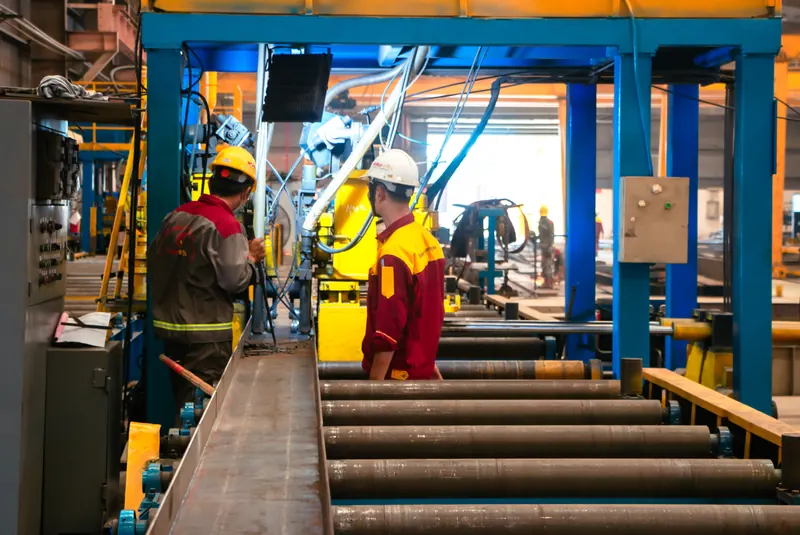
Heavy beam line
Deep and heavy sections go through the SAW heavy beam line, set up for thick plate and large welds.
-
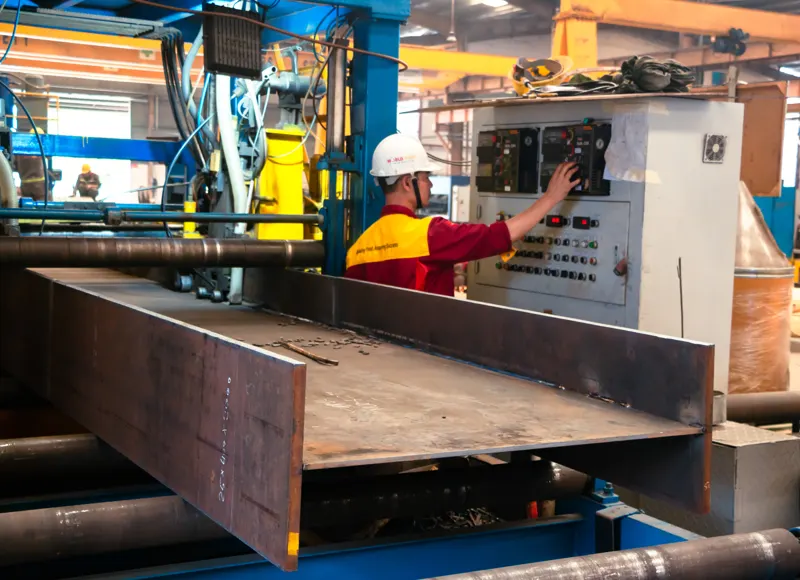
Straightening line
Flanges pulled by welding heat are straightened on the straightening machine line before the member goes to fit-up.
What comes off the line
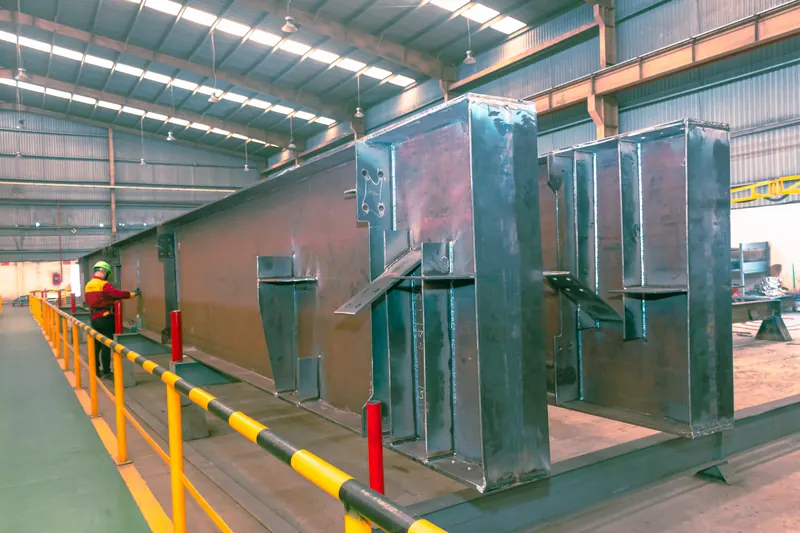
The heavy members of a large steel package
Constant-depth or tapered, sized to the load rather than to the next rolled shape
Deep at the haunch, shallow at midspan, for clear-span frames
Deep, stiffened girders for long spans, transfer beams and heavy floors
Built-up sections for industrial buildings with overhead cranes
Why automatic
Four reasons the heavy welds are made by machine
Machine travel speed, wire feed and voltage hold steady along the whole seam, so the weld on the hundredth rafter matches the first.
SAW welding procedures are qualified before the job starts, and QC checks voltage, current and travel speed against the approved WPS on a random basis.
Long, deep members are welded in continuous runs instead of many short manual passes.
Line production is what lets the plant run several large packages in parallel at 2,500 metric tons a month.
Questions
Beam line questions
What is a built-up member?
A column, rafter or girder made by welding flange plates to a web plate. It lets the engineer size the section to the load, including tapered shapes, instead of choosing the next heavier rolled shape.
How are web-to-flange welds made?
On automatic submerged-arc (SAW) lines. Flanges and web are tacked in the H-beam assembly line, then automatic heads with one or two wires weld them under granular flux.
Are the welds on one side or both?
Standard fillet welds that need no groove preparation are made on one side. Both sides are welded when the design or your specification calls for it.
How is distortion controlled?
Welding sequence is planned for thin flanges and deep webs, and members pass through the straightening machine line after welding. Dimensions are then checked against drawing tolerances.
Who checks the welds?
The operator checks flange height and machine settings, the foreman checks dimensions and weld appearance, and QC checks dimensions, weld quality and the welding parameters against the WPS, recording them on the welding inspection report.
Built for large jobs
Put your next steel package through this station
Automatic beam lines is one of eight stations in a plant that fabricates 2,500 metric tons of structural steel a month, accredited under IAS AC472 since 2019 and audited twice a year. Shop drawings are included on every project.
- 5,000 tSunpro Steel Factory
- 2,500 tCPV Food Processing Factory
- 2,000 tLong Son petrochemical complex
- 2,000 tM&D (MD Factory)
Request a quote
Send drawings, a model or a steel list. Our engineers take off the quantities, check the US code basis and price the fabricated steel, delivered to your US port.
Become our partner in the US
You erect and own the customer; we design, fabricate and ship. Engineering support on your bids and OEM supply under your brand.
Watch this station work on your own job. Hold and witness points can be attended live on Zoom or Microsoft Teams, and every record is in PEB Studio.
Book an online audit