
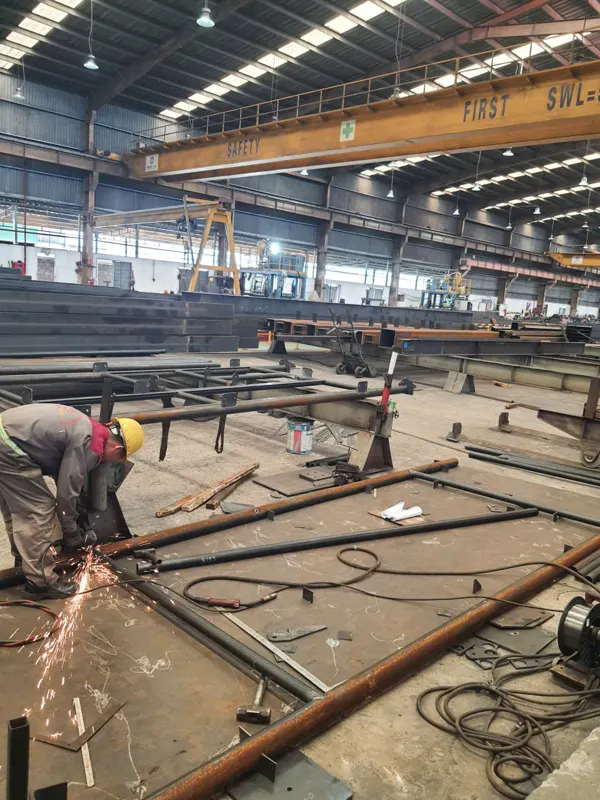
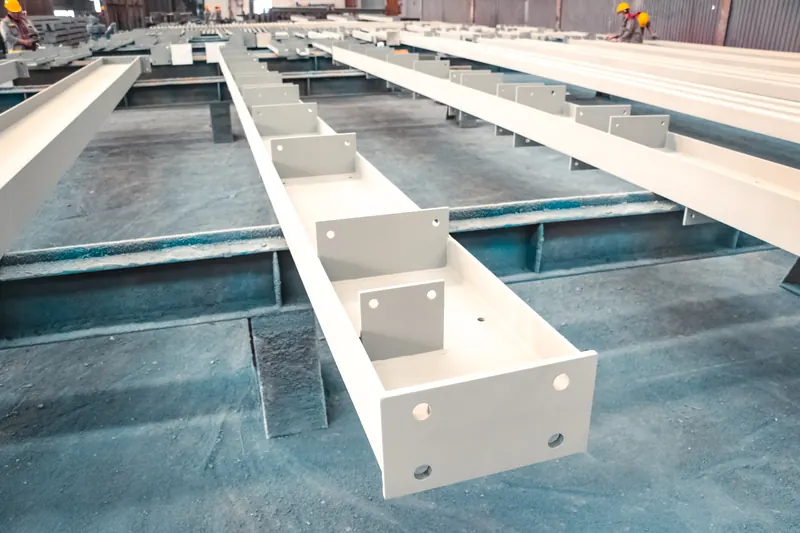
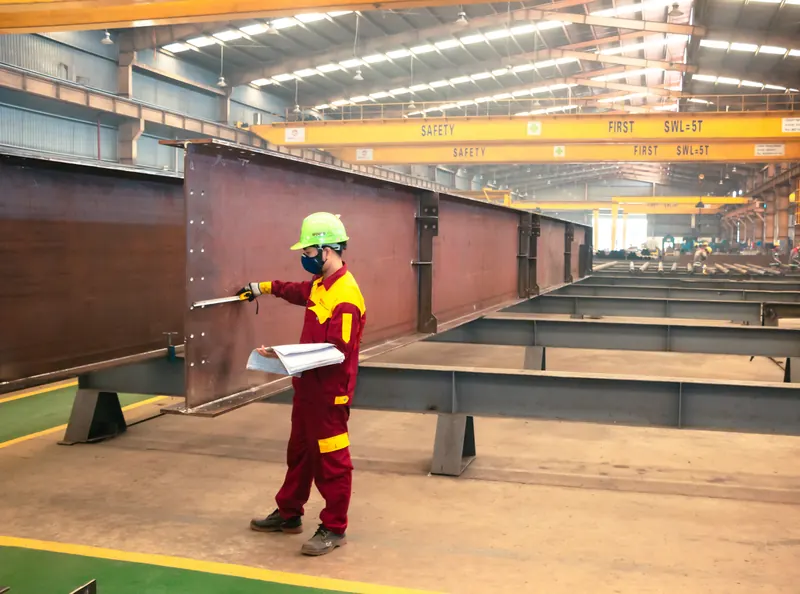
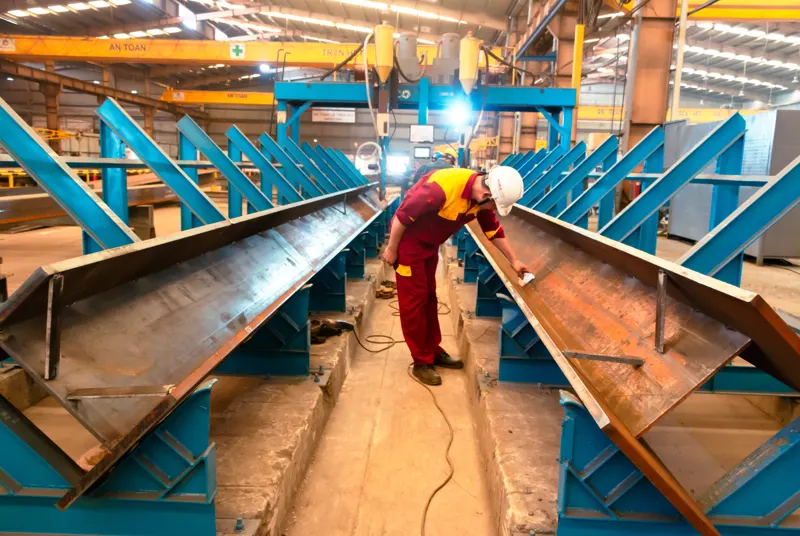
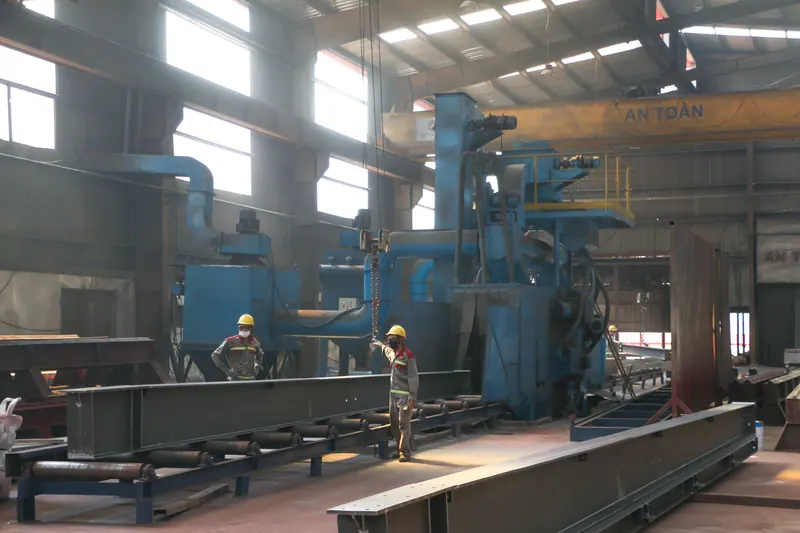
Cut edges are dressed before fit-up, World Steel plant in Vietnam.
PT of welds and edges
Surface cracks on any metal, shown in red on white by dye penetrant
Penetrant testing for edges, corners, copes, repairs and nonmagnetic parts, performed in-house or by the third party you designate, in a plant that fabricates 2,500 metric tons of structural steel a month.
Surface flaws on any metal
A colored liquid drawn into the crack, then pulled back out where you can see it
Penetrant testing works by capillary action. A thin, brightly colored liquid soaks into anything open to the surface, the excess is wiped away, and a white developer draws the trapped liquid back out as a red line or a fluorescent glow. It needs no magnetism, so it works on stainless steel and aluminum, and its spray cans reach into corners, copes and edges a yoke cannot sit on.
PT finds only what breaks the surface, and only on a surface that is truly clean. Preparation is half the test.
Start the clock
Six steps, and the time each one takes
Every penetrant test follows the same sequence. What changes from job to job is the penetrant system and the times, both fixed in the written procedure.
Pre-clean
Grease, scale, spatter and paint are removed, and the surface is left to dry, so nothing blocks the opening of a crack.
Before
Apply penetrant
The penetrant is sprayed or brushed over the area and the surrounding margin.
Start the clock
Dwell
The penetrant is left to soak into flaws for the time the written procedure sets for the material and temperature.
Procedure time
Remove excess
Surface penetrant is wiped off with a lint-free cloth lightly damped with remover, never flushed out of the flaws.
Gently
Develop
A thin, even coat of developer is applied. It acts like blotting paper, pulling penetrant out of the flaws.
Development time
Inspect and record
Indications are read under the right light, measured, judged against the acceptance criteria and recorded.
Within the window
Type and Method
Two penetrant types, four ways to remove the excess
Naming as used in ASTM E165 and E1417. The combination, the materials and the sensitivity level are fixed in the written procedure for your job.
Fluorescent
Glows under UV-A light in a darkened area. Higher sensitivity, needs a booth or a dark corner.
Visible (color contrast)
Red dye on white developer, read in normal light. Portable, the usual choice in a fabrication shop.
Method A
Water-washable
Excess removed with a water rinse.
Method B
Post-emulsifiable, lipophilic
An oil-based emulsifier is applied before rinsing.
Method C
Solvent-removable
Excess wiped off with solvent on a cloth. The common spray-can kit.
Method D
Post-emulsifiable, hydrophilic
A water-based remover is applied before rinsing.
PT or MT?
Six situations, and which surface method fits
On magnetic structural steel, magnetic particle testing is usually the first choice. Penetrant takes over where a magnet cannot work or cannot reach.
| Situation | Method | Why |
|---|---|---|
| Stainless steel or aluminum parts | PT | Not magnetic, so MT cannot be used. |
| Corners, small copes, tight edges | PT | A spray reaches where yoke legs cannot sit. |
| Fillet weld toes on structural steel | MT | Faster, works on rougher welds, sees slightly below the surface. |
| Hot or wet steel | MT | Dry-powder MT tolerates conditions that spoil a penetrant test. |
| Back-gouged roots and repair cavities | Either | Both find the surface cracks that must be removed before rewelding. |
| Thermally cut access holes | Either | AISC 360 and AISC 341 accept MT or PT on these surfaces. |
What spoils a result
Six ways a penetrant test can miss a crack
Each one is controlled by the written procedure and checked by the technician, because a missed crack does not show up as a failed test.
Dirty or wet surface
Oil, water or paint in the crack keeps penetrant out.
Smearing
Grinding or wire brushing can close a crack opening; surfaces are prepared by methods the procedure allows.
Over-washing
Flushing remover over the area pulls penetrant out of the flaws.
Short dwell
Fine, tight cracks need the full dwell time to fill.
Out of temperature range
Too cold or too hot changes how the penetrant flows and dries.
Thick developer
A heavy coat masks fine indications instead of revealing them.
Who performs it
Who performs PT on your job
The Inspection and Test Plan both sides agree before production names who performs each test, where it happens and how the results come back to you.
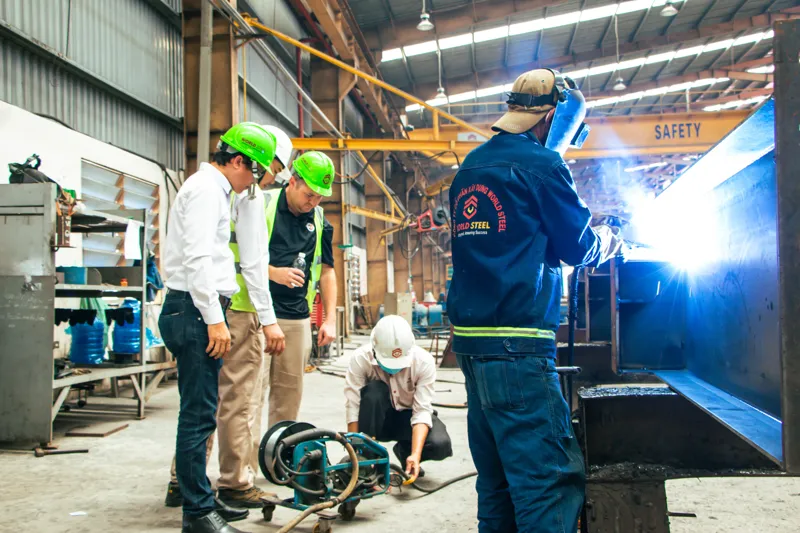
In-house, by World Steel QC
Our QC performs PT to the extent your specification assigns to the fabricator, to written procedures, with calibrated equipment, at the plant in Vietnam.
Or by the third party you designate
Your QA agency, special inspector or testing firm can perform or witness PT at hold points in our plant, live by video alongside our QC, or on arrival at site.
Agreed in the ITP
Each PT line in the Inspection and Test Plan names the method, extent, acceptance criteria and who performs it, before production starts.
Weld types
The welds PT checks on your steel
Each weld type has its own landing: how it is sized, how we weld it, and how it is inspected.
The other methods
Five more ways we test a weld
Questions
Penetrant testing questions from US reviewers
When is PT used on a structural steel job?
Mostly on nonmagnetic parts, on edges and corners a yoke cannot reach, and on thermally cut copes and access holes, back-gouged roots and repairs where your specification or the code calls for MT or PT.
Can PT find flaws inside the weld?
No. Penetrant finds only flaws open to the surface. Flaws inside a groove weld need UT or RT.
Who performs PT on our job?
World Steel QC, to the extent your specification assigns to the fabricator, or the third party you designate, at hold points in our plant or live by video.
Which kit is normally used in the shop?
Type II visible red dye, solvent-removable (Method C), from spray cans. Fluorescent systems are used when the procedure or your specification asks for higher sensitivity.
What acceptance criteria apply?
The AWS D1.1 visual acceptance criteria apply to indications PT reveals, for the loading the weld is designed for, unless your specification sets others.
Is the penetrant cleaned off before painting?
Yes. Penetrant and developer are removed after the test, and the surface is prepared again before blasting and coating.
Send the details where PT is called for
We write each PT location, procedure and acceptance level into the ITP and show who tests it.