
Heavy frames and their anchor rod sets are detailed and released in the same plant schedule.
High-strength rods and templates travel early so the foundations are poured on time.
A193 B7, A449 or A354 supply, maker and certificates are confirmed before ordering.
Every heavy base set is tagged with its column line, like every other anchor set.
Grades
Four high-strength rod grades, side by side
Anchor rods are sized by yield, so the yield column matters most.
- Yield
- 725 MPa (105 ksi)
- Tensile
- 860 to 1,035 MPa (125 to 150 ksi)
- Sizes
- Up to 76 mm (3 in)
The anchor rod standard’s own high-strength grade, with a red end mark. Covered on our anchor rod page.
- Yield
- 725 MPa (105 ksi) up to 64 mm (2-1/2 in)
- Tensile
- 860 MPa (125 ksi) min up to 64 mm
- Sizes
- Larger sizes at lower strength
Chromium-molybdenum alloy, quenched and tempered. Common on equipment and vessel foundations.
- Yield
- 635 MPa (92 ksi) up to 25 mm (1 in)
- Tensile
- 830 MPa (120 ksi) up to 25 mm
- Sizes
- Strength steps down above 25 and 38 mm
Quenched and tempered medium carbon steel; the strength falls in steps as the diameter grows.
- Yield
- 895 MPa (130 ksi) up to 64 mm
- Tensile
- 1,035 MPa (150 ksi) up to 64 mm
- Sizes
- Larger sizes at lower strength
Alloy steel at A490-like strength, for the heaviest tension where the Engineer of Record calls for it.
Nominal minimums from the ASTM standards for the smaller diameters; each standard steps the strength down for larger sizes. The Engineer of Record sizes the rods and checks the concrete to ACI 318 Chapter 17. Grades 36 and 55 and the parts of a set: ASTM F1554 anchor rods. Foreign counterparts: metric and foreign equivalents.
Handling rules
Four rules for quenched and tempered rods
No welding
Quenched and tempered rods lose strength and can crack if welded. Plate washers and nuts are not welded to these rods unless the Engineer of Record approves a procedure.
No hot bending or heating
Heat changes the temper. Hooked shapes are not made from these grades; a heavy hex nut and plate at the bottom anchors them instead.
A194 2H heavy hex nuts
B7 and A449 rods take A194 2H nuts, or A563 DH where the rod standard allows, at both leveling and top nuts.
Coating by the standard
Galvanizing the highest-strength grades is limited, as with A490 bolts; any coating follows the rod standard and the project specification.
Nut grades for every rod: heavy hex nuts.
Where they fit
Bases that pull hardest on their anchors
Tall frames and portal frames fixed at the base, with large tension on the anchor group.
Heavy crane loads that pull and push on the column bases with every lift.
Tall equipment where wind or earthquake overturning lifts one side of the base.
Equipment bases where the maker specifies a high-strength rod and its pretension.
Who does what
High-strength rods: our part and the US contractor's part
World Steel
- Sizes rods from the frame or equipment reactions with the frame design
- Confirms rod grade, maker, nuts and certificates in the quote
- Supplies rods, 2H nuts, plate washers and setting templates, tagged by grid
- Ships the sets ahead of the steel with the anchor bolt plan
The US contractor, our customer
- Engineer of Record specifies the grade and checks the concrete to ACI 318 Chapter 17
- Concrete crew sets rods to the templates before the pour
- Erector never welds or heats a quenched and tempered rod
- Owner’s inspector checks rods, nuts and any pretension the project lists
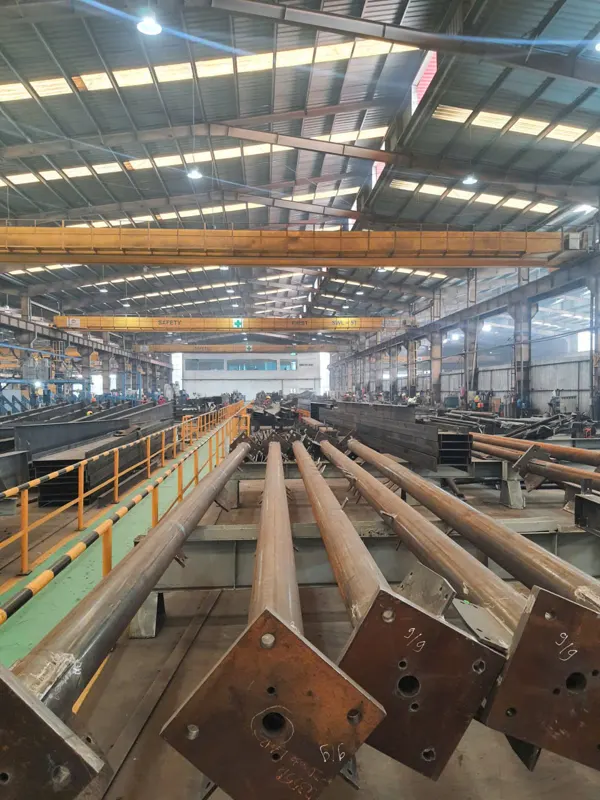
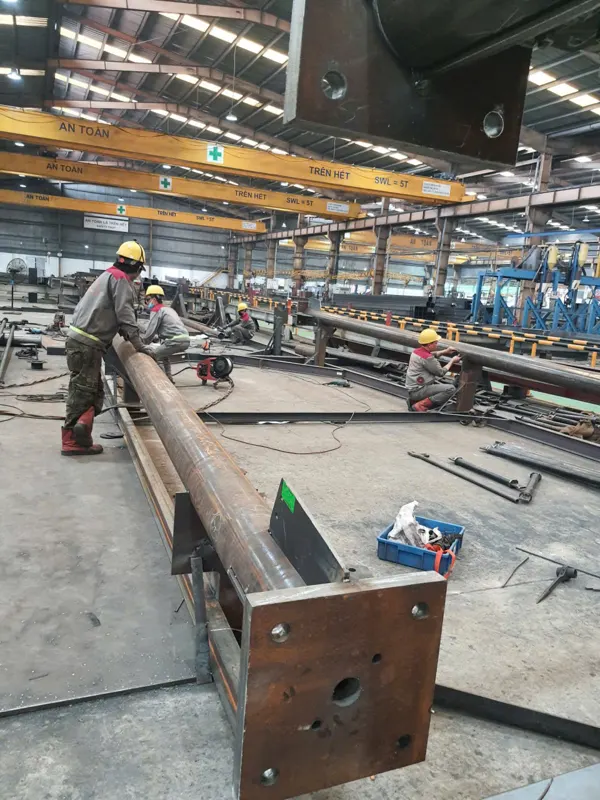
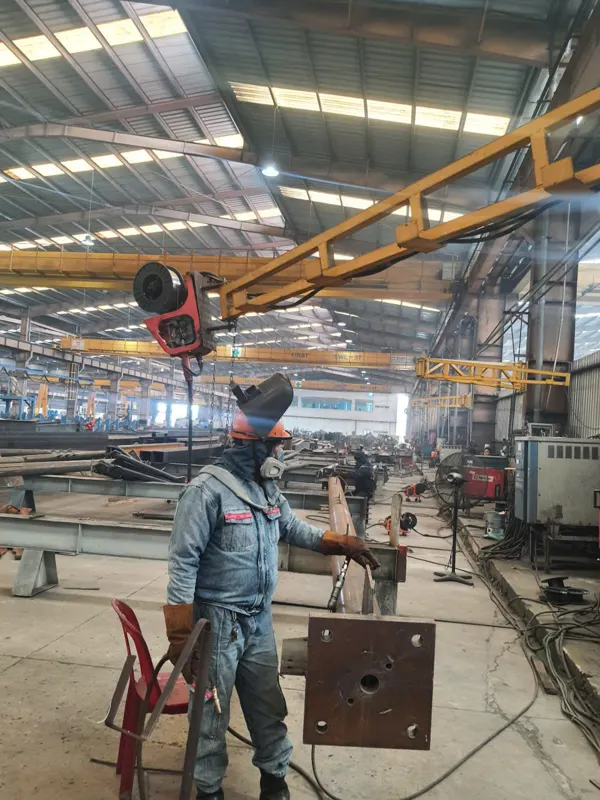
Heavy base plates in our plant
Questions
High-strength anchor rod questions from US contractors
What is an A193 B7 anchor rod?
A threaded rod of chromium-molybdenum alloy steel, quenched and tempered to ASTM A193 Grade B7, with a yield of 725 MPa (105 ksi) in the common sizes. It is often used on equipment and vessel foundations.
Is A193 B7 the same as F1554 Grade 105?
They have a similar minimum yield, but they are different standards with different chemistry, sizes, tests and markings. The Engineer of Record specifies one; swapping needs approval.
Why does A449 strength change with diameter?
A449 is heat treated, and thick bars cannot be hardened as deeply as thin ones. The standard sets lower strengths above 25 mm (1 in) and again above 38 mm (1-1/2 in).
Can high-strength anchor rods be welded?
Not without an approved procedure. Quenched and tempered rods such as A193 B7, A449 and A354 lose strength and can crack when welded or heated.
Can high-strength anchor rods have a hook?
Bending would need heat or cold work that changes the temper, so these grades are usually headed or anchored with a nut and plate at the bottom.
Do you supply A193 B7 rods?
Supply of A193 B7, A449 or A354 rods, with nuts and certificates, is confirmed in the quote for each job that specifies them.
Built for large jobs
High-strength anchor rods for your next large package
Our own plant in Vietnam fabricates 2,500 metric tons of structural steel a month, is accredited under IAS AC472 since 2019 and is audited twice a year. Shop drawings are included on every project.
- 5,000 tSunpro Steel Factory
- 2,500 tCPV Food Processing Factory
- 2,000 tLong Son petrochemical complex
- 2,000 tM&D (MD Factory)
Request a quote
Send drawings, a model or a member schedule. Our engineers check the US code basis, size or verify the members and price the fabricated steel, delivered to your US port.
Become our partner in the US
You erect and own the customer; we design, fabricate and ship. Engineering support on your bids and supply under your brand.
Who approves the design. We prepare calculations and drawings ready for your Engineer of Record’s review and approval. The PE seal and the permit stay with the US contractor, our customer.
Shop drawings, included