After the 1994 Northridge earthquake, investigators cut open fractured beam-to-column joints and kept finding the same thing: incomplete fusion and trapped slag in the middle of the bottom flange weld, right under the beam web. That is exactly where the welder has to reach through a small access hole in the web, working around an obstacle, often in an awkward body position. A welder who passes the normal plate test may still struggle there. AWS D1.8 responds with one extra test, the Supplemental Welder Qualification for Restricted Access Welding, set out in Clause 5 and Annex D. This article explains who needs this restricted access welder test, how it is built and what it qualifies.
Who needs the test
Clause 5.1.1 requires the test only when a welder makes a weld that meets all three conditions:
- it is a Demand Critical complete joint penetration (CJP) groove weld;
- it joins the beam bottom flange to the column flange; and
- the groove must be welded through the beam web access hole.
The commentary is clear about what falls outside: the test is not needed for fillet welds, for back welds of groove welds made through the access hole, or for welds that miss any of the three conditions. Top flange welds, made from above without the web in the way, do not need it. Neither do continuity plate welds or column splices.
Tack welders are also exempt (Clause 5.1.4). They still need normal D1.1 qualification, and the person who tack welds the test assembly can be someone other than the welder being tested, except that the candidate must attach the weld tabs.
What the test does not replace
The commentary stresses that the Annex D test does not replace AWS D1.1 welder qualification. D1.1 tests show a welder can weld in the positions used in production. The Annex D test adds proof of skill under restricted access. D1.8 does not ask for supplemental tests in every production position; the Annex D test is welded in the flat position, because the bottom flange groove weld is normally made flat from above the flange, through the hole.
Testing parameters
Clause 5.1.2 and Annex D set three key parameters:
- Process. The test uses the welding process that will be used in production, such as FCAW, SMAW, GMAW or SAW.
- Deposition rate. The test runs at a deposition rate equal to or higher than the highest rate used in production. The commentary explains that the electrode type, diameter, current, voltage and brand may differ from production, as long as the process is the same and production does not exceed the tested deposition rate.
- Backing. The test uses the type of backing that will be used on the project (Clause 5.1.3).
The WPS used for the test does not have to be the production WPS. But the production WPS for these joints should limit current, wire diameter, stickout and polarity so that welders cannot exceed the deposition rate they qualified at. Our article on seismic WPS requirements covers that link.
The test assembly
Annex D, Figures D.1 to D.3, describe a mock beam-to-column joint. A flat test plate, standing in for the beam flange, is welded to a column plate. A web plate, standing in for the beam web, sits on top of the test plate over the middle of the joint, and a weld access hole is cut in it. The welder has to make the groove weld under and around that web plate, just as in a real bottom flange joint. The test plates and column plate are at least 300 mm (12 in) long.
Two options depend on the backing:
Option A: steel backing
Used when the production WPS calls for steel backing (D3.2):
- steel backing 6 to 20 mm (1/4 to 3/4 in) thick and at least 25 mm (1 in) wide, tacked in line with the D1.8 rules for tack welds to backing
- a 10 mm (3/8 in) root opening, ±1.5 mm, with a 30° included angle, ±5°
- backing removal optional; if it is removed, the candidate removes it in the overhead position, then backgouges no deeper than 6 mm and back welds overhead, with any suitable process
A welder qualified with Option A may weld any joint with steel backing, provided the same process is used for the flat position welding and production stays within the tested deposition rate (D3.2.5).
Option B: other backing or open root
Used when the production WPS calls for ceramic or copper backing, or no backing at all (D3.3):
- backing, root condition and groove details as specified in the WPS
- non-steel backing removed by the candidate after welding, and the root treated as the WPS requires
- optional backgouging, no deeper than 6 mm, and back welding in the overhead position by the candidate
An Option B welder is qualified for the specific backing type on the WPS. In production the root opening may be no larger, and the groove angle no smaller, than in the test (D3.3.4). Clause 5.1.3 adds that when backing other than steel, or no backing, is used, the test uses the largest root opening permitted in production.
Welding the test
The candidate attaches the weld tabs, following the tab length and tack weld rules of Clauses 6.16.1 and 6.16.2. The candidate makes every weld pass, cleans every pass, and measures the interpass temperature to show it stays within the WPS (D3.1.3). The position of the web plate is marked on the test plate before it is removed, so the evaluator can find the critical zone under the web.
How the test is judged
Visual inspection first (D4.1). After the web plate, column plate and attachment plate are removed, the weld is inspected visually to the D1.1 criteria. No repairs are allowed once the plate has been submitted.
Then one of three tests (D4.2), at the contractor's choice:
| Method | What is done |
|---|---|
| Bend tests | Four transverse side bends, each 10 mm (3/8 in) thick: two from under the web plate and two from within 6 mm (1/4 in) of the weld ends, bent so the end side is in tension |
| Radiography | Full length of the test plate, with edge blocks |
| Ultrasonic testing | Full length, scanned from both faces and both sides |
The bend specimens from the weld ends are chosen on purpose: weld starts and stops, and the area under the web, are where Northridge defects concentrated.
If left-in-place backing gets in the way of the chosen test, anyone may remove it, as long as no more welding is needed before testing.
Retests and validity
Retest (D5). A welder who fails may take one more test. After a second failure, the welder must get more training and practice before testing again.
Validity (Clause 5.2). The qualification lasts 36 months, as long as the welder meets the D1.1 continuity requirements for the process. The commentary admits the 36-month period was chosen as a reasonable span. If it expires while the welder is working on a project and still producing welds that meet the project quality standards, the qualification stays valid on that project unless there is a specific reason to question the welder's ability.
Earlier tests (D1). Welders qualified on similar restricted access plate tests before the code was adopted, such as the FEMA 353 test the Annex D test is based on, are treated as qualified for the rest of their qualification period.
What goes on the welder record
Clause 5.3 asks the Welder Performance Qualification Record for this test to show the D1.1 essential variables plus:
- the type of backing, if any
- the maximum root opening, when steel backing is not used
- the minimum groove angle, when steel backing is not used
- the maximum deposition rate
Clause 1.4.2.8 requires the fabricator to keep this documentation for welders who make Demand Critical bottom flange welds.
Why welding through the hole is hard
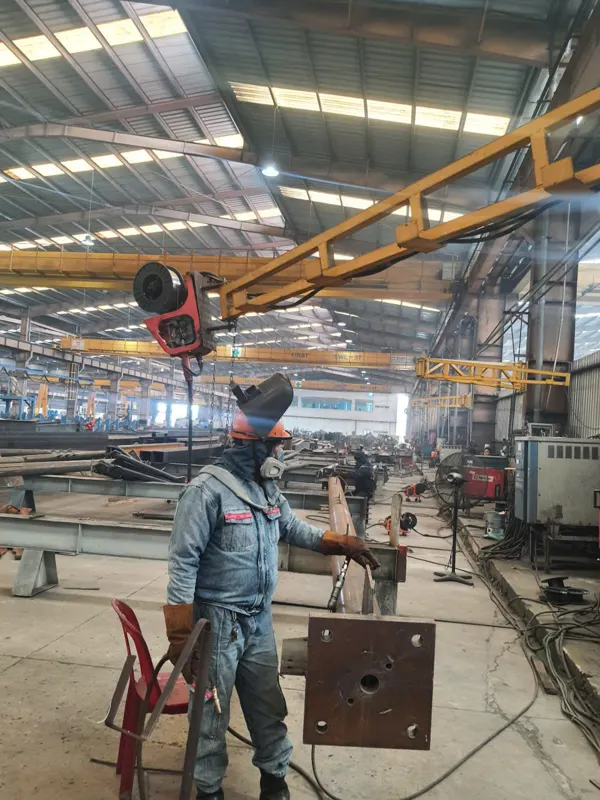
The access hole is small, typically a little deeper than the flange weld and only as wide as it needs to be. The welder has to angle the electrode under the web, see the root past the web plate, and keep the arc on both groove faces while the electrode is close to the web edge. Slag can collect in the middle, under the web, and is hard to clean out between passes. That is why the test puts the welder's skill where the risk is, rather than on an open plate.
Shop or field?
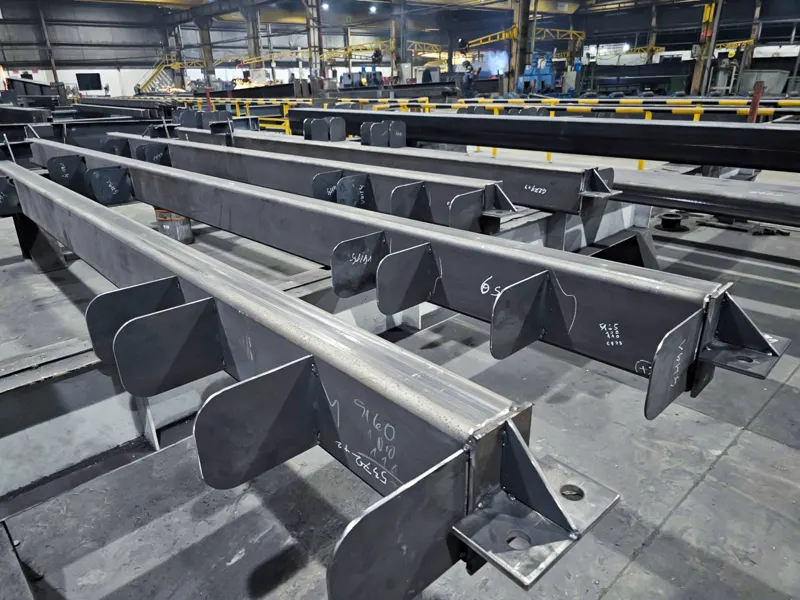
The bottom flange joint is usually welded wherever the beam meets the column. On many moment frames that happens in the field, after the beam is erected, which makes this a test for the erector's welders and the US contractor's scope. On shop-welded column trees and on moment connections built into prefabricated frames, the same joint is welded in the shop, and the fabricator's welders need the test. Agreeing early which bottom flange joints are shop welds and which are field welds tells everyone whose welders need qualifying.
How World Steel handles welder qualification
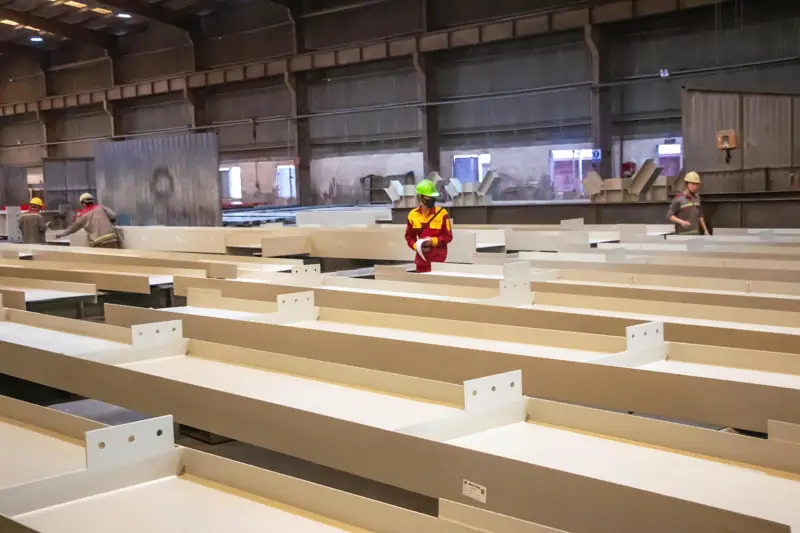
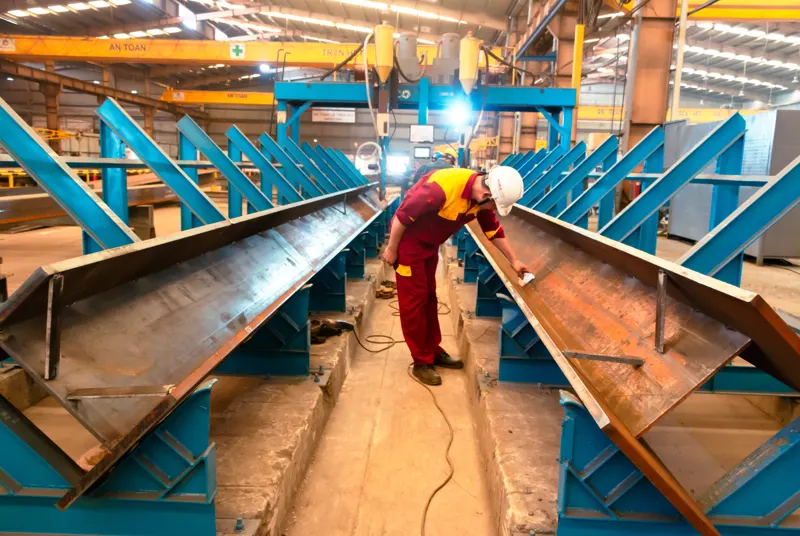
World Steel's shop welding procedures and welders are qualified to AWS D1.8. When a seismic project includes shop-welded Demand Critical bottom flange joints made through an access hole, the welders assigned to them are drawn from those who hold the restricted access qualification for the process and backing type on the WPS, and their records go into the project quality file under our IAS AC472-accredited system. Welder identification on each joint ties the weld back to the welder, as Clause 6.10 requires. The QA agency can review the records, or watch production, through inspector access.
For the welding sequence the same joint must follow, read our article on bottom flange weld sequence.
Quick answers
Who needs the restricted access welder test?
Welders who make demand critical complete joint penetration welds joining a beam bottom flange to a column flange, when the weld has to be made through the beam web access hole. All three conditions must apply.
Does it replace normal welder qualification?
No. Welders still qualify to AWS D1.1. The Annex D test is supplemental and covers the restricted access condition only.
How long does the qualification last?
36 months, as long as the D1.1 continuity rules for the process are met. If it expires while the welder is working on a project, it stays valid on that project unless there is a reason to question the welder.
Does a change of backing need a new test?
Yes. Backing type is an essential variable: steel, ceramic, copper and open root each need their own qualification. A test with no backing also qualifies the welder for steel backing.
Keep building your steel plan
Go further on USPEB.com
On this topic
Across the US market
- Quality hubInspection, testing and sign-off at the plant
- IAS AC472 accreditationThe first and only AC472 plant in Vietnam
- Accredited testing labsILAC ISO/IEC 17025 testing on every project
- Online factory auditWalk the shop live with our QA team
- Large projects, 2,500 t a monthCapacity for large US general contractors
- Contractor partnershipLong-term supply for US contractors