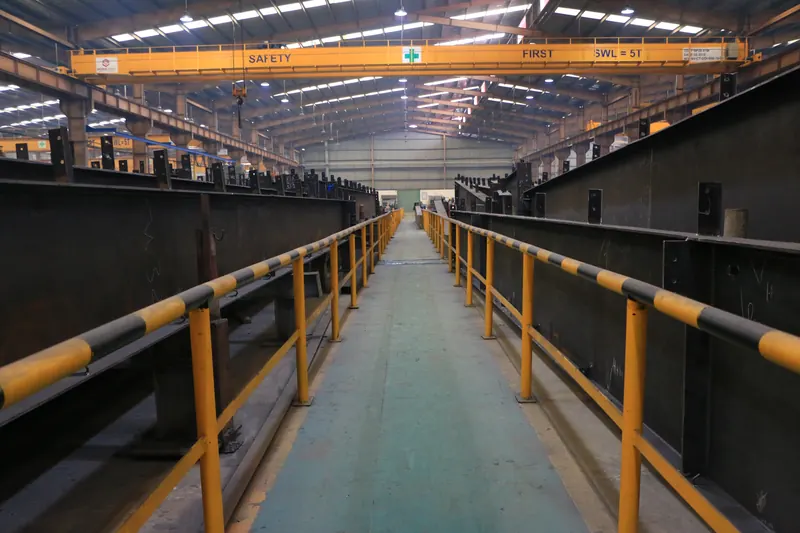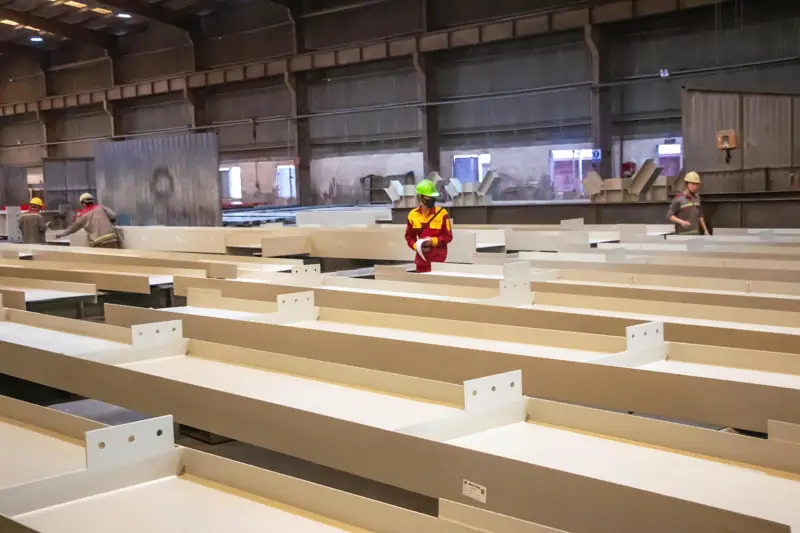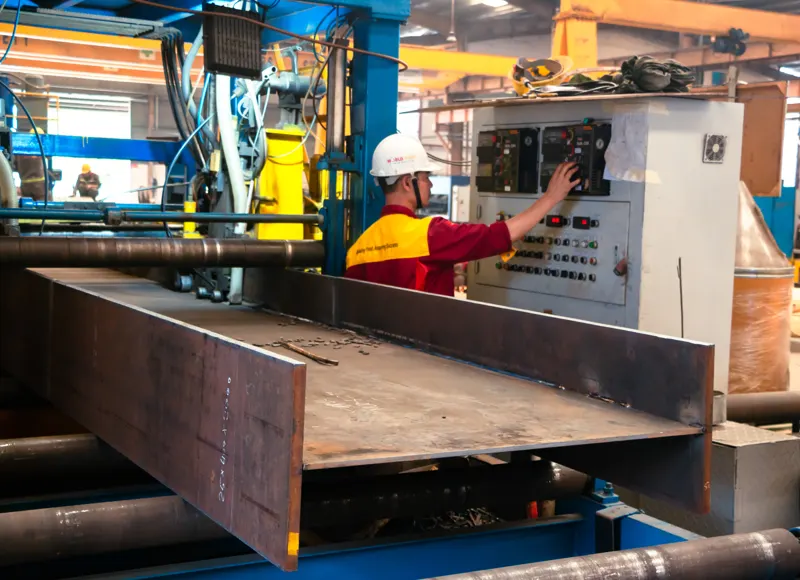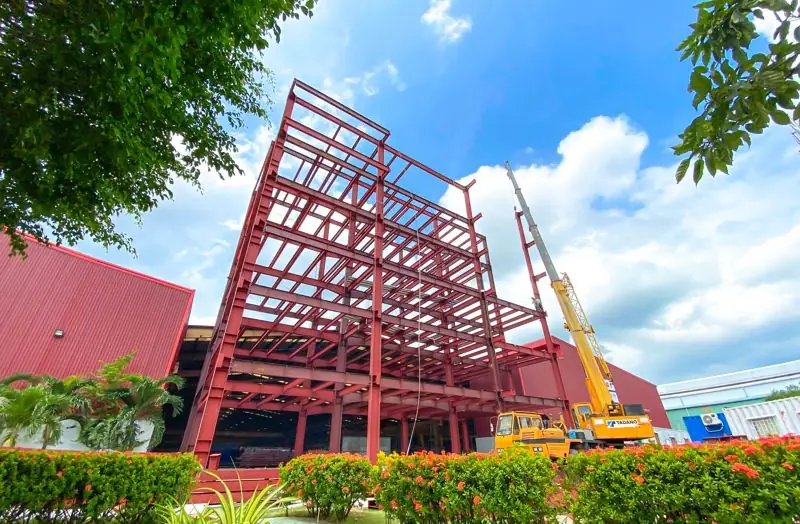
Most seismic steel buildings are welded in two places. In the shop, fabricators use gas-shielded flux cored wire (FCAW-G), solid-wire GMAW and submerged arc welding (SAW) for speed and quality under cover. In the field, erectors often prefer self-shielded flux cored wire (FCAW-S), which needs no gas bottle and tolerates wind. Most of the time the two never touch. But sometimes they do: a field weld laid over a shop root, a shop weld repaired in the field, a tack weld made with one process and covered with another. AWS D1.8 Clause 6.1.4 and Annex B cover that case with FCAW-S intermix testing. This article explains why the test exists, when it applies, how the specimens are taken and how shop and field teams can plan around it.
Why mixing matters
The commentary explains the problem in one sentence: research has found that weld metal made by mixing FCAW-S with other processes can show lower notch toughness than either process alone. There have been cases where each filler metal was classified with good toughness, but the combined weld fell short.
The metallurgy is the reason. FCAW-S wires protect the molten metal without gas by adding strong deoxidizers and nitrogen-binding elements, aluminum in particular, to the weld metal. That chemistry is balanced for weld metal that is all FCAW-S. When FCAW-S weld metal is diluted with, or dilutes, weld metal from another process, the balance changes and the microstructure can lose toughness. Because a seismic weld depends on toughness, D1.8 requires proof that a given combination works, rather than assuming two good products always make a good joint together.
When the test applies
Clause 6.1.4 requires Annex B intermix testing whenever FCAW-S filler metal is used in combination with filler metal from another process, including FCAW-G. The commentary is clear about what does not need testing:
- Combinations of FCAW-S with other FCAW-S electrodes.
- Combinations of SMAW, FCAW-G, GMAW, SAW or ESW with each other, with no FCAW-S involved.
The rule applies to all welds covered by D1.8, not only Demand Critical welds, but Demand Critical welds have a higher acceptance level, explained below.
Common situations that trigger it:
| Situation | Root or first material | Fill or second material |
|---|---|---|
| Field completion of a shop-started joint | Shop FCAW-G or GMAW | Field FCAW-S |
| Field repair of a shop weld | Shop process | Field FCAW-S |
| Shop tack welds inside a field joint | Shop process tack | Field FCAW-S |
| FCAW-S root, other process fill | FCAW-S | FCAW-G, SMAW or SAW |
| Field weld over an electroslag shop weld | Shop ESW | Field FCAW-S |
The tack weld case is easy to miss. The commentary on tack welds notes that weld metal used for tacks inside a joint must be compatible under Clause 6.1.4, because the tack becomes part of the final weld.
How Annex B works
Who may test. The filler metal manufacturer, the contractor or an independent testing agency. Major FCAW-S makers already publish results for common pairings, so check before planning a new test.
Essential variables. Tables B.1 and B.2 list which filler metal variables, such as AWS classification, manufacturer, trade name and diameter, require a new test when changed. The commentary gives an example: a test with a GMAW root and a specific FCAW-S electrode qualifies that FCAW-S electrode with any GMAW wire of the same AWS classification, regardless of the GMAW wire's brand or diameter. Not every combination needs its own test, but the FCAW-S product is always specific.
Test plate. One plate is welded. Base metal depends on strength level: A36, A572 Grade 50 or A992 for E70 combinations; A572 Grade 65 or A913 Grade 65 for E80; A913 Grade 70 for E90. For combinations with FCAW-G, SMAW, GMAW or SAW, the plate is 20 mm (3/4 in) thick, with either a 16 mm root opening and 20° groove or a 12 mm root opening and 45° groove.
Order of deposit. The order must match production. About one third of the joint thickness is welded with the first material, the "substrate" or root, and the rest with the second, the "fill." The commentary stresses that a test in the opposite order is not a substitute.
Electroslag substrate. When FCAW-S goes over an ESW weld, the whole butt joint is first made by ESW, then a groove at least 12 mm deep and 12 mm wide with a 6 mm minimum root radius is machined, ground or gouged into it and refilled with FCAW-S.
Specimen location. This is the clever part. The cross section is etched, a line is scribed at the interface between the two deposits, and each Charpy specimen is cut mainly from the second material with its edge within 1.5 mm of the interface. That puts the notch in the zone most affected by mixing.
Acceptance criteria
Five or ten Charpy specimens are tested, depending on the required number of tests.
For all welds covered by D1.8 (B7):
- 70 and 80 ksi filler metals: 27 J (20 ft·lbf) at -18 °C (0 °F).
- 90 ksi filler metals: 34 J (25 ft·lbf) at -29 °C (-20 °F).
- The highest and lowest of five values are dropped. Two of the remaining three must meet the required energy, the third may be up to 7 J (5 ft·lbf) lower, and the average of the three must meet the requirement.
For Demand Critical welds, additionally (B8):
- 54 J (40 ft·lbf) at 21 °C (70 °F), or at the colder temperature required by Clause 6.2.2.
- Again the extremes are dropped; two of three must reach 54 J, one may be as low as 40 J, and the average must be at least 54 J.
- Where LAST is below 10 °C, the test temperature is LAST plus 11 °C (20 °F).
Before the 2021 edition, other intermix tests could be accepted. That option has been removed, so Annex B is now the only method.
Planning shop and field processes together
For an imported seismic package, where the fabricator and the erector are different companies on different continents, intermix is a coordination issue more than a testing issue. Good practice:
- List the field welds early. From the erection drawings, identify field welds in the SFRS, especially Demand Critical ones such as field-welded beam flanges and column splices.
- Ask the erector which process and product they will use. FCAW-S is common; some erectors use FCAW-G with wind screens or SMAW.
- Check for contact. Will any field weld lie over, under or against shop weld metal, including shop tack welds inside field joints, shop-welded backing or shop repairs?
- Choose a path. Either confirm the combination already has Annex B data, often available from the FCAW-S manufacturer for common pairings, or change one process, or plan the test.
- Record it. Put the intermix basis in the WPS file for both shop and field.
A simple way to avoid the question for shop-installed steel backing and weld tabs at field joints is to agree how they are tacked. Tack welds placed inside the groove become part of the final weld, so their process matters.
Wind is part of the same decision
The reason erectors like FCAW-S is wind. D1.8 Clause 6.6.3 limits gas-shielded processes, GMAW and FCAW-G, to winds of no more than 5 km/h (3 mph) at the weld, unless windscreens or shelters are used. The commentary notes that toughness drops with air movement before any porosity is visible, and that welds made at 13 to 16 km/h can have hidden internal porosity. Self-shielded FCAW, SMAW and SAW have no wind limit as long as visual acceptance is met, and tests found FCAW-S toughness unaffected at winds up to about 29 km/h. So the field process choice, the wind rule and the intermix test are one decision, best made before the shop starts.
Questions a general contractor can ask
Before the shop starts, a short exchange between the general contractor, the erector and the fabricator settles intermix:
- Which SFRS field welds are planned, and which of them are Demand Critical?
- What process and product will the erector use for each, and will wind screens allow FCAW-G?
- Which shop processes are used for tack welds, backing, weld tabs and any partial welds at those joints?
- Is there Annex B data for each FCAW-S combination, in the production order, at the right test temperature?
- If not, who runs the test, and when will results be ready relative to the erection schedule?
The answers usually fit on one page, and that page belongs in both the shop and the field WPS files. When the special inspector asks how a field weld over shop metal was qualified, the answer is ready.
How World Steel coordinates intermix
World Steel supplies the steel structure; erection and field welding are the US contractor's scope. On seismic packages we ask for the field welding process early, mark field joints and any shop weld metal inside them on the shop drawings, and confirm the shop process at those joints is compatible with the field product or covered by Annex B data. Our shop welding procedures and welders are qualified to AWS D1.8, and the intermix basis goes into the project quality file under our IAS AC472-accredited system.
For more on filler metal choices, read seismic filler metal toughness, and for site handover see receiving structural steel on site.
Quick answers
When is intermix testing required?
When self-shielded flux cored (FCAW-S) filler metal is combined in the same weld with filler metal from another process, including gas-shielded FCAW. Combinations without FCAW-S, and FCAW-S with FCAW-S, do not need it.
Why can mixed weld metal lose toughness?
FCAW-S weld metal relies on deoxidizing and nitrogen-binding elements such as aluminum. Diluted with weld metal from another process, the mix can form a less tough structure even when each product passes on its own.
What toughness must the intermix weld meet?
For all welds, 27 J at -18 °C for 70 and 80 ksi filler metals, or 34 J at -29 °C for 90 ksi. For demand critical welds, also 54 J at 21 °C, or at LAST plus 11 °C when LAST is below 10 °C.
Does the order of the two processes matter?
Yes. The test must use the production order. A test with FCAW-S in the root does not cover a joint with FCAW-S on top, and the reverse.
Keep building your steel plan
Go further on USPEB.com
On this topic
Across the US market
- US codes and standardsIBC, AISC, AWS and MBMA, designed to
- Seismic steel structuresSDC D to F framing for West Coast jobs
- Crane building designUS crane standards for mill and bay buildings
- Design ReportWhat our US-code design report contains
- Large projects, 2,500 t a monthCapacity for large US general contractors
- Solutions by stateState-by-state steel solutions