Most structural welding in the United States is done to AWS D1.1, the general structural welding code for steel. When a building has to ride out a strong earthquake, a small group of its welds must do something ordinary welds never do: hold together while the steel around them stretches far past yield, back and forth, many times. AWS D1.8, Structural Welding Code, Seismic Supplement is written for those welds. This article walks through the 2025 edition from the fabricator's side: what it covers, what it leaves to D1.1, and which shop practices it changes.
It is the first article in our series on seismic fabrication. Each later article takes one part of the code and turns it into the checks a US general contractor can ask a fabricator about.
Why a seismic supplement exists
The code grew out of the 1994 Northridge earthquake in California. Many welded steel moment frames that looked fine from the outside were found to have fractured at the beam-to-column joints. The cracks started at the root of the bottom flange weld, at left-in-place backing, at weld access holes, and at defects hidden under the beam web.
The research that followed, run as the FEMA/SAC program, showed that good design was not enough on its own. Reliable seismic behavior also needed tighter control of materials, details, workmanship, testing and inspection. Those findings reshaped AISC 341, the Seismic Provisions for Structural Steel Buildings, and they are the reason D1.8 exists. AISC 341 says how a seismic frame is designed and which welds matter most. D1.8, together with D1.1, says how those welds are made, tested and inspected.
The design idea behind both documents is simple. A seismic frame is meant to absorb earthquake energy by yielding in chosen places, such as a reduced beam section, a brace or an eccentric link. The welds are detailed to stay elastic and let that yielding happen in the steel nearby. If a weld cracks first, the frame loses the ductility it was designed around.
Scope: a supplement, not a replacement
Clause 1.1 sets the relationship. D1.8 supplements AWS D1.1 and applies to welded joints designed to AISC 341. Every D1.1 provision for statically loaded structures still applies to those welds, except where D1.8 changes it.
Three practical points follow:
- Only the seismic force-resisting system (SFRS) is covered. Gravity beams, purlins, girts, secondary framing and most connections in a building stay under D1.1 alone.
- Not every weld in the SFRS is covered either. The commentary says the code is aimed at joints likely to see yield-level stress in the design earthquake, or whose failure would badly hurt the SFRS. That is usually a small share of the welds, even on a seismic frame.
- The Engineer decides. Clause 1.4.1 makes the Engineer mark on the contract documents which members, connections and welds fall under D1.8, and which welds are Demand Critical.
For a fabricator this means the first D1.8 task is reading the drawings, not welding. If the contract documents do not say which welds are Demand Critical or where the Protected Zones are, the shop asks before it orders filler metal.
Limits on steel strength
Clause 1.5 limits the code to structures made of steels with a minimum specified yield strength of 490 MPa (70 ksi) or less. Beams and braces that are expected to yield must have a minimum specified yield of 380 MPa (55 ksi) or less.
The commentary explains why. Plastic hinging has been tested extensively in steels up to 380 MPa, which covers ASTM A992 and A572 Grade 50 shapes, the workhorses of US seismic frames. Higher-strength steel up to 490 MPa is allowed mainly in columns, where hinges are not expected to form. Beyond those limits the code says its provisions may not be enough.
What the Engineer must put on the drawings
Clause 1.4.1 lists fifteen items the Engineer provides in addition to what D1.1 already asks for. For a fabricator, they are the inputs to the seismic shop drawings:
- connection configuration, materials and sizes
- which members and connections are part of the SFRS
- the location and size of every Protected Zone
- the location of Demand Critical welds
- where weld backing must be removed, and where it may stay with a fillet weld
- where reinforcing fillet welds are needed
- where weld tabs must be removed
- the shape of the weld access holes
- the Lowest Anticipated Service Temperature if the structure is not enclosed and kept at 10 °C (50 °F) or warmer
- butt joints in tension that need tapered transitions
- joints that need a specific assembly order or welding sequence
- the project Quality Assurance Plan (QAP)
Our article on seismic weld submittals turns this list into a pre-bid checklist, together with the records the shop has to hand back.
The six parts of Clause 6
Clause 6, Fabrication, is where most of the shop work sits. It is split into six parts:
| Part | Subject | What it means in the shop |
|---|---|---|
| A | Filler metal and weld metal | Strength, toughness and hydrogen limits for every SFRS weld |
| B | Extra rules for Demand Critical welds | Heat input envelope testing, production lot control, FCAW electrode exposure |
| C | Welding procedure specifications | Approved processes, WPS content, wind limits, interpass temperature, heat input, bottom flange sequence, welder ID |
| D | Details | Weld access holes, tack welds, backing, reinforcing fillets, weld tabs, end dams |
| E | Protected Zone | What may not be attached, and how mistakes are repaired |
| F | Restoration and repair | Grinding slopes, repair welding, MT after repair |
Parts A and B govern what goes into the weld. Part C governs how it is laid down. Parts D, E and F govern the steel around the weld, which is where Northridge showed most fractures begin.
Demand Critical welds: where the extra rules concentrate
Clause 3 defines Demand Critical welds as those the Engineer designates in the contract documents. The AISC 341 commentary describes them as welds that see yield-level or higher stress and sit in a joint whose failure would seriously reduce the strength or stiffness of the SFRS. Typical examples are the complete joint penetration (CJP) groove welds of beam flanges to columns in special moment frames, link-to-column welds in eccentrically braced frames, and column splice and base plate welds in some systems.
For these welds the code asks for:
- filler metal that gives at least 54 J (40 ft·lbf) Charpy V-notch toughness at 21 °C in welds made at both a high and a low heat input, on top of the classification toughness
- filler metal production lot control, or a documented exemption
- limits on how long FCAW electrodes may sit exposed to air
- a WPS that names the electrode manufacturer and trade name and sets heat input limits
- for bottom flange welds made through an access hole, a supplemental welder test under restricted access
Our Demand Critical weld checklist goes through each item.
Clause 4 and Clause 5: details and welders
Clause 4 covers a few connection details that crack easily if done wrong: the corner clips on continuity plates and stiffeners, which keep welds out of the cold-worked k-area of rolled shapes; tapered transitions in butt joints; and the joint detail for web doublers welded at the fillet of a rolled shape.
Clause 5 adds one welder test to D1.1 welder qualification. Welders who make Demand Critical CJP welds joining a beam bottom flange to a column flange, working through the beam web access hole, must pass the Supplemental Welder Qualification for Restricted Access Welding in Annex D. The qualification lasts 36 months, subject to the D1.1 continuity rules.
Clause 7: inspection and testing
Clause 7 covers inspection. The Engineer prepares the QAP when the building code or contract requires it, and it splits tasks between the fabricator's quality control (QC) and an independent quality assurance (QA) agency. The clause sets minimum inspector qualifications, asks QA agencies to work to a written practice, and sets rules for:
- magnetic particle testing (MT) of the k-area after welding doublers, continuity plates or stiffeners, no sooner than 48 hours after welding
- ultrasonic testing (UT) for lamellar tearing in thick base metal
- MT or penetrant testing (PT) of weld access holes and beam copes before welding
- MT after repairs at tab removal sites and in Protected Zones
- UT of CJP welds with a qualified written procedure, by technicians who have passed the Annex F practical test
The annexes do much of the work
Eight normative annexes hold the test methods: heat input envelope testing (A), intermix testing when self-shielded flux cored wire meets another process (B), the restricted access welder test (D), extended exposure testing for FCAW wire (E), UT technician qualification (F), the magnetic particle procedure (G) and UT flaw sizing (H). Each has its own article in this series.
What changed in the 2025 edition
The 2025 edition aligns the Engineer's responsibilities with AISC 341, makes clear that doubler location and connections come from the design drawings, adds heat input limits and an alternative to production lot testing for WPSs qualified by test, and clarifies that test plates for heat input envelope testing may be preset before welding. The overall structure is unchanged from earlier editions, so shops already working to D1.8 can map their procedures across clause by clause.
How World Steel applies AWS D1.8
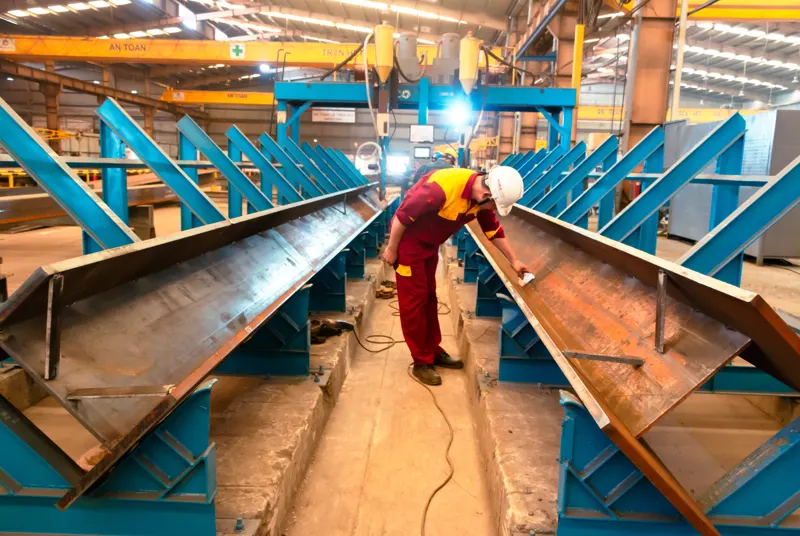
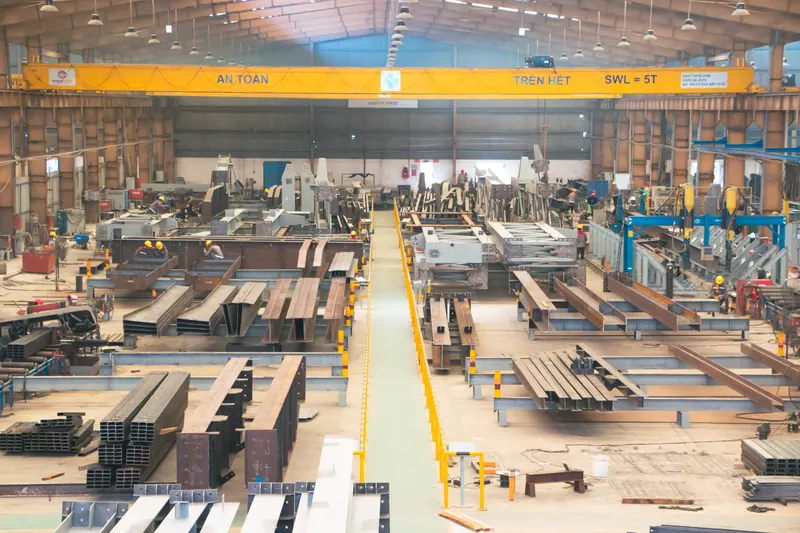
World Steel fabricates structural steel in Vietnam for US general contractors and ships it to the jobsite, where erection and site work is the US contractor's scope. On seismic work we follow the same order the code does:
- Read the drawings for D1.8 data. We list the Demand Critical welds, Protected Zones, backing and tab rules, access hole geometry and LAST from the contract documents and send an RFI for anything missing.
- Match procedures and people. Our shop welding procedures and welders are qualified to AWS D1.8 for the joints the project needs.
- Control the consumables. Filler metal certificates, heat input envelope data and FCAW exposure logs go into the project quality file.
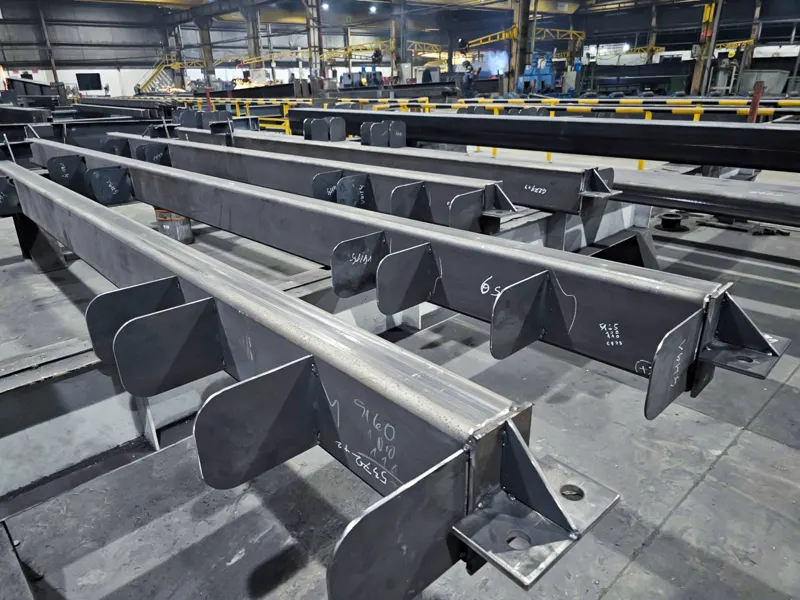
- Detail for the code. Shop drawings show the access hole geometry, corner clips, weld tabs and the Protected Zone limits, and Protected Zones can be marked on the steel on request.
- Inspect and record. Our IAS AC472-accredited quality system runs the QC side, and the QA agency named in the QAP can inspect in person or through remote inspector access.
The Engineer of Record and the US contractor approve the drawings and own the design and its seal. Our job is to fabricate exactly what they approved, and to prove it with records. If you have a seismic package in California, Washington, Oregon or another high-seismic state, send the drawings and the QAP and we will tell you what the shop needs before it can quote.
Quick answers
Does AWS D1.8 replace AWS D1.1?
No. D1.8 is a supplement. Every D1.1 rule for statically loaded structures still applies to the welds it covers, and D1.8 adds or tightens requirements on top.
Which welds does AWS D1.8 cover?
Welded joints in seismic force-resisting systems designed to AISC 341. The Engineer marks on the contract documents which members, connections and welds fall under it; most welds in a building do not.
Is there a steel strength limit?
Yes. The code is written for steels with a minimum specified yield of 490 MPa (70 ksi) or less, and 380 MPa (55 ksi) or less for beams and braces expected to yield.
What is the biggest change for the shop?
Demand Critical welds. They need filler metal with proven toughness across a heat input range, controlled electrode exposure, documented procedures, and in some joints a special welder test.
Keep building your steel plan
Go further on USPEB.com
On this topic
Across the US market
- US codes and standardsIBC, AISC, AWS and MBMA, designed to
- Crane building designUS crane standards for mill and bay buildings
- Design ReportWhat our US-code design report contains
- Large projects, 2,500 t a monthCapacity for large US general contractors
- Contractor partnershipLong-term supply for US contractors
- Solutions by stateState-by-state steel solutions