On a seismic steel job, the term Demand Critical shows up on the drawings, in the specification, in the Quality Assurance Plan and in every inspector's report. It decides which filler metal goes on the welding machine, which welder can strike the arc and how the finished joint is tested. This article explains what a demand critical weld is, where you will normally find one, and the controls a fabricator has to prove for each.
What "Demand Critical" means
AWS D1.8 defines Demand Critical welds simply as the welds the Engineer designates in the contract documents (Clause 3). The meaning comes from AISC 341. Its commentary describes a demand critical weld as one that sees yield-level or higher stress and sits in a joint whose failure would cause a significant loss of strength or stiffness in the seismic force-resisting system (SFRS).
Two ideas sit inside that definition:
- High demand. In a design earthquake the steel next to the weld yields. The weld must carry the full force the yielding member can deliver, including strain hardening.
- High consequence. If the weld breaks, the frame loses a load path it depends on, not just a secondary piece.
The D1.8 commentary adds that Demand Critical welds usually come from three sources: connection prequalification analysis under AISC 341 Chapter K, connection qualification testing under the same chapter, and the prequalified connections of AISC 358.
Where demand critical welds usually sit
The Engineer marks them on each project, but the pattern is consistent. Typical locations are:
| Frame type | Usual Demand Critical welds |
|---|---|
| Special and intermediate moment frames | CJP welds of beam flanges to column flanges; welds of beam webs to columns in some connection types; column splice welds |
| Eccentrically braced frames | Link-to-column flange and web welds; welds in the link region |
| Special concentrically braced frames | Column splice welds and column base welds, when the system calls for them |
| Most systems | CJP welds of columns to base plates, where AISC 341 lists them |
The D1.8 commentary figures show a reduced beam section connection, an eccentric brace link and a welded unreinforced flange connection, with every weld labeled as Demand Critical, D1.8 only or D1.1 only. The labels matter: on a typical moment connection, the continuity plate welds, doubler welds and shear tab welds usually follow D1.8 or D1.1 without being Demand Critical.
Control 1: confirmed locations on the drawings
Clause 1.4.1 requires the Engineer to show the location of Demand Critical welds. The shop's first control is to transfer those locations to the shop drawings and the weld maps, so every fitter, welder and inspector sees the same designation. When the contract documents only say "all CJP welds in the SFRS," we send an RFI rather than guess. Guessing low risks a non-conforming weld; guessing high adds cost the bid did not carry.
Control 2: filler metal toughness in two layers
Every SFRS weld uses filler metal meeting Table 6.1 of D1.8: for 70 and 80 ksi classes, 27 J (20 ft·lbf) at -18 °C (0 °F); for 90 ksi filler metal, 34 J (25 ft·lbf) at -29 °C (-20 °F). Demand Critical welds add a second layer in Table 6.3: at least 54 J (40 ft·lbf) at 21 °C (70 °F) for 70 and 80 ksi classes, or at 10 °C (50 °F) for the 90 ksi class, measured on welds made at both ends of the production heat input range.
The full story is in our article on seismic filler metal toughness.
Control 3: a proven heat input envelope
Heat input changes weld metal toughness, and it can drop at both the high and the low end. For prequalified WPSs, D1.8 asks for filler metal tested to Annex A at a high and a low heat input (Clause 6.2.1). Production welding must then stay inside that envelope (Clause 6.8.1). For WPSs qualified by test, the limits are 80% to 120% of the average heat input in the qualification test (Clause 6.8.2). Common SMAW E7018 electrodes and solid GMAW wires listed in Table 6.4 are exempt from the envelope test when the structure stays at 10 °C or warmer.
See heat input envelope testing for the method.
Control 4: production lot control
Each production lot of filler metal for Demand Critical welds must be tested, unless an exemption applies (Clause 6.3). The common exemption for prequalified WPSs needs three lots tested to Annex A and a manufacturer audited by a body such as ABS, Lloyd's Register, ASME or the US Department of Defense, with a retest at least every three years. Our article on filler metal production lot control explains the classes and the paperwork.
Control 5: FCAW electrode exposure
Flux cored wire can pick up moisture, which raises diffusible hydrogen and the risk of cracking. For Demand Critical welds, D1.8 Clause 6.4 limits how long FCAW electrodes may be out of protective packaging: the manufacturer's tested limit, or 72 hours of accumulated exposure when no test data exists. Over-exposed wire must be dried to the manufacturer's instructions or moved to other work. See FCAW electrode exposure limits.
Control 6: a WPS that names the product
For Demand Critical welds, the WPS must list two extra essential variables (Clause 6.6.2): the electrode manufacturer and trade name, and one or more combinations of amperage, voltage and travel speed that keep heat input inside the qualified limits. A generic "E71T-1" on the WPS is not enough. Changing brands means checking that the new product has its own envelope data. See seismic WPS requirements.
Control 7: the right welder for the bottom flange
When a Demand Critical CJP weld joins a beam bottom flange to a column flange and has to be made through the beam web access hole, the welder must hold the Supplemental Welder Qualification for Restricted Access Welding of Annex D, on top of normal D1.1 qualification (Clause 5.1). The test uses the production process, the production backing type and at least the production deposition rate. A later article in this series covers the restricted access welder test in detail.
The same joint also follows the bottom flange sequence of Clause 6.9: no starts or stops under the beam web where it can be avoided, each layer finished across the full flange width, and starts and stops swapped side to side layer by layer.
Control 8: inspection and records
Demand Critical welds are where the Quality Assurance Plan spends most of its effort. Under AISC 341 Chapter J, CJP Demand Critical welds normally get ultrasonic testing, done to a qualified written procedure (D1.8 Clause 7.10) by a technician who has passed the Annex F practical exam. Clause 6.10 requires a way to tie each joint to the welder who made it, with low-stress stamps if stamps are used. Our weld inspection and NDT checkpoint shows how testing is scheduled in the shop.
What does not change
D1.8 does not ask for a special weld profile, a special electrode diameter or special positions. The usual D1.1 rules on preheat, fit-up, weld size and visual acceptance still apply. What changes is proof: the shop must be able to show, joint by joint, which welder used which filler metal lot, in which heat input range, with which inspection result.
Common ways a demand critical weld goes wrong
Most rejected demand critical welds fail for reasons that are easy to prevent once they are named:
- A brand swap on the shop floor. A different FCAW wire of the same AWS class is loaded because the usual product ran out. The weld may be sound, but it no longer matches the WPS or the envelope data on file.
- Heat input drift. A welder slows the travel speed to fill a wide root opening and pushes heat input above the tested maximum. Toughness can drop without any visible sign.
- Wire left on the feeder over a weekend. Exposure hours accumulate silently unless someone logs them.
- A tack weld in the wrong place. A tack holding backing to the underside of a beam flange is prohibited in the Protected Zone and must be ground out and checked.
- A missing welder mark. Without the welder record, a later UT reject cannot be traced and a pattern cannot be found.
Each of these is a records problem first and a welding problem second, which is why the controls above lean so heavily on documentation.
A one-page checklist for the general contractor
Before awarding a seismic package, a general contractor can ask the fabricator for:
- A list of Demand Critical weld types taken from the contract documents, with any RFIs.
- The WPSs for those welds, showing manufacturer, trade name and heat input range.
- Filler metal Certificates of Conformance and heat input envelope or exemption data.
- The production lot control approach for each filler metal.
- The FCAW exposure control method, if FCAW is used.
- The roster of welders qualified for restricted access bottom flange welds, where needed.
- The welder identification method.
- The inspection and test plan that matches the QAP.
How World Steel handles demand critical welds
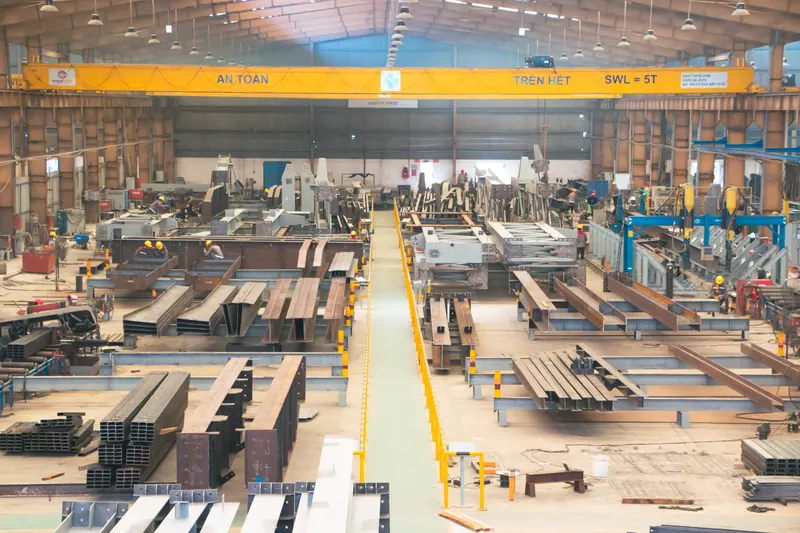
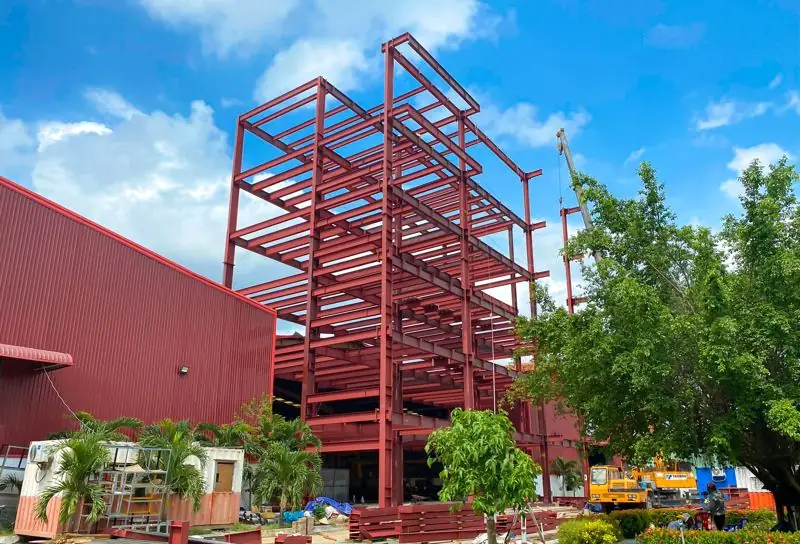
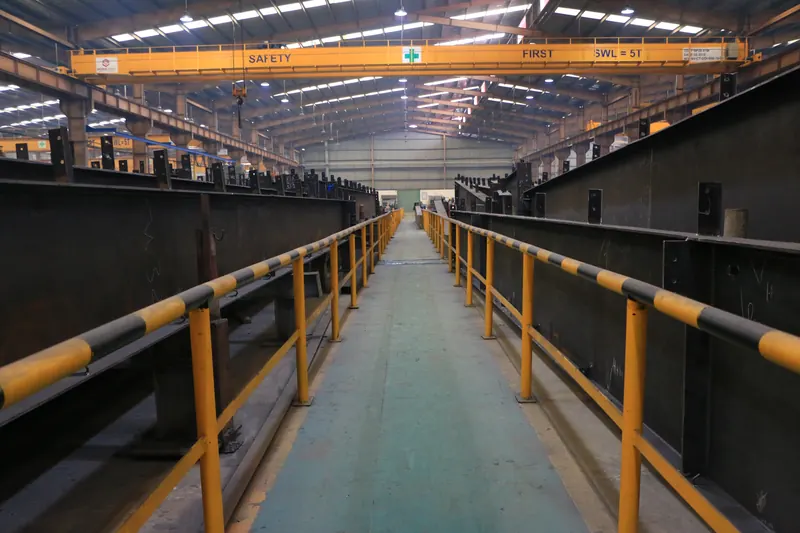
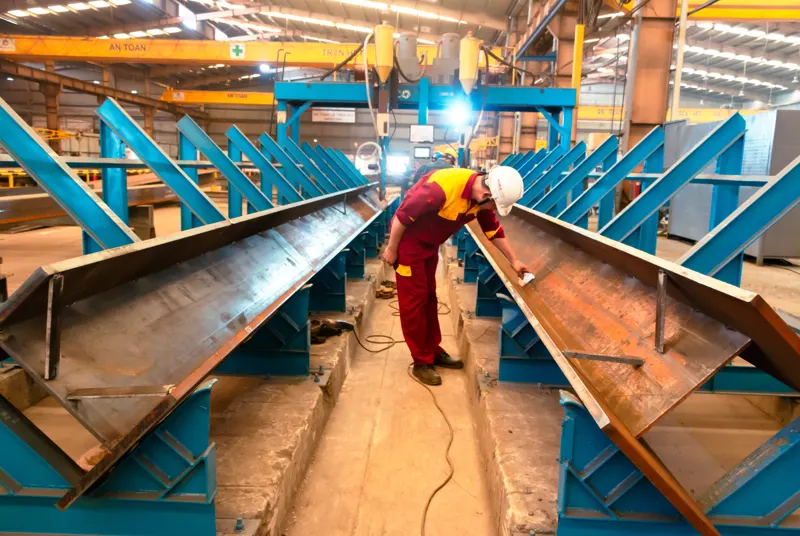
World Steel fabricates seismic moment frame and braced frame members in Vietnam for US general contractors; erection and site work is the US contractor's scope. Our shop welding procedures and welders are qualified to AWS D1.8, and our quality system is accredited to IAS AC472. Each Demand Critical weld type is mapped in the inspection and test plan with its WPS, its filler metal and its test. Steel plate can be supplied with EN 10204 3.1 certificates including Charpy results on request, and every material test is done at an ISO/IEC 17025 laboratory or a laboratory the customer names.
Most demand critical welds are shop welds on built-up and rolled members, or field welds made by the US contractor's erector. Where field welds are Demand Critical, we coordinate the shop and field processes early, because mixing self-shielded flux cored wire with other processes triggers its own test, explained in our article on FCAW-S intermix testing.
Quick answers
Who decides which welds are Demand Critical?
The Engineer of Record, on the contract documents. AWS D1.8 requires the locations to be shown; the fabricator does not pick them.
Are all CJP welds in a seismic frame Demand Critical?
No. Typical Demand Critical welds are beam flange to column welds in special and intermediate moment frames, link-to-column welds in eccentrically braced frames, and certain column splices and base plate welds. Many other SFRS welds follow D1.8 without being Demand Critical.
What toughness does a Demand Critical weld need?
Filler metal classified for 27 J (20 ft·lbf) at -18 °C, plus at least 54 J (40 ft·lbf) at 21 °C in welds made at both a high and a low heat input, or at a lower temperature when the Engineer sets a cold service temperature.
Does every Demand Critical weld get ultrasonic testing?
The Quality Assurance Plan sets the testing. AISC 341 Chapter J normally calls for UT of CJP Demand Critical welds, done to the procedure and technician rules of AWS D1.8 Clause 7.
Keep building your steel plan
Go further on USPEB.com
On this topic
Across the US market
- Quality hubInspection, testing and sign-off at the plant
- IAS AC472 accreditationThe first and only AC472 plant in Vietnam
- Accredited testing labsILAC ISO/IEC 17025 testing on every project
- Online factory auditWalk the shop live with our QA team
- Large projects, 2,500 t a monthCapacity for large US general contractors
- Contractor partnershipLong-term supply for US contractors