A welding procedure specification (WPS) is the recipe a welder follows: process, filler metal, joint, position, preheat, current, voltage, travel speed and the rest. Under AWS D1.1, a WPS is either prequalified, following the code's rules without testing, or qualified by test, backed by a procedure qualification record (PQR). AWS D1.8 keeps both routes, then adds a short list of requirements for welds in the seismic force-resisting system (SFRS), most of them for Demand Critical welds. This article goes through those seismic WPS requirements one by one.
Prequalified or qualified by test
Clause 6.6.1 allows both kinds of WPS. The choice changes how heat input is controlled and what paperwork is needed:
| Item | Prequalified WPS | WPS qualified by test |
|---|---|---|
| Basis | D1.1 prequalification rules plus D1.8 | D1.1 qualification test plus D1.8 |
| Demand Critical heat input limits | Inside the filler metal's Annex A envelope | 80% to 120% of the PQR's average heat input |
| Filler metal envelope certificate | Needed, unless the product is on Table 6.4 and LAST is 10 °C or warmer | Not needed; the PQR shows the properties |
| PQR | None | Submitted to the Engineer (Clause 1.4.2.7) |
| Lot control path | Clause 6.3.3.1 | Clause 6.3.3.2 |
Clause 1.4.2.6 puts the fabricator in charge of all WPSs. The commentary on PQR submittals explains why they go to the Engineer: so the heat input range on the WPS can be checked against the qualification test, and so the test's soundness and mechanical results can be confirmed.
Approved processes
Clause 6.5.1 lists four processes that may make Demand Critical welds without further justification:
- SMAW, shielded metal arc welding (stick)
- GMAW, gas metal arc welding, except short-circuit transfer
- FCAW, flux cored arc welding, gas-shielded or self-shielded
- SAW, submerged arc welding
The commentary explains the list. SMAW and FCAW were used in US connection qualification tests, and GMAW in Japanese tests. SAW was included because it can reach the required properties at similar heat inputs. Short-circuit transfer GMAW is left out; it is a low-energy mode widely known for incomplete fusion on thick structural joints.
Clause 6.5.2 allows other processes, such as electroslag (ESW) or electrogas (EGW) welding, only when one of these holds:
- the process is part of an AISC 341 prequalified connection detail;
- AISC 358 permits it for the connection;
- it was used in a passing AISC 341 connection qualification test; or
- the Engineer approves it.
The commentary adds that connection qualification and WPS qualification are different things. A connection test approves a process for a connection; it does not lock in WPS parameters, and a later WPS change does not mean repeating the connection test.
Extra essential variables
D1.1 lists the essential variables a WPS must show. Clause 6.6.2 adds two for Demand Critical welds:
- The electrode manufacturer and trade name. The commentary explains that each product has its own heat input envelope, so a generic AWS classification is not enough.
- One or more combinations of variables that produce heat input within the limits of Clause 6.8.1 or 6.8.2.
The commentary also connects the WPS to welder qualification. Welders who make restricted access bottom flange welds are qualified up to a maximum deposition rate. The production WPS for those joints should limit amperage, wire diameter, electrical stickout and polarity so a welder cannot exceed the rate they tested at.
Clause 1.4.2.3 adds that for FCAW, SMAW and metal-cored GMAW, the manufacturer's data sheets come with the WPS, showing recommended parameters and storage, exposure and baking guidance. The commentary notes that FCAW and metal-cored products have product-specific voltage and current relationships, and the D1.1 tolerances can be applied to the manufacturer's values as long as heat input limits are met.
Heat input limits
Clause 6.8 sets heat input limits for Demand Critical welds:
- Prequalified WPSs: within the range proven by Annex A testing of the filler metal.
- WPSs qualified by test: within 80% to 120% of the average heat input in the qualification test.
Heat input is computed with the D1.1 formula: 60 × volts × amps divided by 1000 × travel speed. With travel speed in mm per minute, the result is in kJ/mm. If the WPS gives ranges, every combination within those ranges must fall inside the limits. Our article on heat input envelope testing works through an example.
Wind limits
Clause 6.6.3 sets air velocity limits that are stricter than D1.1:
- GMAW and FCAW-G may not be used in winds above 5 km/h (3 mph). Windscreens or shelters may be used.
- SMAW, FCAW-S and SAW have no wind limit, provided the welds meet visual acceptance criteria.
D1.1 allows gas-shielded welding up to 8 km/h. The commentary explains the tighter limit: Charpy toughness falls with air movement before any porosity appears, and welds made in winds of about 13 to 16 km/h can contain significant internal porosity with nothing visible on the surface. Precise measurement is not intended. A 5 km/h breeze moves welding smoke gently; anything that can be felt on the face is too much. Wind is judged at the weld, not from the weather report.
In a closed shop this is rarely an issue near open doors. In the field it shapes the erector's process choice.
Maximum interpass temperature
Clause 6.7.1 caps the interpass temperature at 288 °C (550 °F), measured 25 to 75 mm (1 to 3 in) from the joint. The cap applies to all welds covered by D1.8.
The commentary contrasts this with preheat. Minimum preheat and minimum interpass temperatures are measured at least 75 mm from the weld, so the whole surrounding volume is warm enough. The maximum is measured closer, because it protects the weld and heat-affected zone from slow cooling, which can reduce strength and toughness. Temperature crayons should not be marked inside the joint.
Clause 6.7.2 allows a higher maximum if it is qualified by test. The test uses the maximum production heat input, the same steel type and grade as production, and the lowest interpass temperature reached in any pass becomes the qualified maximum. Both the weld metal and the HAZ are tested; HAZ Charpy specimens are taken at 1 mm and 5 mm from the fusion line and must meet Table 6.1.
Tack welds follow a WPS too
Tack welds are often treated as minor. D1.8 does not. Clause 6.12.1 requires tack weld preheat to follow the WPS, and the commentary notes that tack welding must be done by qualified personnel to approved WPSs. The tack WPS may differ from the WPS for the completed joint. Tack welds create small, fast-cooling heat-affected zones that can be harder than the base metal, which is why their placement in the Protected Zone is restricted, as explained on our protected zones page.
Bottom flange sequence and welder ID
Two more procedure rules belong in the WPS or the shop instructions for Demand Critical joints:
- Bottom flange sequence (Clause 6.9). For CJP welds of beam bottom flanges made through an access hole: avoid starts and stops under the beam web, finish each layer across the full width, and alternate start and stop sides layer by layer. A later article in this series covers the sequence.
- Welder identification (Clause 6.10). Every joint must be traceable to its welder. Stamps, if used, must be low-stress.
Keeping the WPS on the floor
A WPS only protects a seismic weld if the welder actually follows it. Three habits close the gap between paper and practice:
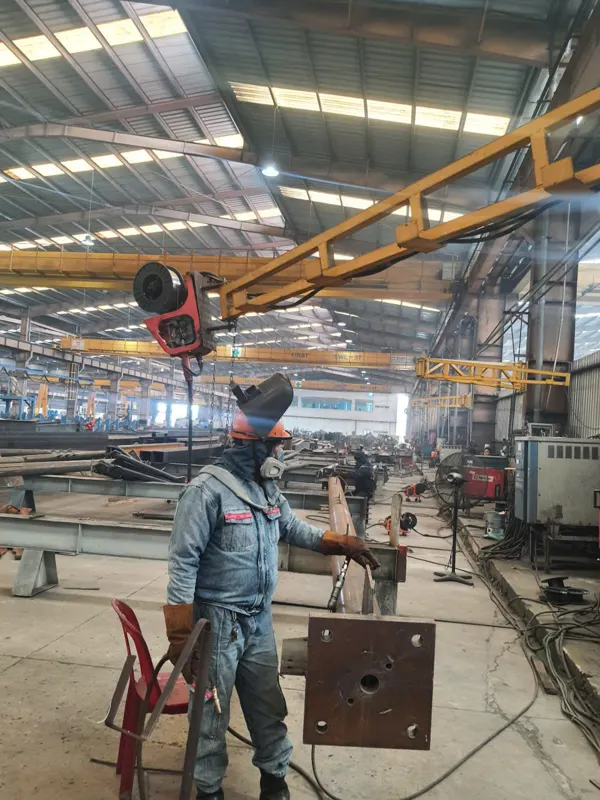
- The WPS at the station. A laminated copy, or a screen at the workstation, showing the joint, the filler metal by trade name and the parameter window for the job.
- Parameter checks during welding. QC inspectors read amperage and voltage at the arc and time travel speed on Demand Critical joints, then compute heat input against the WPS limits. A clamp meter and a stopwatch are enough.
- Temperature checks. Preheat measured at least 75 mm from the joint before welding starts; interpass measured 25 to 75 mm from the joint before each pass on thick members.
Recording those checks against the joint and the welder turns a WPS from a document into evidence. It is also what a QA inspector watching a Demand Critical weld, in person or by video, is looking for.
A WPS review checklist
When a seismic WPS lands on your desk, check:
- Is it prequalified or qualified by test, and is the PQR attached where needed?
- Is the process on the approved list, or is there a documented basis for another one?
- For Demand Critical welds, does it name the manufacturer and trade name?
- Do all parameter combinations stay inside the heat input limits?
- Does it state the 288 °C maximum interpass temperature or a qualified alternative?
- For gas-shielded processes, does it address the 5 km/h wind limit?
- Are manufacturer data sheets attached for FCAW, SMAW and metal-cored wire?
- For restricted access joints, does it cap deposition rate to match welder qualification?
How World Steel writes seismic WPSs
World Steel's shop welding procedures and welders are qualified to AWS D1.8. For each seismic project, the WPSs for SFRS and Demand Critical joints are listed in the inspection and test plan with their filler metal, heat input range and interpass limit, and they are available for review by the Engineer and the QA agency before production starts. Our page on WPS and PQR explains how our procedures are organized, and our quality system is accredited to IAS AC472.
For the filler metal side of the WPS, read seismic filler metal toughness.
Quick answers
Which processes may make demand critical welds?
SMAW, GMAW except short-circuit transfer, FCAW and SAW. Other processes, such as electroslag or electrogas welding, need an AISC 341 or AISC 358 basis, a connection qualification test, or the Engineer's approval.
What extra information must a demand critical WPS show?
The electrode manufacturer and trade name, and one or more combinations of welding variables that keep heat input within the limits of Clause 6.8.
What is the maximum interpass temperature?
288 °C (550 °F), measured 25 to 75 mm from the joint, unless a higher value is qualified by test on the same steel type and grade with weld metal and HAZ Charpy testing.
Are WPSs submitted to the Engineer?
PQRs for WPSs qualified by test are submitted under Clause 1.4.2.7. The fabricator is responsible for all WPSs, which are normally reviewed under the project QAP.
Keep building your steel plan
Go further on USPEB.com
On this topic
Across the US market
- Quality hubInspection, testing and sign-off at the plant
- IAS AC472 accreditationThe first and only AC472 plant in Vietnam
- Accredited testing labsILAC ISO/IEC 17025 testing on every project
- Online factory auditWalk the shop live with our QA team
- Large projects, 2,500 t a monthCapacity for large US general contractors
- Contractor partnershipLong-term supply for US contractors