
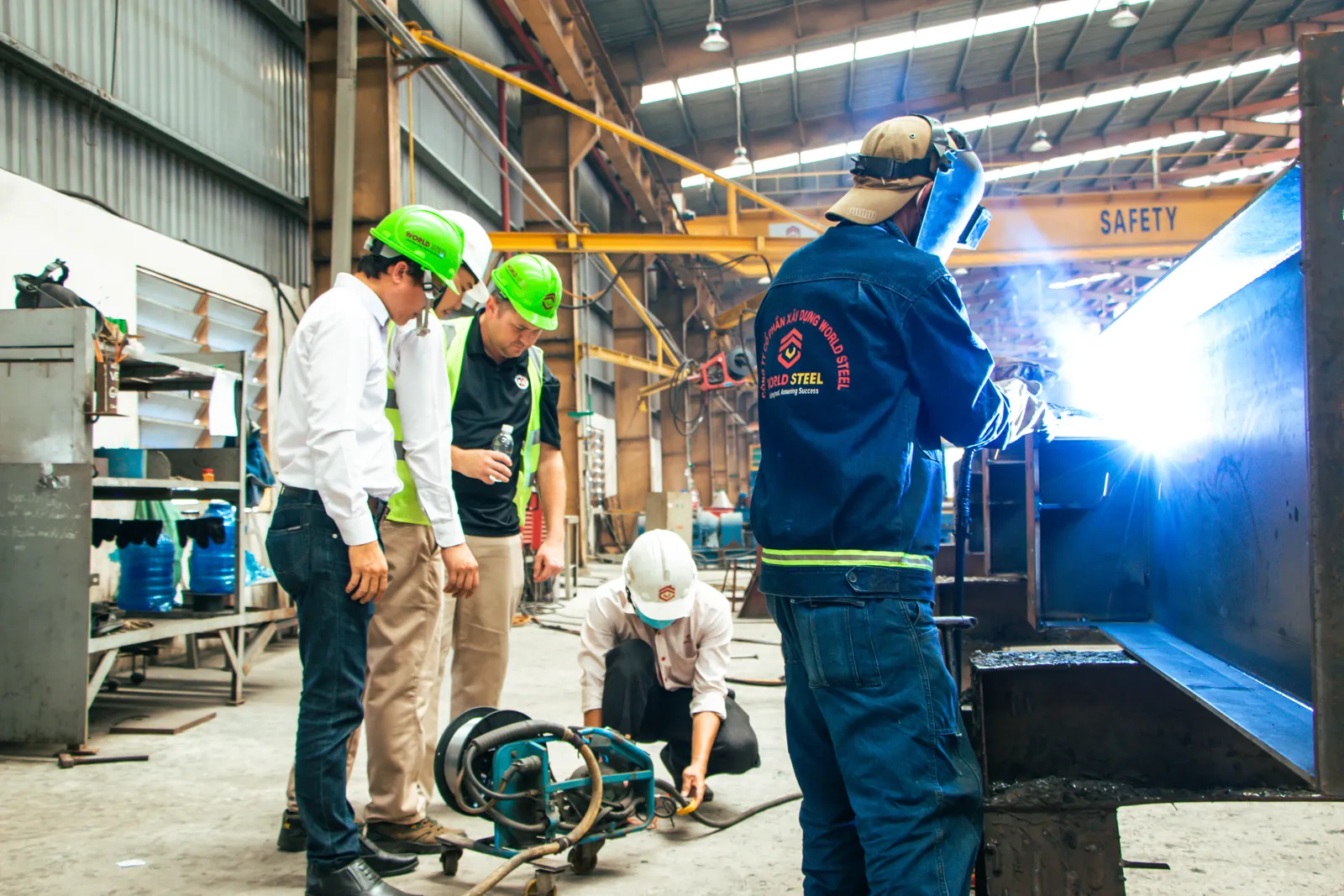
Three documents, one weld
What has to line up before a welder starts
Each one answers a different question: how the weld is made, whether that way works, and whether this welder can do it.
Welding Procedure Specification
The recipe for a weld: process, joint design, base metal, filler metal, position, preheat, current, voltage and travel speed.
Posted at the workstation and named in your ITP for each joint type.
Procedure Qualification Record
The proof. A test weld made to the WPS, then cut and tested in tension and bending, with the actual values recorded.
Needed for any WPS that is not prequalified under AWS D1.1.
Welder Performance Qualification
The welder’s own test: a coupon welded in the process and position they will use, inspected and bend tested.
Each welder’s record lists what they are qualified to weld, and in which positions.
Read the full guide to WPS, PQR and welder qualification under AWS D1.1
Two ways to a valid procedure
Prequalified, or proven by test
Within the code’s limits
Prequalified WPS
AWS D1.1 lists joint details, base metals, filler metals and parameter ranges that are accepted without a procedure test. A WPS that stays inside those limits still has to be written down, followed and checked, but no PQR is required.
Outside them
WPS qualified by test
When a joint, a process or a parameter falls outside the prequalified limits, a test coupon is welded and tested and the PQR supports the WPS. The PQR is the evidence your Engineer of Record or inspector reviews.
Seismic frames
What AWS D1.8 adds on top of D1.1
Our welding procedures and welders are qualified to AWS D1.8, the seismic supplement, for the welds in moment and braced frames that have to stay ductile in an earthquake.
Demand-critical welds
AISC 341 names the welds in a seismic force-resisting system that must hold under large inelastic strain. Your drawings mark them, and they are welded only with procedures qualified for them.
Filler metal toughness
Filler metals for demand-critical welds are classified for notch toughness, so the weld is not the brittle link in a ductile frame.
Low hydrogen
Electrodes and wire are low hydrogen and are stored and handled so they stay that way, because hydrogen is behind much of the cracking in heavy welds.
Records for your submittal
WPS, PQR, filler metal certificates and welder qualifications for the seismic welds are bundled so your Engineer of Record can review them in one place.
On the shop floor
How qualifications stay true in production
Parameters checked at random
QC inspectors check the actual current, voltage and travel speed at the machine against the WPS on a random basis, and record what they find in the Welding Inspection Report.
Preheat when it is needed
Base metal is preheated when the WPS calls for it, and whenever it is thicker than 38 mm (1 1/2 in).
Right welder, right joint
Welders work only within the processes and positions on their qualification record, and the record is kept current through continued use of the process.
Audited from outside
Our welding quality system is certified to EN ISO 3834-2 by Bureau Veritas, and welding is inside the scope of the IAS AC472 Part A plant audits held twice a year.
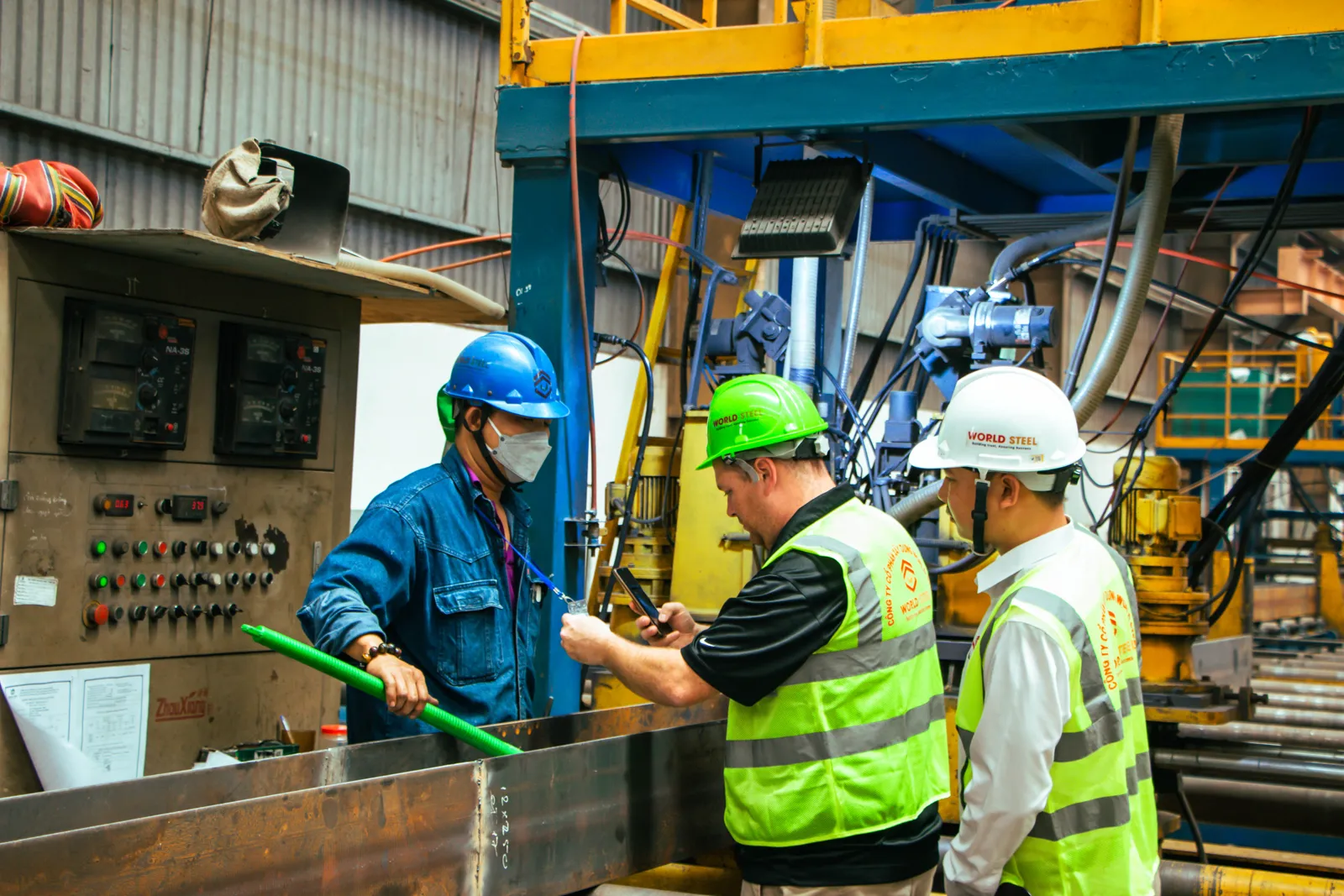
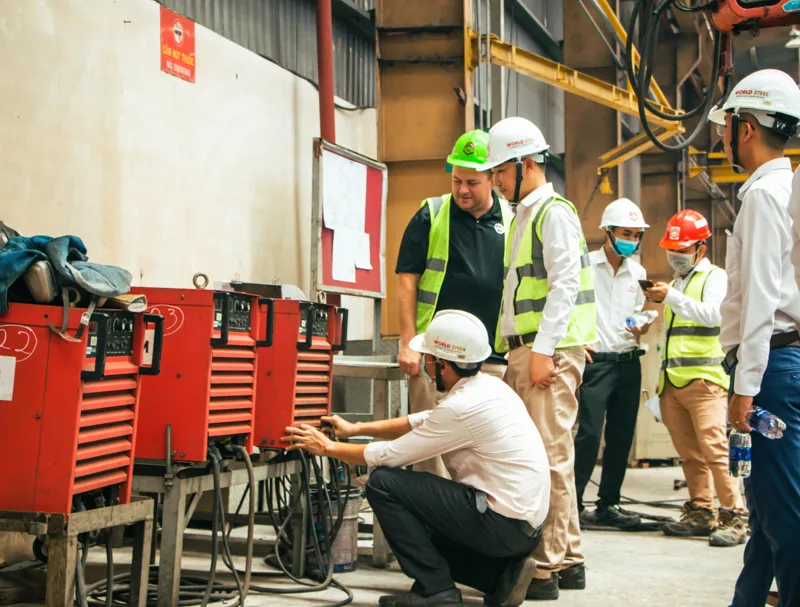
Welding lines are part of every IAS AC472 plant audit. These photos are from a periodic audit by Smith-Emery Laboratories at our plant in Vietnam.
QC and QA
Who checks what at this checkpoint
US practice separates the fabricator’s quality control from the quality assurance carried out for the owner. World Steel runs the QC; your side decides how much QA it adds, and the Engineer of Record sets what is acceptable.
World Steel QC
Quality control: the fabricator
Writes and qualifies the procedures, tests and keeps welders qualified, posts the WPS at the workstation and checks the parameters during production.
Your inspector
Quality assurance: owner, special or third-party inspector
Reviews the WPS, PQR and welder records as a document review in the ITP, and can witness a procedure or welder test in Vietnam or live by video.
Your Engineer of Record
Sets the criteria, rules on what changes the design
Approves the procedures for critical joints, marks demand-critical welds and any notch-toughness requirement on the drawings, and accepts any qualification outside the code.
Inspectors can attend in Vietnam, join hold points live on Zoom or Microsoft Teams, or be given remote access to the records on request. The plant itself is audited twice a year under IAS AC472, with periodic plant inspections by Smith-Emery Laboratories.
Questions from US contractors and inspectors
Questions about welding procedures and welders
Ask us anything else about this checkpoint before you award, or during the job through your project manager.
Are your welders qualified to AWS D1.1?
Yes. Welders are qualified by test in accordance with AWS D1.1 for the processes and positions they weld. Their qualification records are available for your review as part of the ITP.
Can you weld to AWS D1.8 for seismic frames?
Yes. Our welding procedures and welders are qualified to AWS D1.8, the seismic supplement to AWS D1.1, for the demand-critical welds your drawings identify.
Does AWS approve World Steel as a company?
AWS D1.1 does not certify fabricators as companies. What it requires is qualified procedures, qualified welders and inspection, which is what we provide on each job, together with EN ISO 3834-2 certification of our welding quality system and IAS AC472 accreditation of our fabrication.
Which welding processes do you use?
Submerged arc welding on the automatic beam lines for flange-to-web welds, and flux-cored arc welding for splices and fitted parts, each under its own WPS. The process for each joint type is named in your ITP.
Can our inspector watch a welder qualification test?
Yes. A procedure or welder test can be set as a witness point in the ITP and attended in Vietnam or live over Zoom or Microsoft Teams.
What if our specification requires a procedure you have not qualified?
We qualify it by test before production: the coupon is welded to the proposed WPS, tested, and the PQR is sent to you for review before any member is welded that way.
Keep reading
Where this checkpoint connects
Send us the welds your job needs
Mark up the critical joints, the seismic welds and any special filler metal. We will match them to qualified procedures, or qualify new ones before production.