
Load path
Follow a column load down through the girder
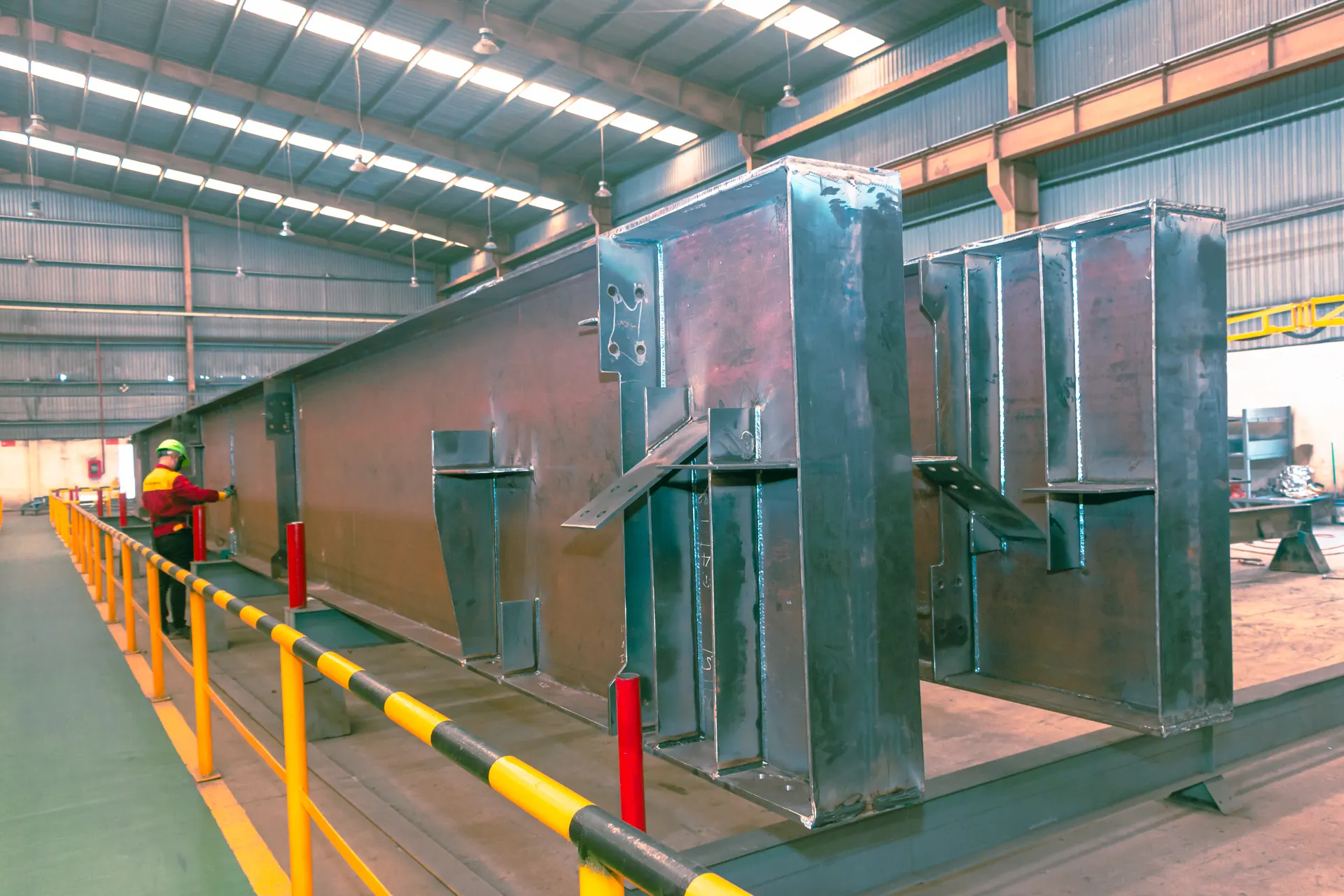
Every part of a transfer girder sits on this path. If one link is weak, the floors above feel it. That is why we treat the stiffeners and their welds with the same care as the flanges.
 Photo
IAS AC472
Accredited since 2019, audited twice a year
Columns above
Columns from the upper floors land on the top flange of the girder.
Bearing stiffeners
Full-depth stiffeners under each column carry the load into the web.
Deep web
The web carries the shear to the supports; its depth keeps deflection small.
Thick flanges
Heavy flange plates carry the bending, often stepped down toward the supports.
Supports
The girder delivers everything to the columns or walls at each end.
Heavy plate
Rules for the thickest plate in the building
Preheat for thick plate
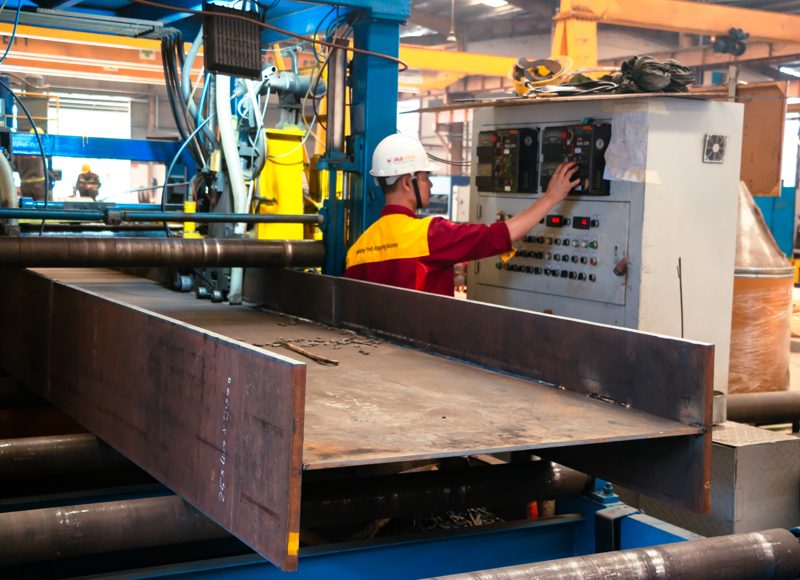
Thick flanges are preheated before welding as the written procedure sets; our method statement calls for preheat above 38 mm (about 1.5 in).
Laser cut to 100 mm
Flanges, webs and stiffeners up to 100 mm (about 4 in) thick are cut on our laser machines, bolt holes included.
UT on full-penetration welds
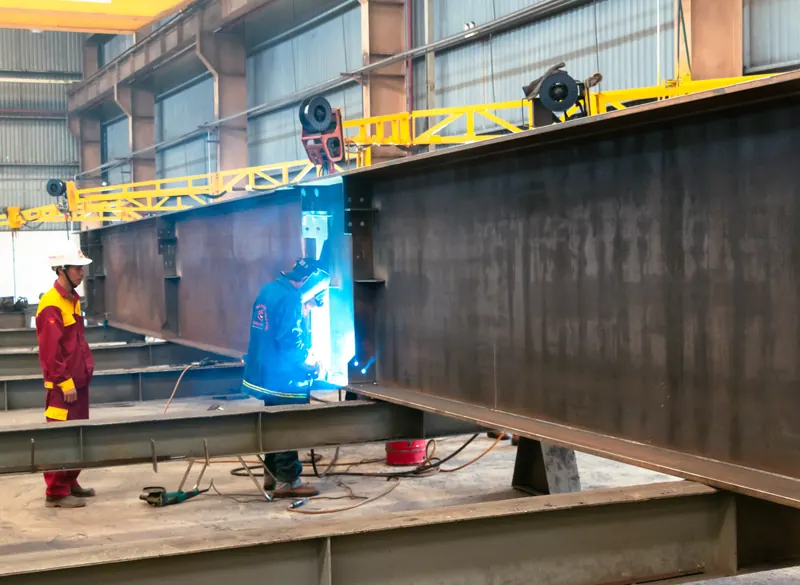
Complete joint penetration welds in flange splices and at heavy stiffeners get ultrasonic testing where your specification calls for it.
Charpy on request
Plate can be supplied with EN 10204 3.1 certificates including Charpy impact results when your design needs toughness.
Lift and erection
Made to be lifted and set safely
Weight on every piece
Each segment’s weight in kg (lb) and its center of gravity are on the erection drawing, so your erector can plan the crane.
Splices away from the columns
Field splices are placed where shear and moment allow, never under a column landing.
Camber to the drawing
Any camber your Engineer of Record wants is cut into the web profile and measured before release.
Shoring is your plan
Temporary support until the floors above are complete is part of the US contractor’s erection plan; we supply the weights and camber data it needs.
For the girder family as a whole, see welded plate girders; for whole frames, multi-story steel framing.
Questions
Transfer girder questions
What makes a transfer girder different from an ordinary girder?
It carries concentrated column loads from several floors, so it is usually much heavier, deflection is critical, and the bearing stiffeners and their welds under each column are as important as the girder itself.
How thick can the plate in a transfer girder be?
As thick as the design needs within the plate grades your Engineer of Record specifies. Our laser machines cut steel up to 100 mm (about 4 in), and thicker plate is cut on our gas machines. ASTM A572 Grade 50 is available up to 100 mm thick.
Why does deflection matter so much on a transfer girder?
Because every millimeter the girder sags is passed to the floors above it, where it can crack finishes and partitions. Transfer girders are often sized by stiffness rather than strength, and may be cambered.
Is the transfer girder shipped in one piece?
Only when it fits a container, flat rack or breakbulk slot and your erector can lift it. Otherwise it is split at field splices placed where your design allows, with every segment weighed and match-marked.
Who designs the temporary shoring?
The US contractor, our customer, as part of the erection plan. We provide segment weights, centers of gravity and camber so that plan is easy to make.
Built for large jobs
Transfer girders for your next large package
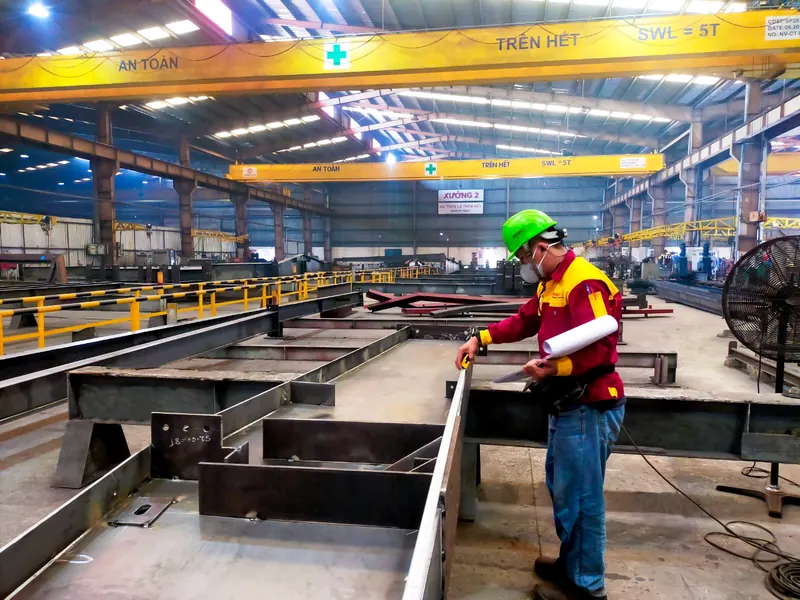
Our own plant in Vietnam fabricates 2,500 metric tons of structural steel a month, is accredited under IAS AC472 since 2019 and is audited twice a year. Shop drawings are included on every project.
- 5,000 tSunpro Steel Factory
- 2,500 tCPV Food Processing Factory
- 2,000 tLong Son petrochemical complex
- 2,000 tM&D (MD Factory)
Request a quote
Send drawings, a model or a member schedule. Our engineers check the US code basis, size or verify the members and price the fabricated steel, delivered to your US port.
Become our partner in the US
You erect and own the customer; we design, fabricate and ship. Engineering support on your bids and supply under your brand.
Who approves the design. We prepare calculations and drawings ready for your Engineer of Record’s review and approval. The PE seal and the permit stay with the US contractor, our customer.
Shop drawings, included